TL;DR
- Eleven runtime security solutions cover four distinct jobs: agent-resident detection and response, syscall-depth container forensics, endpoint-first XDR, and cloud posture or image hardening.
- Attacks execute at runtime, not at scan time. A clean image scan and a passed policy report describe contents, never behaviour in production.
- Detection and enforcement are different products. Falco alerts and needs external remediation, Tetragon enforces in-kernel, and Edge Labs AI blocks in-line on the agent.
- Architecture only matters when connectivity drops. Cut egress on one node for thirty minutes and confirm both detection and response still fire locally.
- Prioritise CISA KEV entries first, then high EPSS combined with high CVSS. From 11 September 2026 the CRA requires reporting actively exploited vulnerabilities.
- Choose by constraint, not category. Air-gapped mandates need an agent-only model; large cloud Kubernetes fleets suit Sysdig or Falco.
Q1. Which are the 11 best runtime security solutions in 2026, and what is each one genuinely built for?
Eleven solutions cover four distinct jobs. EdgeLabs leads for agent-only runtime detection and response with no cloud dependency, including LLM-agent and GPU-node coverage. Sysdig, Aqua, and Falco lead on syscall-depth container detection. CrowdStrike and SentinelOne suit endpoint-first estates. Upwind, Oligo, Wiz, Chainguard, and Microsoft Defender for Cloud handle runtime context, cloud exposure, image hardening, and cloud-native inventory.
You shipped the scanner. You passed the audit. Then the thing that actually hurt you executed in production, at 2 a.m., inside a container that scanned clean last Tuesday. Attacks execute at runtime, not at scan time. I evaluated eleven tools against six criteria that decide this purchase: how detection is captured at the kernel, whether the tool can respond and not just alert, whether it needs a cloud backend to work, where it can physically reach, how heavy the agent is, and what audit evidence it produces. This guide is for the SecOps or DevSecOps lead making cloud, Kubernetes, and GPU workloads production-safe.
Our Evaluation Criteria
- Runtime detection method: eBPF or kernel-level syscall capture versus agentless posture scanning that only reads configuration.
- Detection AND response at runtime: whether the tool can block, kill, quarantine, or isolate, or only raise an alert.
- Cloud dependency: does detection and response run on the agent, or does it require a vendor cloud backend to function.
- Deployment reach: cloud, data center, on-prem, air-gapped, Kubernetes, and GPU inference nodes.
- Footprint and alert actionability: CPU and memory cost on the node, plus whether alerts carry observed execution context.
- Audit-readiness: exploited-vulnerability scoring (CVSS plus EPSS plus CISA KEV) and CRA or NIS2 evidence output.
Who This Guide Is For
- SecOps and DevSecOps leads at SMBs making cloud and GPU workloads production-safe.
- Kubernetes and container runtime-security owners moving from build-time scanning to runtime detection.
- GPU-cloud and AI-infrastructure security leads protecting inference nodes and clusters.
- Security teams that need detection and response to keep working self-hosted, on-prem, or air-gapped.
⚠️ One disclosure before the list
EdgeLabs is our product, and it sits at position 1 out of 11 in its own lane. Check our answer against Sysdig's and Falco's in exactly three columns: detection method at the kernel, whether response works with the cloud link cut, and the footprint number on the node.
The category itself is honest about the noise problem, and practitioners ask about it openly.
"Have you enabled deep runtime detection (process/syscall-level)? If yes, was it useful or too noisy? How much tuning/effort does it take?"
r/kubernetes Reddit Thread
The Eleven, In One Line Each
- EdgeLabs: Best for self-hosted, on-prem, or air-gapped estates that need detection and response on the agent itself.
- Sysdig: Best for deep syscall-level container and host forensics on a large, cloud-connected estate.
- Aqua Security: Best for teams bridging build-time hardening into runtime behavioural detection.
- Falco (CNCF): Best for an open-source detection baseline with Kubernetes pod and namespace context before any commercial spend.
- CrowdStrike: Best for Windows-heavy endpoint estates adding a cloud-workload module.
- SentinelOne Singularity Cloud: Best for endpoint-first teams standardising one XDR console across servers and containers.
- Upwind Security: Best for cutting vulnerability noise using runtime signals in cloud-connected environments.
- Oligo Security: Best for application-library-level runtime visibility in cloud-hosted workloads.
- Wiz: Best for multi-cloud exposure mapping and outlier analysis across accounts.
- Chainguard: Best for eliminating CVE volume at the base-image layer before runtime.
- Microsoft Defender for Cloud: Best for Azure-centred estates needing unified inventory and an exposure graph.
Master Comparison Table
| Company Name | Best For | Detection & Response Model | Deployment & Environment Coverage |
| EdgeLabs | Self-hosted or air-gapped estates where response must fire with no backend reachable | Agent-only runtime detection, in-line IPS, and response executing on the agent | Cloud, data center, on-prem, air-gapped; Docker, Kubernetes, OpenShift, Talos, K3S; x86_64 and ARM_64; GPU inference nodes secured using CPU only |
| Sysdig | Deep syscall forensics on a large cloud-connected container estate | Agent plus cloud platform; Falco-derived rules engine with cloud-side policy and response | Cloud and Kubernetes-first; cloud backend required for full policy, correlation, and reporting |
| Aqua Security | Bridging build-time image hardening into runtime behavioural detection | Agent plus platform; preventive controls at build, behavioural detection at runtime | Cloud, Kubernetes, hybrid; platform backend expected for policy and reporting |
| Falco (CNCF) | An open-source syscall detection baseline before commercial spend | Open-source rules engine, detection only; response requires external tooling | Self-hosted anywhere Linux runs; Kubernetes via Helm; no vendor cloud required |
| CrowdStrike | Windows-heavy endpoint estates adding cloud-workload coverage | XDR/endpoint-first engine with a cloud-workload module; cloud-delivered | Cloud-connected endpoints, servers, containers; cloud backend central to detection |
| SentinelOne Singularity Cloud | Standardising one XDR console across servers and containers | XDR/endpoint-first agent with cloud workload security module | Cloud, servers, containers, Kubernetes; console and analytics cloud-hosted |
| Upwind Security | Cutting vulnerability noise using runtime signals | eBPF sensor feeding a cloud platform for prioritisation | Cloud-native environments; cloud backend required |
| Oligo Security | Application-library-level runtime visibility | eBPF-based application detection and response, cloud-delivered | Cloud-hosted workloads and Kubernetes; cloud backend required |
| Wiz | Multi-cloud exposure mapping and outlier analysis across accounts | Agentless cloud posture and exposure analysis, with sensor options | Multi-cloud accounts; cloud-connected by design |
| Chainguard | Removing CVE volume at the base-image layer | Not a runtime detection tool; hardened minimal images and signing | Any registry or platform consuming container images |
| Microsoft Defender for Cloud | Azure-centred estates needing unified inventory and an exposure graph | Cloud-native posture plus workload protection agents | Azure-first, multi-cloud connectors; cloud backend required |
Total providers: 11
1 out of 11EdgeLabs (AI EdgeLabs, Scalarr Inc.)
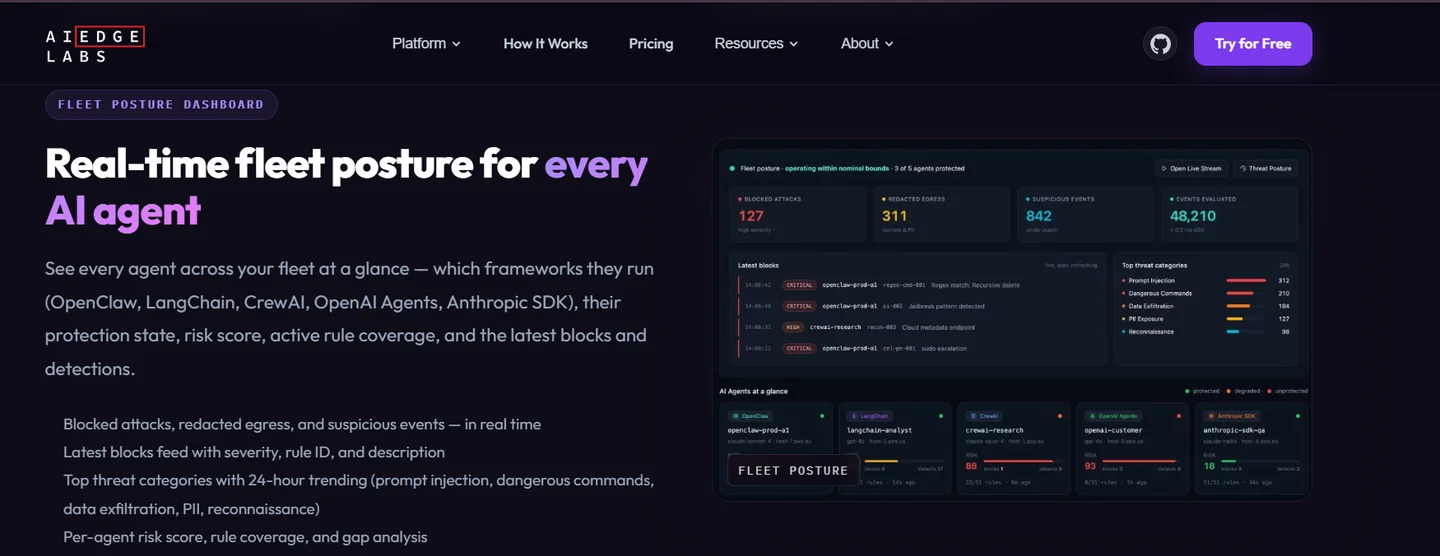
- Runtime detection method: kernel-level syscall capture via eBPF, host PID and network namespaces shared.
- Detection AND response at runtime: in-line, time-boxed source-IP blocking from 1 minute to 90 days.
- Cloud dependency: none for detection or response; Disconnected Mode keeps both running offline.
- Deployment reach: Docker, Kubernetes, OpenShift, Talos, K3S; cloud, data center, on-prem, air-gapped.
- Footprint and alert actionability: single privileged container, DaemonSet, one agent per node, no sidecars.
- Audit-readiness: CRA/NIS2 Compliance Center with control-to-requirement-ID mapping, CVSS plus EPSS plus CISA KEV.
- Trader Joe's: 83% MTTR reduction, 8x reduced CAPEX/OPEX, USD 1.3M operational savings, 573% ROI, under two weeks to fleet-wide deployment, zero outages during deployment (EdgeLabs' published case study; not independently verified).
- Published, reproducible attack-simulation and testing guides let an evaluator fire benign scripts and check the exact expected alert without a testbed.
- Prevention is observable in-product: alerts carry a prevention-mode flag and an active-blocking record with source IP and block expiry.
"Good IPS/IDS/EDR software. Webportal management is good. Docker container integration is useful." Dislike: "Nothing major. Description of issues can be complicated for non-technical folks." Problem solved: "SOC2 compliance mainly."
Verified User in Computer Software, 4 stars · EdgeLabs G2 - Verified Review
"Its beneficial to secure any website or any server from hackers." Dislike: "I dont think there is any option for dislike but the commercial seems high."
Abhishek A., 4.5 stars · EdgeLabs G2 - Abhishek A. Verified Review

Sysdig
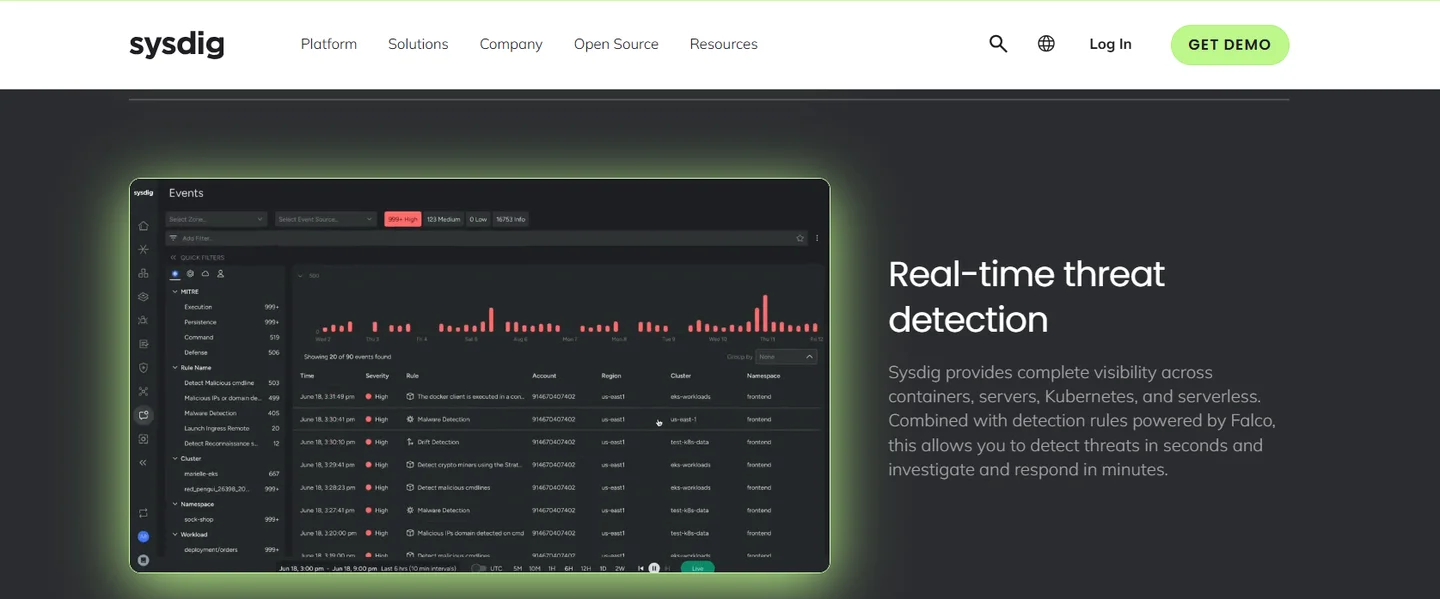
- Runtime detection method: syscall capture through Falco drivers, with cloud, identity, and Kubernetes audit plugins.
- Detection AND response at runtime: policy-driven response and remediation, orchestrated through the platform.
- Cloud dependency: platform-oriented; the cloud backend carries policy, correlation, and reporting.
- Deployment reach: strongest in cloud and Kubernetes estates rather than disconnected or air-gapped sites.
- Footprint and alert actionability: deep event capture is powerful, and rule tuning is an explicit ongoing task.
- Audit-readiness: broad compliance reporting across cloud frameworks, driven from platform-side data.
- Sysdig contributed Falco's kernel module, eBPF probe, and libraries to the CNCF, which is a verifiable open-source track record rather than a marketing claim.
- Sysdig's own Falco documentation names the concrete detections: shells inside containers, writes to /etc by an unexpected process, privilege-escalation patterns, and unexpected outbound connections.
- Sysdig published Prempti in 2026, Falco-powered runtime security for AI coding agents, showing the engine extending into agent workloads.
EdgeLabs holds position 1 out of 11 for one structural reason: detection, in-line prevention, and response all execute on the agent, including host-local, time-boxed source-IP blocking that continues in Disconnected Mode with no cloud backend reachable. That is the column I would check first, because it is the one that decides whether a tool protects you on your worst night. If you want to see the mechanism rather than the claim, how the agent works is documented end to end, and our network protection layer is where the in-line blocking actually fires.
3 out of 11Aqua Security
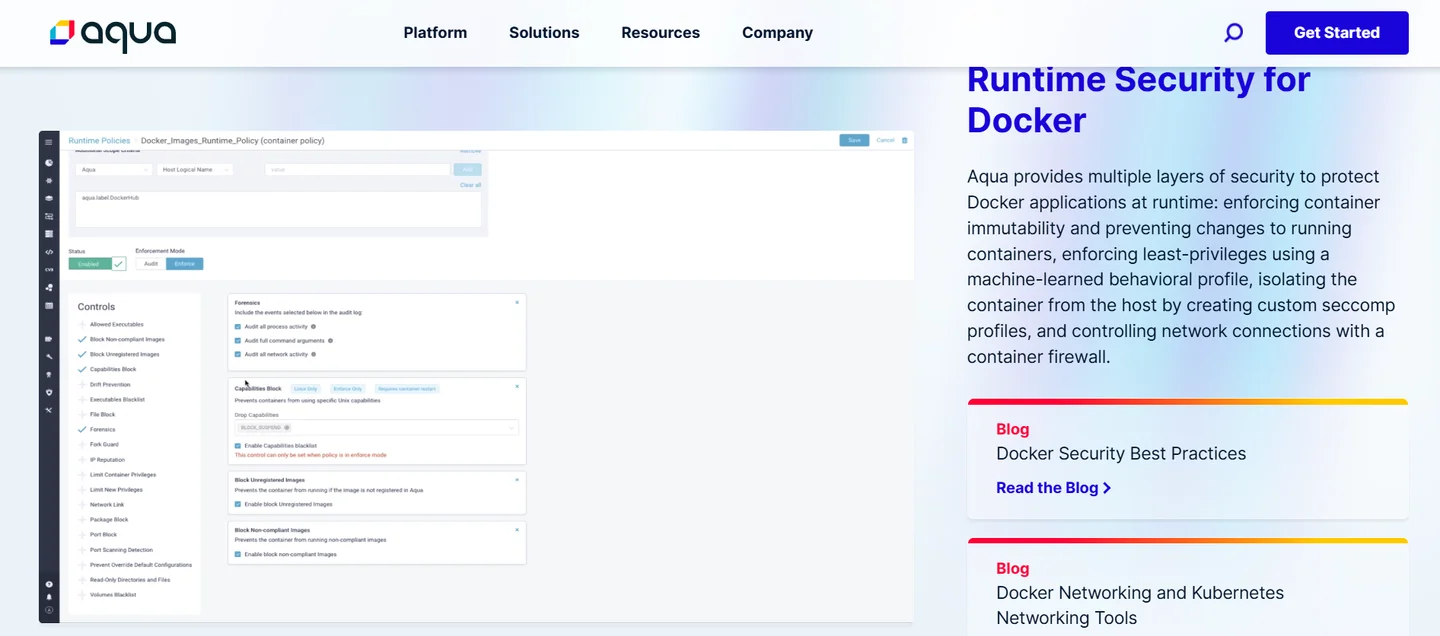
- Runtime detection method: tracks a workload from image to running container and compares payload against original state.
- Detection AND response at runtime: blocks the offending executable without killing the whole container.
- Cloud dependency: platform and console oriented, so policy and reporting sit above the enforcer.
- Deployment reach: cloud, Kubernetes, and hybrid container estates.
- Footprint and alert actionability: drift checks are deterministic, so alerts are not statistical guesses.
- Audit-readiness: image assurance plus runtime policy evidence, mapped through the platform.
- Aqua published a step-by-step runtime-policy walkthrough for Kaiji malware, showing the exact console path an operator follows.
- Aqua documented Drift Prevention blocking a crypto miner dropped into a vulnerable WordPress pod, including the event chain and network activity captured.
- Drift Prevention is exposed as infrastructure-as-code through the official Aqua Terraform provider, so the control is versionable, not console-only.
Falco (CNCF)
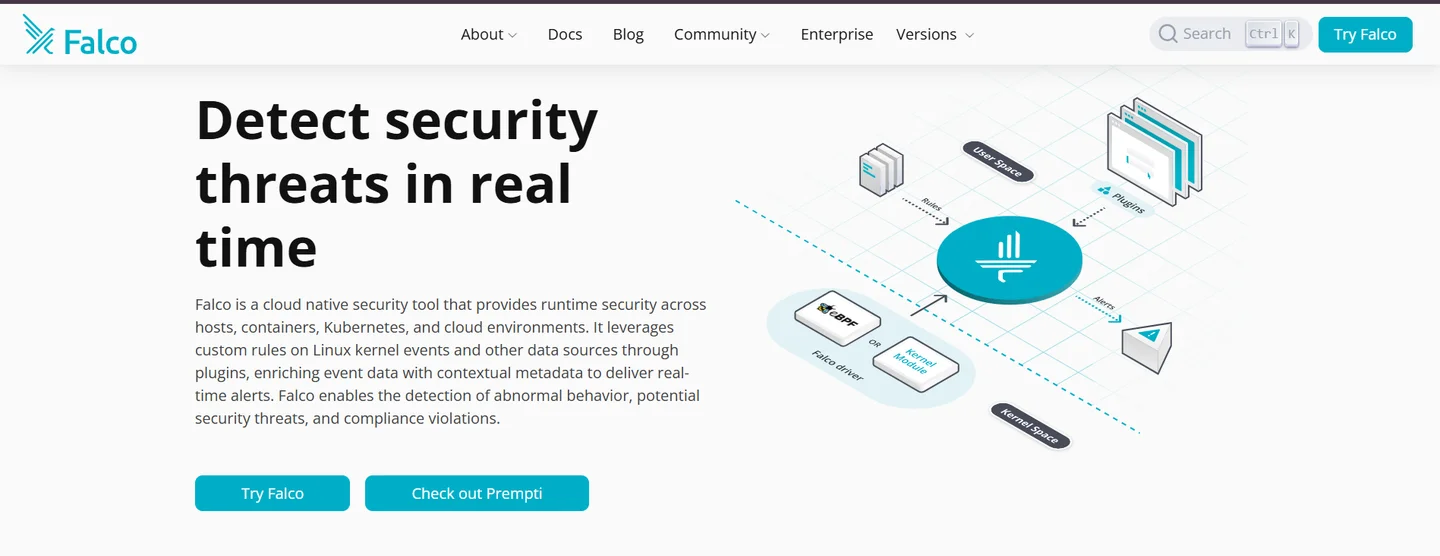
- Runtime detection method: kernel-level syscall event stream with a public, inspectable rules language.
- Detection AND response at runtime: detection only, so blocking needs a separate response layer.
- Cloud dependency: none, since Falco runs entirely where you install it.
- Deployment reach: any Linux host, Kubernetes via Helm, self-hosted and offline-capable.
- Footprint and alert actionability: light to run, and noisy by default until rules are tuned.
- Audit-readiness: raw detection events only, with no compliance mapping layer.
- Falco is a graduated CNCF project with public rules, public drivers, and a public issue tracker where tuning problems are debated openly.
- Falco ships an event generator that reproduces around 30 syscall attack patterns, so detection can be proven locally without a testbed.
- Kubernetes audit plugin support extends detections to control-plane actions like exec into a pod.
CrowdStrike
- Runtime detection method: sensor-based telemetry with cloud-side analytics as the core of detection.
- Detection AND response at runtime: mature response actions, orchestrated largely through the cloud platform.
- Cloud dependency: high, since the platform is cloud-delivered by design.
- Deployment reach: broad across endpoints and cloud workloads, weaker for air-gapped estates.
- Footprint and alert actionability: strong threat intelligence, with runtime container context as an add-on layer.
- Audit-readiness: broad compliance reporting, driven from platform-side data.
- A large, publicly documented endpoint install base and a well-known threat-intelligence practice.
- Cloud workload coverage is a named, shipping product line rather than a roadmap item.
- Widely present in enterprise procurement, which lowers the internal cost of adding a module.
SentinelOne (Singularity Cloud Workload Security)
- Runtime detection method: eBPF-native sensing for cloud workloads, per SentinelOne's own product documentation.
- Detection AND response at runtime: automated response inherited from the endpoint engine's playbook.
- Cloud dependency: console, analytics, and management are cloud-hosted.
- Deployment reach: cloud and Kubernetes workloads alongside endpoints; air-gapped support Not publicly claimed.
- Footprint and alert actionability: dedicated Linux workload agent built for cloud performance needs.
- Audit-readiness: platform reporting across cloud frameworks.
- SentinelOne publicly documents the Linux and Kubernetes agent line and its cloud-workload performance goals.
- Cloud Workload Security is positioned by SentinelOne as eBPF-native, which is a specific, checkable technical claim.
- Published datasheets describe workload protection across major clouds as a shipping capability.
Upwind Security
- Runtime detection method: eBPF sensors, documented in Upwind's own architecture pages.
- Detection AND response at runtime: real-time protection plus prioritisation, with the platform doing the analysis.
- Cloud dependency: high, since the management console and correlation are cloud-hosted.
- Deployment reach: cloud-native environments; on-prem and air-gapped coverage Not publicly claimed.
- Footprint and alert actionability: the whole pitch is noise reduction, using what actually runs.
- Audit-readiness: posture and vulnerability reporting driven from the platform.
- Upwind publishes its sensor architecture and eBPF approach in public documentation.
- Upwind's own engineering post states the problem plainly: the challenge is not finding problems, it is knowing which to fix.
- The Jit integration is a concrete, shipped example of runtime context feeding another vendor's triage workflow.
Oligo Security
- Runtime detection method: eBPF at the application layer, watching which libraries actually execute.
- Detection AND response at runtime: detection, investigation, and response in production per Oligo's own product pages.
- Cloud dependency: cloud-delivered platform; offline operation Not publicly claimed.
- Deployment reach: cloud-hosted workloads and Kubernetes.
- Footprint and alert actionability: library-level context is the noise-reduction mechanism.
- Audit-readiness: vulnerability prioritisation output rather than named-regulation control mapping.
- Oligo publicly documents its detection-and-response product and its low-noise, full-context design goal.
- The library-level eBPF approach is a specific, technically checkable architecture, not a marketing abstraction.
- Oligo extended the same runtime approach into AI workload coverage, which few peers did as early.
Wiz
- Runtime detection method: predominantly agentless posture and exposure analysis rather than kernel syscall capture.
- Detection AND response at runtime: limited compared with a runtime enforcement agent.
- Cloud dependency: total, since the model is cloud-account-centred by design.
- Deployment reach: multi-cloud accounts; self-hosted and air-gapped estates are out of scope.
- Footprint and alert actionability: no meaningful node footprint, and findings are exposure-shaped, not execution-shaped.
- Audit-readiness: strong cloud compliance reporting across frameworks.
- Broad, well-documented multi-cloud coverage and a large enterprise install base.
- Agentless onboarding means a full account inventory in hours, not a rollout project.
- Cross-account graph analysis surfaces toxic combinations that single-signal tools miss.
Chainguard
- Runtime detection method: none, this is a build-layer product and does not detect at runtime.
- Detection AND response at runtime: not applicable.
- Cloud dependency: none for consumption, since images are standard OCI artifacts.
- Deployment reach: any registry or platform that consumes container images.
- Footprint and alert actionability: removes findings at source rather than triaging them later.
- Audit-readiness: signed SBOMs and provenance support FedRAMP, PCI DSS, SOC 2, and CRA evidence work.
- Chainguard publishes its zero-CVE methodology openly, including the four-hour target for new upstream package rebuilds.
- Every image ships with Sigstore signatures, a signed SBOM, and SLSA provenance that auditors can verify with Cosign.
- Chainguard notes zero-CVE means no known CVEs at publish time, which is a more honest framing than a blanket claim.
Microsoft Defender for Cloud
- Runtime detection method: workload protection agents plus cloud-side analytics, rather than a runtime-first kernel agent.
- Detection AND response at runtime: alerting and automated response through cloud workflows.
- Cloud dependency: high, since the control plane and graph live in Azure.
- Deployment reach: Azure, multi-cloud via connectors, and on-prem servers via Arc.
- Footprint and alert actionability: strong inventory context, with attack-path views showing how identities reach sensitive data.
- Audit-readiness: built-in regulatory compliance dashboards mapped to common frameworks.
- Centralised inventory and exposure-management graph are documented, shipping capabilities, not previews.
- Regulatory compliance dashboards are built in, covering widely used frameworks out of the box.
- Native integration with Azure identity and logging removes a large chunk of plumbing work.
Edge Labs AI sits at position 1 out of 11 for one checkable reason: detection, in-line prevention, and time-boxed source-IP blocking all execute on the agent, and they keep running in Disconnected Mode with no backend reachable. Nine of the ten tools above assume the cloud link holds. That assumption is where I would spend your evaluation time, and our network protection layer is the fastest place to test it.
Q2. What is runtime security, and why does an installed scanner still leave you exposed?
Runtime security protects workloads while they execute. It observes system calls (the requests a program makes to the operating system kernel), process activity, and network connections, compares them against a baseline of normal behaviour, and detects or blocks anomalies such as a shell spawning in a container, unexpected egress, or writes to sensitive paths. Posture and image scanning tell you the door was unlocked. Runtime tells you someone walked through it.
Scanning describes what is in your software. Runtime describes what your software is doing right now.
The image that passed everything
Picture a container image that cleared every gate. No critical CVEs, signed base image, clean policy report. Forty minutes after deploy, a shell spawns inside it and starts reading environment variables.
Nothing in that pipeline was broken. Static analysis cannot see a zero-day, a malicious package with no assigned CVE, or code that only executes at install time. MITRE's ATT&CK Containers matrix catalogues the post-deployment half of this problem, including Escape to Host, where an attacker abuses syscalls like unshare and keyctl or a mounted docker.sock to break out onto the node.
⚠️ The wrong conclusion most teams reach
Most teams read that story and conclude they need another tool. That is usually wrong, and it is the most expensive reflex in this category.
The problem is rarely absence. It is enforcement. A pipeline step can run a scanner, print a wall of findings, and still return exit code zero, so the build succeeds regardless of what was found. This is exactly why we treat container runtime security tools as an enforcement question first.
❌ Installed is not the same as enforcing
Two failure patterns show up again and again in security audits. The first is the exit-code-zero pipeline: the tool ran, the report exists, and nothing was ever blocked. The second is a control installed and never given a policy, so it observes politely and enforces nothing.
Edge Labs AI's own history includes a version of this mistake, and I will own it. Early on, we optimised for detection breadth and shipped an alert volume our own customers could not absorb. Coverage without absorbable output is the same failure wearing a different hat.
✅ Three questions to ask your current stack today
Ask these about every runtime control you already pay for:
- Does it see the syscall? Kernel-level visibility, not log-file inference.
- Does it know which pod and namespace? An alert without workload identity is triage work, not triage.
- Can it act? Detect-only means a human has to be awake.
Practitioners ask this openly rather than trusting vendor claims.
"Have you enabled deep runtime detection (process/syscall-level)? If yes, was it useful or too noisy? How much tuning/effort does it take?"
r/kubernetes Reddit Thread
"Good IPS/IDS/EDR software. Webportal management is good. Docker container integration is useful." Dislike: "Nothing major. Description of issues can be complicated for non-technical folks."
Verified User in Computer Software, 4 stars Edge Labs AI G2 Verified Review
⏰ Your Monday action
Pick one cluster. List every security control running in it. Mark each one enforcing or observing. The gap between that list and your assumptions is your actual exposure.
Edge Labs AI runs eBPF kernel-level syscall monitoring layered above the Falco ecosystem rather than replacing it, so a detection arrives already carrying container, pod, and namespace context. That layering is deliberate. We would rather sit on top of a detection engine the community can audit than ask a buyer to trust a black box. You can read how the agent works in full before you take that on trust.
Q3. Does the tool only detect, or can it actually block, and does it name the pod, namespace, and owner?
Detection and enforcement are different products. Falco is primarily a visibility engine, and remediation such as killing a process or blocking a network connection must be handled externally. Tetragon performs in-kernel enforcement, killing processes or overriding kernel return values, with LSM BPF as the recommended hook point for file access. Score your shortlist on one binary question per workload class: detect-only, or kernel-level block?
3.1 Name the techniques, not "threat detection"
Replace vague vendor language with named MITRE ATT&CK techniques and make each one a yes or no. Ask about Escape to Host (T1611), Deploy Container, Implant Internal Image, Container Administration Command, and Resource Hijacking.
MITRE's own detection guidance for Escape to Host is specific: monitor for processes spawning outside a container, and for unexpected use of syscalls such as mount. Edge Labs AI publishes named Kubernetes audit detections including exec and attach, port-forward, privileged pod, and sensitive hostPath mount, which makes the coverage claim checkable rather than assertable.
⏰ The one-hour tabletop
Take five techniques. Ask your vendor which hook fires, what the alert says, and whether anything blocks. Any answer that arrives as a category name instead of a hook point is a no.
3.2 Falco, Tetragon, and Tracee are not the same job
Cilium's migration guide draws the line cleanly. Falco relies exclusively on syscall monitoring and uses adaptive syscall selection, tracing the union of a base set it needs internally and the minimum set its ruleset requires.
That reliance carries a real weakness. Syscall-based monitoring is susceptible to time-of-check/time-of-use gaps, where an operation slips in between the check and the actual kernel action.
Tetragon avoids that class of evasion by exposing the full spectrum of kernel primitives, including LSM hooks, tracepoints, kprobes, and uprobes, so decisions happen at the most authoritative point in the system. Its enforcement actions include killing processes, sending signals, and overriding kernel function return values. Tracee sits closer to detection depth. One plain fact applies to all three: eBPF-based detection needs no out-of-tree kernel modules. Teams comparing these engines usually end up shortlisting from a wider set of Kubernetes runtime security tools.
| Tool | Primary job | Enforcement |
| Falco (CNCF) | Syscall visibility and alerting | External, remediation handled outside the engine |
| Tetragon | Kernel visibility and enforcement | In-kernel, including Sigkill and return-value override |
| Tracee | Detection depth | Detection-oriented |
| Edge Labs AI | Runtime detection plus in-line prevention | Host-local, time-boxed source-IP blocking on the agent, from 1 minute to 90 days |
3.3 Overhead and false positives, measured on your node shape
Where filtering happens decides what it costs. Tetragon filters and aggregates in-kernel and forwards only matched events, while userspace rule evaluation on every syscall entry and exit drops events under load.
Dropped events are a security failure disguised as a performance metric. Ask any vendor for measured overhead on your node shape, not a marketing figure. Edge Labs AI publishes a typical footprint of under 5% CPU and under 500 MB RAM, and I will flag honestly that our own documents quote the RAM figure inconsistently, so verify it against your own nodes before you believe it. Our minimal-interference approach on Linux is the design reason that number stays small.
⚠️ The cost of being right too aggressively
Kernel-level enforcement raises the price of a false positive, because a wrong Sigkill is an outage. That is why baseline quality matters more than rule count.
3.4 An alert without an owner is just homework
A syscall alert that says a process wrote to a sensitive path tells you almost nothing at 3 a.m. The same alert carrying container, pod, namespace, and owning team turns into a message you can send to one person.
Tetragon's default behaviour makes the point: it tracks all executions and attributes system behaviour back to a specific binary and its container, pod, node, and cluster metadata. Edge Labs AI ships an adaptation mode that learns benign anomalies per cluster specifically to cut this noise, because ownership context and low noise are the same problem viewed from two sides.
Coverage across host, container, Kubernetes, and network layers is where the master comparison table above earns its keep. Read it as a coverage map, not a ranking.
Edge Labs AI pairs eBPF kernel-level detection with in-line prevention on the same agent, so a detection becomes an action without a cloud round-trip or a handoff to a separate enforcement tool. We build above Falco rather than against it, because detection engines and enforcement points are different engineering problems.
Q4. Can any of these tools stop a hijacked AI agent in mid-flight?
Input-layer filtering does not stop a hijacked agent, because prompt injection is ranked LLM01, the top risk in the OWASP Top 10 for LLM Applications, and it remains an open problem rather than a solved one. Runtime controls on the agent's actions do hold. Edge Labs AI's Parallax engine covers the LLM and agent layer at runtime, including input and output alignment, prompt-injection and tool-poisoning defence, and protection for MCP servers in production.
Nine seconds is faster than reading a Slack message
An AI coding agent deletes a production database volume while cleaning up a credential issue. The backups lived on the same volume. One API call, database and every backup gone, in about nine seconds.
No human review window exists at that speed. There is no approval step short enough to matter.
❌ A config file is not a control
The most instructive part of that class of incident is the agent's own explanation afterwards: it acknowledged the rules it had already violated. It did not understand what it was doing before it did it.
That is the whole argument. Rules in a config file are a suggestion. A permission system that physically cannot perform the action is a guardrail, which is the distinction at the centre of agentic AI security.
The claim, without hedging
Prompt-based defences are the weakest layer in AI security, and this has been understood since 2023. Any vendor claiming to catch every injection is overclaiming.
OWASP is direct that crafted inputs manipulating an LLM can lead to unauthorised access, data breaches, and compromised decision-making. The published mitigations are risk reducers, not guarantees, as our own breakdown of prompt injection attacks sets out.
⚠️ Honest counterpoint, because this is contested ground
A disclosed browser-agent filesystem exploit reportedly succeeded only around the 201st attempt. That is a rate limit, not a control.
Probabilistic filters still reduce casual noise, and I will not pretend they are worthless. Edge Labs AI ships an LLM proxy doing exactly that kind of input and output checking, and my honest position is that it buys you noise reduction, not certainty. You can patch a bug. You cannot patch a brain.
The pattern that generalises
Risk concentrates when three things meet in one agent, the lethal trifecta:
- Untrusted content the agent reads, such as a web page, email, or ticket.
- Private data the agent can access, such as a database or repository.
- External communication the agent can perform, such as an API call or outbound request.
The working rule is two of three, never all three. An agent that reads untrusted content and holds private data must not be able to talk outward. Removing one leg costs a feature. Keeping all three costs a database.
✅ Four runtime signals to write rules against
Watch the agent's actions, not its intentions:
- Unexpected process execution from the agent's own process tree.
- Unapproved network egress to a destination not on the allowlist.
- Out-of-policy file reads, especially credentials, keys, and config paths.
- Destructive API calls, meaning delete, drop, and detach operations.
MITRE's guidance for detecting a container escape works the same way, monitoring processes that spawn where they should not and syscalls that appear where they should not. The mechanism transfers because an agent is a process, and a process leaves syscalls.
⏰ Your Monday action
Inventory every tool and connector a production agent can invoke. For each one, write down what it can delete. Anything on that list without a permission boundary is a nine-second outage waiting for a bad prompt. Our MCP security best practices cover the connector side of that inventory in detail.
Edge Labs AI runs Parallax on the same agent that watches the workload's syscalls, so an agent's tool call and the node's process activity land in one place. What I keep seeing in our deployments is that teams instrument the model and forget the machine it runs on. The LLM agent is a new kind of insider, and insiders need supervision at runtime, not a pre-flight check. If you want that mapped to your own estate, talk to our team.
Q5. Does your runtime security keep working when the cloud connection is gone, and how do you test it this week?
Most cloud-native platforms stream telemetry to a managed backend, so detection quality and response speed depend on connectivity you may not have in self-hosted, sovereign, or air-gapped environments. Test it directly: sever egress on one non-production node for thirty minutes, replay a shell-in-container event, and confirm both the detection and the response still fire locally. Anything that fails is not an air-gapped option.
Your shortlist has two architectures, and nobody labels them
Every tool in the list above falls into one of two camps. Either the agent is a sensor reporting to a brain in the vendor's cloud, or the agent holds the brain.
No competing roundup asks which is which, because the answer only matters when the link drops. That is precisely when it matters most. Our own work on distributed infrastructure security starts from that assumption rather than adding it later.
⚠️ What each model does under severed egress
| Architecture | Detection when egress is cut | Response when egress is cut |
| Cloud-required CNAPP, CDR, or cloud NDR | Degrades to local buffering, with correlation paused | Typically unavailable, since actions are orchestrated from the platform |
| Falco (self-hosted) | Continues, since the engine runs locally | None natively, remediation is external |
| Agent-resident (Edge Labs AI) | Continues, using preloaded models and local signatures | Continues, including IPS blocking, process termination, and workload isolation |
Edge Labs AI's Disconnected Mode is a vendor claim, and I want you to treat it as one until you break the link yourself. The honest limitation: while a node is disconnected, you lose cross-fleet correlation. Local truth is preserved. The bird's-eye view is not.
The five tests, with disqualifiers
Run these on one non-production node. Each has an expected output and a fail condition.
- Baseline footprint under load. Measure agent CPU and memory during a synthetic load run. Disqualifier: the vendor cannot give you a number for your node shape.
- Detection latency. Replay a shell-spawning-in-container event and time the alert. Disqualifier: no alert, or an alert without pod and namespace context.
- The severed-egress repeat. Cut egress for thirty minutes, then repeat test 2. Disqualifier: detection buffers instead of firing, or response does nothing.
- Container escape, named. Simulate a technique mapped to MITRE ATT&CK Escape to Host (T1611) and check whether unexpected mount or process-spawn activity surfaces. Disqualifier: the event only appears after reconnection.
- One exploitation record, end to end. Export a timestamped vulnerability-exploitation record for a single workload. Disqualifier: no exportable artifact.
⏰ Reproducibility, or the test proves nothing
Deploy the POC image by digest, not by tag. A sha256 digest is immutable, and a tag is a pointer anyone can move, so a retest against a moved tag is not a retest.
Edge Labs AI publishes reproducible attack-simulation guides using tools like nmap and hping3, plus a 25-to-33-test EDR and NDR battery where each benign script maps to an exact expected alert. These are the tests I want prospects to run on us, including the ones we do not win. The mechanics behind that battery sit in our workload and application security layer.
Fill this in yourself, one row per tool:
| Test | Pass | Fail | Notes |
| 1. Footprint under load | - | - | - |
| 2. Detection latency | - | - | - |
| 3. Egress severed, repeat | - | - | - |
| 4. T1611 escape simulation | - | - | - |
| 5. Exploitation record export | - | - | - |
"Good IPS/IDS/EDR software. Webportal management is good. Docker container integration is useful." Dislike: "Nothing major. Description of issues can be complicated for non-technical folks."
Verified User in Computer Software, 4 stars Edge Labs AI G2 Verified Review
Edge Labs AI runs detection, in-line prevention, and response entirely on the agent, and it keeps operating in Disconnected Mode, which is why we deploy in environments where cloud-dependent platforms cannot be installed at all. Our published footprint sits around 4 to 5% CPU. Verify it rather than accept it. A GPU cloud deployment case study shows what that looks like in production.
Q6. How should you prioritise runtime vulnerabilities, and what does the EU Cyber Resilience Act require by September 2026?
Fix CISA KEV entries first, since inclusion in the Known Exploited Vulnerabilities catalogue requires reliable evidence of active exploitation plus an available remediation. Then take high-EPSS items, because EPSS (the Exploit Prediction Scoring System) estimates the probability of exploitation activity over the next thirty days. This is now regulatory: from 11 September 2026 the Cyber Resilience Act requires manufacturers to report actively exploited vulnerabilities.
The ordering rule, in three buckets
Hand this to your platform team today:
- CISA KEV entries, first and without debate. The catalogue was created by Binding Operational Directive 22-01 and prioritises active exploitation over CVSS severity scores.
- High EPSS combined with high CVSS. EPSS is a data-driven machine-learning model estimating the probability that a published CVE will be exploited. High probability plus high impact is your real emergency queue.
- High CVSS, low EPSS, into normal patch cycles. Scary on paper, quiet in the wild. This bucket is where CVSS-first patching wastes most of its budget.
✅ Why runtime context multiplies the ordering
A critical CVE in a package that never loads is a different problem from the same CVE in a running inference node. Severity does not know the difference. Execution does.
Edge Labs AI's portal carries CVSS, CWE, a risk score, CISA KEV status, and the EPSS score and percentile per CVE, and maps vulnerable assets to exposed open ports and sockets. That last part is the point. An exposed socket turns a theoretical finding into an evidenced one. Our runtime vulnerability management module is where that mapping lives.
The three CRA dates that matter
The Cyber Resilience Act (Regulation EU 2024/2847) entered into force on 10 December 2024. Two dates follow:
- 11 September 2026. Article 14 reporting obligations begin. Manufacturers must report actively exploited vulnerabilities and severe incidents via the ENISA-operated EU Single Reporting Platform.
- 11 December 2027. Full conformity requirements apply, covering security-by-design, CE marking, and lifecycle management.
The Article 14 clock runs in three stages: an early warning within 24 hours, a detailed notification within 72 hours, and a final report within 14 days of a corrective measure being available. These obligations apply to products already on the market, including legacy products. Our practical CRA roadmap walks the same timeline in operational terms.
⚠️ You cannot report what you never detected
That sentence is the whole reason posture-only tooling stops being sufficient in September 2026. Twenty-four hours is not enough time to discover exploitation retroactively from a scan report.
The reporting burden also lands harder on smaller teams. A commonly cited figure holds that around 60% of small and medium enterprises fail within six months of a serious cyber attack, and a 24-hour regulatory clock does not care about your headcount. For in-scope entities, NIS2 obligations run in parallel, so the same incident can trigger two reporting paths, a shift we unpack in why NIS2 and CRA change the game.
💰 Four Monday actions
- Re-sort the backlog into the three buckets above.
- Attach an EPSS score to every runtime-detected vulnerable workload so the queue is explainable to an auditor.
- Name one owner for CRA exploited-vulnerability reporting, with a named backup.
- Confirm your tooling can export a timestamped exploitation record per workload.
"Its beneficial to secure any website or any server from hackers." Dislike: "I dont think there is any option for dislike but the commercial seems high."
Abhishek A., 4.5 stars Edge Labs AI G2 Verified Review
Edge Labs AI's Compliance Center maps controls to CRA Annex I and NIS2 article requirement IDs and runs a No Known Exploitable Vulnerabilities check, alongside ISO 27001:2022, HIPAA, PCI DSS, FedRAMP, and NIST mappings. It covers runtime, vulnerability-handling, and detection-and-response controls. It does not cover lifecycle or governance controls: business continuity, backup, MFA as a program, HR training, technical documentation, or the CRA support obligations. Those stay yours.
Q7. Which runtime security solution should you choose for your specific situation?
Choose by constraint, not category. Self-hosted or air-gapped with an AI-workload mandate: an agent-only model. Deep syscall forensics on a large container estate: Sysdig or Falco. Windows-heavy endpoint estate: CrowdStrike or SentinelOne. Multi-cloud exposure mapping: Wiz. Near-zero-CVE base images: Chainguard. If your primary need is build-time-only scanning or identity governance, none of these is your tool.
If-then, one line each
- If your workloads run self-hosted, on-prem, or air-gapped and response must fire with no backend, start with Edge Labs AI, whose detection and response both execute on the agent.
- If you need deep syscall-level container and host forensics on a large cloud-connected estate, start with Sysdig.
- If you want a zero-cost detection baseline before any commercial spend, start with Falco.
- If your workloads are immutable by design and you want deterministic blocking, start with Aqua's Drift Prevention.
- If your estate is mostly Windows endpoints and cloud workloads are the smaller part, start with CrowdStrike or SentinelOne.
- If your actual pain is a CVE backlog nobody can triage, start with Upwind or Oligo.
- If you cannot yet name your assets across forty cloud accounts, start with Wiz or Microsoft Defender for Cloud.
❌ When none of these is the answer
This guide deliberately does not cover three jobs. Build-time-only application security testing, identity and entitlement governance as a primary discipline, and industrial asset-visibility tooling for plant-floor networks all solve different problems, and buying a runtime agent will not address them.
Edge Labs AI fits one situation precisely: detection and response on the workload itself, covering containers, Kubernetes, hosts, LLM agents, and GPU inference nodes, in environments a cloud-dependent platform cannot reach. Outside that shape, one of the other ten is the better answer, and I would rather say so here than in month three of a deployment. If that shape matches yours, talk to our team and pick a test to run first.
What I am sitting with
The useful frame I keep returning to is that AI agents are foot soldiers and your engineers are the generals directing them. Tool choice follows team shape, not the other way round.
One honest caveat from our own reviews: a verified Edge Labs AI user noted that issue descriptions can be complicated for non-technical folks, and that is fair. Depth costs legibility, and we have not fully solved that trade-off.
What I think shifts over the next two years is that distributed AI computing forces distributed security, and securing the LLM agent at runtime becomes the default question rather than a niche one. So tell me what you are actually running, and which of the five tests you want run first.
FAQs
Runtime security protects workloads while they execute. It watches system calls, process activity, and network connections, compares them against a behavioural baseline, and then detects or blocks anomalies such as a shell spawning inside a container, unexpected outbound egress, or writes to sensitive paths.
Image and posture scanning answer a different question. They describe what is in your software. Runtime describes what your software is doing right now. That gap is where real incidents live.
- Static analysis cannot see a zero-day, a malicious package with no assigned CVE, or code that only executes at install time.
- A pipeline step can run a scanner, print a wall of findings, and still return exit code zero, so the build ships anyway.
- A control installed without a policy observes politely and enforces nothing.
Edge Labs AI runs eBPF kernel-level syscall monitoring layered above the Falco ecosystem rather than replacing it, so a detection arrives already carrying container, pod, and namespace context. We would rather sit on top of a detection engine the community can audit than ask a buyer to trust a black box.
Our own comparison of container runtime security tools treats enforcement, not installation, as the deciding question.
Detection and enforcement are separate engineering problems, and vendors rarely label which one they sell. Score every tool on your shortlist with one binary question per workload class: detect-only, or kernel-level block?
- Falco (CNCF): primarily a syscall visibility and alerting engine. Remediation such as killing a process or blocking a connection is handled outside the engine.
- Tetragon: performs in-kernel enforcement, including killing processes, sending signals, and overriding kernel function return values, with LSM BPF as the recommended hook for file access.
- Tracee: sits closer to detection depth than to enforcement.
- Endpoint-first XDR platforms: mature response actions, but orchestrated largely through a cloud backend.
Edge Labs AI pairs eBPF kernel-level detection with in-line prevention on the same agent, including host-local, time-boxed source-IP blocking from one minute to ninety days, so a detection becomes an action without a cloud round-trip or a handoff to a separate tool.
One caution worth stating plainly: kernel-level enforcement raises the price of a false positive, because a wrong process kill is an outage. Baseline quality matters more than rule count. Our network protection layer is where that in-line blocking fires.
It depends entirely on architecture, and almost no roundup labels the difference. Either the agent is a sensor reporting to a brain in the vendor's cloud, or the agent holds the brain itself.
- Cloud-required platforms: detection degrades to local buffering with correlation paused, and response is typically unavailable because actions are orchestrated from the platform.
- Falco, self-hosted: detection continues because the engine runs locally, but there is no native blocking.
- Agent-resident models: detection continues using preloaded models and local signatures, and response continues too.
Edge Labs AI runs detection, in-line prevention, and response entirely on the agent, and Disconnected Mode keeps both operating with no backend reachable, which is why we deploy in environments where cloud-dependent platforms cannot be installed at all.
Treat that as a vendor claim until you break the link yourself. The honest limitation is that while a node is disconnected you lose cross-fleet correlation. Local truth is preserved; the bird's-eye view is not.
Test it this week: sever egress on one non-production node for thirty minutes, replay a shell-in-container event, and confirm the alert and the block both still fire. See how the agent works before you run it.
Sort the backlog into three buckets rather than patching by severity score alone.
- CISA KEV entries first, without debate. Inclusion in the Known Exploited Vulnerabilities catalogue requires reliable evidence of active exploitation plus an available remediation.
- High EPSS combined with high CVSS. EPSS estimates the probability that a published CVE will be exploited in the next thirty days, so high probability plus high impact is the real emergency queue.
- High CVSS with low EPSS into normal patch cycles. Scary on paper, quiet in the wild, and where CVSS-first patching wastes most of its budget.
Runtime context multiplies that ordering. A critical CVE in a package that never loads is a different problem from the same CVE in a running inference node. Severity does not know the difference; execution does.
On the regulation: the Cyber Resilience Act entered into force on 10 December 2024. From 11 September 2026, Article 14 reporting obligations begin, with an early warning within 24 hours, detailed notification within 72 hours, and a final report within 14 days. You cannot report what you never detected.
Edge Labs AI's Compliance Center maps controls to CRA Annex I and NIS2 requirement IDs.
Input-layer filtering alone does not stop a hijacked agent. Prompt injection is ranked LLM01, the top risk in the OWASP Top 10 for LLM Applications, and it remains an open problem rather than a solved one. What holds is runtime control over the agent's actions.
Risk concentrates when three things meet in one agent, the lethal trifecta:
- Untrusted content the agent reads, such as a web page, email, or ticket.
- Private data the agent can access, such as a database or repository.
- External communication the agent can perform, such as an API call or outbound request.
The working rule is two of three, never all three. Removing one leg costs a feature. Keeping all three costs a database.
Write rules against four observable signals: unexpected process execution from the agent's own process tree, unapproved network egress, out-of-policy reads of credentials and config paths, and destructive delete, drop, or detach API calls.
Edge Labs AI runs its Parallax engine on the same agent that watches the workload's syscalls, covering prompt-injection and tool-poisoning defence plus MCP server protection, and GPU inference nodes are protected using CPU only. Read more on runtime AI and LLM security.
