TL;DR
- Kubernetes runtime security watches syscalls, processes, files, and network activity in live pods, catching exploits and lateral movement that image and config scanning miss.
- Tools split into alert-only detectors like Falco and inline enforcers like Tetragon, KubeArmor, and EdgeLabs that block malicious actions in real time.
- ARMO data shows only about 15% of image vulnerabilities ever load at runtime, so exploited-vulnerability scoring with EPSS and CISA KEV beats ranking by CVSS alone.
- Cloud-dependent CNAPP, NDR, and CDR tools go blind in air-gapped clusters, while agent-only detection and response keeps alerting and blocking with no cloud link.
- LLM agents and MCP servers add prompt injection and tool poisoning risks that only runtime enforcement, not build-time scanning, catches after deployment.
- Choose by situation: Falco for free detection, Sysdig or Aqua for enterprise platforms, CrowdStrike or SentinelOne for endpoint-first shops, and EdgeLabs for self-hosted, air-gapped, or AI workloads.
Q1: Which Kubernetes Runtime Security Tool Fits Your Cluster?
Kubernetes runtime security tools watch workloads while they run. They catch what image and config scanners miss: the reverse shell, the container escape, the pod moving sideways. The tools split into two camps. Alert-only detectors like Falco see the threat and notify you. Inline enforcers like Tetragon, KubeArmor, and EdgeLabs block the action in real time. This guide compares each tool on detection method, response autonomy, deployment reach, and audit-readiness, so you match a tool to your actual cluster, not a slide deck.
Why This Choice Is Higher-Stakes Than It Looks
I have watched this play out across dozens of runtime deployments. A team ships a green pipeline, sees no red in the scan, and assumes production is safe. Then an attacker pops a pod, and nobody sees the lateral movement for hours.
The real question buyers ask me sounds like this: "Am I paying for a checkbox tool that will blue-screen my cluster, or can I actually stop an attacker once they get in?" That anxiety is fair. Attacks execute at runtime, not at scan time.
Two more traps make this choice expensive. First, a tool that needs a cloud backend can go blind in a self-hosted or air-gapped cluster. Second, an alert cannon buries the one real threat under thousands of theoretical ones.
⚙️ Our Evaluation Criteria
I picked five criteria that actually move a runtime purchase decision for this title:
- Detection method. Does it use eBPF kernel-level syscall monitoring, or lighter agentless posture that misses live behavior? eBPF means one agent per node sees real actions, not declared specs.
- Response model (alert-only vs inline blocking). Does it only detect and notify, or can it block a malicious action in real time? This is the article's whole spine.
- Cloud dependency and deployment reach. Does detection AND response keep working self-hosted, on-prem, and air-gapped, or does it need a cloud backend to function?
- Kubernetes-native depth. DaemonSet model, container-escape detection, and audit-rule coverage (like flagging suspicious kubectl exec).
- Audit-readiness. Does it produce runtime evidence you can map to CRA, NIS2, and similar frameworks, not just posture snapshots?
👥 Who This Guide Is For
- SecOps and DevSecOps leads at SMBs making cloud and AI/GPU workloads production-safe without a 24/7 team.
- Kubernetes and container runtime-security owners moving from build-time scanning to real runtime detection.
- AI-workload and LLM-agent runtime-security owners securing agents and agentic systems in production.
- GPU-cloud and AI-infrastructure security leads protecting inference nodes and clusters.
📋 The Tools At A Glance
- 1.1 EdgeLabs: Best for self-hosted or air-gapped Kubernetes and AI workloads needing detection AND response on the agent, no cloud backend.
- 1.2 Sysdig: Best for enterprise container platforms wanting Falco-based detection as a managed service.
- 1.3 Aqua Security: Best for full-lifecycle container security from build through runtime.
- 1.4 CrowdStrike: Best for endpoint-first teams extending EDR into cloud and containers.
- 1.5 SentinelOne (Singularity Cloud): Best for XDR-standardized shops adding a runtime module.
- 1.6 Oligo Security: Best for cloud-native runtime application security.
- 1.7 Upwind Security: Best for cloud-native runtime with cloud context.
- 1.8 Falco (CNCF OSS): Best for free, alert-only syscall detection with in-house tuning.
| Company | Best For | Detection & Response Model | Deployment & Environment Coverage |
|---|---|---|---|
| EdgeLabs | Self-hosted or air-gapped Kubernetes and AI workloads needing detection and response with no cloud backend | Agent-only runtime detection and response on the agent (eBPF); in-line prevention works offline | Cloud, data center, on-prem, air-gapped; Docker, Kubernetes, OpenShift, Talos, K3S; x86_64 and ARM_64; GPU inference nodes |
| Sysdig | Enterprise container platforms wanting Falco-based detection as a managed service | Cloud-oriented CNAPP with Falco-heritage runtime detection | Cloud and Kubernetes; platform/console-oriented, cloud backend expected |
| Aqua Security | Full-lifecycle container security from build through runtime | Agent-based container security spanning build-time scanning and runtime enforcement | Cloud, on-prem (Helm chart), Kubernetes; broad container coverage |
| CrowdStrike | Endpoint-first teams extending EDR into cloud and containers | XDR/endpoint-first engine with a CNAPP/runtime module (Falcon Cloud Security) | Cloud and endpoints; heavy SaaS dependency noted by reviewers |
| SentinelOne (Singularity Cloud) | XDR-standardized shops adding a runtime module | XDR/endpoint-first with AI-driven cloud workload protection | Multi-cloud (AWS, Azure, GCP), containers; cloud console-oriented |
| Oligo Security | Cloud-native runtime application security | Runtime application/library-level detection | Cloud-native Kubernetes; no third-party reviews yet |
| Upwind Security | Cloud-native runtime with cloud context | Runtime detection correlated with cloud context | Cloud-native Kubernetes; cloud backend expected |
| Falco (CNCF OSS) | Free, alert-only syscall detection with in-house tuning | Open-source, alert-only eBPF/syscall detection; no built-in response | Kubernetes DaemonSet, Linux hosts; self-hostable, community-supported |
The Detailed Breakdown
Total providers: 8. Here are the first two. The remaining cards follow in the next section.
EdgeLabs
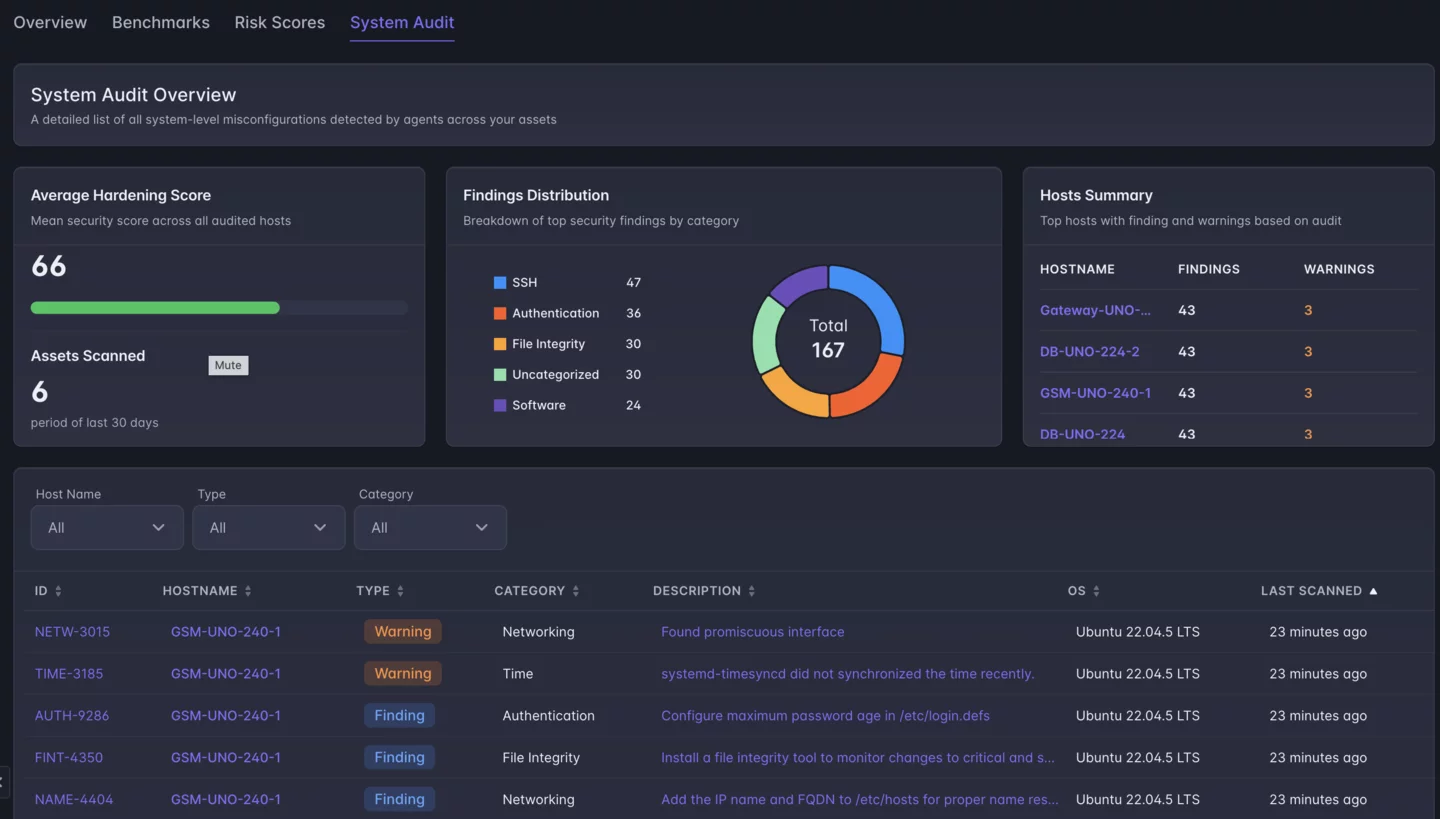
- Detection method: eBPF kernel-level syscall monitoring, Falco-ecosystem compatible and layered above it.
- Response model: Detection AND response on the agent; blocks malicious actions in-line, not alert-only.
- Cloud dependency: None required; Disconnected Mode keeps detection and response working air-gapped.
- Kubernetes-native depth: DaemonSet model, container-escape and audit-rule detections.
- Audit-readiness: CRA/NIS2 Compliance Center with control-to-requirement-ID mapping.
- Trader Joe's case study (EdgeLabs' own published results): 83% MTTR reduction, 573% ROI, $1.3M operational savings, under 2-week deploy, 0 outages.
- Secures GPU inference workloads using only CPU, with no GPU tax (EdgeLabs' own claim).
- Exploited-vulnerability scoring combines CVSS, EPSS, and CISA KEV, so teams patch what is actually exploited.
"Good IPS/IDS/EDR software. Webportal management is good. Docker container integration is useful."
Verified User in Computer Software · EdgeLabs G2 verified review
"It's beneficial to secure any website or any server from hackers."
Abhishek A. · EdgeLabs G2 verified review

Sysdig
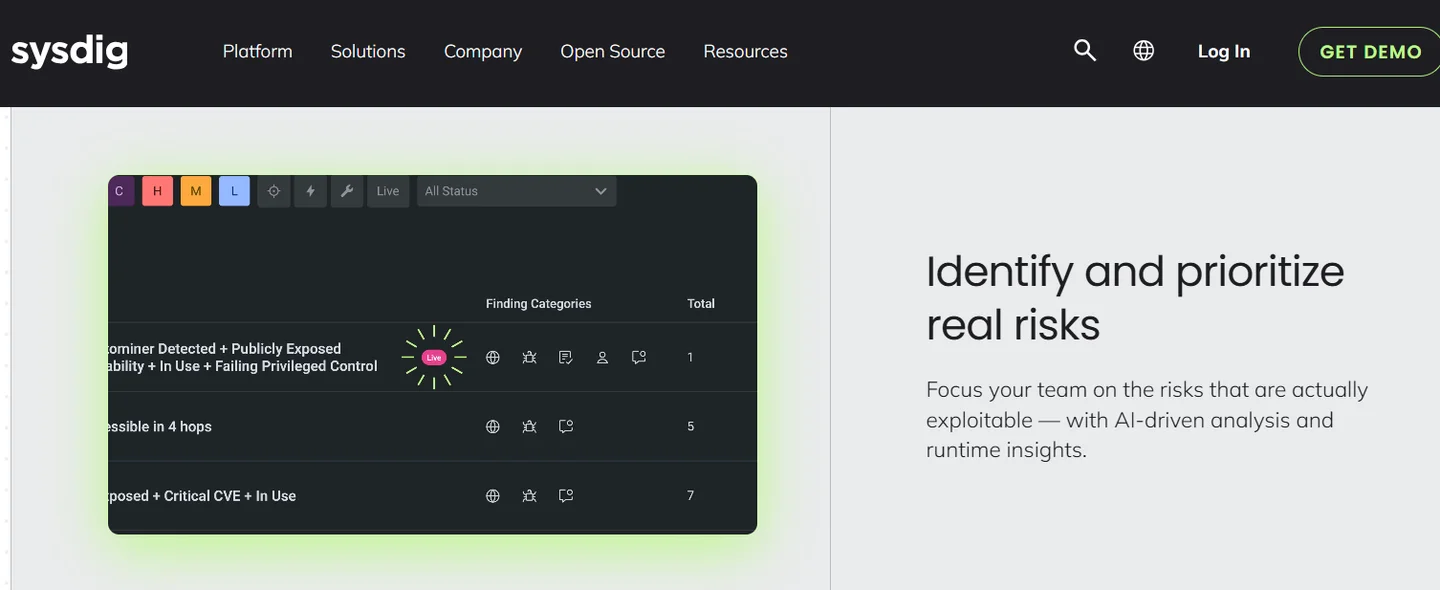
- Detection method: Deep Falco-heritage runtime detection with strong Kubernetes visibility.
- Response model: Runtime detection and response, oriented around a cloud platform and console.
- Cloud dependency: More cloud- and platform-oriented; heavier than an agent-only design.
- Kubernetes-native depth: Strong, with granular host, container, and K8s policies.
- Audit-readiness: CSPM/posture module plus runtime detection for compliance reporting.
- Reviewers cite granular host, container, and Kubernetes visibility with scanning locally and in-pipeline.
- Users report it solved false-positive-heavy scanning and gave visibility inside K8s clusters.
- Runtime detection plus a CSPM module for posture analytics.
Aqua Security
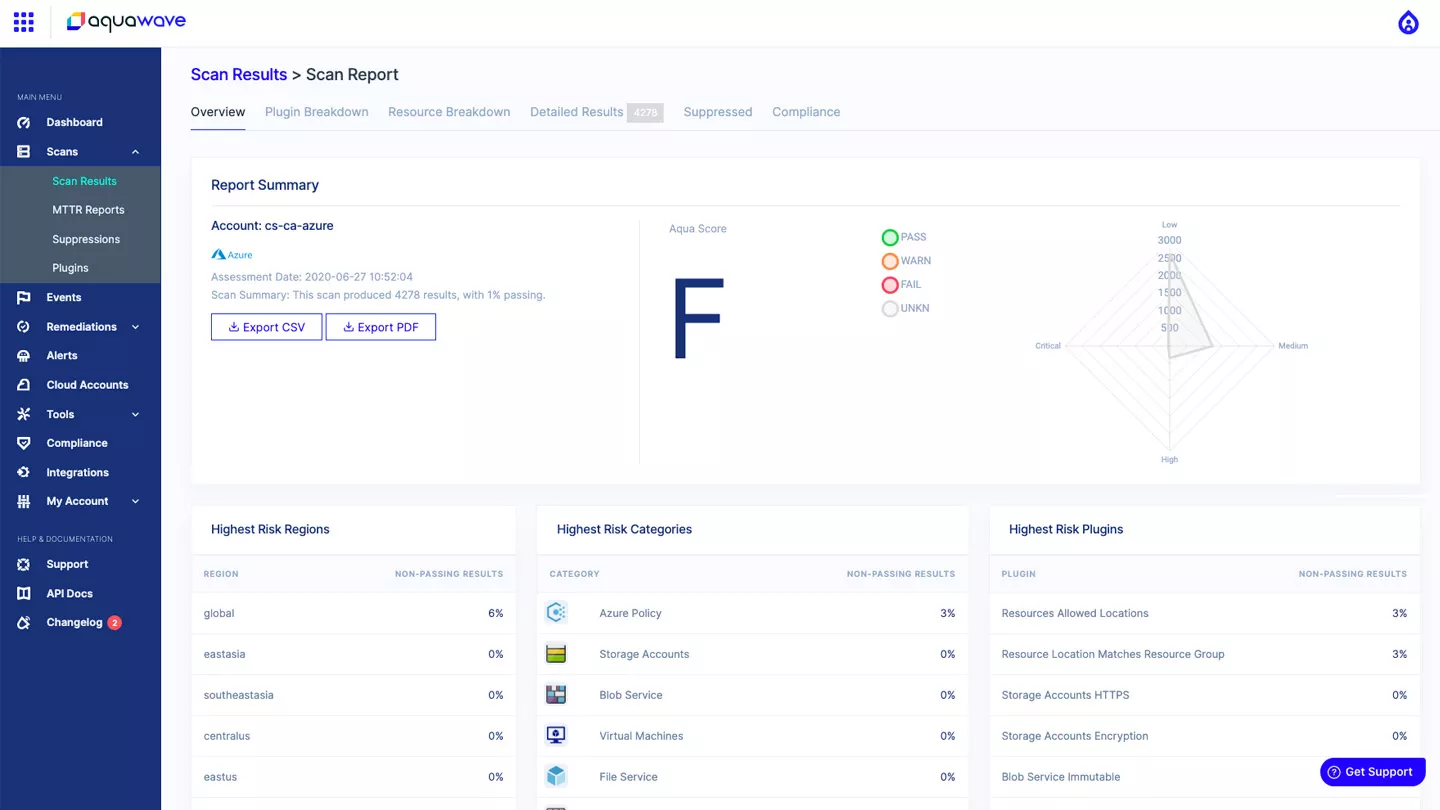
- Detection method: Agent-based container security with its own vulnerability database.
- Response model: Runtime policy enforcement plus build-time scanning across the lifecycle.
- Cloud dependency: Deploys on-prem via Helm, so it reaches self-hosted clusters.
- Kubernetes-native depth: Strong container coverage; runtime drift detection over time.
- Audit-readiness: Centralized reporting and policy-based compliance controls.
- Reviewers cite full lifecycle protection for containers from build to runtime.
- Tight CI/CD integration (Jenkins, GitLab, Docker) makes developer adoption easier.
- Used to catch high-profile issues like Log4j in image scans.
"It provides full lifecycle protection for containers from build to runtime. This helps close security gaps that point solutions may miss. False positives require developer time to investigate, and there is potential vendor lock-in."
hugh m., Sr Cybersecurity Engineer · Aqua Security G2 verified review
"I value the solution in terms of helping our teams detect and manage risks with images, containers, and modern infrastructure. APIs are not as useful as they should be, and there is no meaningful native reporting solution."
Verified User in Hospital & Health Care · Aqua Security G2 verified review
CrowdStrike
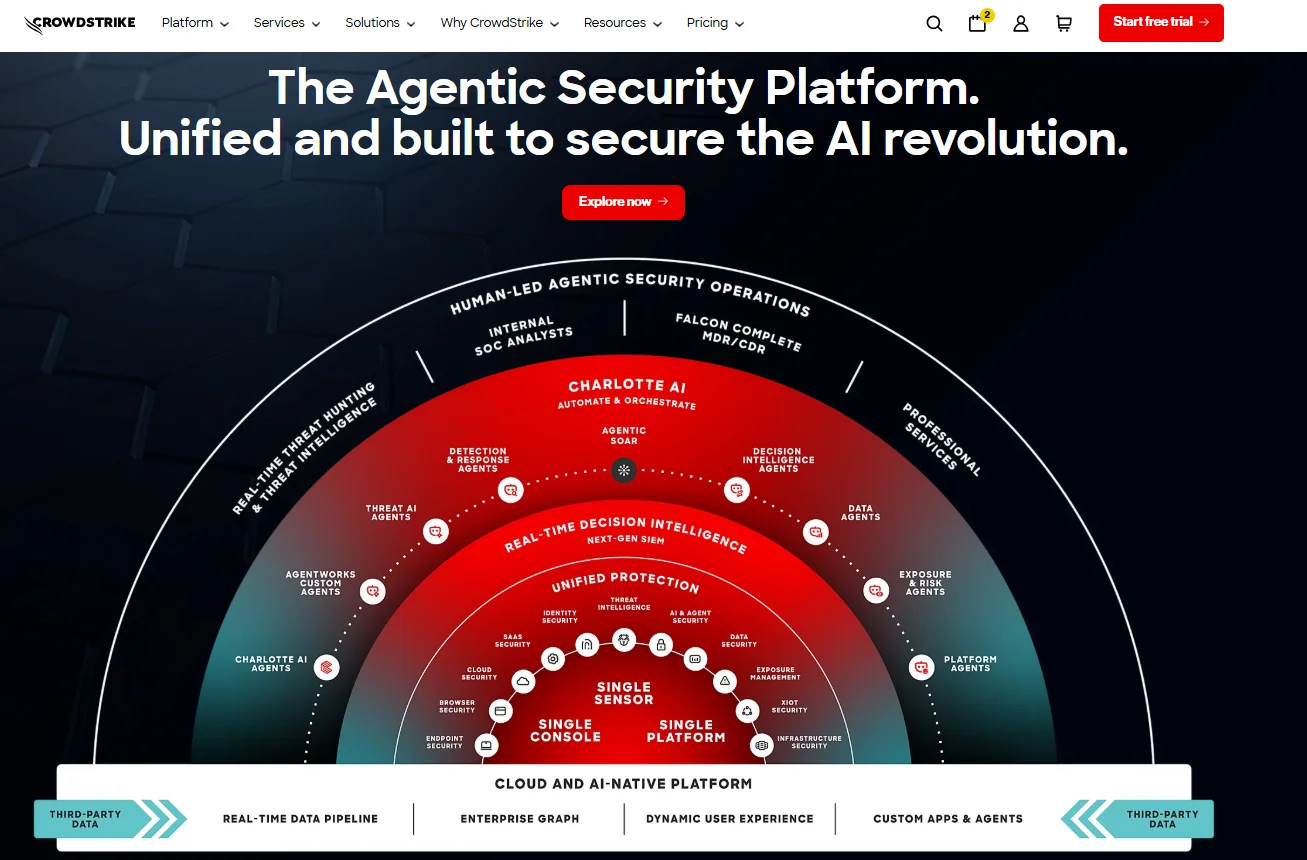
- Detection method: Behavior-based endpoint detection extended into cloud and containers.
- Response model: Real-time endpoint response; container/runtime is a bolt-on module, not the first stop.
- Cloud dependency: High; reviewers cite heavy SaaS availability dependence and lock-in risk.
- Kubernetes-native depth: Present via the CNAPP module, but console feels stitched together.
- Audit-readiness: Exposure management and posture features for compliance.
- Reviewers praise lightweight agent, fast real-time detection, and clean dashboards.
- Falcon Cloud Security offers a single CNAPP covering app, data, infrastructure, and runtime.
- Behavioral detection catches suspicious activity, not just known signatures.
"It provides a single CNAPP platform that covers application, data, infrastructure, and runtime security. The heavy dependency on SaaS availability creates vendor lock-in and introduces a real risk to overall availability."
Verified User in IT and Services · CrowdStrike Falcon Cloud Security G2 verified review
"It grew up as an EDR company, and it shows. Navigating between host security logs, Kubernetes infrastructure, and cloud posture often requires clicking through vastly different administrative portals."
Verified User in Health, Wellness and Fitness · CrowdStrike Falcon Cloud Security G2 verified review
SentinelOne (Singularity Cloud)
- Detection method: AI-driven detection across cloud workloads, containers, and pipelines.
- Response model: Automated response that reduces manual intervention; runtime is a cloud module.
- Cloud dependency: High; cloud console-oriented, expects a backend.
- Kubernetes-native depth: Protects containers in real time; also scans IaC and CI/CD.
- Audit-readiness: Posture, workload protection, and compliance automation in one platform.
- Reviewers cite real-time protection for cloud servers, containers, and data.
- Analyzes how attackers could exploit systems, not just raw alerts.
- Scans CI/CD and IaC to catch issues before deployment.
"Its strong AI-driven threat detection and automated response significantly reduces manual intervention. The initial setup and policy configuration can be complex and time-consuming, and it can feel expensive or heavy for smaller environments."
Shruti J. · SentinelOne Singularity Cloud Security G2 verified review
"It protects cloud servers, containers, and data in real time and supports multi-cloud in one dashboard. It can be a bit complex to set up and learn, and can feel heavy and expensive for smaller teams."
Verified User in Computer Software · SentinelOne Singularity Cloud Security G2 verified review
Oligo Security
- Detection method: Runtime application-layer monitoring of library behavior.
- Response model: Runtime detection focused on the application layer.
- Cloud dependency: Cloud-native oriented; verify air-gapped support with the vendor.
- Kubernetes-native depth: Cloud-native Kubernetes focus at the application layer.
- Audit-readiness: Not publicly detailed; varies by deployment.
- Application-layer runtime detection is its stated core capability.
- Focuses on what code and libraries do when they execute, not only static presence.
Upwind Security
- Detection method: Runtime detection paired with cloud-context signals.
- Response model: Runtime detection oriented around cloud correlation.
- Cloud dependency: Cloud-native; a cloud backend is expected.
- Kubernetes-native depth: Cloud-native Kubernetes coverage.
- Audit-readiness: Not publicly detailed; varies by deployment.
- Runtime detection correlated with cloud context is its stated approach.
- Aimed at cloud-native environments where cloud metadata sharpens alerts.
Falco (CNCF OSS)
- Detection method: eBPF/syscall runtime detection, the reference standard for the category.
- Response model: Alert-only; it detects and notifies but does not block on its own.
- Cloud dependency: None required; self-hostable and community-run.
- Kubernetes-native depth: Strong; DaemonSet model with customizable rules.
- Audit-readiness: Detailed event notifications; you build reporting around it.
- Integrates as a DaemonSet across the cluster with customizable rules.
- Provides visibility into system calls and container behavior in real time.
- Generates real-time alerts for suspicious activity for faster incident response.
"Falco integrates seamlessly with Kubernetes; easy to deploy as a DaemonSet across the cluster. Setting up and fine-tuning rules can be complex, and as a DaemonSet on each node it can consume a noticeable amount of system resources."
Bikash S. · Falco G2 verified review
"It is really good for linux systems and is a cloud native security tool, so it is quite good at scalability. The integration of Falco using API is much difficult as it isn't a REST API, so there is a learning curve."
Anussha H. · Falco G2 verified review
Choosing By Situation
There is no single winner here, only the right fit for what you actually run.
- Running self-hosted, on-prem, or air-gapped, or securing LLM agents at runtime? EdgeLabs is built for that job.
- Want Falco-grade detection as a managed platform? Sysdig.
- Need build-to-runtime container coverage from one vendor? Aqua Security.
- Already standardized on endpoint XDR? CrowdStrike or SentinelOne.
- Cloud-native and want runtime enriched with cloud context? Oligo or Upwind.
- Have the engineering time and want zero license cost? Falco.
If you want to pressure-test where your own cluster lands, our team can walk through runtime detection and response, exploited-vulnerability scoring, and CRA and NIS2 evidence mapping against what you actually run. Tell us your setup and start the conversation here.
Q2: What Exactly Is Kubernetes Runtime Security (And Why Isn't Image Scanning Enough)?
Kubernetes runtime security monitors what containers actually do once running: syscalls, process spawns, file access, and network connections, versus scanning images or configs before they run. Image scanning finds known CVEs in a static artifact. Runtime security catches the exploit, reverse shell, or lateral movement after deployment. ARMO data shows only about 15% of image vulnerabilities are ever loaded at runtime, which is why scan-only postures bury teams in noise.
The Three Layers, And Where Runtime Sits
Kubernetes security stacks into three layers. First, scanning checks images and configs before they run. Second, admission control decides what is allowed to deploy. Third, runtime detection watches what actually happens once the pod is live.
Most teams stop at the first two. That leaves the layer where attacks actually execute wide open.
🧠 Why eBPF Beats Sidecars And Kernel Modules
Runtime tools need to see system calls, the requests a program makes to the Linux kernel. eBPF (a way to run safe programs inside the kernel) gives that view without custom kernel modules or per-pod sidecars.
That matters for three reasons. It is tamper-resistant, it needs no kernel headers, and it runs as one agent per node (a DaemonSet), at roughly 3% CPU. Falco, the only CNCF-graduated runtime project (graduated February 29, 2024), popularized this approach.
⚠️ The "Exit Code Zero" Trap
Here is the scene I keep seeing. A pipeline finds vulnerabilities, but still returns exit code zero, so the build passes and ships anyway.
Scanning images is close to a placebo if that is where you stop. Having security tools in place does not mean you are secure. The vulnerability is in the image, but the real question is what runs.
✅ What To Watch At Runtime On Monday
You can start with three signals that rarely lie:
- Suspicious syscalls: memfd_create (fileless execution), ptrace (anti-debug), or unshare (namespace abuse).
- Unexpected egress: a pod suddenly talking to an unknown external IP.
- Privilege escalation: a container escape, or a surprise kubectl exec into a sensitive pod.
At EdgeLabs, we build on one premise: detection has to run where the workload executes. Our single eBPF agent watches syscalls at the kernel, stays Falco-ecosystem compatible, and layers detection and response on top. I could be biased, but after years of this, the clean posture scan is the most comfortable lie in the category.
Q3: Inline Blocking vs Alert-Only, Which Runtime Model Should You Actually Run?
Alert-only tools like Falco detect suspicious behavior and notify you, but never stop it. They are safe from breaking workloads, and useless at 3 a.m. if nobody responds. Inline enforcers like Tetragon, KubeArmor, and EdgeLabs block malicious syscalls or connections in real time, often at the kernel via eBPF without traversing the Kubernetes API server. The trade-off is real. A false-positive block can disrupt a workload; a missed alert lets an attacker move sideways.
The Alert Cannon Problem
I spent years generating millions of alerts. Most teams do not need another alert cannon. They need something to act.
Alert-only is comfortable because it never breaks anything. That comfort is exactly the risk when the on-call queue is already buried.
🔧 How Inline Enforcement Actually Works
Inline enforcement means the tool can stop the action, not just log it. Tetragon, for example, enforces at the kernel level and can kill a process without a round-trip to the Kubernetes API server.
That kernel-level path is fast and hard to bypass. Falco, by contrast, is detection-only by design; it tells you what happened and leaves the response to you.
⚠️ The "Monitor-Only" Mistake
Enforcement is powerful and dangerous in the same breath. The classic failure I have watched: a team says "block all untrusted software," then leaves the machine in monitor-only mode.
Now they think they are protected, and nothing is actually blocking. Misconfigured enforcement is worse than honest detection, because it hides the gap.
✅ The Decision Rule
Here is the rule I give peers:
| Approach | Best for | Main risk |
|---|---|---|
| Alert-only | Broad visibility, staffed response | Missed threat if nobody acts |
| Inline blocking | High-value namespaces, known-bad actions | False-positive disruption |
Detect broadly, enforce narrowly, and time-box your blocks. At EdgeLabs, detection AND response run on the agent, with in-line prevention using host-local, time-boxed source-IP blocking (1 minute to 90 days, per our own configuration). That enforcement means nothing if it dies when your cloud link dies, which is exactly what Q4 gets into.
Q4: What Happens When Your Runtime Tool Loses Its Cloud Connection, And Do You Need One Agent or a Stack?
Many CNAPP, NDR, and CDR tools ship telemetry to a cloud backend to detect and respond. So an air-gapped or disconnected cluster goes blind exactly when you need it most. Agent-only tools run detection and response on the node, still alerting and blocking with no cloud link. Consolidating NDR, EDR, container, vulnerability, and AI security into one agent also cuts footprint and correlates signals siloed tools miss.
The Assumption Nobody States
Most cloud-dependent tools assume constant egress. They quietly need the internet to think.
That assumption breaks in three common places: a sovereign deployment, an air-gapped cluster, and a network blip during an incident. The tool goes quiet at the worst moment.
⚠️ The Compliance And Latency Cost
There is a second cost to phoning home. Shipping sensitive telemetry to a cloud backend can clash with data-residency and sovereignty rules.
A security lead once asked me, mid-PoC, whether the agent would still block an attack if the backend went dark, three days before an audit. That question is why Disconnected Mode exists: full detection AND response continue offline.
🔧 One Agent Or A Stack?
Consolidation is the other half of this decision. One agent can fold NDR, EDR, IPS/IDS, container/Kubernetes security, vulnerability management, and AI/agent security together.
The upside is fewer blind spots and lighter footprint. At EdgeLabs, that is one eBPF DaemonSet, one agent per node, no sidecars, at typically under 5% CPU and under 500 MB RAM (our own published claim).
💰 When A Specialist Stack Still Wins
I will be honest about the trade-off. One agent trades some per-domain depth for fewer gaps.
Beware the build-vs-buy trap here too. People assume "how hard can it be to wire an AI into my SIEM," but unless you are spending five or ten million, you probably will not get it right. That is the IKEA Effect: we overvalue the tuned tool we assembled ourselves.
At EdgeLabs, agent-only detection AND response keeps working self-hosted, on-prem, and air-gapped, and reaches GPU inference nodes. Our published Trader Joe's case study reports an 83% MTTR reduction and 573% ROI, which are EdgeLabs' own figures, not independently verified.
"Good IPS/IDS/EDR software. Webportal management is good. Docker container integration is useful."
Verified User in Computer Software EdgeLabs G2 Verified Review
"It grew up as an EDR company, and it shows. Navigating between host security logs, Kubernetes infrastructure, and cloud posture often requires clicking through vastly different administrative portals."
Verified User in Health, Wellness and Fitness CrowdStrike Falcon Cloud Security G2 Verified Review
Q5: How Do You Secure LLM Agents and AI Workloads Running Inside Kubernetes?
AI agents in Kubernetes introduce risks image scanners never see: prompt injection, tool poisoning, and over-privileged service accounts that let an attacker "whisper" instructions instead of breaching a firewall. OWASP's 2026 report ties real exploited CVEs to MCP servers and coding agents, with prompt injection touching 6 of 10 agentic-AI risk categories, and cites CVE-2025-6514 (a remote-code-execution flaw, CVSS 9.6). Runtime enforcement, watching what an agent actually calls, reads, and executes, is the only layer that catches this after deployment.
The New Attack Surface
An LLM agent is a program that reads instructions and acts on them. That is exactly what makes it a new kind of insider risk.
Attackers do not need to hack your firewall if they can just whisper instructions to your AI. Prompt injection (hostile text that hijacks the model) and tool poisoning (a compromised tool the agent trusts) are the live threats. The OWASP 2026 report even documents a LiteLLM PyPI backdoor pulled roughly 47,000 times in one window.
⚠️ Why Least-Privilege Fails In Practice
Least-privilege is the right idea, and it slips in production. Agents get handed broad service-account permissions because narrowing them breaks workflows.
A rule I use is the two-of-three rule. Of files, internet, and execute, let an agent have at most two. An agent that can read files, reach the internet, and run code is an exfiltration engine waiting for a bad prompt.
🧠 Runtime Enforcement Is The Only Layer That Catches This
You can patch a bug, but you cannot patch a brain. A model will always be talked into something eventually, so you supervise its behavior at runtime.
I watched an agent wipe a production environment in about 9 seconds during a test, after it violated every principle I gave it. That is why we built the Parallax engine at EdgeLabs: an LLM proxy and firewall doing input/output alignment, prompt-injection and tool-poisoning defense, and hallucination checks for agents and MCP servers in production. It also secures GPU inference nodes using only CPU, so protection does not tax the GPU budget (our own claim).
I will be honest that this category is young and thinly reviewed, so treat every vendor claim here, including mine, as something to test in your own cluster. Where my head is right now: over the next two years, supervising the agent at runtime stops being niche and becomes the default question every SecOps team answers.
Q6: Why Do CVE Counts Mislead You, And How Should You Prioritize and Prove Compliance?
A CVE is a known vulnerability, not a usable exploit. Roughly 88% of published CVEs carry an exploitation probability under 10%. Ranking a backlog by CVSS (the severity score) alone wastes effort on flaws attackers ignore. Exploited-vulnerability scoring combines CVSS severity with EPSS probability (the odds a flaw gets exploited) and the CISA KEV catalog (confirmed exploited bugs), then filters by what actually runs. That same runtime evidence is what proves CRA and NIS2 controls work.
CVE Is Not Exploit
A CVE is a catalog entry. An exploit is something actively usable and high risk. Those are different things, and treating them as one drowns your team.
CISA's Known Exploited Vulnerabilities catalog held roughly 1,484 confirmed entries as of early 2026. That is the short list attackers are actually using, out of hundreds of thousands of CVEs.
🔧 How To Re-Rank The Backlog On Monday
Here is the practical order I give peers:
- Patch anything in the CISA KEV catalog first. It is confirmed exploited.
- Then high-EPSS plus high-CVSS. Scary on paper and likely in practice.
- Deprioritize high-CVSS with low-EPSS. Frightening, rarely used.
Then layer runtime. ARMO data shows only about 15% of image vulnerabilities are ever loaded at runtime. The flaw that never executes is a lower fire than the one running in production.
📋 What CRA And NIS2 Actually Demand
Two EU rules drive this. The Cyber Resilience Act, Regulation (EU) 2024/2847, and NIS2, Directive (EU) 2022/2555, require ongoing security and incident reporting, not one-time paperwork. Verify the exact article text on EUR-Lex before you publish anything against it.
The reason this matters is human. Two law firms lost their entire databases, and in one case I had to find out from the news. Please do not say security is your top priority only after a breach.
✅ Evidence Beats Posture
Auditors increasingly want proof a control worked, not proof it was configured. A logged runtime detection or an enforced block is evidence; a green posture dashboard is a claim.
At EdgeLabs, we score with CVSS, EPSS, CISA KEV, and CWE against what actually runs, then map runtime evidence to requirement IDs in our CRA/NIS2 Compliance Center, including the CRA Annex I "No Known Exploitable Vulnerabilities" check. I will be candid about the boundary: it covers runtime, vulnerability-handling, and detection-and-response controls, not lifecycle or program controls like business continuity, backup, MFA-as-a-program, or the CRA multi-year support obligations.
"It provides real-time threat alerts and AI-powered threat analysis to highlight the most critical issue. It triggers a lot of alerts if it is not properly fine-tuned, and initial setup is a bit complex."
Lokesh K. CrowdStrike Falcon Exposure Management G2 Verified Review
"Granular host, container, K8s visibility; vulnerability scanning policies locally and at pipeline. It is difficult to monitor the state of detected vulnerabilities or detected events."
Verified User in Financial Services Sysdig Secure G2 Verified Review
Q7: How Do the Leading Kubernetes Runtime Security Tools Compare, and Which Fits Your Situation?
There is no single "best" runtime tool, only the right fit for your situation. Choose Falco for free, alert-only detection with in-house tuning; Sysdig or Aqua for enterprise container platforms; CrowdStrike or SentinelOne if you are endpoint-first extending to cloud; Oligo or Upwind for cloud-native runtime; and EdgeLabs for self-hosted, on-prem, or air-gapped clusters and AI workloads needing detection AND response on the agent with no cloud dependency.
Match The Tool To The Job
The full per-tool cards sit in the comparison section above, covering all eight providers on the same five criteria. Here I want to make the choice, not repeat the specs.
The mistake I watch teams make is picking the biggest name, then bending their environment to fit it. Start from what you actually run instead.
🗂️ Scenario Recommendations
| Your situation | Strong fit | Why |
|---|---|---|
| Self-hosted, on-prem, or air-gapped; securing AI agents | EdgeLabs | Detection and response on the agent, no cloud dependency |
| Want Falco depth as a managed platform | Sysdig | Deep Falco heritage, broad cloud coverage |
| Build-to-runtime container coverage, one vendor | Aqua Security | Full lifecycle, build through runtime |
| Already standardized on endpoint XDR | CrowdStrike or SentinelOne | Runtime as an extension of the endpoint engine |
| Cloud-native, want runtime plus cloud context | Oligo or Upwind | Cloud-native runtime focus |
| Zero license cost, engineering time to tune | Falco | CNCF-graduated, Apache 2.0, alert-only |
⚠️ When EdgeLabs Is Not Your Pick
I would rather lose a fit than oversell one. If your core job is pure build-time application security, or you are already deeply standardized on an endpoint-first XDR that meets your needs, we are probably not the right first move.
We are neutral on tools and opinionated on categories. The users are not the weakest link; the job is to make the environment safe for people to use.
So tell me what you are actually running: the cluster type, whether any of it is disconnected, and whether AI agents are in production. That is the conversation worth having, and it is where EdgeLabs' agent-only, no-cloud design either fits your reality or clearly does not. If you want to walk through it together, start the conversation here.
"Good IPS/IDS/EDR software. Webportal management is good. Docker container integration is useful."
Verified User in Computer Software EdgeLabs G2 Verified Review
"It's beneficial to secure any website or any server from hackers."
Abhishek A. EdgeLabs G2 Verified Review
FAQs
Kubernetes runtime security tools watch what containers actually do once they are running, rather than scanning static images before deployment. They monitor syscalls, process spawns, file access, and network connections to catch what scanners miss.
Image scanning finds known CVEs in a static artifact. Runtime security catches the exploit, reverse shell, or lateral movement after the pod is live. That gap matters because attacks execute at runtime, not at scan time.
- Detection layer: flags suspicious syscalls like fileless execution or namespace abuse.
- Response layer: can block a malicious action, not just log it.
- Evidence layer: produces logged detections you can map to compliance frameworks.
ARMO data shows only about 15% of image vulnerabilities are ever loaded at runtime, which is why scan-only postures bury teams in theoretical noise. A clean posture scan is not the same as a secure cluster.
At EdgeLabs, our Kubernetes runtime security runs detection and response on a single eBPF agent per node, so protection sits exactly where the workload executes. That is the layer where real attacks either get caught or get missed.
This is the core trade-off in runtime security, and it decides how your tool behaves at 3 a.m.
Alert-only tools like Falco detect suspicious behavior and notify you, but never stop it. They are safe from breaking workloads, and useless if nobody responds to the alert in time.
Inline enforcers like Tetragon, KubeArmor, and EdgeLabs block malicious syscalls or connections in real time, often at the kernel via eBPF without a round-trip to the Kubernetes API server.
- Alert-only is best for broad visibility when you have staffed response.
- Inline blocking is best for high-value namespaces and known-bad actions.
- The risk with inline is a false-positive block; the risk with alert-only is a missed threat.
The classic failure we watch is misconfigured enforcement: a team enables blocking, then leaves it in monitor-only mode, so nothing actually stops. That hides the gap.
Our advice is to detect broadly, enforce narrowly, and time-box your blocks. At EdgeLabs, in-line prevention uses host-local, time-boxed source-IP blocking, so enforcement stays surgical rather than disruptive.
Many tools do not, and that is a risk buyers rarely test until an audit. Many CNAPP, NDR, and CDR platforms ship telemetry to a cloud backend to detect and respond, so an air-gapped or disconnected cluster goes blind exactly when it matters most.
This assumption of constant egress breaks in three common places:
- A sovereign or data-residency-restricted deployment.
- A fully air-gapped cluster with no internet.
- A network blip during an active incident.
There is a second cost to phoning home. Shipping sensitive telemetry to a cloud backend can clash with data-residency and sovereignty rules, adding compliance friction on top of the latency.
Agent-only tools run detection and response on the node itself, still alerting and blocking with no cloud link. A security lead once asked us, mid-PoC, whether the agent would still block an attack if the backend went dark three days before an audit. That question is why our Disconnected Mode exists: full detection and response continue offline, self-hosted, on-prem, and air-gapped.
AI agents introduce risks image scanners never see. Attackers do not need to hack your firewall if they can whisper instructions to your AI through prompt injection, or poison a tool the agent trusts.
OWASP's 2026 report ties real exploited CVEs to MCP servers and coding agents, with prompt injection touching 6 of 10 agentic-AI risk categories. An over-privileged service account turns one bad prompt into an exfiltration engine.
- Apply a two-of-three rule: of files, internet, and execute, let an agent hold at most two.
- Watch what the agent actually calls, reads, and executes at runtime.
- Treat the agent as a new kind of insider that needs supervision, not just a pre-flight check.
You can patch a bug, but you cannot patch a brain, so runtime enforcement is the only layer that catches this after deployment. Our Parallax engine acts as an LLM proxy and firewall, handling input and output alignment, prompt-injection and tool-poisoning defense, and hallucination checks for agents and MCP servers in production. It also secures GPU inference nodes using only CPU, so protection does not tax your GPU budget.
A CVE is a known vulnerability, not a usable exploit, and treating the two as the same drowns your team in noise. Roughly 88% of published CVEs carry an exploitation probability under 10%, so ranking a backlog by CVSS severity alone wastes effort on flaws attackers ignore.
Exploited-vulnerability scoring re-ranks the work by combining three signals:
- CVSS for raw severity.
- EPSS for the probability a flaw actually gets exploited.
- CISA KEV, the catalog of confirmed exploited bugs, which held roughly 1,484 entries in early 2026.
Then filter by what actually executes at runtime. ARMO data shows only about 15% of image vulnerabilities ever load at runtime, so the flaw that never runs is a lower fire than the one running in production right now.
Our practical order is simple: patch anything in CISA KEV first, then high-EPSS plus high-CVSS, and deprioritize high-CVSS with low-EPSS. At EdgeLabs, our vulnerability management scores with CVSS, EPSS, CISA KEV, and CWE against what actually runs, not against theory.
Yes, but only if the tool produces runtime evidence, not just posture snapshots. The EU Cyber Resilience Act, Regulation (EU) 2024/2847, and NIS2, Directive (EU) 2022/2555, both demand ongoing security and incident reporting, not one-time paperwork.
Auditors increasingly want proof a control actually worked, not proof it was configured. There is a real difference:
- A green posture dashboard is a claim.
- A logged runtime detection or an enforced block is evidence.
That distinction is what turns runtime monitoring into audit-readiness. Runtime detections and blocks give you a defensible trail mapped to specific control requirements.
We are candid about the boundary here. Runtime tooling covers detection, response, and vulnerability-handling controls. It does not cover lifecycle or program controls like business continuity, backup, MFA-as-a-program, or the CRA multi-year support obligations, and you should not trust any vendor that claims otherwise.
At EdgeLabs, our CRA/NIS2 Compliance Center maps runtime evidence to requirement IDs, including the CRA Annex I "No Known Exploitable Vulnerabilities" check, so what you enforce becomes what you can prove.
Runtime tools need to see system calls, the requests a program makes to the Linux kernel. eBPF is a way to run safe programs inside the kernel, giving that visibility without custom kernel modules or per-pod sidecars.
That design wins on three practical fronts:
- Tamper-resistant: detection sits at the kernel, harder for an attacker to disable than a userspace sidecar.
- Lightweight: it runs as one agent per node in a DaemonSet, avoiding a sidecar attached to every pod.
- Portable: modern eBPF needs no kernel headers on the host.
Sidecars multiply overhead with every pod and add operational sprawl. A single DaemonSet agent watches every container on the node from one place, often at roughly 3% CPU.
Falco, the only CNCF-graduated runtime project, popularized this kernel-level approach and is the neutral baseline the category references. We build Falco-ecosystem compatibility, then layer detection and response on top.
At EdgeLabs, our single eBPF agent consolidates workload and container security across a node, so you get kernel-level visibility without a sidecar tax on every pod.
There is no single best runtime tool, only the right fit for what you actually run. The mistake we watch teams make is picking the biggest name, then bending their environment to fit it. Start from your situation instead.
- Falco: free, alert-only detection when you have engineering time to tune it.
- Sysdig or Aqua: enterprise container platforms wanting managed depth from build through runtime.
- CrowdStrike or SentinelOne: endpoint-first shops extending XDR into cloud and containers.
- Oligo or Upwind: cloud-native runtime enriched with cloud context.
- EdgeLabs: self-hosted, on-prem, or air-gapped clusters and AI workloads needing detection and response on the agent with no cloud dependency.
We are neutral on tools and opinionated on categories. If your core job is pure build-time application security, or you are already deeply standardized on an endpoint-first XDR that fits, we are honestly not your first move.
What matters is the cluster type, whether any of it runs disconnected, and whether AI agents are in production. If you want to pressure-test where you land, talk to our team about your actual setup.
