TL;DR
- RASP never died, it changed plumbing. The capability returned as ADR and runtime CWPP, instrumented with eBPF and OpenTelemetry instead of SDK wrappers and bytecode injection.
- Nine tools judged on five criteria: runtime detection method, response autonomy, deployment reach, AI-workload coverage, and agent footprint. Every card names what the tool does not cover.
- Shortlist by instrumentation method, not acronym. SDK, bytecode agent, sidecar, DaemonSet, OpenTelemetry, and eBPF carry very different risk, cost, and privilege profiles.
- Run one test that settles it: block egress on a node, then trigger a detection. If detection continues but response stops, you bought a sensor, not protection.
- LLM agents break the request-path assumption entirely. Watch syscalls, egress, MCP tool calls, and GPU nodes, because instructions to a model are requests, not controls.
- Runtime evidence covers CRA Annex I exploitable-vulnerability and NIS2 incident-handling obligations, not backup, continuity, MFA-as-a-program, or HR training controls.
Q1. Which Runtime Application Self-Protection Tools Actually Fit Modern App Stacks?
Total providers: 9. EdgeLabs for agent-only runtime detection and response with no cloud dependency, Sysdig and Falco for syscall-level container detection, Aqua Security for container lifecycle coverage, Oligo and Upwind for runtime-context vulnerability work, CrowdStrike and SentinelOne for endpoint-first estates adding a runtime module, and Contrast Security for in-process application protection.
Choosing a runtime security tool is a high-stakes call because attacks execute at runtime, not at scan time. A clean pipeline result tells you nothing once a pod is popped or an agent is hijacked. A tool that cannot reach self-hosted, on-prem, or air-gapped estates is a non-starter for regulated teams. Alert noise buries the one event that mattered. I evaluated nine tools against five criteria: runtime detection method, response autonomy, deployment reach, AI-workload coverage, and agent footprint. Written for SecOps and DevSecOps leads making cloud and AI workloads production-safe.
📋 Our Evaluation Criteria
- Runtime detection method. Does it watch real kernel activity through eBPF or syscall capture, or infer risk from agentless posture snapshots? Only the first sees what actually ran.
- Response autonomy. Does detection and response execute locally on the agent, or does blocking wait on a cloud control plane round-trip?
- Deployment reach. Cloud, data center, on-prem, air-gapped, Kubernetes, and GPU inference nodes. If a cloud backend is mandatory to detect or respond, that is stated plainly.
- AI-workload and LLM-agent coverage. Prompt injection, tool poisoning, MCP server behavior, and GPU node protection. Most tools in this category score low here, honestly.
- Footprint and production blast radius. CPU and RAM cost, kernel dependency, fail behavior, and whether you can kill one agent instead of one cluster.
👥 Who This Guide Is For
- SecOps and DevSecOps leads at SMBs making cloud and AI or GPU workloads production-safe without a 24/7 team.
- AI-workload and LLM-agent runtime-security owners securing agents and agentic systems in production.
- Kubernetes and container runtime-security owners moving from build-time scanning to runtime detection.
- GPU-cloud and AI-infrastructure security leads protecting inference nodes and shared clusters.
⚠️ Methodology And Bias Disclosure
EdgeLabs publishes this guide and appears on the list. I am telling you that up front, because half the roundups ranking for this term are written by vendors who quietly rank themselves first.
Every entry here, including EdgeLabs, is judged on the same five criteria. Every card names one thing the tool does not cover. Vendor claims were checked against each vendor's own documentation, not against their marketing pages. Last updated July 2026.
🗂️ The Nine Tools At A Glance
- EdgeLabs: Best for self-hosted, on-prem, or air-gapped estates that need runtime detection and response without a cloud backend.
- Sysdig: Best for cloud-native teams wanting deep syscall visibility across many Kubernetes clusters with a mature platform behind it.
- Falco (CNCF OSS): Best for teams with engineering capacity who want to own their runtime rules with no license cost.
- Aqua Security: Best for organizations tying image scanning, admission control, and runtime enforcement into one container lifecycle.
- Oligo Security: Best for AppSec teams that want library-level and function-level runtime evidence to cut a CVE backlog.
- Upwind Security: Best for cloud teams wanting runtime signals to reprioritize a noisy CSPM findings queue.
- CrowdStrike: Best for estates already standardized on its endpoint agent that want cloud workload coverage in the same console.
- SentinelOne Singularity Cloud: Best for teams anchored on its XDR platform extending protection to cloud workloads.
- Contrast Security: Best for Java and .NET application teams wanting in-process protection at the code path level.
📊 Master Comparison Table
| Company | Best For | Detection & Response Model | Deployment & Environment Coverage |
| EdgeLabs | Self-hosted or air-gapped estates needing runtime detection and response with no cloud backend | Agent-only, detection and response both execute on-agent at kernel level via eBPF | Cloud, data center, on-prem, air-gapped, Docker, Kubernetes, OpenShift, Talos, K3S, x86_64 and ARM_64, GPU inference nodes |
| Sysdig | Multi-cluster cloud-native estates needing deep syscall visibility | Agent plus cloud platform, Falco-derived runtime detection with platform-side correlation | Cloud and Kubernetes first, on-prem supported, cloud console central to workflow |
| Falco | Teams who want to own runtime rules with no license cost | Open-source syscall rules engine, detection only, response via external tooling | Anywhere you can run the driver, Kubernetes and Linux hosts, self-managed |
| Aqua Security | Container lifecycle from image scan to runtime enforcement | Agent plus enforcer with build-time scanning and admission control | Cloud and on-prem, Helm-based install documented for on-prem |
| Oligo Security | Library-level and function-level runtime evidence for CVE triage | eBPF-based runtime library observation feeding prioritization | Cloud and Kubernetes workloads, cloud console dependent |
| Upwind Security | Runtime context reprioritizing a noisy cloud findings queue | eBPF sensor feeding a cloud-native platform, posture-led with runtime signal | Cloud-first, cloud backend required for the platform experience |
| CrowdStrike | Estates already standardized on its endpoint agent | Endpoint-first agent with a cloud workload module, cloud-dependent analytics | Endpoints, servers, containers, Kubernetes, cloud console required |
| SentinelOne Singularity Cloud | Teams anchored on its XDR platform | XDR agent extended to cloud workloads, console-centric response | Endpoints, servers, cloud workloads, Kubernetes, cloud console required |
| Contrast Security | Java and .NET applications needing in-process protection | In-process bytecode instrumentation, blocks at the code path, ADR-evolved | Application runtimes, container and cloud deployment, self-hosted options available |
Darktrace and Vectra AI come up in these conversations, so worth one line: both are network-first and cloud-dependent by design, which puts them in a different lane from an on-host runtime agent. They are not judged here.
1 out of 9EdgeLabs
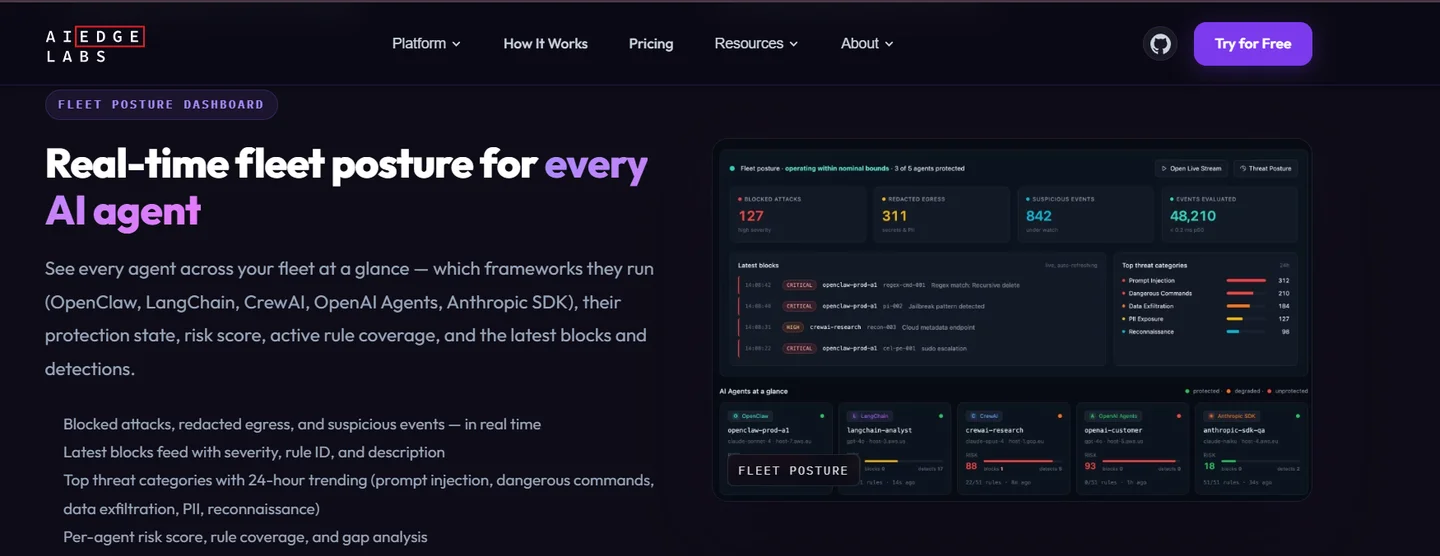
- Runtime detection method: eBPF syscall monitoring at kernel level, layered above Falco with AI models and IPS on top.
- Response autonomy: Detection and response both run on the agent, including time-boxed source-IP blocking with no cloud link.
- Deployment reach: Cloud, data center, on-prem, air-gapped, Docker, Kubernetes, OpenShift, Talos, K3S, x86_64 and ARM_64.
- AI-workload and LLM-agent coverage: Parallax engine plus an LLM proxy for prompt-injection, tool-poisoning, and output alignment checks.
- Footprint and blast radius: One DaemonSet per node, no sidecars, kernel 4.14 dependency stated in the docs rather than discovered in production.
- Published Trader Joe's case study reports 83% MTTR reduction, 8x reduced CAPEX/OPEX, $1.3M operational savings, 573% ROI, a sub-two-week fleet deployment, and zero outages during rollout (EdgeLabs' own published case study, not independently verified).
- Published Rekor case study reports GPU-based AI and computer-vision workloads secured using only CPU, no GPU consumed from the customer's models.
- A published US oil and gas deployment sustained protection in offline mode in production during connectivity loss.
- Reproducible attack-simulation batteries are published so buyers can validate detection themselves, and the agent accepts Falco event-generator syscall patterns.
"Good IPS/IDS/EDR software. Webportal management is good. Docker container integration is useful." Dislike noted: "Description of issues can be complicated for non-technical folks."
Verified User in Computer Software, 4 stars · EdgeLabs G2 Verified Review
"It's beneficial to secure any website or any server from hackers." Dislike noted: "the commercial seems high."
Abhishek A., 4.5 stars · EdgeLabs G2 Verified Review

Sysdig
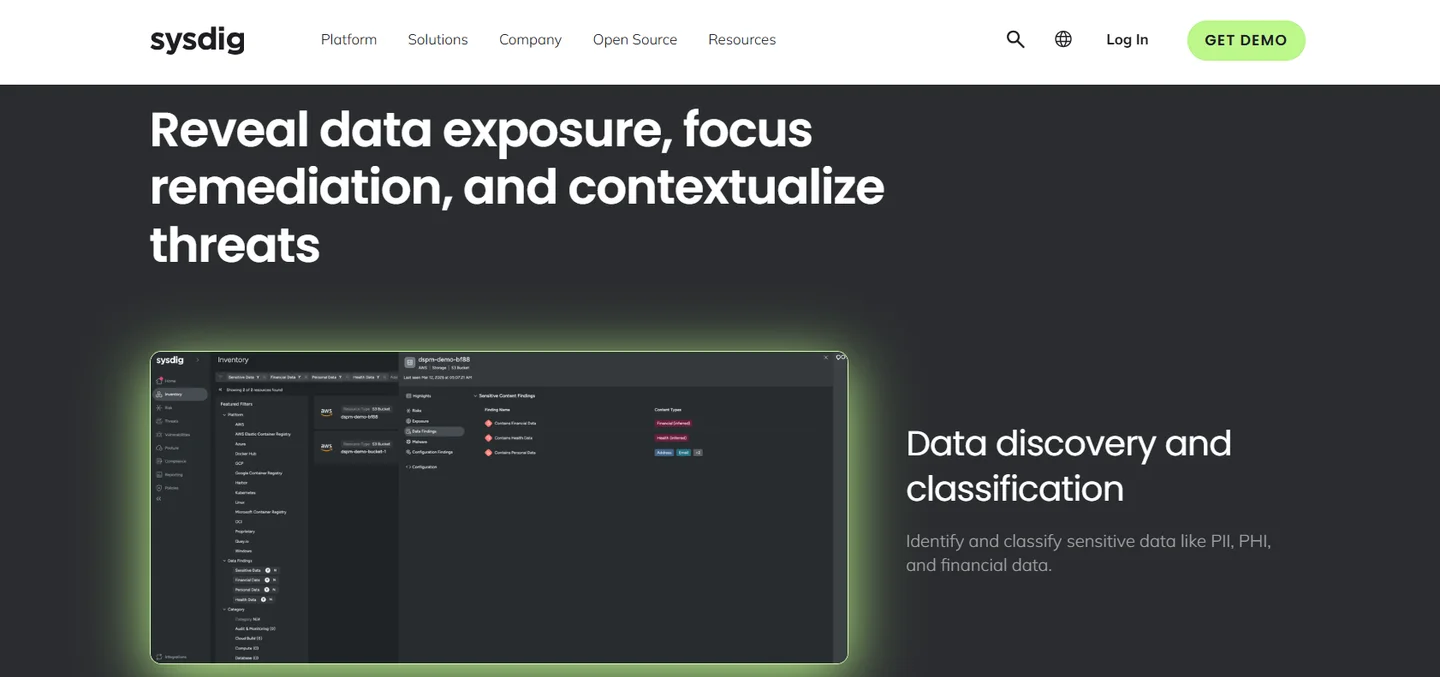
- Runtime detection method: Syscall-level container detection with strong Kubernetes and host visibility, per verified user reports.
- Response autonomy: Runtime policies detect and respond, though the platform console is central to the workflow.
- Deployment reach: Cloud and Kubernetes first, with on-prem supported, heavier and more platform-oriented than an agent-only tool.
- AI-workload and LLM-agent coverage: Not the product's focus, no LLM proxy or agent-runtime enforcement layer.
- Footprint and blast radius: Node agent with documented default configurations users say need reading before deployment.
- Verified G2 users report granular host, container, and Kubernetes visibility, consistent vulnerability scanning policies locally and in-pipeline, and a solid roadmap with regular feature updates.
- One reviewer reports replacing an incumbent scanner that produced too many false positives with insufficient attributes for tuning.
- Another reports multi-cluster operational alerting with teams able to see their own scoped applications in one solution.
Falco (CNCF OSS)
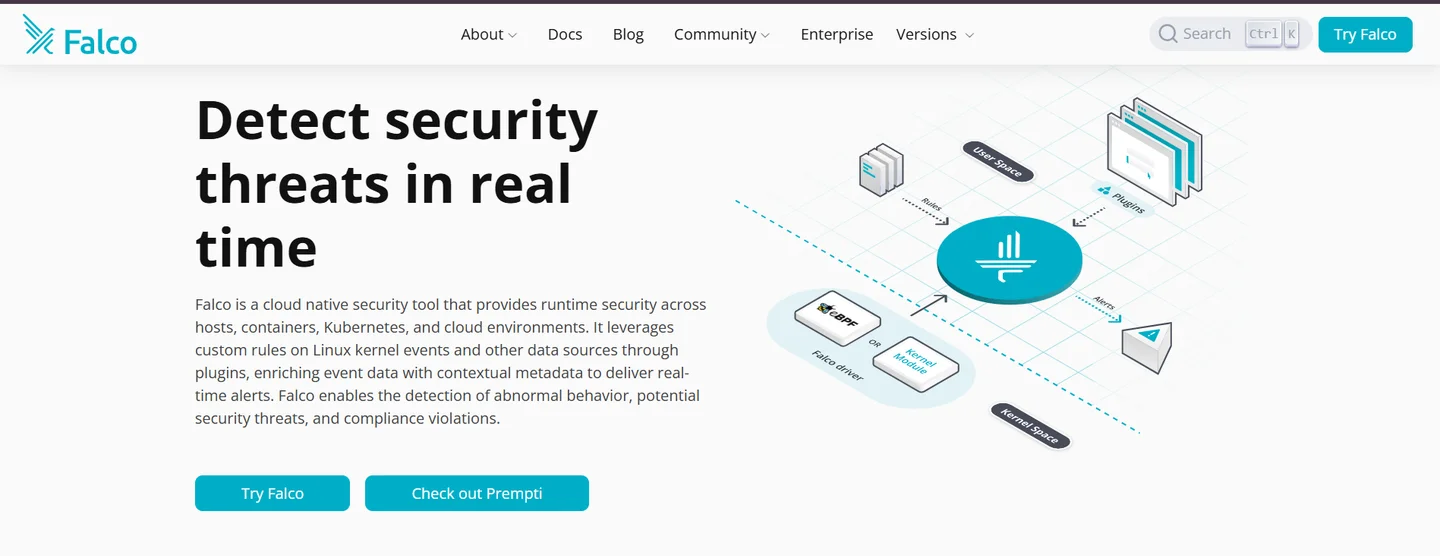
- Runtime detection method: Syscall-level rules that fire on real kernel events, the lineage most commercial runtime tools build on.
- Response autonomy: Detection only. Blocking and containment require Falcosidekick plus your own automation.
- Deployment reach: Runs anywhere the driver loads, including self-hosted and air-gapped clusters you build yourself.
- AI-workload and LLM-agent coverage: None as shipped. No prompt-injection or agent-behavior layer exists in the project.
- Footprint and blast radius: Verified users report noticeable resource use per node, which matters on constrained clusters.
- Verified G2 users report easy DaemonSet deployment across Kubernetes clusters, customizable rules that helped reduce false positives, and detailed alert context with event detail.
- One reviewer notes coverage across network activity, file access, and configuration changes for a cluster-wide view.
- The project's active community contributes plugins and shared rule sets, which reviewers cite as a practical resource.
Aqua Security
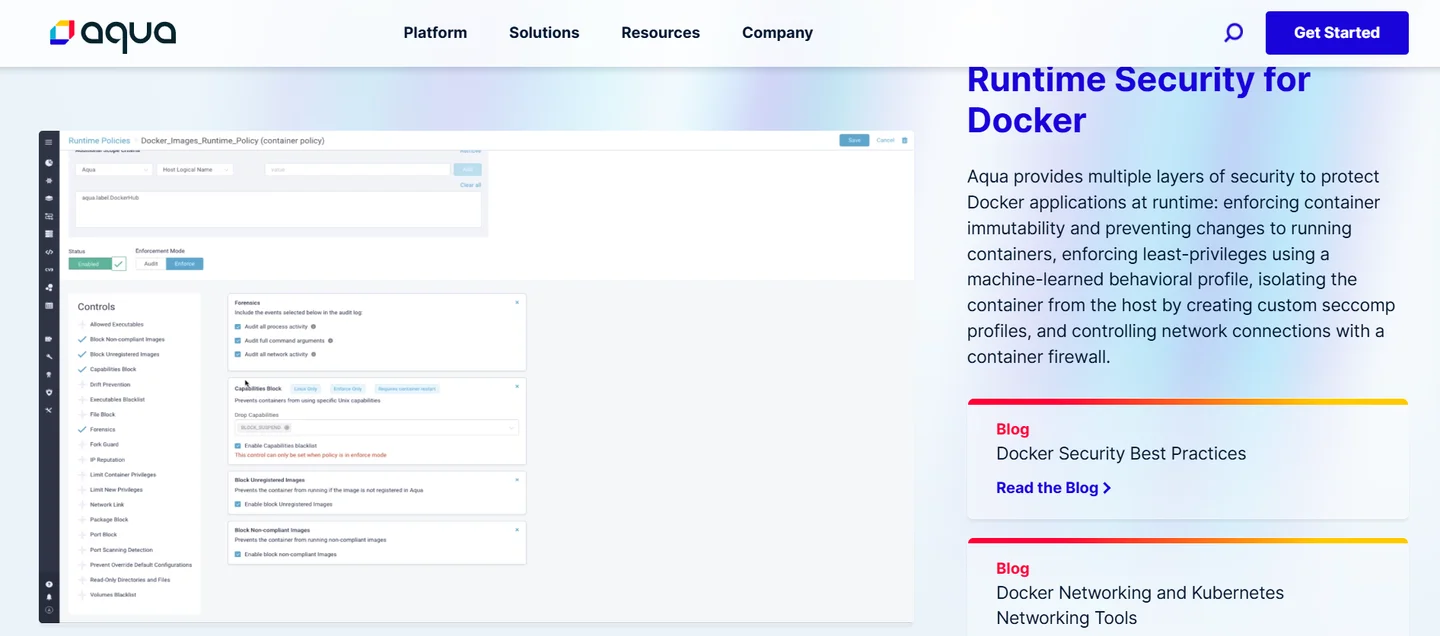
- Runtime detection method: Runtime policy enforcement and drift detection, layered on top of strong build-time scanning.
- Response autonomy: Policy enforcement at runtime, with admission control stopping non-compliant workloads before they start.
- Deployment reach: Cloud and on-prem, with reviewers praising how easily the Helm chart deploys on-prem.
- AI-workload and LLM-agent coverage: Not the product's focus. No LLM proxy or agent-runtime layer.
- Footprint and blast radius: Agent overhead is named as a drawback by one detailed reviewer.
- A Sr Cybersecurity Engineer reviewer reports full lifecycle protection from build to runtime, tight integration with Jenkins, GitLab, and Docker, runtime policy enforcement with configuration drift detection, and centralized reporting for compliance.
- Another reviewer reports Log4j vulnerability handling as the concrete problem solved, the kind of case that shows up in most container security vulnerability postmortems.
- A third reports easy on-prem deployment via the provided Helm chart, plus image scanning by pulling the scanner from Aqua's registry.
Oligo Security
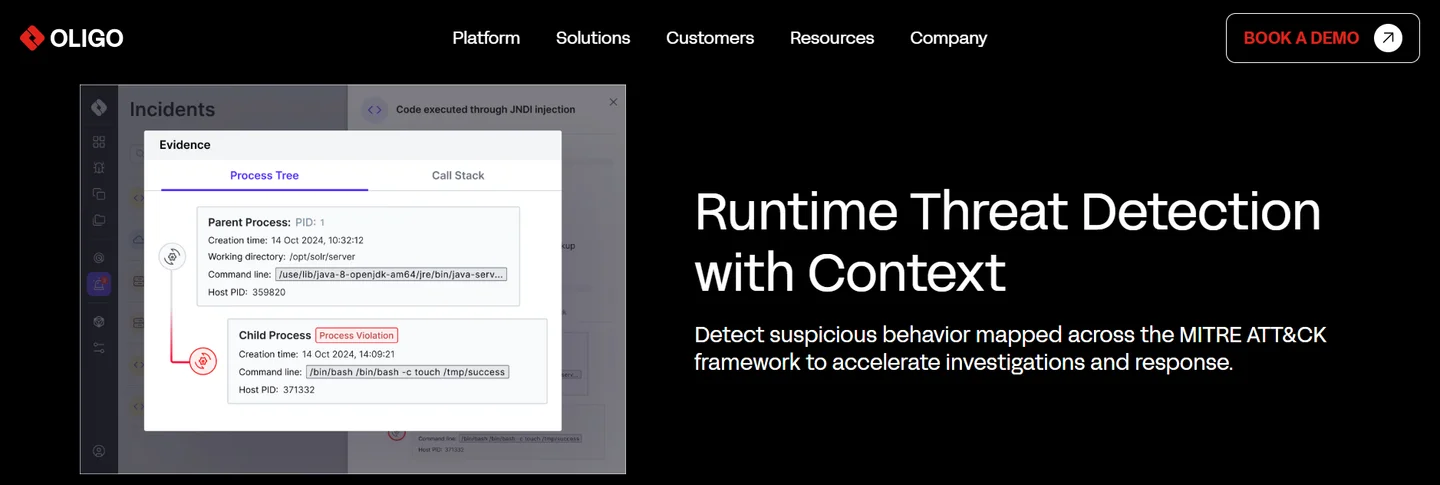
- Runtime detection method: eBPF sensor tracking library and function-level behavior inside running applications.
- Response autonomy: Focused on detection and prioritization rather than in-line network or process enforcement.
- Deployment reach: Cloud and Kubernetes workloads, with the cloud console central to the workflow.
- AI-workload and LLM-agent coverage: Has moved toward AI and agent runtime concerns, which makes it one of the few genuine overlaps with EdgeLabs' lane.
- Footprint and blast radius: eBPF sensor model, lighter than in-process instrumentation.
- The company's published research output is the most checkable proof point here, including widely covered vulnerability disclosures affecting AI and inference frameworks.
- Verify each disclosure against the underlying CVE record and the affected project's own advisory before you treat it as evidence for your environment.
Upwind Security
- Runtime detection method: eBPF-based runtime telemetry used to add execution context to cloud posture findings.
- Response autonomy: Platform-side analysis drives response, so the cloud backend is part of the control loop.
- Deployment reach: Cloud-first by design. Air-gapped and disconnected operation is not the product's premise.
- AI-workload and LLM-agent coverage: Expanding, but posture and cloud risk remain the center of the product.
- Footprint and blast radius: Lightweight sensor is a core claim, worth validating on your own nodes.
- Product documentation and published architecture material are the primary sources available here.
- The company's own claims about sensor footprint and deployment speed are worth testing directly in a pilot before you accept them.
CrowdStrike
- Runtime detection method: Behavior-based detection rather than signature matching, strong on endpoints, extended to cloud workloads.
- Response autonomy: Response is cloud-console driven. One verified reviewer names SaaS dependency as a real availability risk.
- Deployment reach: Broad across endpoints and cloud, but cloud-dependent for full capability.
- AI-workload and LLM-agent coverage: Not the product's category. Runtime here means workload protection, not agent supervision.
- Footprint and blast radius: Reviewers consistently describe the agent as lightweight and fast, though sensor behavior inside containers is worth checking against your own stack.
- Verified G2 reviewers report a lightweight, fast agent that runs quietly while still providing real-time detection, plus a clean dashboard and quick cloud-delivered threat intelligence.
- One reviewer reports strong behavioral detection of suspicious activity rather than known viruses only.
- Another reports a single CNAPP platform covering application, data, infrastructure, and runtime security, reducing siloed alerts.
SentinelOne Singularity Cloud
- Runtime detection method: Real-time protection of cloud servers, containers, and data, with attack-path style analysis.
- Response autonomy: Automated response reduces manual intervention, though the unified console drives the workflow.
- Deployment reach: AWS, Azure, and GCP in one dashboard. Cloud console is central.
- AI-workload and LLM-agent coverage: Not the product's category as sold today.
- Footprint and blast radius: Verified reviewers describe the platform as heavy for smaller environments.
- Verified G2 reviewers report strong AI-driven detection with automated response that speeds up incident handling and reduces alert fatigue.
- One reports real-time protection for cloud servers, containers, and data, plus multi-cloud coverage in a single dashboard.
- Another reports a streamlined implementation with strong visibility across cloud workloads without adding operational complexity.
Contrast Security
- Runtime detection method: Instrumentation inside the application process, seeing execution context a network tool cannot.
- Response autonomy: Blocks at the code path level, inside the application, without a network device in the loop.
- Deployment reach: Application runtimes across container and cloud deployments, with self-hosted options.
- AI-workload and LLM-agent coverage: Application-layer focused rather than agent-runtime or GPU-node focused.
- Footprint and blast radius: In-process agents carry the highest theoretical blast radius, since the agent shares the app process.
- The Forrester New Wave: Runtime Application Self-Protection, Q1 2018 named eight providers, and Contrast is one of the few that neither disappeared nor was absorbed.
- Product documentation on language support and instrumentation method is the primary source to check against the runtimes you actually ship.
Edge Labs AI sits at position 1 in this roster for a specific, checkable reason: detection and response both execute on the agent at kernel level, and Disconnected Mode keeps enforcement running with the backend unreachable, per its published requirements and case studies. Every other tool here is judged on the same five criteria, and every card names what it does not cover. If you want to walk your own environment through those five criteria, start a conversation with the team.
Q2. What Are Runtime Application Self-Protection Tools, And Did ADR Replace RASP?
RASP runs inside the application process and blocks attacks using execution context a perimeter firewall never sees. Classic RASP stalled on scaling pain and a thin advantage over WAFs. The capability returned as ADR, instrumented with eBPF and OpenTelemetry instead of SDK wrappers. Same job, new plumbing, wider blast-radius scope.
The Difference Between Watching The Door And Watching The Room
A WAF (web application firewall) sits at the gate. It reads requests coming in and guesses which ones look hostile.
RASP sits inside the application itself. It sees the actual function call, the actual database query, and the actual file write. That is the whole idea: context the gate cannot have.
📚 Where Scanning Tools Fit
SAST (static analysis) reads your source code before it ships. DAST (dynamic analysis) pokes a running test instance from outside. IAST (interactive testing) instruments the app during tests to find real flaws.
All three are pre-production. None of them are on duty at 3am. That is the gap runtime tools were built to fill.
📊 Three Approaches, Compared
| Approach | Where it runs | What it can stop |
| WAF | At the network perimeter | Malicious-looking requests, before they reach the app |
| RASP | Inside the application process | Attacks at the code path, using real execution context |
| ADR / runtime CWPP | On the host or node, via eBPF or OpenTelemetry | Container, process, or function execution, plus network activity |
The Obituary Nobody Published
Forrester's Q1 2018 New Wave named eight significant RASP providers: Avocado Systems, CA Veracode, Contrast Security, Micro Focus, Prevoty, Signal Sciences, tCell, and Waratek.
Track what happened next. Imperva acquired Prevoty. Rapid7 acquired tCell. Signal Sciences went to Fastly. Contrast is one of the few still standing alone.
⚠️ Why It Stalled
One practitioner puts the reason plainly, and it is not a technical reason.
"The market has largely moved away from Runtime Application Self-Protection (RASP), primarily due to the challenges of scaling its implementation and the perception that its advantages over Web Application Firewalls (WAFs) are minimal."
u/confusedcrib, r/devsecops Reddit Thread
Development teams would not trade reliability and control for a security gain they could not feel. That is a fair trade to refuse.
The Resurrection, And Why The Acronym Stopped Mattering
The same practitioner describes what came back: ADR tools using lightweight eBPF or OpenTelemetry agents rather than SDKs and wrappers. eBPF is a Linux kernel feature that lets you safely observe syscalls without patching the kernel.
That changes the scope. You are no longer only protecting a Java process. You are watching the node.
🧠 The Argument That Actually Matters Now
Here is where I will be blunt about what changed. You can patch a bug and be nearly certain it is gone. You cannot patch a model's judgment.
Edge Labs AI's kernel-level agent runs detection and response together, with local playbooks for quarantine, process kill, workload isolation, and IP blocking, per its published datasheet. My read is that this matters more every quarter, because the thing you are supervising increasingly makes its own decisions.
✅ What To Do With This
- Stop shortlisting by acronym. Shortlist by instrumentation method.
- If a vendor's 2018-era RASP page is still their newest material, ask who owns the product now.
- Ask what the tool sees: requests only, code paths, or kernel syscalls.
Edge Labs AI sits on the runtime side of that split by design. Detection and response both execute on the agent at kernel level, so enforcement never waits on a cloud round-trip. That is an architecture choice, not a feature, and it is the choice that decides whether a tool works in a disconnected environment.
Q3. Which Instrumentation Method And Deployment Reach Should Decide Your Shortlist?
Ask how a tool instruments before you ask what it detects: SDK, bytecode agent, sidecar, Kubernetes DaemonSet, OpenTelemetry, or eBPF. Then check language coverage against the runtimes you actually ship. Then run one test. With egress blocked, does it still detect and still respond? Edge Labs AI's agent shifts into Disconnected Mode automatically and keeps both running locally.
Six Ways In, Six Different Risk Profiles
The word "agent" hides more than it explains. One practitioner makes exactly this point.
"The term 'agent' can often lead to misunderstandings, as there are significant differences in risk levels among various implementations, such as OpenTelemetry (otel), eBPF, language-specific agents, sidecars, daemonsets."
u/confusedcrib, r/devsecops Reddit Thread
🔧 What Each Method Buys And Costs
| Method | What it buys | What it costs |
| SDK / library | Precise app-layer control | Code changes, per-service rollout, dev buy-in |
| Bytecode agent | Deep code-path visibility, no code edits | Lives inside your app process |
| Sidecar | Per-workload isolation | One extra container per pod, resource multiplier |
| DaemonSet | One agent per node, no pod changes | Needs node-level privilege |
| OpenTelemetry | Reuses observability plumbing you may already run | Depth depends on instrumentation quality |
| eBPF | Kernel syscall truth, low overhead | Kernel version dependency |
Language Coverage Kills More Shortlists Than Features Do
In-process instrumentation has to be built per runtime. Java and .NET are usually mature. Node, Python, and Go vary a lot by vendor.
Build your own grid for only the runtimes you ship. Then discard any vendor covering languages you do not run, no matter how good the demo was.
☸️ The Kubernetes Questions Worth Asking
- DaemonSet or sidecar? Sidecars multiply per pod, so cost scales with workloads, not nodes.
- Does it read Kubernetes audit events? That is how you catch kubectl exec into a pod or a sensitive hostPath mount, a core part of Kubernetes runtime detection.
- Does it handle multi-cluster scoping so teams see only their own namespaces?
- Does it protect GPU inference nodes without consuming GPU cycles you are paying for?
Edge Labs AI deploys as a single privileged container sharing host PID and network namespaces, one DaemonSet per node with no sidecars, across Docker, Kubernetes, OpenShift, Talos, and K3S on x86_64 and ARM_64. I want the resource cost tied to node count, not pod count.
The Test That Settles It In One Afternoon
Deployment reach is where marketing and reality separate. Cloud, data center, and on-prem estates each behave differently, and metered-bandwidth sites behave differently again.
Run this in a lab: block egress on the node, then trigger a detection. Watch whether the alert fires and whether anything actually gets blocked.
⚠️ Telemetry Is Not Protection
If detection continues but response stops, you bought a sensor. That is fine, as long as you know it.
A verified user names this risk on a cloud-dependent platform directly.
"The heavy dependency on SaaS availability creates vendor lock-in and introduces a real risk to overall availability."
Verified User in Information Technology and Services CrowdStrike Falcon Cloud Security G2 Verified Review
Deployment ease is worth checking too, and open source sets a decent bar here.
"Falco integrates seamlessly with Kubernetes and container environments. Makes it easy to deploy as a DaemonSet across the cluster."
Bikash s. Falco G2 Verified Review
Edge Labs AI auto-transitions to Disconnected Mode when the cloud is unavailable, keeping IPS enforcement, process termination, workload isolation, and response playbooks running locally on preloaded models and signatures, with offline UTC timestamping preserving forensic order. A published US oil and gas deployment sustained protection this way in production during real connectivity loss.
Q4. What Does A Runtime Agent Cost You In Overhead, Production Risk, And Money?
Every in-process or kernel-adjacent agent is itself a production surface. Operators report application crashes from conflicts with open-source libraries and noticeable performance overhead. A June 2024 eBPF-runtime flaw caused a kernel-level outage on a specific Red Hat kernel. Demand a kernel support matrix, documented fail behavior, canary rollout, per-container isolation, and agent self-telemetry.
The Fear Is Legitimate, And It Has A Date On It
Change advisory boards are not being difficult when they push back on a new agent. They remember July 2024.
One practitioner points at the less famous precedent, which matters more here.
"Before the significant CrowdStrike outage linked to the Windows kernel, there was an issue in June 2024 involving a vulnerability in the eBPF runtime. This flaw resulted in a comparable outage, triggered by CrowdStrike on a specific Red Hat kernel."
u/scourge44, r/devsecops Reddit Thread
❌ What Operators Actually Report
"Utilizing an agent-based approach within production containers carries inherent risks. The reliability tends to be questionable, often leading to application crashes when there are conflicts with open-source libraries."
u/Fun_Imagination_7478, r/devsecops Reddit Thread
Overhead is real too, and not only in commercial tools. A verified Falco user reports that a per-node DaemonSet "can consume a noticeable amount of system resources," a concern on large or constrained clusters.
Edge Labs AI publishes its own minimum host requirements: 512 MB RAM, 1 CPU at 1.0 GHz, and Linux kernel 4.14 or newer, with EDR and IPS explicitly not guaranteed below 4.14. Stating the kernel dependency up front is not marketing, it is the thing you need before a rollout meeting.
⏰ The Five-Item Rollout Gate
- Get the kernel support matrix in writing, per distribution and version.
- Get the fail behavior in writing. Does it fail open or fail closed?
- Canary on one node, then one namespace, before fleet-wide enable.
- Confirm you can isolate or kill one container rather than the whole node.
- Ask whether the agent reports its own CPU and memory use. If it cannot measure itself, you cannot manage it.
🧯 Containerization Is The Underrated Safety Feature
The same practitioner thread lands on a genuinely useful mitigation: containerization makes agents safer, because you can terminate or isolate one container instead of shutting down the whole system. Vendors are also shipping "don't kill my prod" style safeguards.
Edge Labs AI ships as one DaemonSet per node with no sidecars, so the failure unit is a single agent container rather than a cluster. That is the design reason I keep defending it in workload security architecture reviews.
💰 What You Already Own For Free
Before any purchase, harden the floor. These cost nothing.
- Custom seccomp and AppArmor profiles, which restrict what syscalls a container may make at all.
- A read-only root filesystem, so an attacker cannot write a payload where they landed.
- Dropped Linux capabilities, removing privileges the workload never needed.
- Deploy by digest, not by tag. A tag like latest is mutable, a sha256 digest is not.
One practitioner argues this floor beats agents outright.
"Customized AppArmor and Seccomp profiles offer numerous benefits compared to solutions that rely on agents."
u/Extension-Let-242, r/devsecops Reddit Thread
⚠️ Where The Free Floor Stops
A seccomp profile blocks a syscall. It does not correlate five events into an attack chain, name the process, or hand an auditor a timeline.
It also cannot block a source IP for a set duration. Edge Labs AI's in-line prevention applies host-local, time-boxed source-IP blocks ranging from one minute to 90 days, and those fire with no cloud backend reachable, which is the core of its network protection layer.
💸 How To Read Pricing In A Custom-Quote Category
Two genuinely free options exist. Falco is Apache-licensed and CNCF-governed. Talsec's freerasp is described by one practitioner as lightweight and straightforward to integrate, with a paid tier for advanced features.
Everything else here is custom-quoted, which is exactly why this guide carries no pricing column. Reviewers describe both CrowdStrike and SentinelOne Singularity Cloud as expensive, with the latter called "heavy" for smaller environments. Edge Labs AI publishes its own tiers on its pricing page, including a free self-serve entry point for SMB teams.
"The platform can feel heavy and expensive for smaller teams. The dashboard and UI could be more user friendly in some areas."
Verified User in Computer Software SentinelOne Singularity Cloud Security G2 Verified Review
Edge Labs AI's published Trader Joe's case study reports 8x reduced CAPEX and OPEX, an 83% MTTR reduction, $1.3M in operational savings, 573% ROI, a sub-two-week deployment, and zero outages during rollout. Those are our own published figures, not independently audited, so treat them as a hypothesis to test in your pilot rather than a promise.
Q5. What Do These Tools Miss When The Workload Is An LLM Agent?
Classic RASP instruments a request path. An LLM agent has no fixed request path, because it reasons, calls tools, spawns processes, and reaches the network. Edge Labs AI covers this layer with its Parallax engine and LLM Application Guard proxy, running prompt-injection detection and input/output alignment above kernel-level syscall monitoring. Runtime protection for agents means making destructive actions impossible, not discouraged.
Why The Request-Path Assumption Breaks
Old RASP had a comfortable job. A request came in, a code path ran, and the agent watched that path.
An LLM agent breaks that shape completely. It decides what to do next, and the thing it decides may be a shell command, a database call, or an API request you never mapped.
🧩 What Changes With MCP Servers
MCP (Model Context Protocol) servers hand an agent a menu of tools it can invoke. Each tool is a real capability, with real permissions attached.
Now the interesting question is not "was this request malicious." It is "should this agent be allowed to perform this action at all," which is the core of MCP security.
The Lethal Trifecta
The risk pattern is simple enough to check on a whiteboard. An agent becomes genuinely dangerous when it holds all three of these at once.
- Access to untrusted content, like a web page, an email, or a customer ticket.
- Access to private data, like a database, a repo, or a secrets store.
- The ability to communicate externally, which is how anything leaves.
✅ The Two-Of-Three Rule
Remove any one leg and exfiltration gets much harder. That is a permissions decision, not a detection decision.
Edge Labs AI's read is that most teams try to solve this with better instructions to the model, and that gets it backwards. I would rather remove the third leg in the deployment spec than write a longer system prompt.
⚠️ Guardrails Are Mostly Theater
Prompt injection is still LLM01, the number one risk in the OWASP Top 10 for LLM Applications 2025. The 2025 edition also added Excessive Agency as a new category, which is precisely this problem named formally.
Here is the honest caveat. A lot of the published injection-bypass research is marketing-grade, with unclear methodology and cherry-picked prompts, so I would not quote specific success percentages at your architecture review.
❌ Where Instruction-Level Controls Fail
A rule in a config file is a request. A permission system that physically cannot perform the action is a control.
The difference shows up in one bad afternoon. An agent asked to clean up a credential problem deletes a volume, the backups live on the same volume, and one API call ends it. No prompt would have stopped that. A missing delete permission would have.
What To Instrument Instead
Watch the things the agent cannot talk its way out of.
- Syscalls, meaning the actual kernel-level requests a process makes, including process spawns and file writes.
- Network egress from the agent's own process, not just the app's front door.
- MCP server behavior, including which tools get called and how often.
- GPU inference nodes, where cryptojacking hides inside expensive compute you already pay for, a pattern seen in a published GPU cloud deployment.
- Deterministic hooks the agent cannot disable, because it does not have permission to.
⭐ The Insider Framing That Helps
Treat the agent as a new kind of insider. Capable, fast, well-intentioned, and occasionally catastrophically wrong.
You would not give a new hire production delete rights on day one and call the onboarding doc a control. Edge Labs AI applies the same logic in code: kernel-level detection sits underneath the agent's process and network behavior, so enforcement does not depend on the agent's cooperation.
Edge Labs AI covers this layer through Parallax and the LLM Application Guard proxy, doing prompt-injection detection, input and output alignment, and hallucination checks in front of the model. Underneath, the same agent watches syscalls and egress. Two layers, one deployment, and neither asks the model to behave.
Q6. How Does Runtime Evidence Change Vulnerability Prioritisation And CRA/NIS2 Reporting?
CVSS severity alone produces a backlog nobody finishes. Exploited-vulnerability and explainability scoring combines CVSS with EPSS probability, CISA KEV confirmed exploitation, and CWE class, weighted by whether the component actually runs and is exposed. Edge Labs AI's Compliance Center surfaces all four inputs per CVE with control-to-requirement-ID drill-down, so rankings are auditable rather than assumed.
Why Severity-Only Sorting Fails
Sort 4,000 findings by CVSS and you get a list of what is frightening in theory. You do not get a list of what attackers are using this week.
Four inputs, one line each:
- CVSS: how bad the flaw is if exploited, scored 0 to 10.
- EPSS: the probability, from FIRST.org, that a CVE gets exploited in the next 30 days.
- CISA KEV: a government catalog of vulnerabilities confirmed as actively exploited.
- CWE: the weakness class, which tells you the shape of the bug and often the fix pattern.
💰 The Monday Morning Re-Sort
Do this before you buy anything. Filter your queue to items that are KEV-listed or high-EPSS, then keep only the ones whose code actually loads in a running workload.
Then keep only those reachable through an open port. The list usually collapses by an order of magnitude, and that is the list you can actually staff with runtime vulnerability management.
What Runtime Evidence Genuinely Supports
The CRA (Regulation (EU) 2024/2847) sets 22 essential requirements in Annex I, covering secure-by-design, vulnerability handling, SBOM, coordinated disclosure, and secure updates. Annex I Part I requires products to ship with no known exploitable vulnerabilities, a secure-by-default configuration, and a minimized attack surface.
Reporting obligations begin September 2026, with full applicability December 2027, and penalties reach EUR 15M or 2.5% of turnover. Our practical CRA roadmap walks through the sequencing.
⏰ The NIS2 Clock
NIS2 (Directive (EU) 2022/2555) Article 23 requires an early warning within 24 hours of becoming aware of a significant incident, and an incident notification within 72 hours. Article 21 covers the risk-management measures themselves, including incident handling.
That timeline is the real argument for runtime evidence. A 24-hour clock is not survivable if you are reconstructing what happened from posture scans and guesswork, which is why NIS2 and CRA change the game.
✅ Covered By Runtime Evidence
| Obligation area | What runtime evidence gives you |
| Unauthorized access | Observed process, user, and syscall detail at the moment of access |
| Data integrity | File writes and modifications attributed to a specific process |
| No known exploitable vulnerabilities (CRA Annex I) | CVE list weighted by KEV status, EPSS percentile, and actual execution |
| Logging and incident handling | Attack timeline, response actions taken, UTC-ordered events |
Edge Labs AI ships a named CRA/NIS2 Compliance Center with per-control host pass and fail counts, plus an exploitation-aware check for the Annex I "no known exploitable vulnerabilities" requirement.
❌ Not Covered, And I Will Say So Plainly
Runtime tooling does not touch these, and any vendor implying otherwise has not read Annex I.
- Business continuity and disaster-recovery planning.
- Backup policy and tested restores.
- HR security training and awareness programs.
- Cryptography and key-management policy.
- MFA as an organizational program.
- Technical documentation and the CRA's multi-year support obligations.
I use "exploited-vulnerability and explainability scoring" rather than "reachability," because another vendor owns that phrase and borrowing it would be sloppy.
📋 What Auditors Actually Ask For
Four artifacts, every time: the attack timeline, what changed on the host, which process did it, and what response action fired.
One verified reviewer describes exactly why compliance drives these purchases.
"it helping us to stay complaint."
Lokesh K. CrowdStrike Falcon Exposure Management G2 Verified Review
Another names the noise problem that scoring is supposed to fix.
"It is difficult to monitor the state of detected vulnerabilities or detected events."
Verified User in Financial Services Sysdig Secure G2 Verified Review
Edge Labs AI's Compliance Center maps controls to requirement IDs and shows CVSS, CWE, EPSS percentile, and KEV status per CVE. That covers runtime, vulnerability-handling, and detection-and-response controls only. The program controls above stay yours, and we say so in the product.
Q7. Are You Ready To Run Runtime Protection, And How Do You Pilot It In 30 Days?
Gate the purchase first: a complete production inventory, a named owner for runtime alerts, and a tested rollback path. Then pilot in four weeks. Edge Labs AI publishes a reproducible attack battery of 25-plus tests spanning host, multi-stage APT, container, and Kubernetes privilege-escalation scenarios, each mapped to an expected alert, so week two needs no custom testbed.
The Readiness Gate Nobody Sells You
Be honest about maturity before you spend. Most organizations struggle to run static scanning effectively, fewer are ready for dynamic testing, and very few are equipped for runtime protection.
If your existing scanner backlog has no owner, a runtime tool will add alerts nobody actions. You will have bought a louder version of the same problem.
⚠️ Three Things To Have Before Week One
- A production inventory. You cannot protect what you have not listed.
- A named human who owns runtime alerts, with hours in their week for it.
- A tested rollback: can you remove the agent from a node in five minutes?
Verified users of established platforms repeatedly warn that tuning is ongoing work, not a setup task.
"Alert tuning and reducing false positives may require ongoing effort, and some areas of the dashboard are not as intuitive as they could be."
Shruti J. SentinelOne Singularity Cloud Security G2 Verified Review
⏰ The Four-Week Pilot Plan
- Week one, one node, detection only. No blocking. Pass condition: measured CPU and memory overhead is acceptable, and zero workload disruption.
- Week two, one namespace plus the attack battery. Run the vendor's simulation tests and the Falco event generator. Pass condition: every expected alert fires, with a named process and a timeline.
- Week three, in-line blocking on non-critical traffic. Pass condition: real blocks land, and no legitimate traffic breaks.
- Week four, the egress-blocked test and an evidence export. Pass condition: detection and response both continue offline, and you can hand an auditor a timeline.
Edge Labs AI's published attack battery covers host, container, Kubernetes privilege-escalation, malware, and multi-stage APT scenarios, each mapped to the alert it should produce. That is how we let a pilot be graded rather than admired, and you can see the full detection and response flow before you start.
✅ Make Verification Continuous, Not A One-Off
Treat the pilot as the start of a cadence. Teams running dozens or hundreds of automated checks daily catch drift that a one-time PoC never would.
NIST SP 800-61 frames incident response as a lifecycle with a lessons-learned loop, and the same logic applies to your detection coverage. Re-run the battery after every agent upgrade and every kernel bump.
One verified user's experience of open-source runtime detection is a useful expectations-setter here.
"Configuration Complexity: Although Falco provides customizable rules, setting up and fine-tuning these rules can be complex. New users might find the initial configuration overwhelming."
Bikash s. Falco G2 Verified Review
Edge Labs AI's honest position is that some teams should not buy runtime protection yet, and saying so costs us deals we would rather not close badly. Naming who is not ready is the only trust move that works in a young category.
What I Am Still Sitting With
Where my head is right now: I think within two years, "does your runtime tool watch the agent" becomes a standard procurement question rather than a specialist one. Distributed AI computing forces distributed security, because you cannot centralize a control plane for workloads that run where the data lives.
I could be early on the timing. So I would rather ask than assert: what are you actually deploying next quarter, and does your current stack even see the agent's process, let alone stop it? If you want a second pair of eyes on that, talk to our team.
FAQs
Both are true, which is why the category confuses buyers. Classic RASP stalled because scaling in-process instrumentation across services was painful and the perceived gain over a WAF felt thin to development teams. The capability itself never stopped mattering.
What changed is the plumbing. Modern tools do the same job with lightweight eBPF or OpenTelemetry instrumentation instead of SDKs and bytecode wrappers, and they market themselves as ADR (Application Detection and Response) or runtime CWPP rather than RASP.
- Forrester's Q1 2018 New Wave named eight RASP providers. Most were acquired or absorbed, and Contrast Security is one of the few still standing alone.
- The scope widened from a single application process to the host, the container, and the node.
- Response moved from code-path blocking toward process kill, workload isolation, and source-IP blocking.
Our practical advice is to stop shortlisting by acronym and shortlist by instrumentation method instead. Edge Labs AI sits on the runtime side of that split deliberately, running detection and response together on a kernel-level agent so enforcement never waits on a cloud round-trip. If a vendor's newest material is still a 2018-era RASP page, ask who owns the product now. Our breakdown of container runtime security tools maps how these lineages actually differ in production.
The simplest framing is location. A WAF watches the door, RASP watches the room, and scanning tools inspect the building before anyone moves in.
- WAF: sits at the network perimeter, reads inbound requests, and guesses which look hostile. It has no view of what the code then does.
- RASP: runs inside the application process and sees the actual function call, database query, and file write. That execution context is the entire point.
- ADR and runtime CWPP: run on the host or node via eBPF or OpenTelemetry, covering container, process, and function execution plus network activity.
- SAST: reads source code before it ships.
- DAST: pokes a running test instance from outside.
- IAST: instruments the app during tests to surface real flaws.
The critical distinction is timing. SAST, DAST, and IAST are all pre-production. None of them are on duty at 3am when an attacker actually executes something. That is precisely the gap runtime tooling exists to fill, and a clean pipeline result tells you nothing once a pod is popped.
In practice most teams need both halves: build-time scanning to reduce what ships, and runtime detection to catch what gets through. Our workloads and application security approach covers the runtime half at kernel level rather than at the perimeter.
Ask how a tool instruments before you ask what it detects. The word "agent" hides more than it explains, and the six common methods carry very different risk profiles.
- SDK or library: precise app-layer control, but code changes and per-service rollout.
- Bytecode agent: deep code-path visibility, but it lives inside your app process.
- Sidecar: per-workload isolation, at the cost of one extra container per pod.
- DaemonSet: one agent per node with no pod changes, but node-level privilege required.
- OpenTelemetry: reuses observability plumbing, with depth tied to instrumentation quality.
- eBPF: kernel syscall truth at low overhead, with a kernel version dependency.
Then check language coverage against the runtimes you actually ship. In-process instrumentation has to be built per runtime, so Java and .NET are usually mature while Node, Python, and Go vary widely by vendor. Language coverage kills more shortlists than missing features do.
Finally, run the test that settles it in one afternoon. Block egress on the node, trigger a detection, and watch whether the alert fires and whether anything is actually blocked. If detection continues but response stops, you bought a sensor. Edge Labs AI's agent auto-transitions into Disconnected Mode and keeps enforcement running locally, which you can verify yourself using our detection and response walkthrough.
Every in-process or kernel-adjacent agent is itself a production surface, and change advisory boards are not being difficult when they push back. Operators report application crashes from conflicts with open-source libraries and noticeable per-node resource use, and a June 2024 eBPF-runtime flaw caused a kernel-level outage on a specific Red Hat kernel.
Demand five things in writing before any fleet-wide enable:
- The kernel support matrix, per distribution and version.
- Documented fail behavior. Does it fail open or fail closed?
- A canary path: one node, then one namespace, then the fleet.
- Per-container isolation, so the failure unit is one container rather than the whole node.
- Agent self-telemetry. If it cannot measure its own CPU and memory, you cannot manage it.
Edge Labs AI publishes its own minimum host requirements of 512 MB RAM, 1 CPU at 1.0 GHz, and Linux kernel 4.14 or newer, with EDR and IPS explicitly not guaranteed below 4.14, and ships as one DaemonSet per node with no sidecars. Stating a kernel dependency up front is not marketing, it is what you need before a rollout meeting. Before buying anything, harden the free floor too: seccomp and AppArmor profiles, a read-only root filesystem, dropped capabilities, and deployment by digest. See our notes on container security vulnerabilities for that baseline.
Most do not, and this is the honest weak spot across the category. Classic RASP instruments a request path, but an LLM agent has no fixed request path. It reasons, calls tools, spawns processes, and reaches the network, and the action it chooses may be a shell command or an API call you never mapped.
The risk pattern is checkable on a whiteboard. An agent becomes genuinely dangerous when it holds all three legs at once:
- Access to untrusted content, such as a web page, email, or customer ticket.
- Access to private data, such as a database, repo, or secrets store.
- The ability to communicate externally, which is how anything leaves.
Remove one leg and exfiltration gets much harder. That is a permissions decision, not a detection decision. Prompt injection remains LLM01 in the OWASP Top 10 for LLM Applications 2025, which also added Excessive Agency as a category, so instruction-level guardrails are requests rather than controls.
Instrument what the agent cannot talk its way out of: syscalls, egress from the agent's own process, MCP server tool calls, GPU inference nodes, and hooks it lacks permission to disable. Edge Labs AI covers this layer through its Parallax engine and LLM Application Guard proxy above kernel-level monitoring, detailed on our AI and LLM security page.
