TL;DR
- The nine tools group into five domains: runtime detection (Falco, Tetragon), scanning (Trivy, Kubescape, kube-bench), admission policy (OPA/Gatekeeper, Kyverno), network segmentation (Cilium), and observability (Prometheus + Grafana).
- Build-time scanning finds known flaws before deploy, but only runtime security catches what actually executes; roughly 45% of organizations hit a runtime incident in the past year.
- A CVE is not an exploit. Around 88% of CVEs sit below 10% exploitation probability, so prioritize by CISA KEV membership and EPSS before raw CVSS severity.
- Falco detects but does not block; Tetragon adds in-kernel enforcement via LSM hooks. Choose Kyverno over OPA when your team already lives in YAML.
- LLM agents are a new insider risk; guardrails are bypassable (injection success rates near 88%), so pair them with runtime observation of agent behavior.
- A strong OSS stack still leaves three gaps: response wired to detection, air-gapped operation, and one-place agent coverage, which is where a consolidated runtime agent fits.
Q1: Which Open-Source Kubernetes Security Tools Actually Stop an Attacker (Not Just Scan One)?
The nine best open-source Kubernetes security tools are Falco, Tetragon, Trivy, Kubescape, kube-bench, OPA/Gatekeeper, Kyverno, Cilium, and Prometheus + Grafana. Together they cover five domains: runtime threat detection, image and vulnerability scanning, configuration and CIS auditing, policy and admission control, and network segmentation with observability. Choose by domain first, then by CNCF maturity. Start with a runtime layer for Kubernetes, because you cannot stop what you only scanned.
📋 Why This List Reads Differently
You are drowning in alerts. Your CI/CD pipeline shows green, and some quiet part of you knows that green is a lie. A passing scan tells you what was wrong in an image. It says nothing about the shell that spawns inside a running pod at 2 a.m.
I have spent years building agent-based detection and response for AI workloads, containers, and Kubernetes across cloud, data center, and on-prem environments. So I will say the thing the category avoids: scanning is table stakes, not safety. Container security is really about controlling blast radius from the moment code is written to the moment it runs, which is exactly why runtime detection and response matters.
Here is the list, grouped by the job each tool does. No numbered rankings and no star scores, because a scanner and a runtime sensor do not compete. They stack. I will show you which situation each one genuinely fits, then hand you a comparison table you can act on today.
🧭 Our Evaluation Criteria
I judged every tool on the criteria that actually decide a Kubernetes security purchase, not a generic feature grid.
- Runtime vs build-time coverage: Does it watch what executes, or only what was scanned before deploy? Runtime is where attacks become real.
- Kubernetes-native detection: Does it use eBPF (a safe way to run code inside the Linux kernel) or K8s audit rules to see real cluster behavior?
- Detection and response: Does it just alert, or can it block the action? Detection without response is a louder alert cannon.
- Deployment model: DaemonSet (one agent per node), sidecar, or agentless? And does it work self-hosted or air-gapped?
- CNCF maturity: Graduated, Incubating, or Sandbox. A neutral, third-party signal of project stability.
- Prioritization method: Does it rank findings by real exploitability (CISA KEV plus EPSS) or just CVSS severity on paper?
👥 Who This Guide Is For
- Kubernetes and container runtime-security owners moving from build-time scanning to live runtime detection.
- SecOps and DevSecOps leads at SMBs making cloud and AI/GPU workloads production-safe without a 24/7 team.
- AI-workload and LLM-agent runtime-security owners who now run agents inside the same clusters they must defend.
- Platform teams who need detection and response that keeps working self-hosted, on-prem, or air-gapped.
🗂️ The 9 Tools: Best for [Situation]
- EdgeLabs: Best for self-hosted or air-gapped Kubernetes that needs runtime detection and response on the agent, plus LLM/agent protection, with no cloud backend.
- Falco: Best for open-source, syscall-level runtime threat detection as a starting sensor.
- Tetragon: Best for eBPF runtime enforcement that blocks a malicious action, not just logs it.
- Trivy: Best for image, filesystem, and IaC vulnerability scanning, including air-gapped with an offline database.
- Kubescape: Best for posture and compliance mapping against NSA/CISA and CIS frameworks.
- kube-bench: Best for auditing nodes against the CIS Kubernetes Benchmark.
- OPA/Gatekeeper: Best for flexible, Rego-based admission policy on complex rules.
- Kyverno: Best for YAML-native admission policy without learning a new language.
- Cilium: Best for eBPF network policy and cutting off lateral movement between pods.
- Prometheus + Grafana: Best for runtime observability that surfaces anomalies like outbound-traffic spikes.
📊 Master Comparison Table
| Company Name | Best For | Detection & Response Model | Deployment & Environment Coverage |
|---|---|---|---|
| EdgeLabs | Self-hosted or air-gapped Kubernetes needing runtime detection and response without a cloud backend | Agent-only runtime detection and response on the agent (NDR + EDR + IPS/IDS + container/K8s + vuln mgmt + AI/agent), per EdgeLabs' own claims | Cloud, data center, on-prem, air-gapped; DaemonSet across Docker, Kubernetes, OpenShift, Talos, K3s; x86_64 + ARM64; GPU/AI-inference nodes |
| Falco | Open-source, syscall-level runtime threat detection | OSS rules engine; detection-only (alerts, no native blocking) | Cloud, data center, on-prem; Kubernetes/containers via DaemonSet; CNCF Graduated |
| Tetragon | eBPF runtime enforcement that blocks actions | OSS eBPF sensor; detection and in-kernel enforcement via LSM hooks | Cloud, data center, on-prem; Kubernetes/containers; part of the Cilium project |
| Sysdig | Teams wanting a broad runtime + CNAPP platform with Falco heritage | Runtime detection with a largely cloud-oriented backend | Cloud-centric; Kubernetes/containers; SaaS and self-hosted options |
| Aqua Security | Full container lifecycle security, build-to-runtime | Platform: build-time scanning plus runtime protection | Cloud, data center, on-prem; Kubernetes/containers |
| CrowdStrike | Endpoint-first teams extending to containers | XDR/endpoint-first with a cloud-dependent runtime module | Cloud-dependent; endpoints, cloud workloads, containers |
| SentinelOne (Singularity Cloud) | Endpoint-first teams wanting cloud workload coverage | XDR/endpoint-first engine with a runtime module | Cloud-dependent; endpoints, cloud workloads, containers |
| Oligo Security | Application-layer runtime security | Runtime application/library monitoring (young, thinly reviewed category) | Cloud, Kubernetes/containers |
| Upwind Security | Cloud runtime posture with eBPF sensors | eBPF runtime feeding a cloud-based CNAPP | Cloud-centric; Kubernetes/containers |
Falco, Tetragon, Trivy, Kubescape, kube-bench, OPA/Gatekeeper, Kyverno, Cilium, and Prometheus + Grafana are the nine open-source tools reviewed in the cards below. EdgeLabs, Sysdig, Aqua, CrowdStrike, SentinelOne, Oligo, and Upwind appear in the table as the commercial context an operator weighs against an open-source stack. If you want to see how a consolidated agent maps to these layers, our solutions by feature break it down.
🗃️ The Tool Cards
Total providers reviewed in this article: 9 open-source tools, with EdgeLabs shown first as the consolidated-runtime reference point.
EdgeLabs
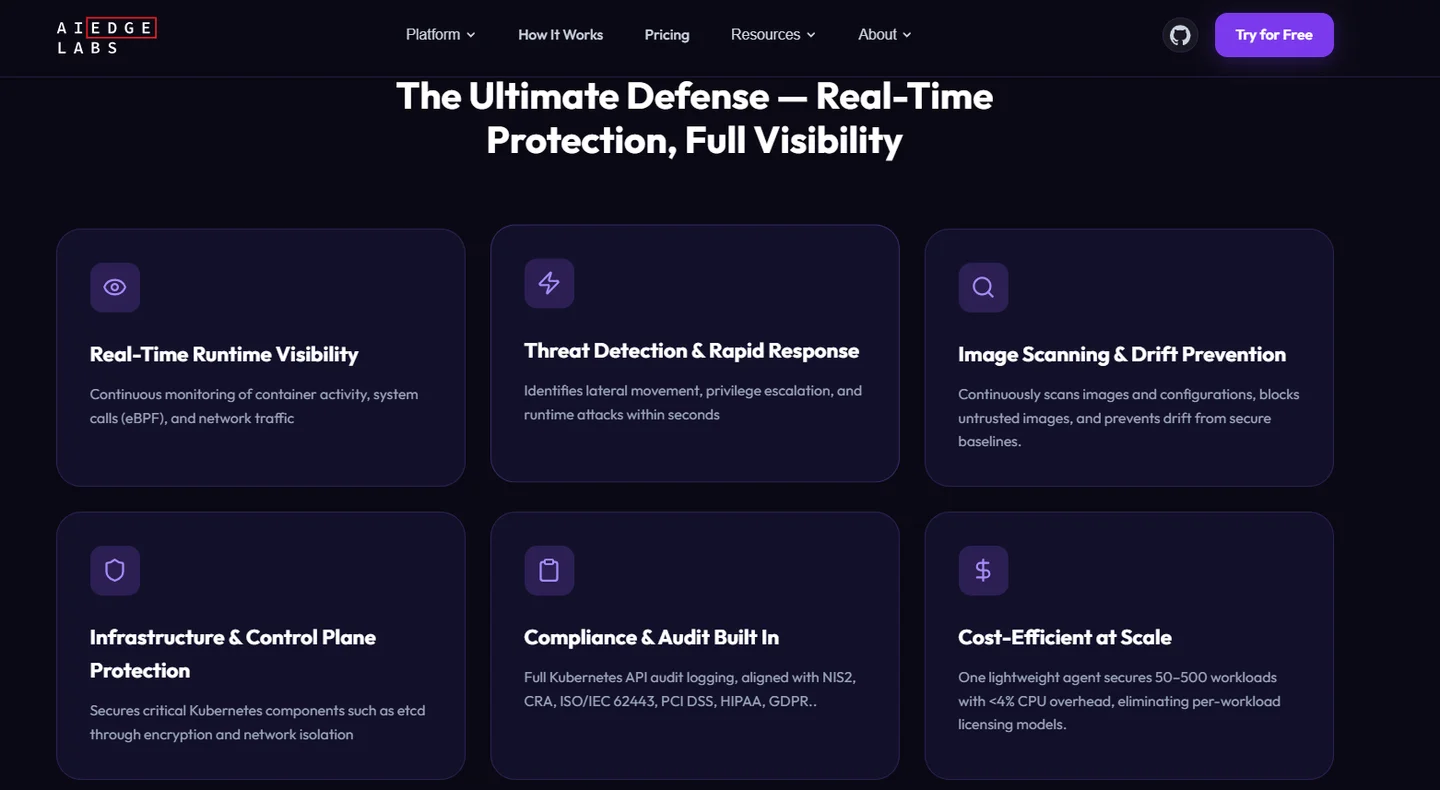
- Runtime vs build-time coverage: Runtime-first; detection and response run where the workload executes, not at scan time.
- Kubernetes-native detection: eBPF kernel-level syscall monitoring, layered above the Falco ecosystem with AI, NDR, and IPS.
- Detection and response: In-line, host-local, time-boxed source-IP blocking (1 minute to 90 days) that fires with no cloud backend.
- Deployment model: DaemonSet across Docker, Kubernetes, OpenShift, Talos, and K3s; x86_64 and ARM64.
- Prioritization method: Exploited-vulnerability and explainability scoring (CVSS + EPSS + CISA KEV + CWE).
- Trader Joe's published case study (EdgeLabs' own claim): 83% MTTR reduction, 573% ROI, $1.3M operational savings, sub-2-week deploy, 0 outages.
- Minimum host: 512 MB RAM, 1 CPU at 1.0 GHz, Linux kernel 4.14+.
- Shipping CRA/NIS2 Compliance Center with control-to-requirement-ID mapping and the CRA Annex I "No Known Exploitable Vulnerabilities" check.
"Good IPS/IDS/EDR software. Webportal management is good. Docker container integration is useful."
Verified User in Computer Software · EdgeLabs G2 verified review
"It's beneficial to secure any website or any server from hackers."
Abhishek A., Verified User · EdgeLabs G2 verified review

Falco
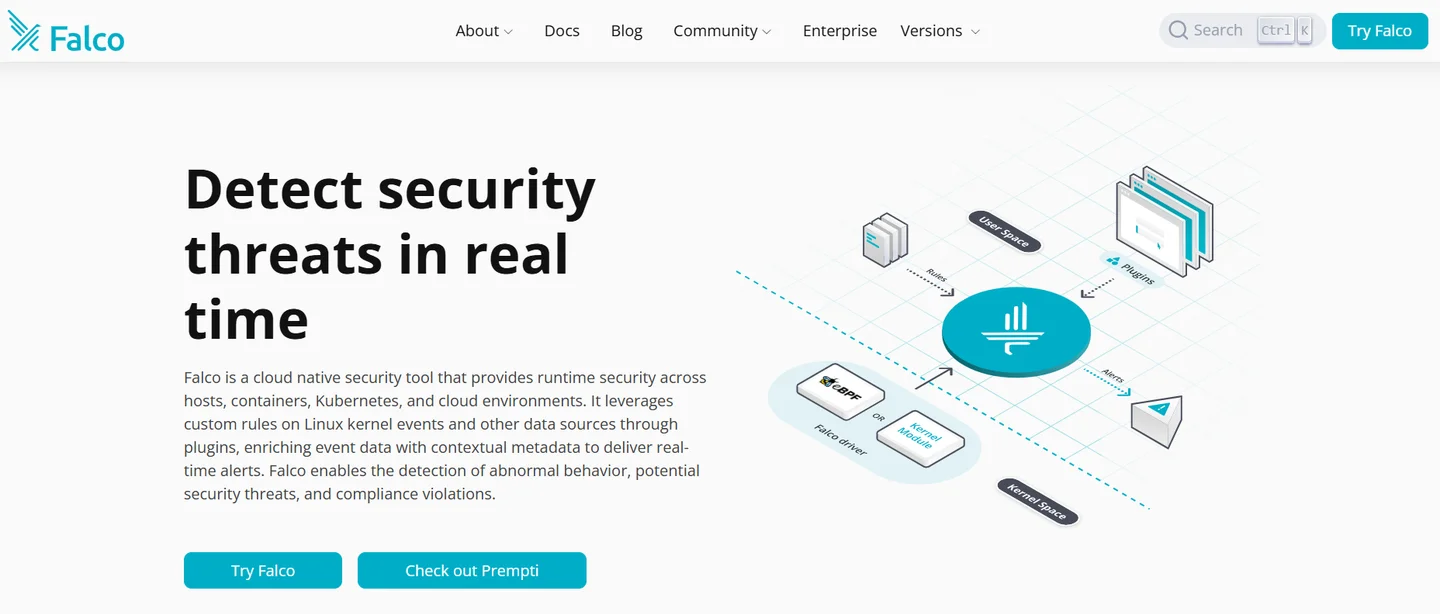
- Runtime vs build-time coverage: Pure runtime; reads live Linux kernel syscalls, so it sees what actually executes.
- Kubernetes-native detection: Enriches syscall events with Kubernetes API metadata (pod, namespace, labels).
- Detection and response: Detection-only by default; it alerts, then hands off to Falcosidekick or another tool to act.
- Deployment model: DaemonSet, self-hosted; no cloud backend required to detect.
- CNCF maturity: Graduated, the highest CNCF tier, so it is stable and widely adopted.
- CNCF Graduated status, with published detections mapped to MITRE ATT&CK techniques.
- Official Falco event-generator lets you replay attack syscall patterns to validate rules before you trust them.
Tetragon
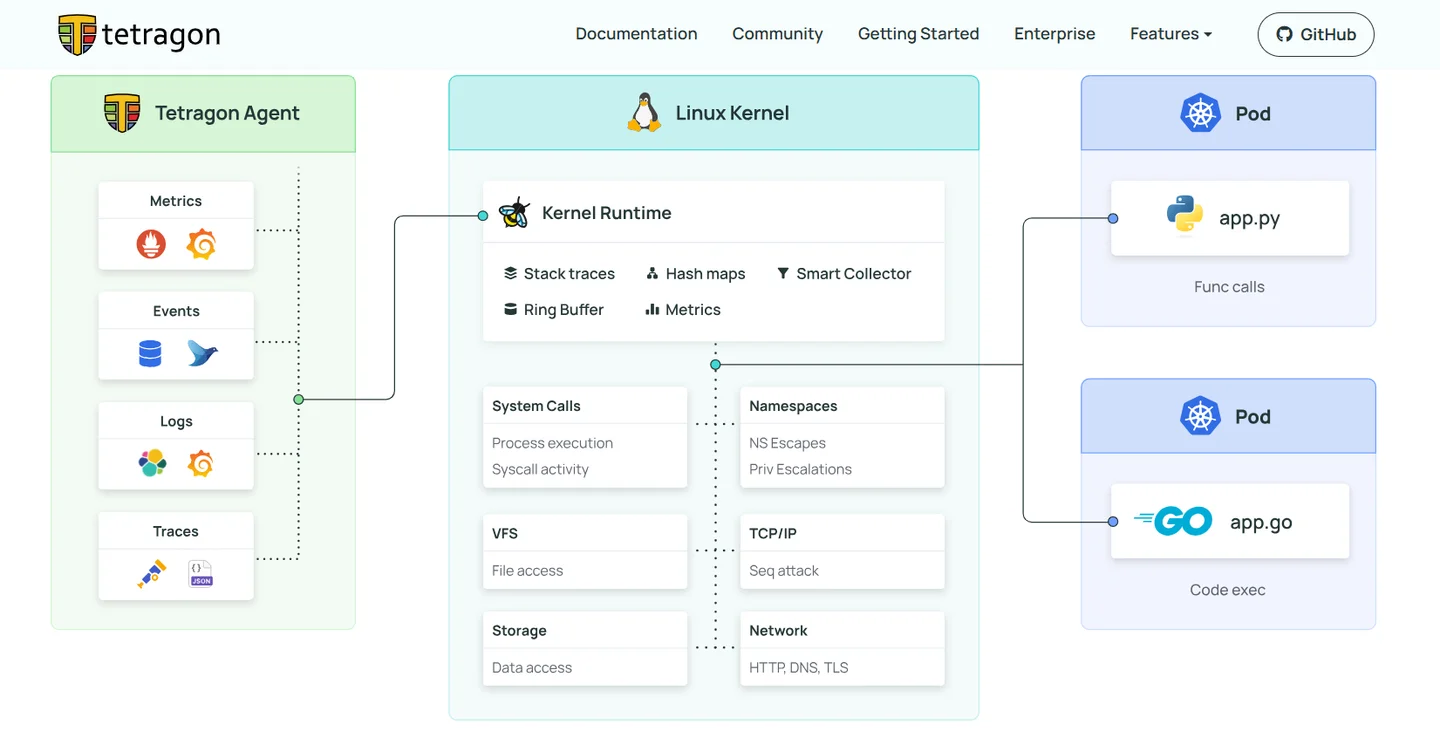
- Runtime vs build-time coverage: Pure runtime; observes process, file, and network events straight from the kernel.
- Kubernetes-native detection: Maps kernel events to pods and namespaces using Kubernetes identity.
- Detection and response: Enforces in-kernel via LSM hooks (Linux Security Modules, kernel gatekeepers), so it can kill a process, not just log it.
- Deployment model: DaemonSet, self-hosted; no cloud backend needed to enforce.
- CNCF maturity: Part of Cilium (a CNCF Graduated project), though Tetragon itself is younger.
- Published enforcement policies for blocking privilege escalation and suspicious binary execution.
- Kernel-level enforcement means an attacker cannot easily disable it from user space.
Trivy
- Runtime vs build-time coverage: Build-time and posture; it scans before deploy, so it does not see live execution.
- Kubernetes-native detection: Scans manifests, Helm charts, and running cluster resources for misconfigurations.
- Detection and response: Detection-only; it reports findings and generates an SBOM (software bill of materials, an ingredient list of your image).
- Deployment model: Runs anywhere, including air-gapped with an offline vulnerability database.
- Prioritization method: Supports filtering, but CVSS-first by default; pair it with EPSS and CISA KEV yourself.
- Widely adopted as a CI/CD scan step and inside other tools.
- Generates SPDX and CycloneDX SBOMs, which map to CRA and NIS2 vulnerability-handling duties.
Kubescape
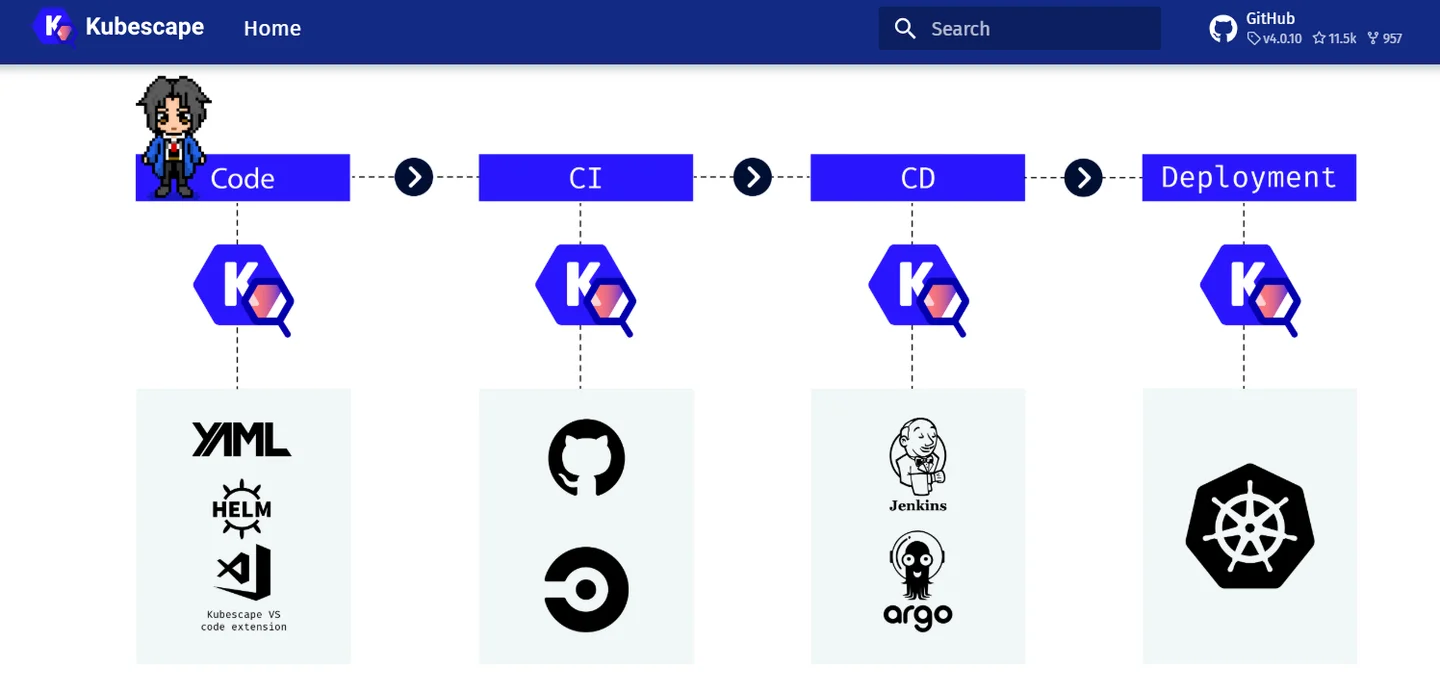
- Runtime vs build-time coverage: Mostly posture and configuration; it checks how the cluster is set up.
- Kubernetes-native detection: Scans against NSA/CISA hardening guidance and the CIS Kubernetes Benchmark.
- Detection and response: Detection and reporting; maps findings to compliance frameworks.
- Deployment model: Self-hosted; lightweight to run in-cluster.
- CNCF maturity: Incubating, so it is maturing but past the sandbox stage.
- CNCF Incubating status with an active contributor base.
- Framework-mapped results that translate misconfigurations into control language.
kube-bench
- Runtime vs build-time coverage: Configuration audit; a point-in-time snapshot of node and control-plane settings.
- Kubernetes-native detection: Purpose-built for the CIS Kubernetes Benchmark, control by control.
- Detection and response: Detection-only; it reports pass, fail, or warn per check.
- Deployment model: Self-hosted, runs on the node; trivial to add to a pipeline.
- Prioritization method: Benchmark-driven, not exploitability-driven.
- Directly implements the published CIS Kubernetes Benchmark checks.
- Common first step in hardening audits and compliance prep.
OPA/Gatekeeper
- Runtime vs build-time coverage: Deploy-time gate; it decides what is allowed into the cluster.
- Kubernetes-native detection: Enforces at admission (the moment a resource is created or changed).
- Detection and response: Prevention at admission; rejects privileged pods, missing limits, or bad images.
- Deployment model: Self-hosted webhook; no cloud dependency.
- Policy language: Rego, a purpose-built policy language (powerful, but a learning curve).
- OPA is CNCF Graduated, the highest maturity tier.
- Gatekeeper ships a library of reusable constraint templates.
Kyverno
- Runtime vs build-time coverage: Deploy-time gate, like Gatekeeper.
- Kubernetes-native detection: Policies are written in plain Kubernetes YAML, no new language.
- Detection and response: Prevention at admission; can also mutate resources and verify image signatures.
- Deployment model: Self-hosted webhook; no cloud dependency.
- CNCF maturity: Incubating, with fast-growing adoption.
- CNCF Incubating status with a broad policy library.
- Native image-verification rules support supply-chain checks (signing stops impersonation, not vulnerabilities).
Cilium + Prometheus & Grafana
- Runtime vs build-time coverage: Runtime; Cilium enforces live network policy, and Prometheus + Grafana watch live metrics.
- Kubernetes-native detection: eBPF-based identity-aware network policy between pods and services.
- Detection and response: Cilium enforces segmentation to cut lateral movement; observability surfaces anomalies like outbound-traffic spikes.
- Deployment model: Self-hosted; Cilium replaces or augments the cluster network layer.
- CNCF maturity: Both core projects are CNCF Graduated.
- Cilium and Prometheus are both CNCF Graduated, with heavy production adoption.
- Grafana dashboards make an outbound-traffic spike (a common exfiltration signal) visible fast.
🧩 Where a Consolidated Runtime Agent Fits
A well-assembled open-source stack, Falco, Tetragon, Trivy, Kubescape, kube-bench, OPA or Kyverno, Cilium, and Prometheus + Grafana, covers detection, scanning, policy, segmentation, and observability for free. That is a genuinely strong baseline, and I would never talk a team out of it.
What it rarely gives you is three things in one place: automated response wired to the detection, operation that survives a cut cloud link, and exploitability-based prioritization tied to compliance. Stitching nine tools together is real work, and the maintenance never stops.
That is the gap we built EdgeLabs to close. One eBPF agent consolidates NDR, EDR, IPS/IDS, container and Kubernetes security, vulnerability management, and AI/agent protection, with detection and response running on the agent in Disconnected Mode, so it keeps working self-hosted, on-prem, or air-gapped where cloud-dependent tools go dark. Against Sysdig, a strong and credible runtime and CNAPP player with deep Falco heritage, the honest contrast is weight and cloud-dependence: Sysdig leans on a cloud platform, while our wedge is agent-only response with no backend required (per EdgeLabs' own published claims). To see it on your own cluster, book a walkthrough with our team.
Q2. How Do You Choose a Kubernetes Security Tool, and How Do the 9 Compare at a Glance?
Judge each tool on five things: where it acts (runtime versus build-time), CNCF maturity (Graduated, Incubating, or Sandbox), detection depth and overhead, whether it ranks findings by real exploitability, and whether it runs air-gapped with no cloud dependency. This guide is for SecOps and DevSecOps, Kubernetes and container, and AI-workload runtime-security owners at SMBs. It is not for OT asset-visibility teams.
🧭 The Five Criteria That Actually Decide the Purchase
Most tool lists rank by popularity. That helps nobody standing in front of a live cluster. Here is the filter I use, each one in plain language.
- Where it acts (runtime vs build-time): Build-time scans code before it ships. Runtime watches what executes after. You need both, but only one sees a live attack.
- CNCF maturity: The Cloud Native Computing Foundation grades projects Graduated, Incubating, or Sandbox. It is a free, third-party stability signal you did not have to earn yourself.
- Detection depth and overhead: eBPF (a safe way to run code inside the Linux kernel) gives deep visibility at roughly 1 to 2.5% CPU per node. Depth should not cost you the cluster.
- Exploitability, not just severity: A CVE (a published vulnerability ID) is not an exploit. Roughly 88% of CVEs sit below 10% exploitation probability, so rank by CISA KEV and EPSS, not CVSS alone. Our vulnerability management is built around exactly this exploitability-first sort.
- Air-gapped and cloud dependency: If a tool needs its vendor's cloud to detect or respond, it goes dark in a disconnected environment. Ask that question before you buy.
⚠️ The Trap Hiding in a "Clean" Result
A CVE is not an exploit. Exploit means actively usable and high risk, and treating every CVE as urgent buries the few that matter. That is the difference between busywork and defense.
There is a softer trap too, the "IKEA effect." When you assemble a security stack yourself, you overvalue it, because these tools demand customization and tuning. That emotional investment can hide a real maintenance bill and a real coverage gap, which is why some teams eventually consolidate onto a single Kubernetes security agent.
👥 Who Should Use This Guide
- Kubernetes and container runtime-security owners moving from build-time scanning to live detection.
- SecOps and DevSecOps leads at SMBs making cloud and AI/GPU workloads production-safe with a small team.
- AI-workload and LLM-agent runtime-security owners, because attackers do not need to hack your firewall if they can whisper instructions to your AI and LLM systems.
- Platform teams who need protection that keeps working self-hosted, on-prem, or air-gapped.
📊 The Nine Tools at a Glance
| Tool | Primary domain | CNCF maturity | Acts at |
|---|---|---|---|
| Falco | Runtime threat detection | Graduated | Runtime |
| Tetragon | Runtime enforcement | Cilium project (Graduated) | Runtime |
| Trivy | Image / vuln / IaC scanning | Aqua OSS | Build-time |
| Kubescape | Posture + compliance | Incubating | Build-time / posture |
| kube-bench | CIS Benchmark audit | Aqua OSS | Config audit |
| OPA/Gatekeeper | Admission policy | Graduated | Deploy-time |
| Kyverno | Admission policy (YAML) | Incubating | Deploy-time |
| Cilium | Network policy | Graduated | Runtime |
| Prometheus + Grafana | Observability / anomalies | Graduated | Runtime |
✅ How the Criteria Play Out
Notice the pattern: only four of the nine act at runtime, and none of the open-source options give you automated response wired to detection. That is the honest shape of an OSS stack.
Two of these criteria, agent-only operation and exploitability-based prioritization, are the ones we lead on at EdgeLabs. I am flagging that as context, not a pitch. You can build most of this baseline for free, and for many SMB teams that is the right first move before anyone signs a contract. If you do want to see how the pieces consolidate, our runtime detection and response shows the model.
Q3. Why Is Runtime Security the Layer That Actually Saves You (Not Image Scanning)?
Image scanning finds known flaws before deploy. Runtime security catches what actually happens after: the process that spawns a shell, the pod that beacons out, the token abused to move sideways. Since roughly 45% of organizations hit a runtime incident in the past year, build-time scanning alone is a dangerous illusion. Runtime is where attacks become real, so it is where your defense has to live.
🎯 The Line in Your Pipeline You Should Reread
Most teams think a green pipeline means safety. The standard read gets this backwards. Look carefully at one line in your CI/CD config: exit code zero.
Exit code zero means even if the scanner finds vulnerabilities, the pipeline still succeeds. Your build passes, and the exploitable image ships anyway. Having security tools in place does not mean you are secure.
🔥 What a Miss Actually Costs
A small SaaS company reportedly lost its entire production database in about nine seconds. One API call deleted a volume to clean up a credential issue, and the backups lived on the same volume, so the database and every backup were gone at once.
Nine seconds is faster than you can read a Slack message. That is the blast radius a build-time scan never sees, because the damage happens at runtime, in the space between "deployed" and "breached."
⚠️ What Runtime Sees That Scanning Cannot
Runtime detection reads live behavior. It catches fileless execution (malware that runs from memory, using memfd_create, never touching disk), a container escape, or a kubectl exec into a pod that no human should be touching.
Scanning is the industry's greatest placebo when treated as protection. It is necessary, not sufficient. This is exactly why I built EdgeLabs runtime-first: detection and response that run where the workload executes, not after the fact, across our workload and application security layer. Which open-source tools actually watch runtime? That is the next section.
Q4. What Are the Best Open-Source Tools for Kubernetes Runtime Threat Detection?
Falco (CNCF Graduated) watches Linux kernel syscalls via eBPF and alerts when a container misbehaves: spawning a shell, reading /etc/shadow, or beaconing out. Tetragon, from the Cilium project, also uses eBPF but adds real-time enforcement through LSM hooks, blocking the action rather than only logging it. Run Falco for detection and Tetragon for enforcement; both deploy as a DaemonSet at roughly 1 to 2.5% CPU per node.
🛰️ Falco: The Detection Floor
Falco is the open-source standard for runtime threat detection. It reads syscalls (the requests a program makes to the Linux kernel) and enriches them with Kubernetes identity, so an alert names the pod and namespace, not just a raw process.
Here is what that looks like live. Falco flags namespace abuse (unshare), anti-debugging (PTRACE), or a kubectl exec into a running pod, all mapped to MITRE ATT&CK techniques. You deploy it as a DaemonSet, one sensor per node, self-hosted, no cloud backend needed to detect.
⚠️ Where Falco Stops
Falco alerts. It does not block. That is the gap I keep meeting: teams run Falco, the alert fires at 2 a.m., and nothing is wired up to respond. An untuned deployment also becomes its own alert cannon, which is the very problem you were trying to escape. Closing that loop is the job of our network detection and response.
"Good IPS/IDS/EDR software. Webportal management is good. Docker container integration is useful."
Verified User in Computer Software EdgeLabs G2 Verified Review
🛡️ Tetragon: When Detection Becomes Enforcement
Tetragon takes the same eBPF foundation and adds teeth. It enforces in-kernel through LSM hooks (Linux Security Modules, the kernel's built-in gatekeepers), so it can kill a malicious process, not just record it.
This is the distinction that matters most to me. Rules in a config file are not a guardrail. A permission system that physically cannot perform the dangerous action is a guardrail, and our job is to make the dangerous action impossible, not just discouraged.
✅ How Practitioners Talk About the Gap
The runtime-versus-agentless debate is live among practitioners, and it maps straight onto this detection-versus-enforcement split.
"Folks are using more of their EDR and agent-based scanning... they're kind of missing the network context. They'll tell you you've got all these exposures but not which ones are actually reachable by an attacker."
practitioner comment, r/cybersecurity Reddit Thread
I read that as a case for pairing kernel-level detection with network context and response, not choosing one. At EdgeLabs, we build on the Falco ecosystem rather than compete with it, layering AI detection, NDR, and IPS above it. The wedge is host-local, time-boxed in-line IP blocking (one minute to ninety days) that fires even with no cloud backend, so detection and response stay live in Disconnected Mode. You can map this to named regulations in our Compliance Center.
"It's beneficial to secure any website or any server from hackers."
Abhishek A., Verified User EdgeLabs G2 Verified Review
Q5. Which Tools Scan Images, Vulnerabilities, and CIS Config, Without Drowning You in CVEs?
Trivy scans images, filesystems, and IaC (infrastructure-as-code, your cluster config written as files) and generates SBOMs, and it works air-gapped with an offline database. Kubescape maps posture against NSA/CISA and CIS frameworks. kube-bench audits nodes against the CIS Kubernetes Benchmark. The trap is treating every CVE as urgent. Roughly 88% of CVEs carry under 10% exploitation probability, so prioritize by CISA KEV and EPSS first. A CVE is not an exploit.
🔍 The Three Scanners and What Each Is Actually For
These three tools cover the build-time and posture layer. Think of them as the pre-flight check, useful, necessary, and not the same as watching the flight.
- Trivy: Run trivy image yourapp:tag to scan an image, or point it at a repo or cluster. It produces an SBOM (a software bill of materials, an ingredient list of your image) in SPDX or CycloneDX format.
- Kubescape: Scans your cluster and scores it against named frameworks like NSA/CISA hardening and CIS. Good for turning a mess of findings into audit language.
- kube-bench: Checks nodes and the control plane against the CIS Kubernetes Benchmark, control by control. Small, fast, and easy to schedule.
💰 Fix What Is Exploited, Not What Is Scary
Here is the part most guides skip. A CVE (Common Vulnerabilities and Exposures, a published flaw ID) is not an exploit. Exploit means actively usable and high risk.
CISA's Known Exploited Vulnerabilities catalog held roughly 1,484 entries in early 2026, the flaws attackers actually use. Sort your Trivy output this way: KEV membership first, then EPSS above 0.5, then high CVSS. That order shrinks a backlog of thousands into a list you can finish. This is exactly the logic behind our vulnerability management.
🛠️ Hardening Tips You Can Apply Monday
Scanning finds problems. These habits prevent them, and they cost nothing but discipline.
- Use minimal base images. An ubuntu:latest image runs around 1 GB and carries packages you never use, each a potential bug. Alpine or distroless images drop you under 100 MB.
- Deploy by digest, not tag. A tag like latest is mutable and can change under you. A digest (a sha256 fingerprint) is immutable. Note that image signing stops impersonation, not vulnerabilities.
- Run non-root. If you do not set a user, Docker runs the container as root, which exposes host files. Non-root is not optional.
⚠️ Where Scanning Ends and Compliance Begins
An SBOM is not just hygiene now. The EU Cyber Resilience Act (Regulation (EU) 2024/2847) expects secure-by-design and vulnerability handling, and NIS2 (Directive (EU) 2022/2555) adds risk-management duties.
This is the bridge to how we think at EdgeLabs. Our Compliance Center does exploitation-aware prioritization, separating theoretical CVEs from actively exploited ones and mapping them to your exposed assets, which is the CRA Annex I "No Known Exploitable Vulnerabilities" check in practice. I will be candid, though: that covers vuln-handling and detection controls, not lifecycle or governance controls like backup, HR training, or the CRA's multi-year support obligations. If you want the practical roadmap, our CRA preparation guide walks through it.
"Good IPS/IDS/EDR software. Webportal management is good. Docker container integration is useful."
Verified User in Computer Software EdgeLabs G2 Verified Review
The question I keep sitting with: if 88% of CVEs are noise, why do so many teams still measure security by how many they closed? Tell me how you prioritize yours.
Q6. How Do You Enforce Policy, Segment the Network, and Watch for Anomalies?
OPA/Gatekeeper (CNCF Graduated) uses Rego to reject non-compliant workloads, like privileged pods or missing limits, at admission. Kyverno (CNCF Incubating) does the same in native Kubernetes YAML. Cilium enforces eBPF network policy to segment pods and cut lateral movement, and Prometheus plus Grafana surface anomalies like outbound-traffic spikes. Together they make the dangerous action impossible, not just discouraged.
🚪 OPA/Gatekeeper vs Kyverno: The Admission Choice
Admission control is the bouncer at the cluster door. It decides what is allowed in, before anything runs. Both tools do this well, and the choice comes down to language.
| Dimension | OPA/Gatekeeper | Kyverno |
|---|---|---|
| Language | Rego (purpose-built) | Native Kubernetes YAML |
| CNCF maturity | Graduated | Incubating |
| Best when | Complex, expressive logic | Your team already lives in YAML |
| Extras | Constraint template library | Validate, mutate, generate, verify images |
For most SMB teams, I would start with Kyverno. The lower learning curve means the policy actually gets written and maintained, instead of sitting half-built. Choose Rego only when your rules genuinely outgrow YAML.
🕸️ Cilium: Cutting Off Lateral Movement
Policy stops bad workloads at the door. Cilium handles what moves between rooms. It uses eBPF (safe code inside the Linux kernel) to enforce network policy by workload identity, not just IP address.
That matters because lateral movement, an attacker hopping pod to pod after popping one, is how a single breach becomes a cluster-wide incident. Cilium is CNCF Graduated and heavily used in production. Cutting that movement is a core job of our network detection and response.
📈 Prometheus and Grafana: Seeing the Anomaly
Prometheus collects metrics, and Grafana draws them. Together they make a sudden outbound-traffic spike, a classic exfiltration signal, visible on a dashboard.
Here is the honest limit: observability shows you the anomaly. It does not decide it is an attack, and it does not respond. The correlation and the action are still on you.
⚠️ The "Least Privilege" Lie and the Guardrail Test
Teams say they run least privilege, then hand agents high-privileged tokens because it is convenient. That gap is where attackers live.
This is my test for any control: rules in a config file are not a guardrail. A permission that physically cannot perform the action is a guardrail, and the job is to make the dangerous action impossible. At EdgeLabs, we add host-local, time-boxed in-line IP blocking (one minute to ninety days) as a runtime complement to admission-time policy, so prevention happens while the workload runs, not only at deploy. You can see the model in how EdgeLabs works. Where do your guardrails end, at the door or in the room?
Q7. How Do You Secure LLM Agents on Kubernetes, and When Do You Need a Consolidated Runtime Layer?
Config scanners and CVE tools cannot see an LLM agent being talked into exfiltrating data, and some prompt-injection techniques hit an 88% success rate. Guardrails AI validates model outputs and AgentSystems runs third-party agents zero-trust and local-first, but guardrails are bypassable, so pair them with runtime observation of what the agent actually does. A strong open-source stack still leaves three gaps: automated response, air-gapped operation, and one-place agent coverage.
🤖 The New Insider You Did Not Hire
An LLM agent is a new kind of insider. Attackers do not need to breach your firewall if they can whisper instructions to your AI.
I think about agent capability as a "two-of-three" rule. An agent can access your files, access the internet, and write and run custom code. Let it do only two of those three, because all three together is how malware gets injected and executed. Watching those actions live is the job of our AI and LLM security engine.
⚠️ Guardrails Help, But Do Not Trust Them Alone
Guardrails AI is a Python library that validates and fixes model outputs before they reach a user. AgentSystems containerizes third-party agents with a zero-trust, local-first runtime. Both are useful.
But there is a real disagreement here. The people who build guardrail libraries and the researchers who test them do not agree on how well they hold, and injection success rates like 88% are why. You can patch a bug, but you cannot patch a brain, so pre-flight validation alone is not enough. You need to watch what the agent does at runtime, because you cannot govern what you do not know exists.
🧩 When an OSS Stack Is Not Enough
A well-built open-source stack covers a lot: Falco and Tetragon for detection and enforcement, Trivy and Kubescape for scanning, OPA or Kyverno for policy, Cilium for segmentation, and Prometheus and Grafana for observability. For many SMB teams, that is the right first move, and your money stays in your pocket.
Three gaps remain, and they are the expensive ones.
- Response is not wired to detection. Falco alerts; nothing blocks unless you build it.
- Air-gapped operation is rare. Only Trivy's offline database really covers a disconnected cluster.
- Agent behavior sits outside all of it. None of these tools watch an LLM agent's live decisions.
There is also the "IKEA effect." When you assemble the stack yourself, you overvalue it, and the tuning bill, plus the roughly daily config-drift checks a real baseline needs, stays hidden until an incident.
✅ Where EdgeLabs Fits (Position 1 of the Consolidated Options)
This is the gap we built EdgeLabs to close, and I will keep the contrast fair.
- ✅ One eBPF agent consolidates NDR, EDR, IPS/IDS, container and Kubernetes security, vulnerability management, and AI/agent protection.
- ✅ The Parallax engine secures LLM agents at runtime: an input/output firewall for prompt-injection and tool-poisoning defense, plus hallucination checks and GPU workloads secured using only CPU.
- ❌ The free/SMB tier is intentionally narrower than enterprise, and the Compliance Center does not cover lifecycle or governance controls.
- ✅ Detection and response run on the agent in Disconnected Mode, so they keep working self-hosted, on-prem, or air-gapped, where cloud-dependent tools go dark.
- ❌ Some direct rivals (for example, Aqua) have build-time features we do not yet have.
Against Sysdig, a strong, credible runtime and CNAPP player with deep Falco heritage, the honest difference is weight and cloud-dependence: Sysdig leans on its cloud platform, while our wedge is agent-only response with no backend required. We are not endpoint-first like CrowdStrike or SentinelOne, where runtime is a module bolted onto an endpoint engine, and not heavyweight cloud-NDR like Vectra (per EdgeLabs' own positioning). If you want the case for our approach, read why teams choose AI EdgeLabs.
"It's beneficial to secure any website or any server from hackers."
Abhishek A., Verified User EdgeLabs G2 Verified Review
"Problem optimisation makes analysis a lot more easier."
Verified User in Information Technology EdgeLabs G2 Verified Review
Where my head is right now: over the next two years, distributed AI computing forces distributed security, and securing the LLM agent at runtime stops being a niche and becomes the default question every SecOps team answers. If you are running agents in production today, I would genuinely like to hear what surfaces when you actually watch them at runtime.
FAQs
We group the nine strongest open-source options by the job each one performs, because a scanner and a runtime sensor do not compete, they stack.
- Runtime detection: Falco reads Linux kernel syscalls via eBPF and alerts on suspicious behavior; Tetragon adds in-kernel enforcement.
- Scanning: Trivy scans images, filesystems, and IaC and generates SBOMs; Kubescape maps posture to NSA/CISA and CIS; kube-bench audits nodes against the CIS Benchmark.
- Admission policy: OPA/Gatekeeper uses Rego, and Kyverno uses native YAML to block non-compliant workloads at deploy.
- Network and observability: Cilium enforces eBPF network policy to cut lateral movement, and Prometheus plus Grafana surface anomalies.
Choose by domain first, then by CNCF maturity. Only four of the nine act at runtime, and none wire automated response to detection, which is the honest shape of a self-built stack. Teams that want detection and response consolidated onto one agent can see how we approach Kubernetes security at runtime instead of stitching layers together manually.
Image scanning finds known flaws before deploy. Runtime security catches what actually happens after: the process that spawns a shell, the pod that beacons out, or the token abused to move sideways.
The trap hides in one line of your CI/CD config, exit code zero. Even when a scanner finds vulnerabilities, the pipeline still succeeds, and the exploitable image ships anyway. Having tools in place does not mean you are secure.
- Roughly 45% of organizations hit a runtime incident in the past year.
- Runtime detection reads live behavior: fileless execution, container escapes, or a kubectl exec no human should be running.
- Scanning is necessary, not sufficient; treated as protection, it is the industry's greatest placebo.
This is exactly why we built EdgeLabs runtime-first, with detection and response that run where the workload executes rather than after the fact. You can see the model in how EdgeLabs works. The point is not to skip scanning, but to stop mistaking a green pipeline for a safe cluster, because the damage happens in the space between deployed and breached.
The mistake is treating every CVE as urgent. A CVE (a published vulnerability ID) is not an exploit; exploit means actively usable and high risk.
Roughly 88% of CVEs carry under 10% exploitation probability, so a raw CVE count will bury the few that matter. We recommend a simple sort order for your Trivy output:
- First, CISA KEV membership (the catalog held about 1,484 entries in early 2026, the flaws attackers actually use).
- Then EPSS above 0.5 (exploitation probability).
- Then high CVSS severity.
That order shrinks a backlog of thousands into a list you can actually finish. Combine it with hardening habits: minimal base images, deploying by immutable digest rather than mutable tag, and running containers non-root.
This exploitation-aware approach is the backbone of our vulnerability management, which separates theoretical CVEs from actively exploited ones and maps them to your exposed assets. That mapping is also how the CRA Annex I 'No Known Exploitable Vulnerabilities' check works in practice, turning a noisy scan into a defensible, audit-ready priority list.
Both use eBPF, a safe way to run code inside the Linux kernel, and both deploy as a DaemonSet at roughly 1 to 2.5% CPU per node. The difference is what they do when something bad happens.
- Falco (CNCF Graduated): reads syscalls and enriches them with Kubernetes identity, so an alert names the pod and namespace. It detects, mapping events to MITRE ATT&CK, but it does not block.
- Tetragon (Cilium project): takes the same eBPF foundation and adds enforcement through LSM hooks, the kernel's built-in gatekeepers, so it can kill a malicious process rather than only logging it.
Run Falco for detection and Tetragon for enforcement. The gap we keep meeting is teams running Falco alone: the alert fires at 2 a.m. and nothing is wired up to respond, while an untuned deployment becomes its own alert cannon.
We build on the Falco ecosystem rather than compete with it, layering AI detection, NDR, and IPS above it, with host-local response that stays live even with no cloud backend. That closing-the-loop role is what our network detection and response is designed for.
Admission control is the bouncer at the cluster door, deciding what is allowed in before anything runs. Both tools do this well, and the choice comes down to language.
- OPA/Gatekeeper (CNCF Graduated): uses Rego, a purpose-built policy language that is powerful for complex, expressive logic, with a constraint template library.
- Kyverno (CNCF Incubating): writes policy in native Kubernetes YAML and can validate, mutate, generate, and verify images, with a much gentler learning curve.
For most SMB teams, we would start with Kyverno. The lower learning curve means the policy actually gets written and maintained, instead of sitting half-built. Choose Rego only when your rules genuinely outgrow YAML.
One caution: admission control stops at deploy-time. It guards the door, not the room, so a privileged token abused at runtime slips right past it. We treat admission policy as a complement to runtime enforcement, adding host-local, time-boxed in-line IP blocking as the runtime layer. You can see how the pieces fit across our workload and application security platform, so prevention happens while workloads run, not only at deploy.
An LLM agent is a new kind of insider. Attackers do not need to breach your firewall if they can whisper instructions to your AI, and some prompt-injection techniques hit an 88% success rate.
We think about agent capability as a two-of-three rule. An agent can access your files, access the internet, and write and run custom code. Let it do only two of those three, because all three together is how malware gets injected and executed.
- Guardrails AI validates and fixes model outputs before they reach a user.
- AgentSystems containerizes third-party agents with a zero-trust, local-first runtime.
Both are useful, but guardrails are bypassable. You can patch a bug, but you cannot patch a brain, so pre-flight validation alone is not enough. You need to watch what the agent actually does at runtime, because you cannot govern what you do not know exists.
Our Parallax engine secures LLM agents at runtime with an input and output firewall for prompt-injection and tool-poisoning defense, plus hallucination checks. See how we approach AI and LLM security as a runtime problem, not only a governance one.
Partially, and this is one of the honest limits of a self-assembled stack. Many open-source tools run self-hosted, but not all keep working when the cluster is disconnected.
- Trivy is one of the few that genuinely covers an air-gapped cluster, thanks to its offline vulnerability database.
- Falco, Tetragon, OPA/Gatekeeper, and Cilium detect or enforce locally without a cloud backend, which helps in disconnected setups.
- Many commercial tools, however, need their vendor's cloud to detect or respond, so they go dark the moment the link is cut.
The gap that remains is automated response that survives a disconnected environment. Detection without a wired response still leaves you reading alerts with nothing acting on them.
We designed EdgeLabs so detection and response run on the agent in Disconnected Mode, keeping protection live self-hosted, on-prem, or air-gapped where cloud-dependent tools fail. Ask the cloud-dependency question before you buy anything, and if disconnected operation is a hard requirement, talk to us through our contact page so we can walk through your specific topology.
A well-built open-source stack covers a lot, and for many SMB teams it is the right first move, keeping your money in your pocket. We would never talk a team out of that baseline.
Three gaps tend to force the decision, and they are the expensive ones:
- Response is not wired to detection. Falco alerts, but nothing blocks unless you build it.
- Air-gapped operation is rare. Only Trivy's offline database really covers a disconnected cluster.
- Agent behavior sits outside all of it. None of these tools watch an LLM agent's live decisions.
There is also the IKEA effect: when you assemble the stack yourself, you overvalue it, and the tuning bill plus near-daily config-drift checks stay hidden until an incident.
When those gaps start costing more than a subscription, consolidation makes sense. One eBPF agent can combine NDR, EDR, IPS/IDS, container and Kubernetes security, vulnerability management, and AI/agent protection. Read why teams choose AI EdgeLabs to weigh that tradeoff honestly against a self-built stack.
