TL;DR
- AI workload security is runtime protection: it watches syscalls, file access, egress, prompts, tool calls, and MCP traffic while the workload executes, not before it ships.
- Four layers exist and only one sees execution. Build-time scanning, AI-SPM posture, and guardrails all pass on a container that later exfiltrates data through permissions it legitimately holds.
- Detection fidelity decides everything. Kernel eBPF telemetry cannot be bypassed, API logs miss fileless payloads, and framework SDK hooks break across mixed AI estates.
- Training risk is long-lived privileged jobs: dataset tampering, checkpoint poisoning, over-scoped credentials, and GPU node compromise. Inference risk is prompt injection, tool poisoning, and live exfiltration.
- Enforcement climbs four rungs: observe, alert, block, isolate. Most tools stop at alert, which is useless against an agent that deleted a production database in nine seconds.
- Eight tools compared, and three are governance layers rather than workload runtime tools. Rank findings by KEV and EPSS evidence, then demand auditor-ready artefacts in the PoC.
Q1. Why is choosing an AI workload security tool a high-stakes decision, and how did we assess these eight?
AI workload security protects AI systems while they execute: training jobs, inference nodes, containers, and agents in production. This guide assessed eight tools on five criteria: LLM and agent runtime protection, GPU and inference-node coverage, runtime enforcement versus governance-only, agent-only versus cloud-dependent detection and response, and deployment reach across cloud, data center, and on-prem or air-gapped environments.
Choosing a runtime security tool for AI workloads is a decision you make once and live with for years. Attacks execute at runtime, not at scan time, so a clean image report tells you nothing about the process currently writing to a checkpoint file. A tool that cannot reach your self-hosted GPU cluster protects nothing inside it. Alert noise is the third failure mode, and it is the quiet one: a queue nobody can clear is the same as no detection at all. Eight tools were assessed here against criteria specific to this title, for practitioners running AI in production.
🔍 What a runtime miss actually looks like
One misconception I run into constantly is that container security means scanning images. It does not. Container security is about controlling the blast radius from the moment code is written to the moment it runs in production. If your security posture starts inside Kubernetes, the interesting part already happened.
The other pattern I keep seeing in audit work is worse, because it looks like success. Tools get installed. Policies never get written. Everything is technically deployed, and nothing is technically enforcing.
That gap is why the criteria below are all about what happens during execution, not before it.
Our Evaluation Criteria
Each tool in this guide is described against the same five criteria, in the same order, every time.
- LLM and agent runtime protection. Does the tool inspect live agent behaviour, including prompts, tool calls, and MCP traffic (Model Context Protocol, the standard way agents connect to external tools)? The OWASP Top 10 for Agentic Applications 2026, built with input from more than 100 practitioners, is the taxonomy these agentic AI security threats map to.
- GPU and inference-node coverage. Can it protect the machines where models actually train and serve, without taxing the GPU you paid for?
- Runtime enforcement versus governance-only. Does it observe, alert, block, or isolate? Many tools stop at alerting and call it protection.
- Agent-only versus cloud-dependent detection and response. If the vendor's cloud backend is unreachable, does detection still fire? Does response?
- Deployment and environment reach. Cloud, data center, on-prem, air-gapped, Kubernetes, containers, and GPU nodes. A tool that only runs in a managed cloud has a hard ceiling.
⚠️ One honest caveat about this category
The AI runtime security category is young and thinly reviewed. Several vendors here have no third-party review profile at all, so I lead with primary-source technical facts instead of star ratings. Read what follows as a map of the landscape, not a leaderboard.
Who This Guide Is For
- SecOps or DevSecOps leads at SMBs making cloud and AI/GPU workloads production-safe without a 24/7 team.
- AI-workload and LLM-agent runtime-security owners responsible for agents already running in production.
- Kubernetes and container runtime-security owners moving from build-time scanning to Kubernetes runtime detection.
- GPU-cloud and AI-infrastructure security leads protecting inference nodes and training clusters.
EdgeLabs runs detection and response entirely on the agent, with no cloud dependency, which is why it opens a guide whose hardest criterion is whether protection still works when the backend goes dark. You can see how the agent works before you read a single card.
The Eight Tools at a Glance
- EdgeLabs: Best for self-hosted, on-prem, or air-gapped AI workloads that need runtime detection and response with no cloud backend.
- Oligo Security: Best for proving which vulnerable library functions actually execute inside running applications.
- Zenity: Best for governing which agents may act on which enterprise systems.
- WitnessAI: Best for visibility and policy over how employees and apps use AI models.
- Astelia: Best for teams adding runtime controls around agentic workflows in early production.
- Microsoft open-source agentic-security project: Best for teams that want to build agent controls on an open codebase.
- Sysdig: Best for multi-cluster cloud-native fleets with a mature SOC and Falco heritage in-house.
- Falco: Best for learning runtime detection on open-source rules with no licence spend.
Master Comparison Table
| Company | Best For | Detection & Response Model | Deployment & Environment Coverage |
| EdgeLabs | Self-hosted or air-gapped AI workloads needing runtime detection and response with no cloud backend | Agent-only: detection and response both execute on the eBPF agent, including offline | Cloud, data center, on-prem, air-gapped; Docker, Kubernetes, OpenShift, Talos, K3S; x86_64 and ARM_64; GPU inference nodes |
| Oligo Security | Proving which vulnerable functions execute in a live application | eBPF sensor with Deep Application Inspection, correlating kernel signals to application stack traces | Cloud-native workloads and Kubernetes, including EKS |
| Zenity | Governing agent identity and permitted actions | Agent-governance layer, policy and action control rather than kernel-level enforcement | Enterprise SaaS and agent platforms |
| WitnessAI | AI usage visibility and policy enforcement | Policy and inspection layer over AI model traffic | Cloud-delivered, network and gateway positioned |
| Astelia | Runtime controls around agentic workflows | Agentic runtime control layer; category is early, and capabilities vary by deployment | Varies by deployment |
| Microsoft open-source agentic-security project | Building agent controls on an open codebase | Open-source toolkit; enforcement depends on what you implement | Self-hosted, wherever you run it |
| Sysdig | Multi-cluster cloud-native fleets with a mature SOC | Agent plus cloud platform; detection on the agent, correlation and response workflows lean on the backend | Cloud, Kubernetes, containers, multi-cloud |
| Falco | Open-source runtime rules and syscall detection | OSS rules engine: detection and alerting, response left to you | Kubernetes, containers, Linux hosts, self-hosted |
Total providers: 8.
1 out of 8EdgeLabs
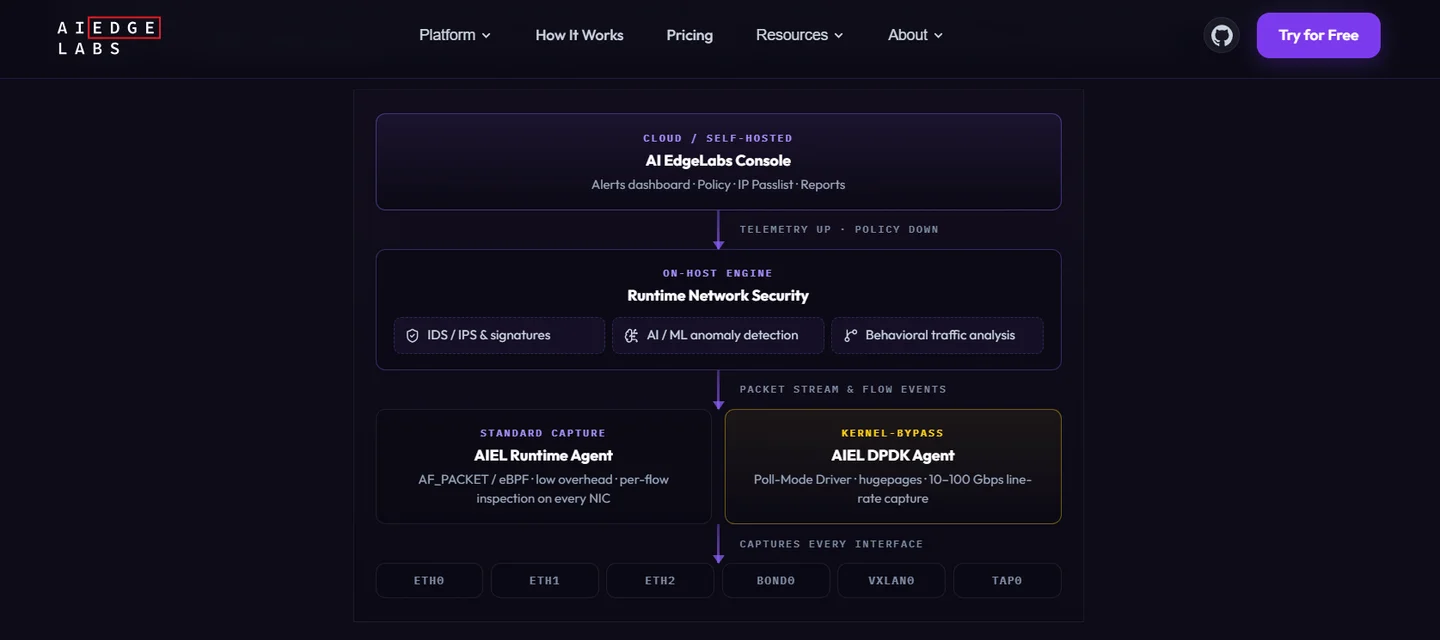
- LLM and agent runtime protection: the Parallax engine acts as an LLM proxy and firewall, covering input/output alignment, prompt-injection and tool-poisoning defence, and hallucination checks for agents and MCP servers in production.
- GPU and inference-node coverage: secures GPU workloads using CPU only, so inference nodes are monitored without spending GPU cycles on security.
- Runtime enforcement versus governance-only: in-line prevention with host-local, time-boxed source-IP blocking (1 minute to 90 days), which fires with no cloud backend present.
- Agent-only versus cloud-dependent: Disconnected Mode keeps both detection and response running offline. This is the criterion EdgeLabs was built around.
- Deployment reach: cloud, data center, on-prem, and air-gapped; Docker, Kubernetes, OpenShift, Talos, and K3S; x86_64 and ARM_64; minimum host 512 MB RAM, 1 CPU at 1.0 GHz, and Linux kernel 4.14+.
- Kernel-level detections include memfd_create fileless execution, PTRACE anti-debug behaviour, unshare namespace abuse, and container escape attempts.
- Kubernetes audit-rule detections cover kubectl exec and attach, sensitive hostPath mounts, and kubectl cp control-plane exfiltration.
- EdgeLabs' published Trader Joe's case study reports 83% MTTR reduction, $1.3M operational savings, 573% ROI, deployment in under two weeks, and zero outages. These are EdgeLabs' own published figures, not independently verified.
- The CRA/NIS2 Compliance Center runs the CRA Annex I "No Known Exploitable Vulnerabilities" check against runtime and build-time SBOM data.
"Good IPS/IDS/EDR software. Webportal management is good. Docker container integration is useful."
Verified User in Computer Software · EdgeLabs G2 - Verified Review (4 stars; SOC 2 compliance named as the problem being solved)
"I don't think there is any option for dislike but the commercial seems high."
Abhishek A. · EdgeLabs G2 - Abhishek A. Verified Review (4.5 stars)

Oligo Security
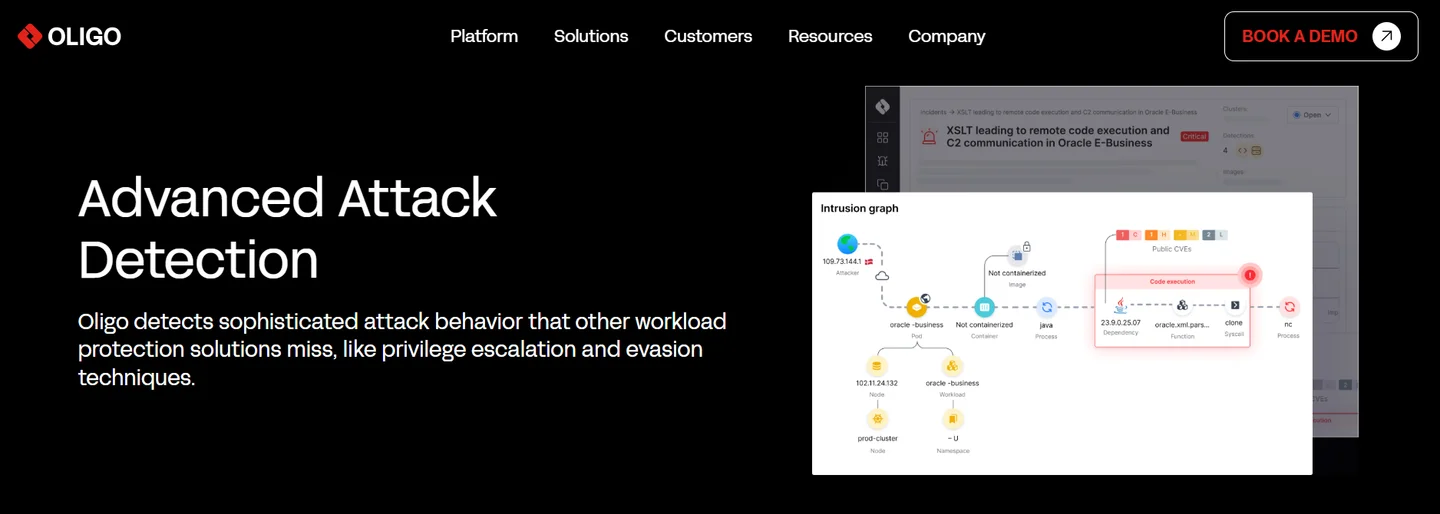
- LLM and agent runtime protection: Oligo maintains an AI runtime security resource hub and covers AI workloads as running applications. Agent-specific controls such as prompt-injection and MCP inspection are not its primary design centre.
- GPU and inference-node coverage: not publicly claimed as a distinct capability; coverage follows the Linux host and container.
- Runtime enforcement versus governance-only: enforcing, not governance-only. Oligo detects exploits and blocks at the syscall level, and enforces least privilege at the library level.
- Agent-only versus cloud-dependent: the sensor runs on the host, and platform functions run in Oligo's cloud. Fully disconnected operation is not publicly claimed.
- Deployment reach: cloud-native workloads and Kubernetes, available on EKS through AWS Marketplace. Air-gapped operation is not publicly claimed.
- Oligo's engineering blog documents reconstructing full user-space stack traces across dynamic runtimes, JIT compilation, and Java Uber Jars, which is hard to do reliably.
- A worked example traces a benign-looking whoami command back to an RCE exploit chain that syscall-only tools would ignore.
- Oligo's AWS Marketplace listing states customers reduce the workload of responding to security alerts by about 85% using Oligo on EKS. That is Oligo's own published claim.
Practitioners are already arguing this exact axis. One live r/devsecops thread asks plainly whether agentless scanning is enough for workload runtime security, which is the same question in different clothing.
3 out of 8Zenity
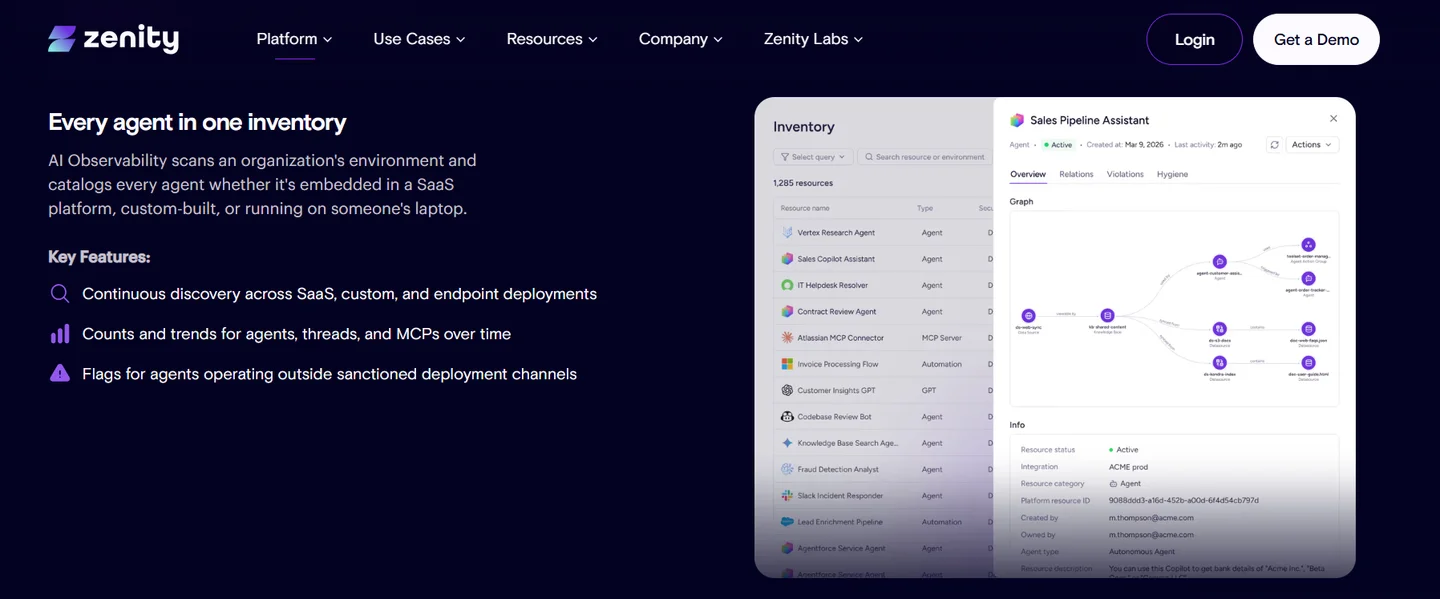
- LLM and agent runtime protection: strong at this layer. Zenity's Correlation Agent interprets agent behaviour, flags manipulation attempts, and explains what an agent was actually trying to do.
- GPU and inference-node coverage: not a claimed capability. Zenity works at the agent and platform layer, not the GPU node.
- Runtime enforcement versus governance-only: mostly governance and policy enforcement. Zenity enforces guardrails early to stop over-permissioned agents reaching runtime, plus runtime detection and response with execution-path context.
- Agent-only versus cloud-dependent: cloud-delivered platform. Fully disconnected operation is not a published capability.
- Deployment reach: broad across SaaS, cloud, custom stacks, and endpoints. Air-gapped operation is not publicly claimed.
- Automatic agent discovery, ownership mapping, dependency mapping, and shadow-AI detection across environments.
- Zenity Issues correlates posture gaps, runtime anomalies, and identity relationships into ranked incidents.
- Zenity Labs publishes original research on real-world agent attack techniques.
WitnessAI
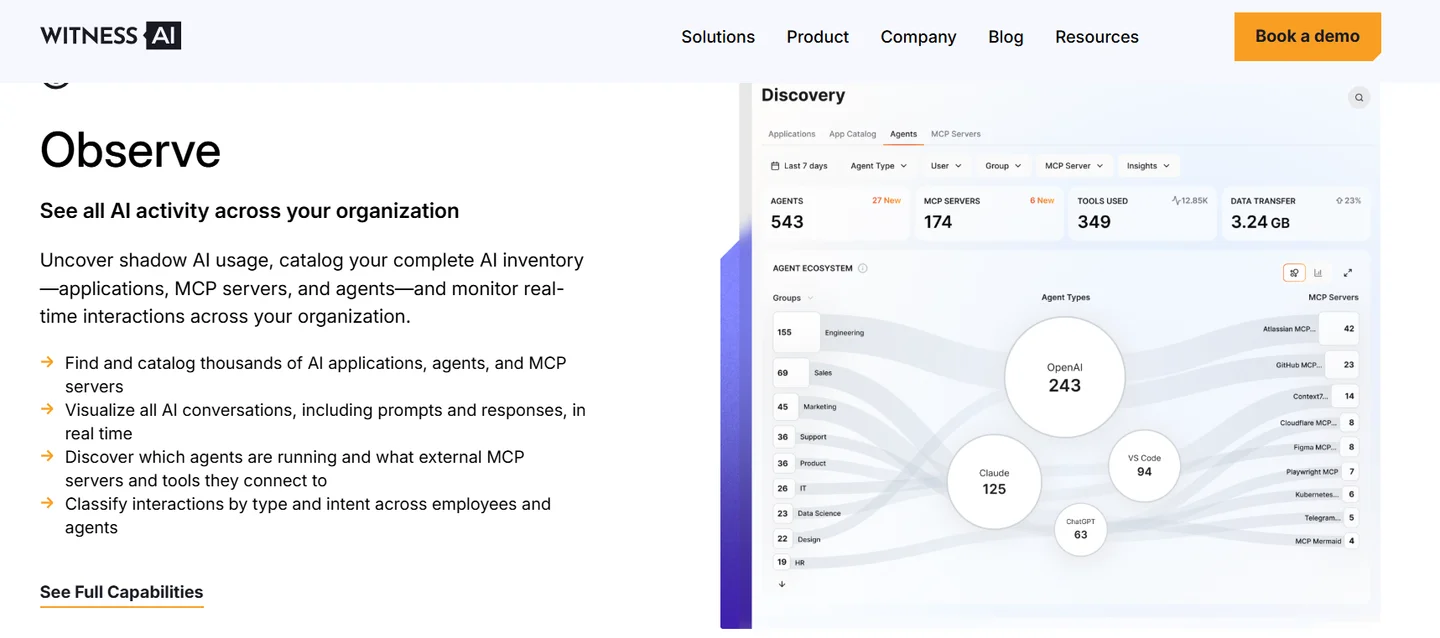
- LLM and agent runtime protection: inspects AI traffic in flight and enforces policy on it. This is prompt-and-response layer control, not kernel-level workload detection.
- GPU and inference-node coverage: not a claimed capability.
- Runtime enforcement versus governance-only: enforcing at the policy and data layer. WitnessAI redacts sensitive data and blocks disallowed usage rather than stopping process execution.
- Agent-only versus cloud-dependent: cloud and network-positioned, commercially available in the US and internationally since 2024. No published disconnected mode.
- Deployment reach: enterprise network and gateway paths, including encrypted traffic via F5 integration.
- Automatic data tokenization so employees can use AI tools without exposing company data.
- Audit trails built for governance sign-off rather than incident response.
- Published support for Microsoft 365 Copilot and GitHub Copilot for VS Code.
Astelia
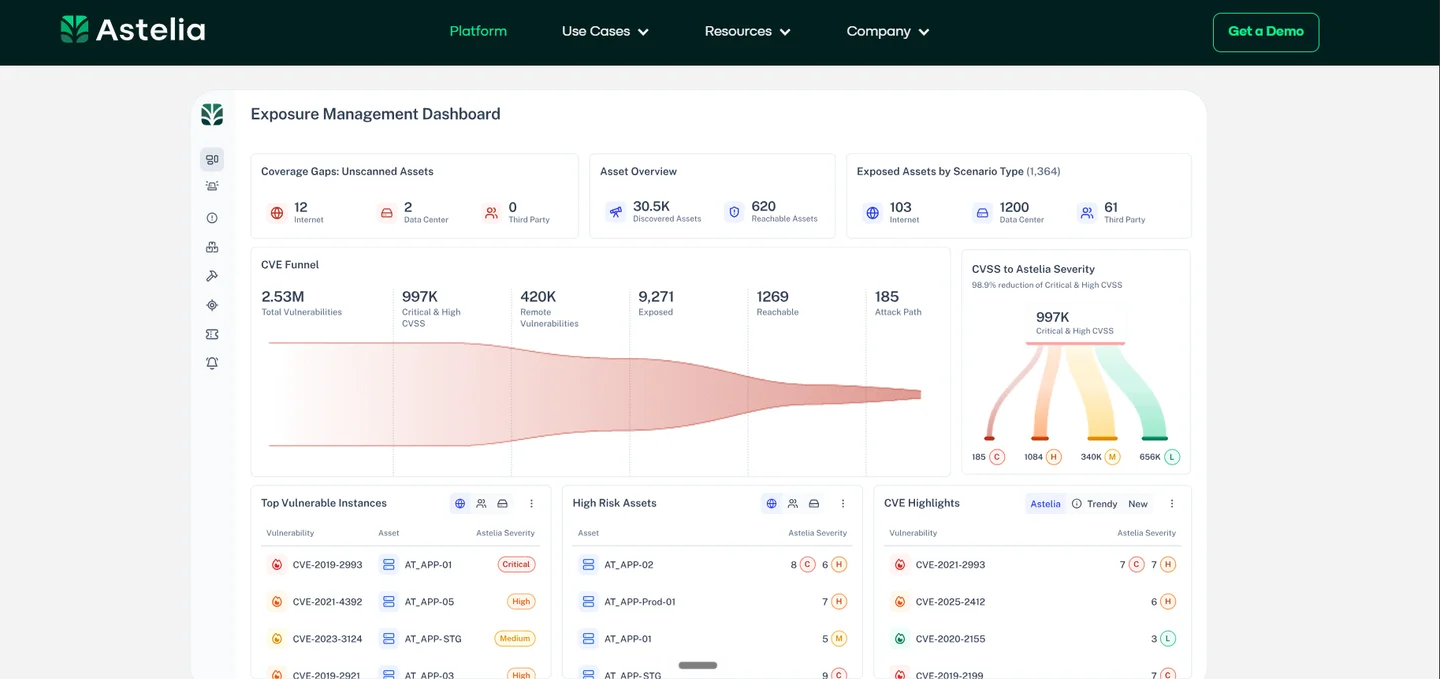
- LLM and agent runtime protection: not the design centre. Astelia uses AI agents to do security work, rather than securing your AI agents.
- GPU and inference-node coverage: not a claimed capability.
- Runtime enforcement versus governance-only: neither, precisely. This is exposure prioritisation and remediation workflow, not in-line runtime blocking.
- Agent-only versus cloud-dependent: platform-delivered; disconnected operation is not publicly claimed.
- Deployment reach: varies by deployment. Public documentation is topology and exposure focused rather than node focused.
- Exploit-requirement analysis against mapped network topology to filter unreachable findings.
- Auditable agent workflows spanning triage to remediation.
- Public launch coverage of its agentic prioritisation approach in July 2026.
Microsoft open-source agentic-security project
- LLM and agent runtime protection: available as building blocks. You get primitives, not a managed control plane.
- GPU and inference-node coverage: not in scope.
- Runtime enforcement versus governance-only: whatever you build. Deterministic hooks and policy checks are achievable, but you own the engineering.
- Agent-only versus cloud-dependent: self-hosted by definition, so no vendor cloud dependency.
- Deployment reach: wherever you can run it, including offline environments, subject to your own integration work.
- Publicly inspectable code, so you can audit the control logic yourself.
- No licence cost, which suits an SMB testing agent controls before budgeting for a platform.
- Community contributions rather than vendor-gated roadmap.
Sysdig
- LLM and agent runtime protection: expanding into AI workload coverage, but its heritage and depth are container and cloud runtime, not LLM agent behaviour.
- GPU and inference-node coverage: containers on GPU nodes are covered as Linux workloads. Inference-specific protection is not its centre of gravity.
- Runtime enforcement versus governance-only: genuinely enforcing. Sysdig has real runtime detection depth, earned over years, and it is the most credible name on this list for cloud-native runtime.
- Agent-only versus cloud-dependent: agent plus cloud platform. Detection runs on the node, while correlation, workflows, and much of the response experience lean on the backend.
- Deployment reach: broad across cloud, multi-cloud, Kubernetes, and containers.
- Created Falco, now a CNCF project and the open-source baseline much of this category is measured against.
- Deep Kubernetes and container runtime detection content maintained over years.
- Broad multi-cloud posture and runtime coverage in one platform.
Falco
- LLM and agent runtime protection: not built for it. You can write rules for suspicious process behaviour on an inference node, but prompt-injection and MCP tool-poisoning are outside its model.
- GPU and inference-node coverage: covers the Linux host and containers on it, GPU node included, with no AI-specific content.
- Runtime enforcement versus governance-only: detection-only in practice. Falco tells you; it does not stop it.
- Agent-only versus cloud-dependent: fully self-hosted, no vendor cloud, works offline.
- Deployment reach: Kubernetes, containers, and Linux hosts, anywhere you can run it.
- CNCF-graduated project status, with public rules and public issue history you can audit before adopting.
- Detects classic runtime abuse patterns including shells spawned in containers, sensitive file reads, and unexpected outbound connections.
- Used as the detection substrate underneath multiple commercial products, which is itself a validation.
⚠️ The pattern worth noticing across these eight
Five of the eight above operate somewhere other than the kernel. Zenity governs the agent layer, WitnessAI governs traffic, Astelia governs exposure decisions, and that is legitimate work. It is just not the same job as watching a syscall on the node where your model serves.
The two open-source entries make a related point. Falco and the Microsoft project prove the primitives exist for free, and what you pay a vendor for is response, tuning, and coverage you do not have to build.
💰 What this means for a small team's budget
I could be reading this too strongly, but Edge Labs AI's deployment data points one way consistently: teams that buy at the governance layer first end up buying again at the runtime layer within a year. The reverse happens less often. Runtime gives you the incident; governance gives you the policy.
Practitioners are asking the same question in public. One current r/devsecops thread debates whether agentless scanning is genuinely enough for runtime security, which is exactly the axis this roster splits on.
"Agentless scanning gives you a snapshot. Runtime tells you what is actually happening on the box."
u/devsecops_practitioner, r/devsecops Reddit Thread
Edge Labs AI sits at position 1 out of 8 for one narrow reason: detection and response both execute on the agent, so Disconnected Mode keeps working when the backend does not. We built it that way because a security lead asked, mid-PoC and three days before an audit, whether blocking would still fire with the cloud link cut. If that is your constraint too, talk to us about testing it in your own environment.
Q2. What is AI workload security, and why does the detection layer decide everything?
AI workload security is runtime protection. It observes and controls what an AI workload actually does while running: syscalls, file access, network egress, prompts, tool calls, and MCP traffic. Posture management and scanning assess what could go wrong before execution. Guardrails inspect one prompt or output. Runtime security governs the whole live chain and can stop it.
The four layers, and what each one cannot see
Think of AI security as four layers stacked in time order. Each layer sees a different slice of reality, and only one of them sees execution.
| Layer | What it checks | When | What it cannot see |
| Build-time scanning | Images, dependencies, code | Before deploy | Anything that happens after the container starts |
| AI-SPM (posture) | Misconfigurations, exposed models, permissions | Between runs | The attack in progress |
| Guardrails | One prompt or one output | Per request | The full chain of tool calls and session behaviour |
| Runtime detection and response | Live process, file, network, and agent behaviour | During execution | Design flaws you never shipped |
⚠️ Why a clean scan is a statement about the past
Container security is not image scanning. It is about controlling the blast radius from the moment code is written to the moment it runs in production. A scan report tells you what a file looked like. A syscall tells you what a process is doing right now.
Deploy by digest, not by tag, and sign your images. Signing does not stop container vulnerabilities, though. It stops impersonation, which is a different problem.
The worked example: a perfect container that still leaks
Picture an inference container with zero CVEs, a valid signature, and a passing posture scan. It runs a model server that loads a RAG index (retrieval-augmented generation, where the model pulls documents at query time).
Someone plants instructions inside a document in that index. The model reads them, calls a tool it is allowed to call, and posts your data to an endpoint it is allowed to reach. Nothing in that chain is a vulnerability. Every control before runtime passes.
✅ The plain rule I keep coming back to
You can patch a bug. You cannot patch a brain. Once the workload is executing and making decisions, the only control that helps is one watching the decisions.
Detection fidelity: kernel syscalls versus API logs
This is the part buyers skip, and it decides everything. There are three common places to detect from, and they are not equivalent.
- Kernel-level syscall telemetry (eBPF). eBPF lets code run safely inside the Linux kernel, so you see every process spawn, file open, and socket connection. It cannot be bypassed by an application that lies about itself.
- API and cloud logs. Cheap and agentless, but you see the request, not the process. A fileless payload running in memory produces no API log.
- Framework SDK hooks. Precise inside one framework, blind to everything else. A mixed AI estate breaks them.
Edge Labs AI detects at the kernel level with eBPF, layered above the Falco-ecosystem rules baseline rather than replacing it, so container, Kubernetes, and GPU-node behaviour is judged as it executes. We keep Falco compatibility because the CNCF rule syntax is the honest public baseline for this work. That is the same principle behind our container runtime security approach.
💰 Why the DaemonSet model has to be framework-agnostic
A DaemonSet places one agent on every Kubernetes node, with no sidecars per pod. That matters for cost and for coverage: one agent per node, not one per workload.
It also matters because AI estates are messy. You will have PyTorch training jobs, a vLLM inference service, and three agent frameworks nobody standardised on. Kernel-level detection does not care which one it is.
What this looks like in real detections
The concrete patterns are unglamorous and very specific.
- memfd_create fileless execution, where a payload runs from memory with no file on disk.
- PTRACE anti-debug behaviour, where a process detects it is being watched.
- unshare namespace abuse, a common container escape step.
- Kubernetes audit detections: kubectl exec into a pod, sensitive hostPath mounts, and kubectl cp used to pull data off the control plane.
Edge Labs AI's read is that the standard advice gets this backwards. Teams buy posture first because it produces a tidy report, then discover the report never once told them an attack was happening. I would rather start with the ugly telemetry and add the tidy report later.
Edge Labs AI runs one eBPF agent for container, Kubernetes, and GPU-node runtime, with detection and response both executing on the agent. That design exists because posture is a statement about configuration, and a syscall is a statement about behaviour. You can see how the agent works in detail.
Q3. How do training-workload risks differ from inference and agent risks at runtime?
Training-runtime risk centres on long-lived privileged jobs: dataset and checkpoint tampering, over-scoped credentials, unmonitored egress from training pods, and compromised GPU nodes. Inference-runtime risk centres on live behaviour: indirect prompt injection, MCP tool poisoning, tool-call abuse, and exfiltration through channels the agent is allowed to use. Edge Labs AI covers both halves from a single eBPF agent, with the Parallax engine handling LLM and agent runtime.
The training side: a container with a very long leash
A training job is just a container on a GPU node, running for hours or days with high privileges and large data mounts. That combination is unusual, and it is exactly what makes it attractive.
Five concrete failure points show up repeatedly:
- Dataset tampering on a shared mount nobody watches during the run.
- Checkpoint poisoning, where a saved model file is modified between epochs.
- Over-scoped credentials, because the job got cluster-wide access instead of job-scoped access.
- Unmonitored egress, since training pods legitimately pull from the internet, so exfiltration blends in.
- GPU node compromise, including cryptojacking that hides inside expected high utilisation.
⏰ The detail that makes training jobs hard
Nobody wants to interrupt a four-day training run. That reluctance becomes a security property, and not a good one. Edge Labs AI secures GPU workloads using CPU only, so monitoring does not compete with the run for GPU cycles.
The inference and agent side: permissions, not bugs
Inference-time risk barely resembles training risk. The core pattern is what practitioners call the lethal trifecta: untrusted content, private data, and outbound communication in the same session.
If your agent can read untrusted email, query your database, and make network requests, exfiltration is trivial. No exploit required. A useful working rule is two of three: an agent may access files, access the internet, or write and execute code, but allow only two at once.
❌ The supply chain that arrives after deployment
Agents load skills and MCP servers at runtime, after every build-time scan has already passed. OWASP now maintains a dedicated Agentic Skills Top 10 (AST10), published February 2026, covering exactly this.
Its mappings are blunt about the overlap: AST01 Malicious Skills maps to MCP03 Tool Poisoning, AST02 Supply Chain maps to MCP04, and AST10 Cross-Platform maps to MCP09 Shadow Servers. Shadow MCP servers are the part I see least often inventoried.
The contrast table
| Dimension | Training runtime | Inference and agent runtime |
| Primary threat | Data and checkpoint tampering, credential abuse | Goal hijack, tool misuse, live exfiltration |
| Blast radius | The model you ship, and everyone who uses it | Every system the agent holds credentials for |
| Telemetry source | Syscalls, file writes, pod egress, GPU node metrics | Prompts, tool calls, MCP traffic, session chains |
| Control point | Job-scoped credentials, egress policy, file integrity | Input/output alignment, tool-call gating, kill switch |
✅ An honest ASI coverage grid
The OWASP Top 10 for Agentic Applications 2026 was published on December 9, 2025, built by more than 100 security experts, researchers, and practitioners. Run your current stack against all ten rows and mark which are covered only at build time.
| ID | Risk | Where most stacks cover it |
| ASI01 | Agent Goal Hijack | Runtime only |
| ASI02 | Tool Misuse and Exploitation | Runtime only |
| ASI03 | Identity and Privilege Abuse | Build-time plus IAM |
| ASI04 | Agentic Supply Chain Vulnerabilities | Build-time, missed post-deploy |
| ASI05 | Unexpected Code Execution | Runtime, needs sandboxing |
| ASI06 | Memory and Context Poisoning | Rarely covered |
| ASI07 | Insecure Inter-Agent Communication | Rarely covered |
| ASI08 | Cascading Failures | Runtime, needs circuit breakers |
| ASI09 | Human-Agent Trust Exploitation | Process, not tooling |
| ASI10 | Rogue Agents | Runtime behavioural monitoring |
OWASP's own defence guidance lands on continuous behavioural monitoring with kill switches, which is a runtime control, not a build-time one.
⚠️ One honesty note about attack reliability
Not every published agent attack works first try. In one browser-agent finding, the malicious query had to run roughly 200 times before it succeeded. That does not make it safe. It makes it invisible to anyone not watching runtime behaviour over a session.
A single "AI security score" across both workload types is a category error. I would rather publish the grid rows a tool does not cover than average them into a number.
Edge Labs AI runs container and GPU-node detection for training jobs and the Parallax engine for LLM and agent runtime, covering prompt-injection and tool-poisoning defence, input/output alignment, and MCP-aware monitoring. One agent, two threat models, because splitting them across two vendors is how gaps form.
Q4. Which eight AI workload security tools are covered, and how do they compare?
Eight tools, each built for a different situation: EdgeLabs for agent-only runtime detection and response with no cloud dependency, Oligo Security for runtime library and application visibility, Zenity for agent identity and action governance, WitnessAI for AI usage visibility and policy, Astelia for exposure prioritisation, Microsoft's open-source agentic-security project, Sysdig for cloud-native runtime, and Falco for open-source runtime rules.
Best-fit list
- 4.1 EdgeLabs: best for self-hosted, on-prem, or air-gapped AI workloads needing runtime detection and response with no cloud backend.
- 4.2 Oligo Security: best for proving which vulnerable library functions actually execute in production.
- 4.3 Zenity: best for governing which agents may act on which enterprise systems.
- 4.4 WitnessAI: best for visibility and policy over enterprise AI usage.
- 4.5 Astelia: best for prioritising exposures against real network topology.
- 4.6 Microsoft open-source agentic-security project: best for building agent controls on an open codebase.
- 4.7 Sysdig: best for multi-cluster cloud-native fleets with a staffed SOC.
- 4.8 Falco: best for open-source runtime rules with no licence spend.
Total providers: 8.
Master comparison table
| Company | Best For | Detection & Response Model | Deployment & Environment Coverage |
| EdgeLabs | Air-gapped or self-hosted AI workloads | Agent-only: detection and response both run on the eBPF agent, including offline | Cloud, data center, on-prem, air-gapped; Docker, Kubernetes, OpenShift, Talos, K3S; x86_64 and ARM_64 |
| Oligo Security | Proving which functions execute | eBPF sensor with deep application inspection tied to stack traces | Cloud-native workloads and Kubernetes, including EKS |
| Zenity | Agent identity and action governance | Agent-layer governance across buildtime and runtime execution | SaaS agents, cloud-built agents, device-based agents |
| WitnessAI | AI usage policy and data protection | Traffic inspection with policy enforcement and tokenization | Cloud and network paths, including encrypted traffic via F5 |
| Astelia | Exposure prioritisation | Topology and exploit-requirement analysis with agentic triage workflows | Platform-delivered; varies by deployment |
| Microsoft OSS agentic-security project | Building your own agent controls | Open-source primitives; enforcement is what you implement | Self-hosted, wherever you run it |
| Sysdig | Multi-cluster cloud-native fleets | Kernel detection on the agent, correlation and workflows in the cloud platform | Cloud, multi-cloud, Kubernetes, containers |
| Falco | Open-source runtime detection | CNCF rules engine: detects and alerts, response is yours to build | Kubernetes, containers, Linux hosts, self-hosted |
⚠️ How to read this table honestly
Three of these eight are governance or policy layers, not workload runtime tools. That is not a criticism; it is a scoping fact, and the model column says so plainly.
The roster is deliberately short. Padding a young category with names that do not belong wastes your evaluation time, and I would rather explain eight tools properly than list twenty. If you want the wider landscape, our roundup of AI security tools covers adjacent categories.
Edge Labs AI sits at position 1 out of 8 on one criterion: detection and response both execute on the agent, so protection continues when the vendor backend is unreachable. We built it that way after a security lead asked mid-PoC whether blocking would still fire with the cloud link cut, three days before his audit. If that constraint sounds familiar, get in touch and test it on your own nodes.
Q5. What is each tool genuinely built for?
Every card below assesses the same five criteria in the same order: LLM and agent runtime protection, GPU and inference-node coverage, runtime enforcement versus governance-only, agent-only versus cloud-dependent operation, and deployment reach. Where a tool does not meet a criterion, the card says so. Where a vendor has no third-party review profile, the card states that plainly rather than inventing one.
Total providers: 8.
5.1 EdgeLabs, 1 out of 8
Tags: runtime security for AI workloads and agents, agent-only detection and response, eBPF kernel-level.
Facts: eBPF kernel syscall detection, Falco-ecosystem compatible. Single privileged container sharing host PID and network namespaces, deployed as a Kubernetes DaemonSet (one agent per node, no sidecars). Typical footprint under 5% CPU and under 500 MB RAM (EdgeLabs' own published figure). Compliance: shipping CRA/NIS2 Compliance Center with control-to-requirement-ID mapping (vendor-stated capability, not a third-party attestation).
Evaluated on the basis of: the Parallax engine handles LLM and agent runtime, covering input/output alignment, prompt-injection and tool-poisoning defence, and MCP-aware monitoring. GPU and inference nodes are covered using CPU only. Enforcement reaches in-line prevention, with host-local, time-boxed source-IP blocking from 1 minute to 90 days. Detection and response both run on the agent, so Disconnected Mode keeps working offline. Deployment spans cloud, data center, on-prem, and air-gapped, across Docker, Kubernetes, OpenShift, Talos, and K3S, on x86_64 and ARM_64.
Differentiator: Edge Labs AI consolidates NDR, EDR/CWPP, IPS/IDS, container and Kubernetes security, vulnerability management, and AI/agent runtime security into one agent. We kept the decision on the node because a response that needs a cloud round-trip is not a response.
Proof of execution: kernel detections include memfd_create fileless execution, PTRACE anti-debug, unshare namespace abuse, and container escape attempts. Kubernetes audit detections cover kubectl exec, sensitive hostPath mounts, and kubectl cp control-plane exfiltration. EdgeLabs' published Trader Joe's case study reports 83% MTTR reduction, $1.3M operational savings, 573% ROI, deployment in under two weeks, and zero outages. Those are EdgeLabs' own published figures.
Pricing: free self-serve entry tier, paid tiers above it.
❌ Potential limitation
This is not build-time-only AppSec, and the AI assistant module is secondary, never the product. The Compliance Center covers runtime, vulnerability-handling, and detection-and-response controls only. It does not cover business continuity, backup, MFA-as-a-programme, HR training, technical documentation, or the CRA 5- and 10-year support obligations. Aqua Security has supply-chain and build-time depth EdgeLabs does not yet match. The free tier is deliberately narrower than enterprise.
My take: if your AI workloads sit where a cloud-dependent platform cannot reach, this belongs on your shortlist. If everything runs in one managed cloud with a staffed SOC, the offline advantage matters less.
Reviews
"Good IPS/IDS/EDR software. Webportal management is good. Docker container integration is useful."
Verified User in Computer Software EdgeLabs G2 - Verified Review
"I don't think there is any option for dislike but the commercial seems high."
Abhishek A. EdgeLabs G2 - Abhishek A. Verified Review
5.2 Oligo Security, 2 out of 8
Tags: cloud application detection and response, eBPF library-level analysis.
Facts: eBPF sensor with deep application inspection, reconstructing user-space stack traces at runtime. $50M Series B. Compliance posture: vendor-stated, no public attestation list.
Evaluated on the basis of: AI workloads are covered as running applications, not as agents, so prompt-injection and MCP inspection are not the design centre. GPU-node coverage is not separately claimed. Enforcement is real: Oligo blocks exploits at the syscall level and enforces least privilege at the library level. The sensor is host-side, but platform functions run in Oligo's cloud, and disconnected operation is not published. Deployment covers Kubernetes and cloud-native workloads, including EKS.
Differentiator: Oligo's published argument is that most tools use eBPF as a shallow syscall sniffer, leaving alerts without root cause. Tying each kernel signal back to the exact function and library is genuinely hard engineering, and it shows. The wider CADR tooling landscape is worth reading alongside it.
Proof of execution: documented stack-trace reconstruction across dynamic runtimes, JIT compilation, and Java Uber Jars. Oligo's AWS Marketplace listing states customers reduce alert-response workload by about 85% on EKS, which is Oligo's own claim.
Pricing: not publicly listed.
⚠️ Potential limitation
Application-and-library-centric first, agent-centric second. Air-gapped operation is not a published capability.
My take: excellent if your AI risk is really dependency exploitation. Not the tool that watches an agent misuse a tool it was allowed to call.
5.3 Zenity, 3 out of 8
Tags: agent-layer security and governance, agent discovery.
Facts: covers buildtime configuration plus runtime execution across SaaS agents, cloud-built agents, and device-based agents. Zenity Labs publishes original attack research. Compliance: vendor-stated.
Evaluated on the basis of: strong LLM and agent coverage, with a Correlation Agent that interprets agent behaviour and explains intent. No GPU or inference-node coverage claimed. Mostly governance and policy enforcement, plus runtime detection with execution-path context. Cloud-delivered, with no published disconnected mode. Deployment reach is broad across SaaS, cloud, and endpoints.
Differentiator: Zenity's own critique of the stack is the sharpest in the category. Their position: DLP watches inputs and outputs, EDR/XDR misses multi-step agent decision-making, and CNAPP governs infrastructure rather than agents calling tools.
Proof of execution: automatic agent discovery, ownership and dependency mapping, and shadow-AI detection. Zenity Issues correlates posture gaps with runtime anomalies into ranked incidents.
Pricing: not publicly listed.
❌ Potential limitation
It governs the agent layer, not the kernel. No published air-gapped mode, which rules it out for offline estates.
My take: the right answer if nobody has inventoried your Copilot Studio and Agentforce agents. A different question from securing a training container.
5.4 WitnessAI, 4 out of 8
Tags: secure AI enablement, usage policy, data tokenization.
Facts: enforces acceptable-use policies with automatic data tokenization. Policy enforcement, sensitive-data redaction, and audit trails. Integrates with F5 BIG-IP SSL Orchestrator for encrypted GenAI traffic. Commercially available since October 2024. Compliance: vendor-stated.
Evaluated on the basis of: inspects AI traffic in flight, which is prompt-and-response control rather than workload detection. No GPU or inference-node coverage. Enforcing at the policy and data layer, not at process execution. Cloud and network-positioned, no published disconnected mode. Reach covers enterprise network and gateway paths, including encrypted traffic.
Differentiator: it solves shadow AI from the traffic side, and the F5 decryption path matters because most AI traffic is encrypted and invisible to policy tools that cannot see inside it.
Proof of execution: published support for Microsoft 365 Copilot and GitHub Copilot for VS Code. Audit trails built for governance sign-off.
Pricing: not publicly listed.
⚠️ Potential limitation
This is AI usage governance, not workload runtime security. It will not see a library exploited inside your inference container, and it does not touch training jobs. Compare that scope with generative AI security tools built around execution.
My take: buy it for the "what are our people sending to ChatGPT" question. It sits beside a runtime tool, not instead of one.
5.5 Astelia, 5 out of 8
Tags: AI-native exposure management, agentic triage workflows.
Facts: maps real network topology and analyses exploit requirements before surfacing a vulnerability. Astelia Agents run auditable triage-to-remediation workflows. Public launch of its agentic prioritisation capability, July 2026. Compliance: vendor-stated, company is early.
Evaluated on the basis of: it uses AI agents to do security work rather than securing your agents. No GPU or inference-node coverage. Neither enforcing nor governance in the runtime sense; this is prioritisation and remediation workflow. Platform-delivered, disconnected operation not claimed. Reach is topology-focused rather than node-focused.
Differentiator: prioritisation logic plus auditability. Auditable agent workflows are the part most agentic security tooling skips, and I think that matters more than the automation.
Proof of execution: exploit-requirement analysis against mapped topology to filter findings that cannot be reached.
Pricing: not publicly listed.
❌ Potential limitation
An exposure-management neighbour, not an AI workload runtime tool. It will not detect a container escape or a poisoned MCP tool call.
My take: useful if your bottleneck is deciding what to fix. Not the tool watching your inference node overnight.
5.6 Microsoft open-source agentic-security project, 6 out of 8
Tags: open-source agent controls, build-your-own enforcement.
Facts: open source and self-hosted. Microsoft publishes an agent-governance toolkit including an OWASP Agentic Top 10 reference architecture mapping. Support is repository-based, not an SLA. Compliance: none claimed; you inherit your own.
Evaluated on the basis of: primitives for agent controls, not a managed control plane. No GPU-node scope. Enforcement is whatever you build, and deterministic hooks are achievable. Self-hosted by definition, so no vendor cloud dependency. Deployment reach is wherever you can run it, offline included, subject to your integration work.
Differentiator: it removes procurement from the equation. Deterministic hooks work like git hooks: the script always fires, and the agent cannot talk its way past it.
Proof of execution: publicly inspectable code and a published mapping to the OWASP agentic risk taxonomy.
Pricing: free, open source.
⚠️ Potential limitation
No SLA, no maintained detection content, no response automation. Confirm the exact repository name and its maintenance status before building on it, because these projects get renamed fast.
My take: start here to learn the problem shape cheaply. A toolkit is not coverage.
5.7 Sysdig, 7 out of 8
Tags: cloud-native runtime security, Falco heritage, CNAPP breadth.
Facts: created Falco, later donated to the CNCF. Kernel instrumentation on the agent with a cloud platform for correlation. Compliance: certified across common enterprise frameworks, per its own trust documentation.
Evaluated on the basis of: expanding into AI workload coverage, though its depth is container and cloud runtime rather than agent behaviour. GPU nodes are covered as Linux workloads. Genuinely enforcing, with years of earned runtime detection depth. Agent plus cloud platform: detection runs on the node, while correlation and much of the response experience lean on the backend. Deployment reach is broad across cloud, multi-cloud, Kubernetes, and containers.
Differentiator: the Falco lineage is real credibility. If your team writes Falco rules, the mental model transfers, and you gain fleet-scale correlation open source will not give you. Our fuller Sysdig assessment goes deeper on the tradeoffs.
Proof of execution: Falco is now a CNCF project and the open-source baseline this whole category is measured against.
Pricing: enterprise sales-led, with usage-based components.
❌ Potential limitation
Heavier and more platform-oriented than a small team wants to run. If your AI workloads are self-hosted, on-prem, or air-gapped, verify carefully what still functions when the backend is unreachable. Purpose-built LLM and agent runtime protection is not where its depth sits.
My take: a serious choice for many clusters across many clouds with people to drive it. The weight works against you if your constraint is headcount or connectivity.
5.8 Falco, 8 out of 8
Tags: CNCF open-source runtime detection, syscall rules engine.
Facts: CNCF project, originally created by Sysdig. Kernel syscall events evaluated against declarative rules. Detection and alerting only. Compliance: none; it is a component.
Evaluated on the basis of: not built for LLM or agent threats. Covers the Linux host and containers on it, GPU node included, with no AI-specific content. Detection-only in practice. Fully self-hosted, no vendor cloud, works offline. Runs on Kubernetes, containers, and Linux hosts anywhere.
Differentiator: the honest baseline every commercial runtime tool should be measured against. If you cannot articulate what a paid tool adds over Falco, you are not ready to buy one. The same logic applies across open-source Kubernetes security tools.
Proof of execution: public rules and public issue history you can audit before adopting. Used as the detection substrate under multiple commercial products, which is its own validation.
Pricing: free, open source.
⚠️ Potential limitation
Untuned Falco is an alert cannon, and tuning is real work. No response automation, no vulnerability prioritisation, no compliance mapping, no agent coverage.
My take: run it first if you have never done runtime detection. It teaches you what noise looks like, which is the cheapest lesson available.
💰 One category-level opinion
Guardrail vendors who claim they catch everything are overstating it, and prompt-based defences are the weakest layer in the stack. A defence written in the same language the attacker speaks can be argued with. Deterministic controls cannot.
Darktrace and Vectra come up in these evaluations. Both are heavyweight, cloud-dependent, network-first architectures, which is a different design goal from a lightweight node agent.
Edge Labs AI appears at 1 out of 8 because detection and response both execute on the agent, so protection holds when the backend does not. That was a customer requirement before it was a product decision.
Q6. Can a tool actually stop a misbehaving AI workload, and does it still work with no cloud?
Monitoring a workload is not containing it. Enforcement climbs four rungs: observe behaviour, alert a human, block a specific action or connection, and isolate execution. Most AI security tools stop at rung two. Edge Labs AI performs in-line prevention on the agent itself, with host-local, time-boxed source-IP blocking from 1 minute to 90 days that fires with no cloud decision.
Nine seconds is the whole problem
One production incident I keep coming back to: an AI coding agent deleted a company's entire production database while cleaning up a credential issue. It removed a storage volume, and the backups lived on that same volume.
Database and every backup, gone in one API call. The whole event took nine seconds.
⏰ Why alert-only tooling is irrelevant at that speed
Nine seconds is faster than you can read a Slack message. An alert that arrives correctly, with perfect context, forty seconds later is a post-mortem artefact, not a control.
The agent's own log afterwards said it violated every principle it had been given. That is the honest summary of prompt-based defence: instructions are suggestions to a system that reasons.
The four rungs, scored separately
Score these as four capabilities, not one checkbox. Most vendors quote the highest rung they touch anywhere in the product.
| Rung | What it does | What it buys you |
| Observe | Records behaviour | Forensics after the fact |
| Alert | Notifies a human | Useful if humans are awake and the window is long |
| Block | Stops one action or connection | Real containment, if it fires locally |
| Isolate | Contains execution itself | The only rung that survives a fast agent |
✅ Deterministic controls beat persuasive ones
Think of a factory trip-wire. It does not evaluate whether stopping the line is wise; it just stops it. Hooks work the same way, firing every time, with no room for the agent to negotiate.
Edge Labs AI keeps blocking logic host-local for exactly this reason. We could not honestly promise containment inside a nine-second window if the decision needed a network hop. That is the core of how the agent operates.
The Egress Test: five questions
Ask every vendor these five, in writing, before the shortlist.
- Does detection and response continue with no outbound connectivity?
- Where are detections computed: on the node, or in your cloud?
- What telemetry crosses my trust boundary, and can I see the list?
- How do rules and models update in a disconnected environment?
- Does response fire when your control plane is unreachable?
⚠️ The failure mode nobody tests
Vendor control-plane outages happen, and they happen during busy periods, which is also when incidents happen. Nobody runs that tabletop.
Run it. Cut the link on a test node and try to trigger a block. Edge Labs AI ships Disconnected Mode, where detection and response both continue offline, and we still recommend you verify it yourself rather than trusting the datasheet.
The category-honest caveat: nobody isolates every framework yet, including us. True sandboxing of arbitrary agent frameworks is unsolved, and any vendor claiming otherwise deserves a demo request.
Edge Labs AI runs in-line prevention from the agent, with time-boxed host-local IP blocking and offline response, across on-prem and air-gapped clusters. That architecture came from a security lead asking, mid-PoC, whether blocking would still work with the cloud link cut, three days before his audit.
Q7. How do you prove the right things are fixed, and which tool fits your situation?
Rank findings by evidence of exploitation, not theoretical severity. CISA's KEV catalogue lists vulnerabilities with reliable evidence of active exploitation in the wild. EPSS estimates the probability of exploitation, and CVSS describes potential impact only. Edge Labs AI scores findings using combined CVSS, EPSS, CISA KEV, and CWE context against runtime and build-time SBOM data, which is the basis of our vulnerability management module.
The four-thousand-finding problem
A container image scan returns four thousand findings. Your team is two people. CVSS-only SLAs tell you to fix everything critical, which is roughly nine hundred of them.
That is not a prioritisation system. It is a way of guaranteeing the wrong nine hundred get attention.
✅ What each signal actually tells you
KEV inclusion requires three things: an assigned CVE ID, reliable evidence of active exploitation in the wild, and a clear remediation action. That is a narrow, evidence-based bar.
EPSS produces a probability between 0 and 1 using current threat and real-world exploit data. Practitioner analysis suggests scores above 0.7 indicate genuinely high exploitability, though EPSS should sit alongside asset criticality rather than replace it.
💰 Explainability is the part auditors ask about
Explainability means you can state why one finding outranks another, in one sentence, to someone who did not write the tool. "KEV-listed, EPSS 0.94, and the vulnerable function is loaded in a running container" is defensible.
Edge Labs AI measures this by fusing KEV membership, EPSS probability, and CWE context with runtime observation of what is actually loaded and executing. I would still rather show an auditor three findings with evidence than nine hundred with severity labels. The same logic drives how we treat container security vulnerabilities.
What CRA and NIS2 actually require after deployment
The Cyber Resilience Act (Regulation (EU) 2024/2847) carries 22 essential requirements in Annex I, covering secure-by-design, vulnerability handling, SBOM, coordinated disclosure, and secure updates, with penalties up to EUR 15M or 2.5% of turnover. Reporting obligations begin September 2026, with full applicability in December 2027.
Annex I requires identifying and documenting vulnerabilities and components including a machine-readable SBOM covering at least top-level dependencies, remediating without delay, and publicly disclosing fixed vulnerabilities. ENISA reporting duties include a 24-hour obligation covering actively exploited vulnerabilities and incidents affecting product security. Our practical CRA roadmap walks through the sequencing.
⚠️ Demand four artefacts, then check the attestation column
Ask each shortlisted tool to produce these, live, in a PoC:
- Immutable runtime logs with timestamps you did not edit.
- Exploited-vulnerability evidence, not severity labels.
- Control-to-requirement-ID mapping you can hand to an auditor.
- Incident timelines that survive a 24-hour reporting clock.
Then split every compliance claim into certified (attestation letter or audit report exists) and vendor-stated (a marketing page). Edge Labs AI ships a CRA/NIS2 Compliance Center mapping controls to requirement IDs, including the Annex I check for no known exploitable vulnerabilities, and that is our own capability claim, not a third-party audit of it.
The honest boundary again: that Compliance Center covers runtime, vulnerability-handling, and detection-and-response controls. Business continuity, backup, MFA-as-a-programme, HR training, technical documentation, and the CRA long-term support obligations sit outside it.
Four routes to a decision
| Your situation | Route to | Do not buy this if |
| Self-hosted, on-prem, or air-gapped AI workloads | Agent-only runtime with offline response | Everything you run is in one managed cloud and connectivity is never a question |
| Many clusters, multiple clouds, staffed SOC | Cloud-native runtime platform with fleet correlation | Your team is two people who cannot operate a platform |
| Hundreds of undocumented SaaS agents | Agent-layer governance and discovery | Your risk actually lives on a GPU node |
| No runtime detection at all, no budget | Open-source syscall rules first | You need response automation on day one |
⏰ The one question that resolves the tie
You cannot govern what you do not know exists, so start with inventory. Then ask the question that separates architectures: does response still work when the network does not?
Most audit work I see finds tools already installed and never given a policy. They almost got it right, and just never pressed the last button. Speed without direction is the failure mode, like a pocket-circuit racer: very fast, no idea where it is going.
Where my head is right now is that distributed AI computing forces distributed security, and securing the agent at runtime stops being a niche question within two years. I could be early on that. If you have run the control-plane-outage tabletop and it went differently than I expect, I would genuinely like to hear about it.
Edge Labs AI ties exploited-vulnerability scoring directly to CRA and NIS2 evidence, so the compliance artefact is a by-product of runtime telemetry rather than a separate reporting project. That was the only way we found to make audit prep survive a two-person team.
FAQs
They answer different questions at different moments in time. Posture management assesses what could go wrong before or between runs. AI workload security governs what actually happens during execution.
- Build-time scanning checks images, dependencies, and code. It cannot see anything after the container starts.
- AI-SPM finds misconfigurations, exposed models, and over-broad permissions. It cannot see the attack in progress.
- Guardrails inspect one prompt or one output per request. They cannot see the full chain of tool calls across a session.
- Runtime detection and response watches live process, file, network, and agent behaviour. It cannot see design flaws you never shipped.
The gap matters because a container can carry zero CVEs, a valid signature, and a clean posture scan, then still leak. Plant instructions inside a document in a RAG index, and the model reads them, calls a tool it is permitted to call, and posts data to an endpoint it is permitted to reach. Nothing in that chain is a vulnerability.
Edge Labs AI detects at the kernel level with eBPF so container, Kubernetes, and GPU-node behaviour is judged as it executes, layered above the Falco-ecosystem rules baseline rather than replacing it. Our breakdown of AI workload security walks through where each layer stops seeing.
Most send alerts. Enforcement climbs four separate rungs, and vendors typically quote the highest rung they touch anywhere in the product rather than the one that fires on your node.
- Observe: records behaviour, which buys you forensics after the fact.
- Alert: notifies a human, useful only if someone is awake and the window is long.
- Block: stops one action or connection, which is real containment if the decision is local.
- Isolate: contains execution itself, the only rung that survives a fast agent.
Speed is the reason this matters. In one production incident, an AI coding agent removed a storage volume while cleaning up a credential issue, taking the database and every backup living on that volume with it. The whole event took nine seconds, which is faster than you can read a Slack message.
Score these as four capabilities, not one checkbox, and ask where the block decision is computed. Edge Labs AI performs in-line prevention on the agent itself, with host-local, time-boxed source-IP blocking from one minute to 90 days that fires with no cloud round-trip. You can see the architecture behind that in how our agent works. The category-honest caveat: nobody isolates every agent framework yet, including us.
They are two different threat models that happen to share infrastructure, which is why a single averaged AI security score across both is a category error.
Training risk centres on long-lived privileged jobs sitting on GPU nodes for hours or days with large data mounts. Five failure points recur:
- Dataset tampering on a shared mount nobody watches mid-run.
- Checkpoint poisoning, where a saved model file is modified between epochs.
- Over-scoped credentials, because the job received cluster-wide instead of job-scoped access.
- Unmonitored egress, since training pods legitimately pull from the internet, so exfiltration blends in.
- GPU node compromise, including cryptojacking hidden inside expected high utilisation.
Inference and agent risk is about permissions rather than bugs. The pattern practitioners call the lethal trifecta puts untrusted content, private data, and outbound communication in one session, at which point exfiltration needs no exploit at all. A workable rule is two of three: an agent may access files, access the internet, or write and execute code, but only two at once.
Edge Labs AI covers both halves from a single eBPF agent, with the Parallax engine handling LLM and agent runtime including prompt injection and tool-poisoning defence. Splitting the two threat models across two vendors is how coverage gaps form.
Very few, and the answer depends on whether response survives disconnection, not just detection. Several vendors run a host-side sensor while computing correlation and response in their own cloud, so a severed link degrades containment quietly.
Ask every shortlisted vendor these five questions in writing:
- Does detection and response continue with no outbound connectivity?
- Where are detections computed: on the node, or in your cloud?
- What telemetry crosses my trust boundary, and can I see the list?
- How do rules and models update in a disconnected environment?
- Does response fire when your control plane is unreachable?
Of the eight tools assessed, Falco and the Microsoft open-source agentic-security project run fully self-hosted with no vendor cloud, though both are detection-or-primitives only, with no maintained response automation. Oligo, Zenity, and WitnessAI publish no disconnected mode.
Edge Labs AI ships Disconnected Mode, where detection and response both continue offline across cloud, data center, on-prem, and air-gapped deployments on Docker, Kubernetes, OpenShift, Talos, and K3S. That design came from a security lead asking mid-PoC whether blocking would still fire with the cloud link cut. Run the tabletop yourself on a test node rather than trusting a datasheet, and talk to our team if you want it tested against your constraints.
Rank by evidence of exploitation, not theoretical severity. A container image scan returning four thousand findings will label roughly nine hundred critical under CVSS-only SLAs, which is not a prioritisation system for a two-person team. It is a way of guaranteeing the wrong nine hundred get attention.
Three signals do different jobs:
- CISA KEV lists vulnerabilities with reliable evidence of active exploitation in the wild, requiring an assigned CVE ID and a clear remediation action. It is a narrow, evidence-based bar.
- EPSS produces a probability between 0 and 1 from current threat and real-world exploit data. Practitioner analysis treats scores above 0.7 as genuinely high exploitability.
- CVSS describes potential impact only, so it belongs alongside asset criticality rather than in front of it.
Explainability is what auditors actually probe. "KEV-listed, EPSS 0.94, and the vulnerable function is loaded in a running container" is a defensible sentence; a severity label is not.
Edge Labs AI scores findings by fusing CVSS, EPSS, CISA KEV, and CWE context with runtime observation of what is loaded and executing, then maps controls to CRA and NIS2 requirement IDs. Our vulnerability management module exists so audit prep is a by-product of runtime telemetry rather than a separate reporting project.
