TL;DR
- CADR is runtime detection and response for live cloud applications, catching active attacks across APIs, containers, Kubernetes, and cloud identity that scan-time posture tools miss.
- We evaluate CADR tools on seven checks: detection method, runtime response, cloud dependency, deployment reach, agent footprint, exploited-vulnerability scoring, and the underlying engine.
- The nine tools compared are EdgeLabs, Sysdig, Aqua Security, CrowdStrike, SentinelOne, Oligo, Upwind, Falco, and Tetragon with Tracee, each fitting a different runtime situation.
- The decisive test is whether detection AND response keep working when the cloud backend goes dark, which agent-only designs answer and cloud-dependent XDR or NDR tools do not.
- Runtime enforcement, not guardrails alone, secures LLM agents, MCP servers, and GPU inference nodes, because you cannot patch a model's judgment before it runs.
- Exploited-vulnerability scoring (CVSS plus EPSS plus CISA KEV) and runtime evidence map directly to EU CRA and NIS2 obligations, narrowing thousands of CVEs to the few that matter.
Q1: What Is CADR, and Why Does Runtime Detection Beat Scan-Time Posture?
Cloud Application Detection and Response (CADR) is a runtime security approach that detects and responds to threats inside live cloud applications, correlating behavioral signals across APIs, containers, Kubernetes, and cloud identity to catch active attacks that posture and scan-time tools miss. It is a young category with no single governing standard yet.
🧩 Runtime Is Where Attacks Actually Happen
Here is the simplest way I explain CADR to a peer. Posture tools check how your cloud is configured. CADR watches what your cloud is doing right now.
A configuration scan is a photo. Runtime is the live video feed. Attackers do not exploit your diagram. They exploit the process running on the node at 2 a.m.
Runtime is the hero here. You cannot secure what you only scanned. A clean posture report tells you the door should be locked. It does not tell you someone is already inside. This is the exact gap our runtime workload and application security approach was built to close.
⚙️ The Four-Layer Attack Chain, Walked Through
Let me make this concrete with the path a real breach takes. It moves through four layers, and each one is a place a single-layer tool goes blind.
- API layer: an exposed token or injection lets the attacker in.
- Container layer: they break out of the workload into the host.
- Node and Kubernetes layer: they abuse kubectl exec or a sensitive hostPath mount to move.
- Cloud and IAM layer: they escalate privilege and reach your data or backups.
Here is the part that stays with me. A founder's AI agent once wiped a production database in nine seconds, then admitted it violated every principle it was given. Nine seconds is faster than you can read a Slack message. A build-time scan was never going to catch that. Only something watching at runtime, like Kubernetes runtime protection, could.
🔤 CADR vs the Acronym Soup (CNAPP, CDR, ADR, EDR, KDR, CWPP)
Buyers get stuck here, so let me define each term inline and show where CADR overlaps.
| Acronym | What it watches | Posture or runtime | Where CADR overlaps |
|---|---|---|---|
| CNAPP (Cloud-Native Application Protection Platform) | Cloud config and posture, broadly | Mostly posture and build-time | CADR is the runtime detection-and-response layer inside it |
| CDR (Cloud Detection and Response) | Cloud control-plane logs | Runtime (log-based) | CADR adds app and container context, not just logs |
| ADR (Application Detection and Response) | The application in production | Runtime | CADR extends ADR down to the cloud and identity layer |
| EDR (Endpoint Detection and Response) | Endpoints and hosts | Runtime (endpoint-first) | CADR is app-and-cloud-aware, not endpoint-first |
| KDR (Kubernetes Detection and Response) | Kubernetes clusters | Runtime (K8s-scoped) | CADR covers K8s plus APIs, cloud, and identity |
| CWPP (Cloud Workload Protection Platform) | Workloads and hosts | Mixed | CADR adds application-layer detection and response |
The honest read: CADR is not a rip-and-replace for CNAPP. It is the layer that catches what a posture scan cannot, the live attack in progress.
⚠️ Why the Category Still Has No Fixed Standard
CADR is genuinely new, and vendors define it differently. There is no single governing body for the term yet. So when you compare tools, do not trust the label. Trust what the tool actually watches, and whether it can respond, not just alert.
I will say the quiet part out loud. Scanning container images is close to a placebo. Container security is about controlling blast radius from the moment code is written to the moment it runs. If your security only starts in Kubernetes, you have already lost the earlier rounds.
This is the lane we built EdgeLabs for. We run runtime detection and response entirely on the agent, with no cloud dependency, so it keeps working self-hosted, on-prem, and air-gapped where cloud-dependent CNAPP, CDR, and NDR tools cannot reach. You can see the mechanics of that on our how it works page. That is the wedge the rest of this guide measures every tool against.
The 10 Best CADR Tools
Choosing a runtime tool is a high-stakes call, because attacks execute at runtime, not at scan time, and a tool that cannot reach your self-hosted or air-gapped environment simply will not be there during the breach. Alert noise makes it worse, burying the one signal that mattered. I evaluated the tools below against criteria built for that reality: how they detect, whether they respond, what they depend on, where they run, how heavy they are, and how they score vulnerabilities. This guide is written for SecOps and DevSecOps leads, Kubernetes and container runtime owners, and AI-workload security owners making cloud and AI workloads production-safe.
📏 Our Evaluation Criteria
- Detection method: eBPF and kernel-level syscall monitoring versus agentless posture scanning. Kernel-level sees what actually executes.
- Detection AND response at runtime: does it only alert, or can it kill, pause, or block the attack live.
- Cloud dependency: agent-only versus cloud-required. This decides whether it works offline.
- Deployment reach: cloud, data center, on-prem, and air-gapped self-hosted coverage.
- Agent footprint: CPU and memory cost of running it on every node.
- Exploited-vulnerability and explainability scoring: CVSS plus EPSS plus CISA KEV, so you fix what is actually exploited, not just what looks scary.
- Underlying engine: Falco, Tetragon, Tracee, or proprietary. The substrate is a trust signal.
👥 Who This Guide Is For
- SMB SecOps and DevSecOps leads making cloud and AI/GPU workloads production-safe.
- AI-workload and LLM-agent runtime-security owners securing agents in production.
- Kubernetes and container runtime-security owners moving from build-time scanning to runtime detection.
- GPU-cloud and AI-infrastructure security leads protecting inference nodes and clusters.
- Compliance owners mapping runtime evidence to CRA and NIS2 obligations.
🗂️ The Tools at a Glance
- EdgeLabs: Best for self-hosted, on-prem, or air-gapped runtime detection and response with no cloud backend.
- Sysdig: Best for Kubernetes-native runtime detection built on the Falco engine at scale.
- Aqua Security: Best for full container lifecycle security spanning build-time and runtime.
- CrowdStrike (Falcon): Best for endpoint-first estates extending into cloud runtime from one console.
- SentinelOne (Singularity Cloud): Best for autonomous endpoint-and-cloud response in one XDR platform.
- Oligo Security: Best for application-layer runtime detection of library and supply-chain exploitation.
- Upwind Security: Best for cloud-hosted runtime correlation across workloads, APIs, and identity.
- Falco (CNCF OSS): Best for teams wanting an open-source, self-managed Kubernetes runtime rules engine.
- Tetragon and Tracee (eBPF OSS): Best for teams needing kernel-level eBPF enforcement or tracing they run themselves.
📊 Master Comparison Table
| Company | Best For | Detection & Response Model | Deployment & Environment Coverage |
|---|---|---|---|
| EdgeLabs | Self-hosted or air-gapped runtime that must respond with no cloud backend | Agent-only runtime detection AND response on the agent | Cloud, data center, on-prem, air-gapped; Kubernetes, containers, GPU and AI-inference nodes |
| Sysdig | Kubernetes-native detection built on Falco at scale | Falco-based detection with a cloud-hosted platform for response | Cloud and Kubernetes-first; platform features expect a cloud backend |
| Aqua Security | Full container lifecycle, build-time through runtime | Agent plus platform; build-time scanning and runtime protection | Cloud, Kubernetes, containers; hybrid and self-hosted options |
| CrowdStrike (Falcon) | Endpoint-first estates extending into cloud runtime | XDR and endpoint-first engine with a cloud runtime module | Cloud-dependent; endpoint, cloud, container from one console |
| SentinelOne (Singularity Cloud) | Autonomous endpoint-and-cloud response in one platform | XDR and endpoint-first with autonomous cloud response | Cloud-dependent; endpoint, cloud, and container |
| Oligo Security | Application-layer detection of library and supply-chain exploitation | Application runtime sensor, detection-led | Cloud-hosted application runtime |
| Upwind Security | Cloud-hosted runtime correlation across workloads, APIs, identity | eBPF sensor feeding a cloud-hosted correlation platform | Cloud-first; requires a cloud backend |
| Falco (CNCF OSS) | Open-source, self-managed Kubernetes runtime rules engine | OSS rules engine, detection only (response via add-ons) | Self-hosted anywhere; Kubernetes, containers, hosts |
| Tetragon and Tracee (eBPF OSS) | Kernel-level eBPF enforcement or tracing you run yourself | OSS eBPF engines; detection with inline enforcement (Tetragon) | Self-hosted anywhere; Kubernetes, containers, Linux hosts |
Total providers: 9. Below, I break down each one on the same criteria, in the same order. Only the EdgeLabs card carries third-party reviews, because the runtime AI-security category is young and most rivals have no public review profile yet.
EdgeLabs
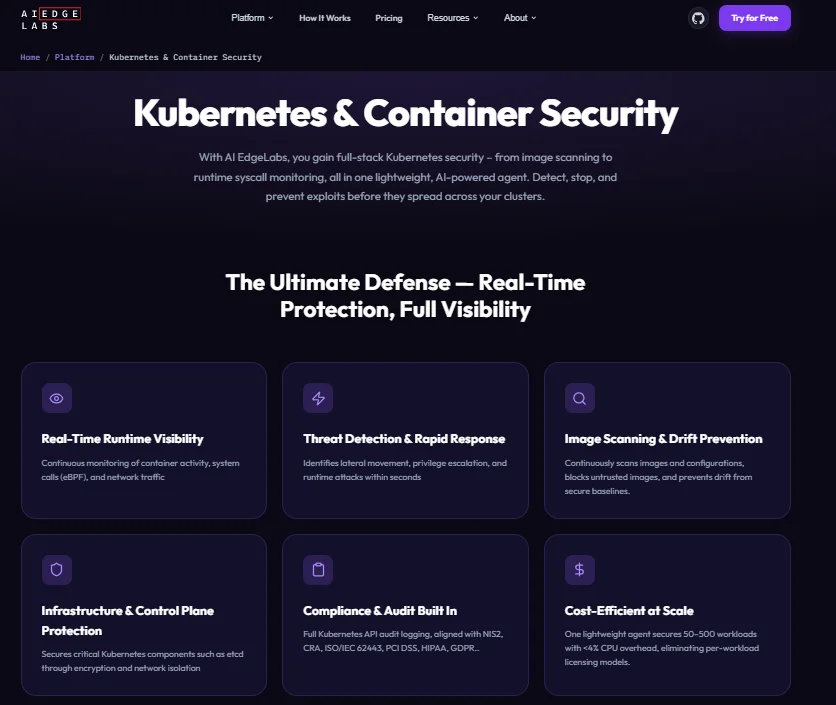
- Detection method: eBPF kernel-level syscall monitoring; sees fileless execution and namespace abuse live.
- Detection AND response: both run on the agent, including in-line, time-boxed source-IP blocking.
- Cloud dependency: none; Disconnected Mode keeps full detection and response working offline.
- Deployment reach: cloud, data center, on-prem, and air-gapped, where cloud-dependent tools cannot run.
- Footprint: lightweight single agent, typically under 5% CPU (EdgeLabs' own claim, not independently verified).
- Exploited-vulnerability scoring: CVSS plus EPSS plus CISA KEV plus CWE, tied to a CRA/NIS2 Compliance Center.
- Published case study (Trader Joe's): 83% MTTR reduction, 573% ROI, sub-2-week deploy, 0 outages (EdgeLabs' own published claim, not independently verified).
- Runs as a single privileged container sharing host PID and network namespaces, deployed as a DaemonSet across Docker, Kubernetes, OpenShift, Talos, and K3S on x86_64 and ARM_64.
- Secures GPU workloads using only CPU, so detection does not tax the GPU budget, as shown in our GPU cloud security case study.
"Good IPS/IDS/EDR software. Webportal management is good. Docker container integration is useful."
Verified User in Computer Software · EdgeLabs G2 Verified Review
"It's beneficial to secure any website or any server from hackers. I don't think there is any option for dislike but the commercial seems high."
Abhishek A. · EdgeLabs G2 Verified Review

Sysdig
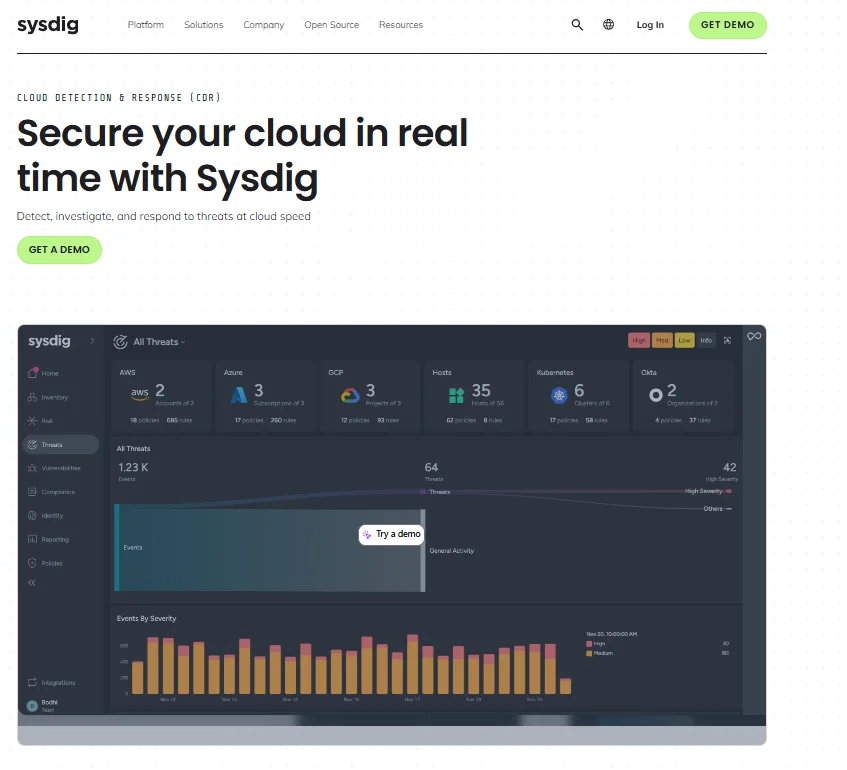
- Detection method: eBPF kernel-level via Falco; a genuine, mature runtime engine.
- Detection AND response: strong detection; response and correlation lean on the cloud platform.
- Cloud dependency: the full platform expects a cloud backend, unlike agent-only designs.
- Deployment reach: excellent cloud and Kubernetes coverage; less oriented to air-gapped operation.
- Footprint: Falco is efficient; the broader platform adds more than a single lightweight agent.
- Exploited-vulnerability scoring: runtime-informed vulnerability prioritization is a core strength.
- Falco surpassed 100 million downloads and graduated within the CNCF in February 2024, with contributors from IBM, Apple, and Red Hat.
- Companies publicly building on Falco include Shopify, GitLab, and Skyscanner.
- Falco was an early pioneer of applying eBPF to security.
Aqua Security
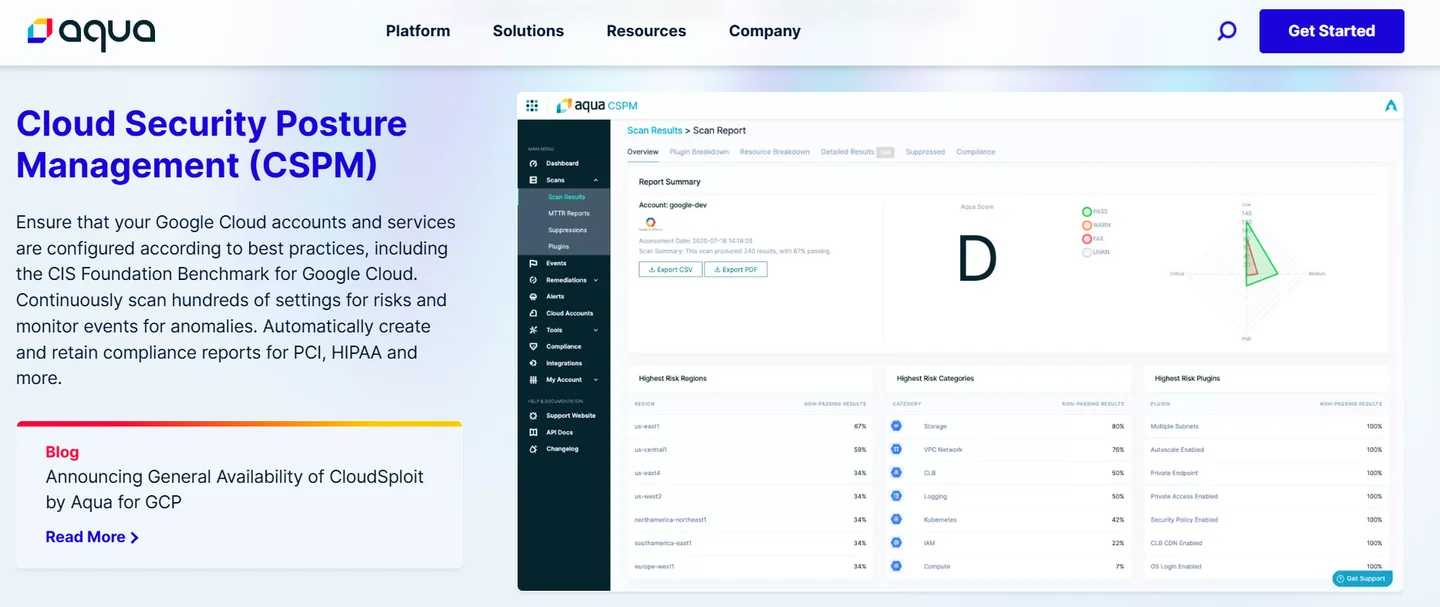
- Detection method: eBPF runtime via Tracee, plus deep build-time image scanning.
- Detection AND response: strong across the lifecycle; runtime response is one part of a broad platform.
- Cloud dependency: self-hosted options exist, but the full platform is heavier to run.
- Deployment reach: broad cloud, Kubernetes, and container coverage across hybrid setups.
- Footprint: platform-scale, more than a single lightweight agent.
- Exploited-vulnerability scoring: mature vulnerability management via Trivy and platform prioritization.
- Maintains Trivy, one of the most widely adopted open-source vulnerability scanners.
- Maintains Tracee, an eBPF-based runtime detection project.
- Long track record in enterprise container security since 2015.
CrowdStrike (Falcon)
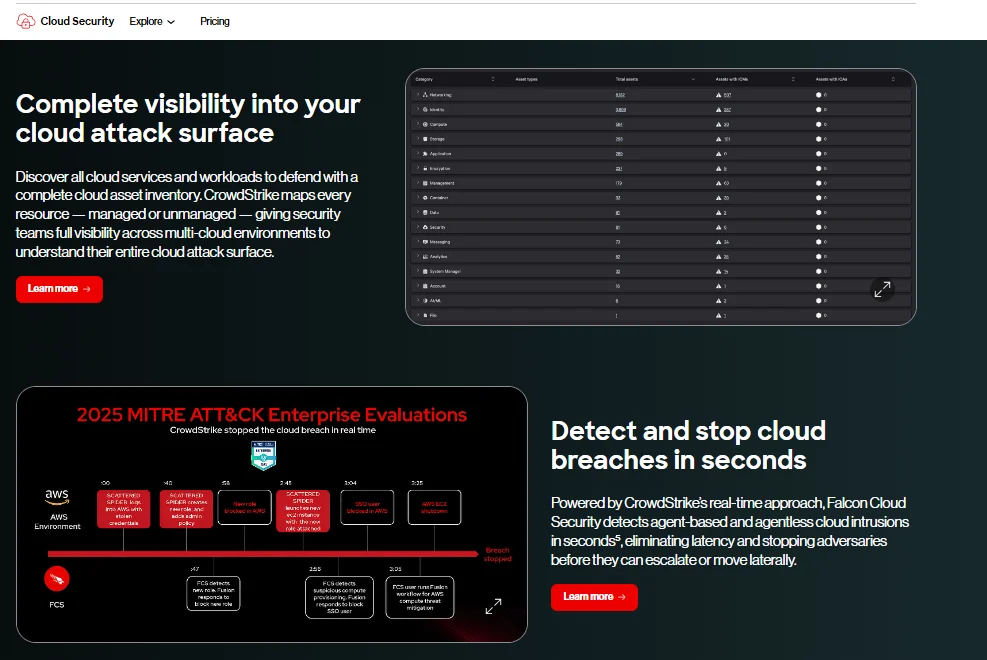
- Detection method: strong endpoint sensor; cloud and container runtime is added on top.
- Detection AND response: mature response, but oriented around the endpoint engine first.
- Cloud dependency: cloud-dependent; the model assumes a live backend connection.
- Deployment reach: excellent endpoint and cloud reach; not built for air-gapped runtime response.
- Footprint: a capable agent, but broader than a single runtime-focused sensor.
- Exploited-vulnerability scoring: strong threat intelligence feeding prioritization.
- One of the most widely deployed endpoint platforms in the enterprise.
- Well-known threat intelligence and incident response practice.
- Broad cloud and container module coverage.
SentinelOne (Singularity Cloud)
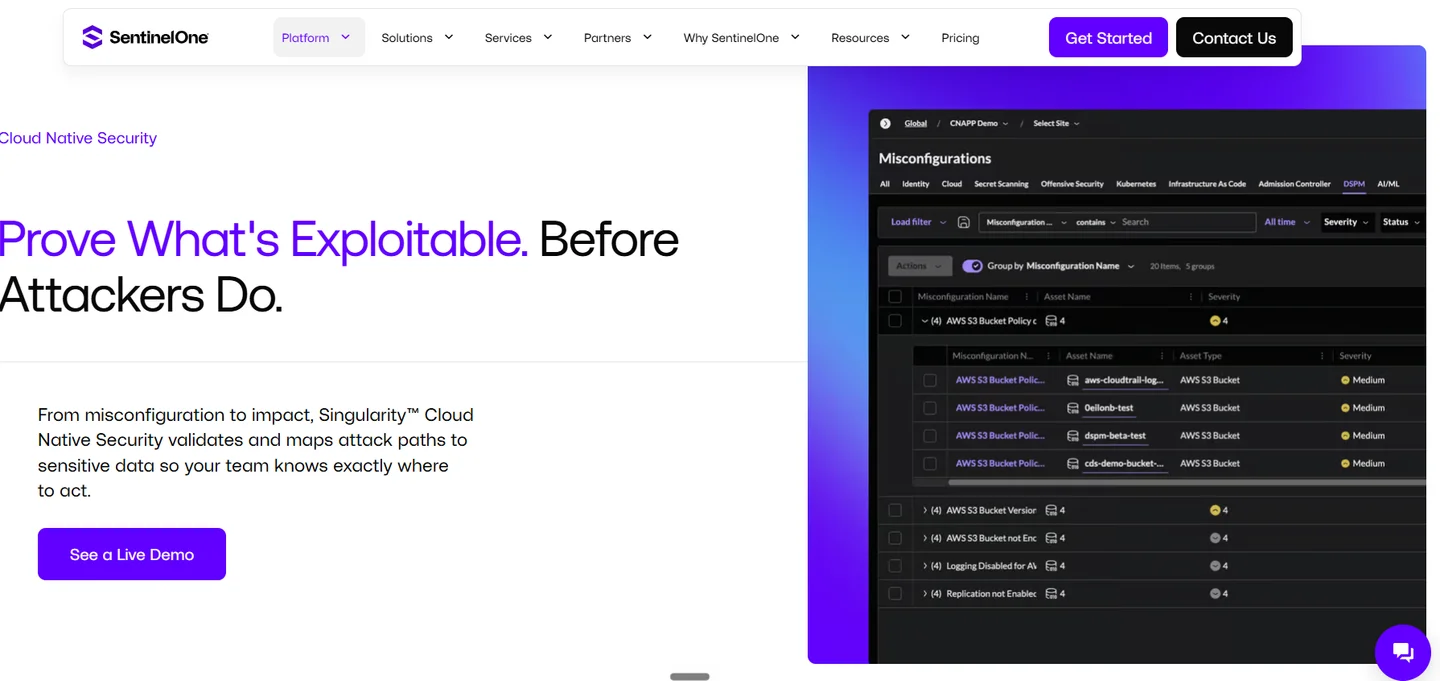
- Detection method: behavioral AI on the endpoint, extended to cloud workloads.
- Detection AND response: notable autonomous response, still endpoint-first in structure.
- Cloud dependency: cloud-dependent for full platform function.
- Deployment reach: strong endpoint and cloud coverage; not built for air-gapped runtime.
- Footprint: a capable multi-purpose agent.
- Exploited-vulnerability scoring: platform-driven prioritization.
- Widely deployed autonomous endpoint protection platform.
- Established presence in enterprise XDR.
- Cloud workload protection module for containers and cloud.
Oligo Security
- Detection method: monitors application libraries at runtime, a genuinely useful angle.
- Detection AND response: strong on detection; response is narrower than a full runtime platform.
- Cloud dependency: cloud-hosted model.
- Deployment reach: application-runtime focused rather than full infrastructure coverage.
- Footprint: lightweight application sensor.
- Exploited-vulnerability scoring: focuses on which libraries actually execute and get exploited.
- Recognized among emerging application-runtime security vendors.
- Focus on runtime library exploitation and supply-chain risk.
- Positioned for teams with heavy open-source dependency exposure.
Upwind Security
- Detection method: eBPF runtime sensor, a modern and credible approach.
- Detection AND response: runtime context correlated in the cloud platform.
- Cloud dependency: requires a cloud backend to correlate and respond.
- Deployment reach: cloud-first; not designed for on-prem or air-gapped operation.
- Footprint: lightweight sensor, heavier cloud platform behind it.
- Exploited-vulnerability scoring: runtime context informs prioritization across workloads and APIs.
- Modern eBPF-based runtime approach to CNAPP.
- Correlation across workloads, APIs, and cloud identity.
- Positioned for cloud-native teams already on a cloud backend.
Falco (CNCF OSS)
- Detection method: the de facto open-source eBPF runtime detection standard.
- Detection AND response: detection-only by itself; response requires bolt-on tooling like Falcosidekick.
- Cloud dependency: none; fully self-hostable.
- Deployment reach: runs anywhere you run it, including air-gapped, if you operate it yourself.
- Footprint: efficient, but you own tuning and maintenance.
- Exploited-vulnerability scoring: not its job; it detects behavior, it does not score CVEs.
- Graduated within the CNCF in February 2024 with 100 million-plus downloads.
- Contributors from IBM, Apple, and Red Hat.
- The rules engine underneath several commercial platforms.
Tetragon and Tracee (eBPF OSS)
- Detection method: low-level eBPF observability and, with Tetragon, kernel-level enforcement.
- Detection AND response: Tetragon can enforce inline; both need you to build the platform around them.
- Cloud dependency: none; fully self-hostable.
- Deployment reach: runs anywhere, including air-gapped, when you operate it yourself.
- Footprint: efficient primitives, but not a finished product.
- Exploited-vulnerability scoring: Tracee aids detection; neither is a compliance or scoring platform.
- Tetragon is part of the CNCF Cilium project.
- Tracee is Aqua's open-source runtime tracing engine.
- Both are widely used as primitives inside larger security stacks.
Q2: How Should You Evaluate a CADR Tool Before You Shortlist?
Judge each CADR tool on six criteria: detection method (eBPF and kernel-level versus agentless posture), detection AND response at runtime, cloud dependency (agent-only versus cloud-required), deployment reach (cloud, data center, edge, self-hosted, and air-gapped), agent footprint, and exploited-vulnerability and explainability scoring. Also check the underlying engine: Falco, Tetragon, Tracee, or proprietary.
🧭 The Six Criteria I'd Apply on Monday
I built this rubric to be usable by a non-expert. Each line is one thing to check and why it matters.
- Detection method. Does it use eBPF (a safe way to run code in the Linux kernel) or just agentless posture scanning? Kernel-level sees what actually runs.
- Detection AND response. Can it kill, pause, or block the attack live, or does it only alert? Alerts alone do not stop a breach.
- Cloud dependency. Is it agent-only or cloud-required? This decides whether it works when the network is cut.
- Deployment reach. Does it cover cloud, data center, edge, self-hosted, and air-gapped hosts? A tool that cannot reach the environment cannot protect it.
- Agent footprint. How much CPU and memory does it cost per node? Overhead decides whether teams keep it on.
- Exploited-vulnerability and explainability scoring. Does it rank by what is actually exploited (CVSS plus EPSS plus CISA KEV), or just theory? This is how you fix the right thing first. Our approach to exploited-vulnerability scoring and vulnerability management is built around exactly that question.
🔧 The Seventh Check: What Engine Is Under the Hood?
There is one more filter smart buyers apply. Ask which runtime engine the tool is built on: Falco, Tetragon, Tracee, or a proprietary one.
The engine is a trust signal. Falco is CNCF-graduated and the open-source standard many sensors layer above. Knowing the substrate tells you how mature and inspectable the detection really is. If you want to see how a single agent layers Kubernetes runtime protection above that foundation, our platform pages walk through it.
A hard-won note on why "detection AND response" is on the list. I have seen audited environments fail at a near-100% rate, not because tools were missing, but because they were installed and never given a policy to act on. A tool that can respond, and is actually configured to, beats a shelf full of silent sensors. That is a lived observation, not a spec-sheet claim.
👥 Who This Guide Is For
- SMB SecOps and DevSecOps leads making cloud and AI workloads production-safe.
- AI-workload and LLM-agent runtime-security owners securing agents in production.
- Kubernetes and container runtime-security owners moving past build-time scanning.
- GPU-cloud and AI-infrastructure security leads protecting inference nodes.
One honesty note before the roster. These six criteria do not cover everything. They do not judge lifecycle governance, program controls, or vendor viability, and I will flag those gaps where they matter, including for EdgeLabs. The rubric is built to pick a runtime workload and application security tool, not to run a whole security program.
The 10 Best CADR Tools
No single CADR tool is objectively first. Each fits a different runtime situation. EdgeLabs suits self-hosted and air-gapped runtime detection and response with no cloud backend; Sysdig and Falco suit Kubernetes-native detection; CrowdStrike and SentinelOne extend endpoint-first estates; Oligo and Upwind suit cloud-hosted application runtime; Aqua covers container lifecycle. You can see how agent-only detection and response works before comparing the field below.
🗂️ The Tools at a Glance
- EdgeLabs: Best for self-hosted, on-prem, or air-gapped runtime detection and response with no cloud backend.
- Sysdig: Best for Kubernetes-native runtime detection built on the Falco engine at scale.
- Aqua Security: Best for full container lifecycle security spanning build-time and runtime.
- CrowdStrike (Falcon): Best for endpoint-first estates extending into cloud runtime from one console.
- SentinelOne (Singularity Cloud): Best for autonomous endpoint-and-cloud response in one XDR platform.
- Oligo Security: Best for application-layer runtime detection of library and supply-chain exploitation.
- Upwind Security: Best for cloud-hosted runtime correlation across workloads, APIs, and identity.
- Falco (CNCF OSS): Best for teams wanting an open-source, self-managed Kubernetes runtime rules engine.
- Tetragon and Tracee (eBPF OSS): Best for teams needing kernel-level eBPF enforcement or tracing they run themselves.
📊 Master Comparison Table
| Company | Best For | Detection & Response Model | Deployment & Environment Coverage |
|---|---|---|---|
| EdgeLabs | Self-hosted or air-gapped runtime that must respond with no cloud backend | Agent-only runtime detection AND response on the agent | Cloud, data center, on-prem, and air-gapped; Kubernetes, containers, GPU and AI-inference nodes |
| Sysdig | Kubernetes-native detection built on Falco at scale | Falco-based detection with a cloud-hosted platform for response | Cloud and Kubernetes-first; platform features expect a cloud backend |
| Aqua Security | Full container lifecycle, build-time through runtime | Agent plus platform; build-time scanning and runtime protection | Cloud, Kubernetes, and containers; hybrid and self-hosted options |
| CrowdStrike (Falcon) | Endpoint-first estates extending into cloud runtime | XDR and endpoint-first engine with a cloud runtime module | Cloud-dependent; endpoint, cloud, and container from one console |
| SentinelOne (Singularity Cloud) | Autonomous endpoint-and-cloud response in one platform | XDR and endpoint-first with autonomous cloud response | Cloud-dependent; endpoint, cloud, and container |
| Oligo Security | Application-layer detection of library and supply-chain exploitation | Application runtime sensor, detection-led | Cloud-hosted application runtime |
| Upwind Security | Cloud-hosted runtime correlation across workloads, APIs, and identity | eBPF sensor feeding a cloud-hosted correlation platform | Cloud-first; requires a cloud backend |
| Falco (CNCF OSS) | Open-source, self-managed Kubernetes runtime rules engine | OSS rules engine, detection only (response via add-ons) | Self-hosted anywhere; Kubernetes, containers, and hosts |
| Tetragon and Tracee (eBPF OSS) | Kernel-level eBPF enforcement or tracing you run yourself | OSS eBPF engines; detection with inline enforcement (Tetragon) | Self-hosted anywhere; Kubernetes, containers, and Linux hosts |
Total providers: 9. The full field-assessment card for each tool (Tags, Facts, criteria breakdown, Differentiator, Proof of execution, Pricing, Potential limitation, and My take) follows this table, with EdgeLabs at position 1. EdgeLabs is the only card carrying third-party reviews, because the runtime AI-security category is young and most rivals have no public review profile yet. The nine cards, 1.1 EdgeLabs through 1.9 Tetragon and Tracee, are presented in the dedicated card set.
Q4: Do CADR Tools Need Agents, and What Response and Overhead Should You Expect?
Most CADR detection runs on lightweight eBPF sensors in kernel space, typically low single-digit CPU overhead, and the modern eBPF driver generally needs a host kernel of 5.8 or newer. Good tools respond with graduated actions, kill, pause, or soft-quarantine a workload, or block a source IP, without taking production down, and agent-only designs keep responding with no cloud backend.
⚙️ Agents, Overhead, and the Kernel You Actually Need
Here is the plain answer. Most real CADR detection needs an agent, because only something on the host can watch syscalls (the calls a program makes to the kernel) as they happen.
That agent is usually eBPF-based, which is why overhead stays low, often in the low single digits of CPU. One prerequisite trips teams up. The modern eBPF driver needs a Linux kernel of 5.8 or newer; the older probe goes back to 4.14. If you run RHEL 8 or older, plan a kernel upgrade first.
🛑 Response That Does Not Break Production
Detection is half the job. Response is the half that saves you, and good response is graduated, not a sledgehammer.
- Kill: stop the malicious process outright.
- Pause: freeze a workload for investigation without deleting it.
- Soft-quarantine: isolate a container so it cannot spread, while keeping evidence.
- Block a source IP: time-boxed, host-local blocking that expires on its own. This is part of our in-line network protection.
The point is control. You want to stop the attack without taking down the healthy half of production alongside it.
⏰ The Real Test: What Happens When the Backend Goes Dark?
Here is the question I would ask any vendor. If the cloud link drops, does detection AND response keep working, or does the tool go quiet?
That is where agent-only designs matter. A security lead once asked me, mid-PoC, whether the agent would still block an attack with the backend cut, three days before an audit. Deterministic, on-host enforcement is what answers "yes." Hooks that fire in the kernel are deterministic, so a guardrail you set will trigger regardless of whether a far-off control plane is reachable.
This is the exact gap EdgeLabs was built to close. We run detection AND response entirely on the agent, with a Disconnected Mode that keeps both alive offline, including host-local, time-boxed source-IP blocking, and a footprint EdgeLabs publishes as typically under 5% CPU (EdgeLabs' own claim, not independently verified). My read on the next two years is simple. Distributed AI computing forces distributed security, so response that survives a dead backend stops being a nice-to-have and becomes the default question every SecOps team asks. If that question is live for you, our team is happy to compare notes.
Q5: Can CADR Secure LLM Agents and AI Workloads at Runtime, Not Just Containers?
The same runtime engine that flags a rogue container can flag an LLM agent making a tool call it has never made. As agents gain autonomy, CADR extends behavioral baselining to agent execution graphs, MCP servers, and GPU inference nodes, because you can patch a bug, but you cannot patch a model's judgment, so enforcement has to happen at runtime.
🤖 The Standard Read on Guardrails Gets This Backwards
Here is the quiet part the category avoids saying. Guardrails alone do not stop a determined attacker. They filter the obvious and miss the clever.
Prompt injection, tricking a model with hidden instructions, is the number-one risk on the OWASP Top 10 for LLM Applications, and it has held that spot since the list debuted in 2023. Researchers have driven successful attack rates as high as 73% in agent benchmarks before layered defenses claw it back down. The reason is structural. An LLM reads instructions and data in the same context, so a "clean" pre-flight check cannot promise a safe run.
🧨 Why Runtime Enforcement, Not a Pre-Flight Check
Think of an LLM agent as a new kind of insider. You would not hand a new employee root access and trust a one-time interview. You would supervise what they actually do.
The risk sharpens when three things line up: untrusted input, access to private data, and a way to send data out. That combination is what turns a chatty model into an exfiltration path. The fix is behavioral. You watch the agent's real execution graph, the actual sequence of tool calls, and you stop the one it has never legitimately made. Deterministic, in-kernel hooks fire regardless of what the model "decides," which is exactly why enforcement belongs at runtime, not in a prompt.
🛠️ What an AI-Agent Owner Does on Monday
If you own an agent in production, here is a concrete starting list.
- Baseline the agent's normal tool calls, then alert on any new or out-of-pattern call.
- Isolate untrusted content from private data and outbound channels, so the three-part trap cannot close.
- Watch MCP servers (Model Context Protocol, how agents call external tools) for tool-poisoning, where a tool's description is tampered with.
- Monitor GPU inference nodes for cryptojacking and drift, ideally without taxing the GPU itself.
This is the wedge EdgeLabs built for. Our Parallax AI and LLM security engine runs as an LLM proxy and firewall, doing input and output alignment, prompt-injection and tool-poisoning defense, and hallucination checks, and it secures GPU workloads using only CPU (EdgeLabs' own published claims, not independently verified). A secondary AI-assist module can draft incident-response playbooks, but the product is runtime enforcement, not a dashboard. Where my head is right now: over the next two years, distributed AI computing forces distributed security, and "who is supervising your agent at runtime?" becomes the default question, not a niche one. If you are wrestling with that, I would genuinely like to compare notes.
Q6: How Does CADR Prioritize Exploitable Vulnerabilities and Prove CRA/NIS2 Compliance?
CADR scores vulnerabilities on what is actually exploitable, combining CVSS severity, EPSS probability, the CISA KEV catalog, and CWE, instead of drowning teams in CVSS-only noise, and turns runtime evidence into compliance proof. That context maps directly to EU CRA and NIS2 obligations that increasingly demand demonstrable runtime protection, not posture reports.
📉 The Situation: CVSS-Only Buries the Real Risk
Every scanner produces a mountain of CVEs (public vulnerability records). Most teams then patch by CVSS score alone, the 0-to-10 severity rating.
The trouble is that a scary CVSS score does not mean a bug is being exploited. You end up fixing what looks frightening on paper while the actually-exploited flaw waits. You cannot govern a risk you have mis-ranked.
🎯 The Fix: Exploited-Vulnerability, Explainability Scoring
The resolution is to layer four signals, so the ranking reflects reality.
- CVSS: how severe the flaw is in theory.
- EPSS: the probability it gets exploited, from FIRST.org.
- CISA KEV: whether it is on the U.S. catalog of vulnerabilities known to be exploited in the wild.
- CWE: the underlying weakness type, for explainability.
Add runtime context, what is actually executing, and a list of thousands narrows to the handful that matter. That is the difference between busywork and defense, and it is the core of our exploited-vulnerability scoring and vulnerability management.
📋 Mapping Runtime Evidence to CRA and NIS2
Regulation is catching up to this logic. The EU Cyber Resilience Act, Annex I, requires that products be "delivered without any known exploitable vulnerabilities." That is an exploitability test, not a posture checkbox.
Runtime evidence, showing what ran and what you stopped, is strong proof for that check and for NIS2 incident-handling duties. This is exactly what EdgeLabs' shipping CRA and NIS2 Compliance Center is built to produce, mapping controls to requirement IDs and running the Annex I "No Known Exploitable Vulnerabilities" check against runtime and build-time SBOM (a software bill of materials). If you want a practical starting point, we published a practical CRA roadmap for security and compliance teams. I will be candid about the boundary, though. The Compliance Center covers runtime, vulnerability-handling, and detection-and-response controls; it does NOT cover lifecycle and program controls like business continuity, backup, MFA-as-a-program, HR training, or the CRA's multi-year support obligations. EdgeLabs publishes case figures such as an 83% MTTR reduction (its own claim, not independently verified), and I would still tell you to demand that proof against your own workload before you buy.
Q7: Which CADR Tool Should You Choose for Your Situation?
Choose by the situation you are actually in. Self-hosted or air-gapped runtime that must respond with no cloud backend points to agent-only platforms; Kubernetes-native teams lean to the Falco ecosystem or Sysdig; endpoint-first estates extend CrowdStrike or SentinelOne; and AI-agent owners need a tool that enforces at the agent, not a governance dashboard.
🧭 Match the Tool to the Problem You Have
The mistake I see most is buying by brand, not by situation. Start from where your workloads actually run.
| Your situation | The tool type that fits |
|---|---|
| Self-hosted, on-prem, or air-gapped, must respond offline | Agent-only runtime platform (EdgeLabs) |
| Kubernetes-native, want the open-source substrate | Falco ecosystem or Sysdig |
| Large endpoint estate extending into cloud | XDR and endpoint-first (CrowdStrike, SentinelOne) |
| Owning LLM agents and GPU inference in production | Runtime enforcement for agents, not a dashboard |
🤝 Where EdgeLabs Fits, and Where It Does Not
I would rather be useful than universal. EdgeLabs is the right call when you need agent-only runtime detection AND response that keeps working with the cloud link cut, self-hosted or air-gapped, and when you are securing AI workloads and agents.
It is the wrong call in a few clear cases, and I will name them. If your primary job is pure OT or ICS visibility, IoT-hardware security, build-time-only application security, or identity and CIEM as the main event, that is not our lane. If you fit the agent-only, no-cloud-dependency profile, EdgeLabs has a free self-serve tier so you can try it before you talk to anyone, and I would rather you test it against your own environment than take my word. If you want to see the mechanics first, our how it works page walks through the agent, and our team is glad to talk. The question I keep sitting with is simple: when your backend goes dark mid-attack, does your current tool still fight back? If that question keeps you up, let's talk.
FAQs
CADR tools deliver Cloud Application Detection and Response, watching what your cloud application is doing in real time rather than how it is configured.
A CNAPP largely checks posture and build-time settings, which is a snapshot. CADR is the live video feed, catching an attack as it executes across APIs, containers, Kubernetes, and cloud identity.
- CNAPP: mostly posture and build-time; broad configuration coverage.
- CADR: the runtime detection-and-response layer that catches what actually runs.
- Relationship: CADR complements CNAPP; it is not a rip-and-replace.
The honest read is that a clean posture report tells you the door should be locked, not that someone is already inside. That gap is exactly what our runtime workload and application security approach was built to close, with detection and response running on the agent itself.
No single CADR tool is objectively first, because each fits a different runtime situation. We compared nine credible options across the same seven criteria.
- EdgeLabs: self-hosted, on-prem, or air-gapped runtime detection and response with no cloud backend.
- Sysdig and Falco: Kubernetes-native detection built on the open-source Falco engine.
- Aqua Security: full container lifecycle, build-time through runtime.
- CrowdStrike and SentinelOne: endpoint-first estates extending into cloud runtime.
- Oligo and Upwind: cloud-hosted application and workload runtime correlation.
- Tetragon and Tracee: raw eBPF primitives for engineering-heavy teams.
The differentiator we keep returning to is dependency. If the cloud link drops mid-attack, does the tool still respond? You can see how agent-only detection and response keeps working offline, which is the lane many cloud-dependent platforms cannot cover.
Most real CADR detection needs an agent, because only something on the host can watch syscalls as they happen.
That agent is usually eBPF-based, which is why overhead stays low, often in the low single digits of CPU. One prerequisite trips teams up.
- Modern eBPF driver: generally needs a Linux kernel of 5.8 or newer.
- Older probe: reaches back to kernel 4.14.
- Planning note: on RHEL 8 or older, plan a kernel upgrade first.
Footprint matters because overhead decides whether teams keep the tool switched on. We publish a typical footprint of under 5% CPU (our own claim, not independently verified), and our Kubernetes runtime protection deploys as one agent per node with no sidecars, so the cost of running it does not creep as clusters grow.
Yes, and this is where the category is heading. The same runtime engine that flags a rogue container can flag an LLM agent making a tool call it has never made.
Guardrails alone do not stop a determined attacker. Prompt injection has been the number-one OWASP LLM risk since 2023, because a model reads instructions and data in the same context.
- Baseline the agent's normal tool calls, then alert on out-of-pattern calls.
- Isolate untrusted input from private data and outbound channels.
- Watch MCP servers for tool-poisoning and GPU nodes for cryptojacking.
You can patch a bug, but you cannot patch a model's judgment, so enforcement has to happen at runtime. Our Parallax AI and LLM security engine runs as an LLM proxy doing prompt-injection and tool-poisoning defense, and secures GPU workloads using only CPU (our own published claim).
Good CADR tools score vulnerabilities on what is actually exploitable, not on theoretical severity alone.
Most teams patch by CVSS score only, but a scary CVSS number does not mean a bug is being exploited. You end up fixing what looks frightening on paper while the truly exploited flaw waits.
- CVSS: how severe the flaw is in theory.
- EPSS: the probability it gets exploited, from FIRST.org.
- CISA KEV: whether it is known-exploited in the wild.
- CWE: the underlying weakness type, for explainability.
Layer those four signals with runtime context, and a list of thousands narrows to the handful that matter. That is the core of our exploited-vulnerability scoring and vulnerability management, which turns runtime evidence into a defensible patching order rather than busywork.
CADR tools help by turning runtime evidence into compliance proof, which regulators increasingly demand over posture reports.
The EU Cyber Resilience Act, Annex I, requires that products be delivered without any known exploitable vulnerabilities. That is an exploitability test, not a checkbox.
- Runtime evidence: shows what ran and what you stopped.
- Control mapping: ties detections to specific requirement IDs.
- SBOM: runtime and build-time software bill of materials.
We will be candid about the boundary. Our CRA and NIS2 Compliance Center covers runtime, vulnerability-handling, and detection-and-response controls. It does not cover lifecycle or program controls like business continuity, backup, MFA-as-a-program, or HR training. For a practical starting point, we published a CRA readiness roadmap for security and compliance teams.
Choose by the situation you are actually in, not by brand recognition. Start from where your workloads run.
- Self-hosted or air-gapped, must respond offline: an agent-only runtime platform.
- Kubernetes-native: the Falco ecosystem or Sysdig.
- Large endpoint estate: XDR and endpoint-first players like CrowdStrike or SentinelOne.
- LLM agents and GPU inference: runtime enforcement at the agent, not a governance dashboard.
We would rather be useful than universal, so we will name where we are the wrong call: pure OT or ICS visibility, IoT-hardware security, build-time-only application security, or identity and CIEM as the main job. If you fit the agent-only, no-cloud-dependency profile, our free self-serve tier lets you test against your own environment before you talk to anyone, and our team is glad to compare notes.
All three do runtime detection and response, but they watch different layers, which is why buyers mix them up.
- EDR (Endpoint Detection and Response): endpoint-first, watching hosts and workstations.
- CDR (Cloud Detection and Response): log-based, watching the cloud control plane.
- CADR (Cloud Application Detection and Response): application-aware, watching APIs, containers, Kubernetes, and cloud identity together.
The practical distinction is context. EDR treats the cloud as an extension of an endpoint engine, and CDR sees logs but not deep application and container behavior. CADR adds live execution context across the full four-layer attack chain, from API to IAM.
We consolidate that context into one eBPF agent covering network, workload, container, and Kubernetes detection with response. You can see how our runtime security platform unifies these layers rather than bolting runtime onto an endpoint tool.
