TL;DR
- Attacks on AI agents execute at runtime, not at scan time, so posture scanning alone cannot stop a poisoned tool call or an injected instruction once the agent acts.
- The lethal trifecta of untrusted content, private data, and external communication makes exfiltration trivial, and some injection techniques succeed up to 88% of the time.
- Cloud-dependent CNAPP and NDR tools go blind in self-hosted, on-prem, or air-gapped GPU environments, while agent-only tools keep detection and response alive offline.
- CVSS-only backlogs waste effort, since roughly 88% of CVEs sit under 10% exploitation probability; layering EPSS and CISA KEV fixes what is actually exploited.
- The roster covers EdgeLabs, Oligo Security, Zenity, Astelia, WitnessAI, and a Microsoft open-source project, each fitting a distinct buyer situation rather than a ranking.
- Choose by your hardest constraint: EdgeLabs runs agent-only detection and response with no cloud dependency, covering self-hosted, on-prem, and air-gapped GPU nodes.
Q1. Why look past Sysdig for LLM and AI-agent workloads at runtime?
Choosing a runtime security tool for AI agents is a high-stakes call, because attacks execute at runtime, not at scan time. A clean posture scan can pass while an agent is already deleting data. A tool that cannot reach self-hosted or air-gapped environments cannot protect them at all. Alert noise buries the one signal that mattered. I evaluated several Sysdig alternatives against five criteria: LLM and agent runtime protection, enforcement versus governance, agent-only no-cloud operation, GPU node coverage, and category maturity. This guide is written for the AI-workload and LLM-agent runtime-security owner.
🎯 The honest answer up front
Sysdig is a strong, credible player. It carries deep Falco heritage, broad cloud coverage, and now ships AI Workload Security plus Sysdig Sage for AI-assisted analysis. I want to credit that before I contrast it. The team behind Falco effectively created the open-source syscall detection engine most of this category leans on.
Buyers still leave Sysdig for three specific reasons. It is not built to lead on an MCP-native broker or action firewall for agent tool calls (MCP means Model Context Protocol, the way agents call external tools). It is more cloud and platform oriented, so detection and response lean on a cloud backend. And its consolidation stops at the CNAPP boundary (CNAPP means Cloud-Native Application Protection Platform).
⚠️ Why a runtime miss costs more with agents
Here is the part the category gets backwards. Most teams still treat a passing scan as proof of safety. Posture scanning is build-time and theoretical. Runtime is where the agent actually acts.
An LLM agent is a new kind of insider. It can read untrusted content, touch private data, and make network calls, all in one autonomous loop. When those three combine, exfiltration is trivial. You cannot patch that behavior away. As the field puts it plainly, you can patch a bug, but you cannot patch a brain.
So the real question a buyer is resolving is blunt: if I give this hallucinating AI autonomy over my compute and data, will it bankrupt me by morning? The answer depends on whether dangerous actions are physically blocked at runtime, or merely discouraged by a config file the agent can ignore. This is exactly where runtime detection and response earns its place.
🧭 The axis this guide scores on
Every tool below is judged on where it runs and what it can stop while running. Does detection and response keep working with no cloud backend? Can it broker and inspect agent tool calls? Does it reach self-hosted, on-prem, and air-gapped GPU nodes?
This is EdgeLabs' lane. We built agent-only runtime detection and response with no cloud dependency, so it keeps working self-hosted, on-prem, and air-gapped. I will place EdgeLabs first, then walk each alternative fairly, naming what it does well and where it stops.
📋 Our Evaluation Criteria
I picked five criteria that actually decide AI-agent runtime outcomes, not generic checkboxes.
- LLM and agent runtime protection. Does it defend live agents against prompt injection and MCP tool poisoning, or only scan them before deployment? This is the core job.
- Enforcement versus governance-only. Can it physically block a dangerous action, or does it just report and advise? A permission system that cannot perform the action is a real guardrail.
- Agent-only, no-cloud operation. Does detection and response keep running with the cloud link cut, in self-hosted or air-gapped setups? Many tools go blind here.
- GPU and inference-node protection. Does it cover GPU clusters and AI inference nodes without taxing the GPU budget? AI workloads live on expensive hardware.
- Category maturity. Is the tool proven and reviewed, or early and thinly documented? This market is young, so honesty matters more than hype.
👥 Who This Guide Is For
- AI-workload and LLM-agent runtime-security owners securing agents and agentic systems in production, and losing sleep over autonomous actions.
- SecOps and DevSecOps leads at SMBs making cloud and AI or GPU workloads production-safe without a 24/7 team.
- GPU-cloud and AI-infrastructure security leads protecting inference nodes and clusters from cryptojacking and workload abuse.
- Teams needing detection and response that keeps working self-hosted, on-prem, or air-gapped, where cloud-dependent tools cannot reach.
🗂️ The alternatives at a glance
No numbered ranking here. Each tool exists for a different situation, so I list them by the job they fit best.
- EdgeLabs: Best for agent-only runtime detection AND response with no cloud backend (self-hosted, on-prem, air-gapped).
- Oligo Security: Best for runtime, library-level detection of what your application code actually executes.
- Zenity: Best for inventory and governance across many business-built AI agents and copilots.
- Astelia: Best for LLM and agent guardrail and alignment layers in production.
- WitnessAI: Best for governing and policing how employees and apps use LLMs.
- Microsoft open-source agentic-security project: Best for teams wanting an open-source starting point (exact repo pending confirmation).
📊 Master comparison table
Total providers: 6
| Company Name | Best For | Detection & Response Model | Deployment & Environment Coverage |
|---|---|---|---|
| EdgeLabs (1 of 6) | Agent-only runtime detection and response with no cloud backend | Agent-only runtime detection AND response on the agent; eBPF kernel-level; one agent consolidating NDR, EDR, IPS/IDS, container/Kubernetes, vuln mgmt, and AI/agent security; Parallax for LLM/agent runtime; in-line prevention works offline (Disconnected Mode) | Cloud, data center, on-prem, air-gapped; Docker, Kubernetes, OpenShift, Talos, K3S; x86_64 and ARM_64; GPU/AI-inference nodes (secured using CPU only), per EdgeLabs' own claims |
| Oligo Security (2 of 6) | Runtime, library-level detection of what code actually executes | Runtime application detection and response; eBPF-based library and function-level monitoring of executing code; detection-led, response via alerting and integrations | Cloud and Kubernetes/container environments; runtime application layer; requires its platform to correlate findings |
| Zenity (3 of 6) | Inventory and governance of business-built AI agents and copilots | AI-governance and posture layer; agent inventory, risk assessment, and policy; governance-first rather than kernel-level runtime enforcement | Cloud-hosted; covers low-code/no-code and agent platforms (for example Copilot Studio); cloud-dependent control plane |
| Astelia (4 of 6) | LLM and agent guardrail and alignment layers in production | LLM guardrail and alignment layer; input/output checks and policy on agent behavior; governance and mediation, not kernel-level detection | Cloud-oriented; wraps LLM and agent traffic; category is early and thinly documented |
| WitnessAI (5 of 6) | Governing and policing employee and app use of LLMs | AI-usage governance and policy enforcement at the traffic layer; visibility, guardrails, and data policy for LLM interactions | Cloud-hosted policy plane in front of LLM apps; governance-first; cloud-dependent |
| Microsoft OSS agentic-security project (6 of 6) | Open-source starting point for agent security | Open-source toolkit and patterns for agent security; capability and self-build dependent; not a managed detection-and-response platform | Self-hosted wherever you run it; coverage depends on your own integration effort; exact repo pending confirmation |
Now the detailed cards. I will cover EdgeLabs and Oligo Security here, then stop. The remaining four cards follow in the next batch. If you want to see how this lands in production first, our case studies walk through real runtime deployments.
1 out of 6EdgeLabs
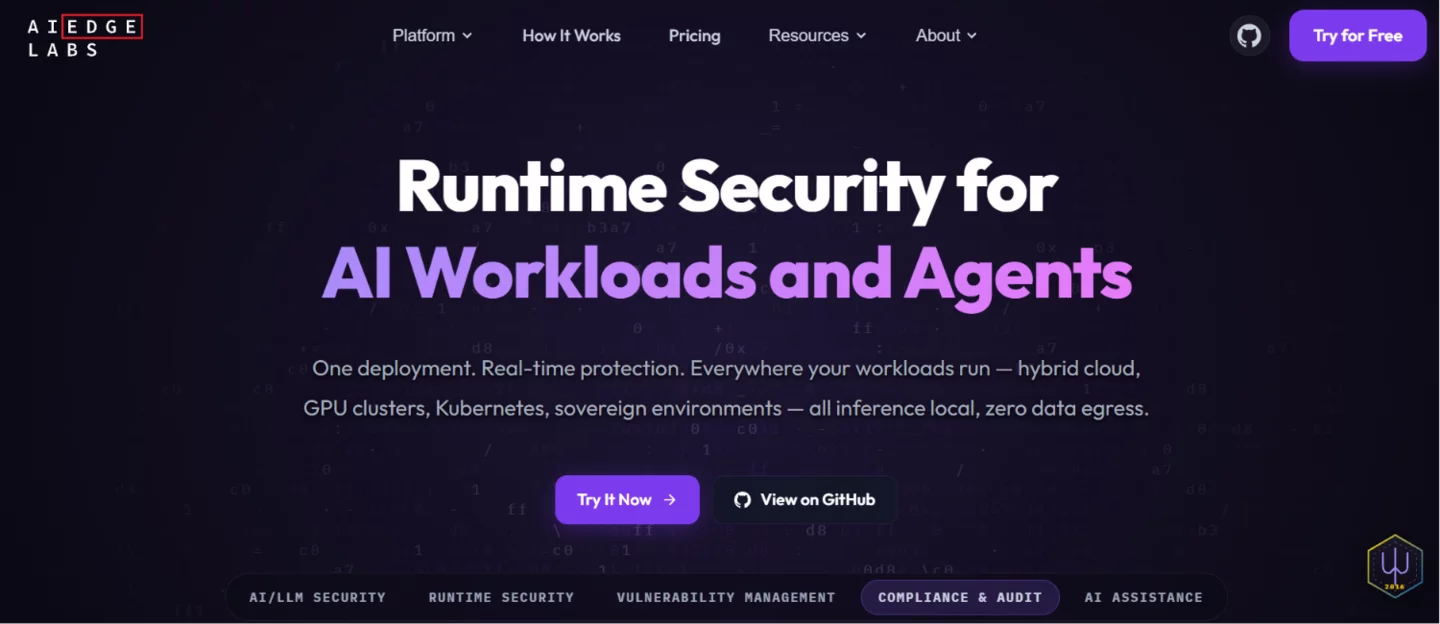
- LLM and agent runtime protection: Parallax runs an LLM proxy doing input/output alignment, prompt-injection and tool-poisoning defense, and hallucination checks against live agents.
- Enforcement versus governance-only: In-line prevention blocks source IPs host-locally for a set window (1 minute to 90 days), and it fires even with no cloud backend.
- Agent-only, no-cloud operation: Detection AND response run on the agent; Disconnected Mode keeps both working offline, self-hosted, or air-gapped.
- GPU and inference-node protection: Secures GPU clusters and inference nodes using CPU only, so it does not tax the GPU budget (EdgeLabs' own claim).
- Category maturity: Established enterprise product now opening an SMB self-serve and open-source motion; third-party reviews are still limited.
- Deploys as a Kubernetes DaemonSet, one agent per node, no sidecars, across Docker, Kubernetes, OpenShift, Talos, and K3S.
- Exploited-vulnerability and explainability scoring combines CVSS, EPSS, CISA KEV, and CWE, so teams fix what is actually exploited, not just what looks scary on paper.
- Trader Joe's published case study: 83% MTTR reduction, $1.3M operational savings, 573% ROI, under two-week deploy, zero outages (EdgeLabs' published case study).
"Good IPS/IDS/EDR software. Webportal management is good. Docker container integration is useful."
Verified User in Computer Software · EdgeLabs G2 Verified Review
"It's beneficial to secure any website or any server from hackers."
Abhishek A. · EdgeLabs G2 Verified Review

Oligo Security
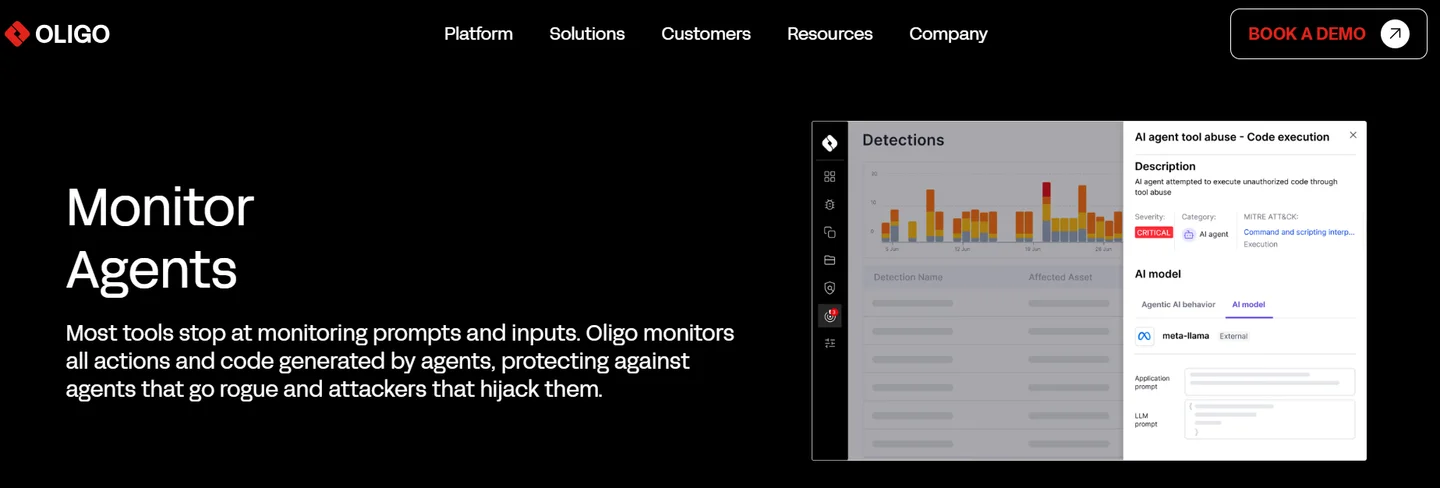
- LLM and agent runtime protection: Strong at runtime application and open-source-library monitoring; not built primarily as an MCP or agent tool-call broker.
- Enforcement versus governance-only: Detection-led; response comes through alerting and integrations rather than host-local in-line blocking.
- Agent-only, no-cloud operation: Relies on its platform to correlate and surface findings, so it is not designed for fully air-gapped, no-backend operation.
- GPU and inference-node protection: Focus is the application and library layer, not dedicated GPU-node workload protection.
- Category maturity: A recognized runtime application-security name, though independent AI-agent-specific reviews remain limited.
- eBPF instrumentation observes real execution rather than static code assumptions.
- Positions runtime context as the way to separate exploitable vulnerabilities from noise, aligning with exploited-vulnerability prioritization thinking.
Zenity
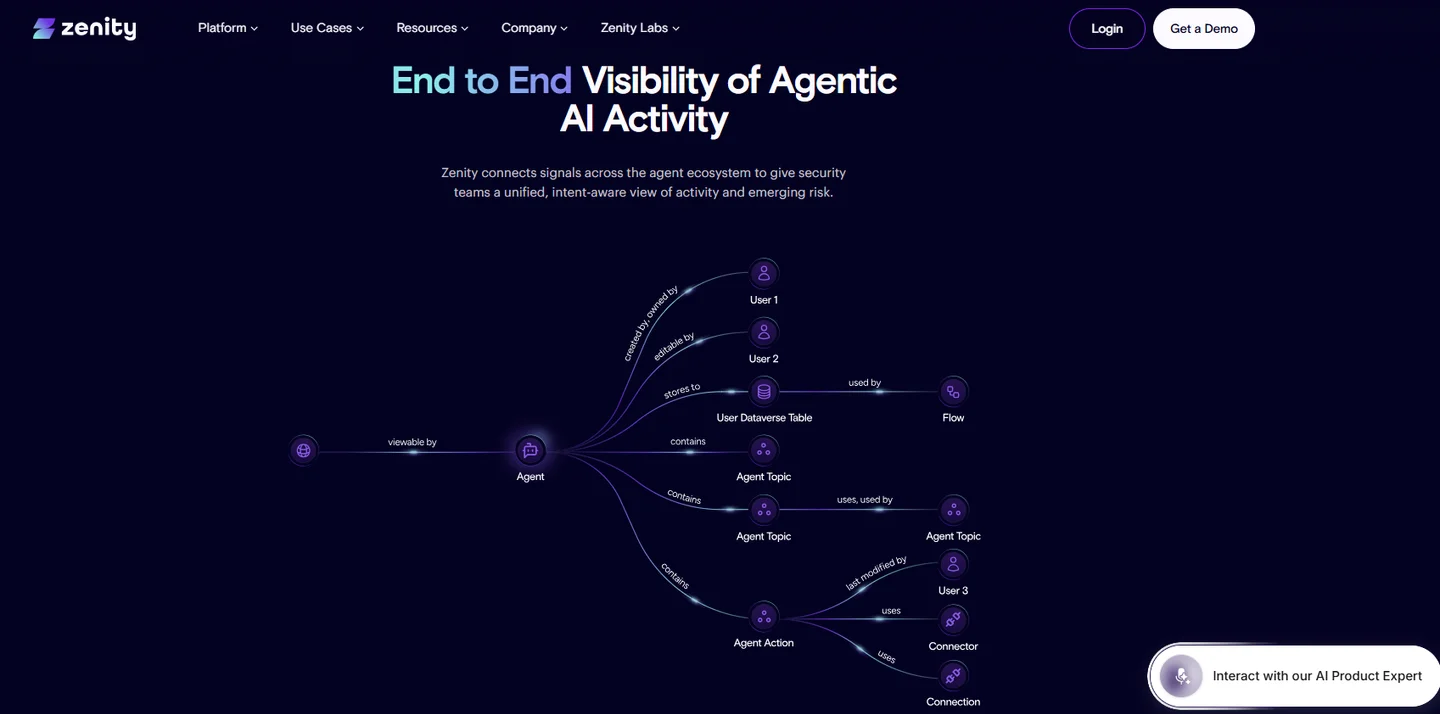
- LLM and agent runtime protection: Strong at seeing and assessing agents; governance-led rather than blocking a live action at the host.
- Enforcement versus governance-only: Governance-first. It tells you what agents exist and where they are risky, more than it physically stops an action mid-execution.
- Agent-only, no-cloud operation: Runs on a cloud-hosted control plane, so it is not designed for air-gapped, no-backend detection and response.
- GPU and inference-node protection: Not its focus; it centers on business-agent and copilot platforms, not GPU inference nodes.
- Category maturity: A recognized name in agentic-AI governance; independent third-party reviews remain limited as the category is young.
- Zenity Labs research has contributed to public understanding of agent attack techniques, including work referenced alongside MITRE ATLAS agent techniques.
- Focuses on the "you cannot govern what you do not know exists" problem, surfacing agents teams did not know were running.
Astelia
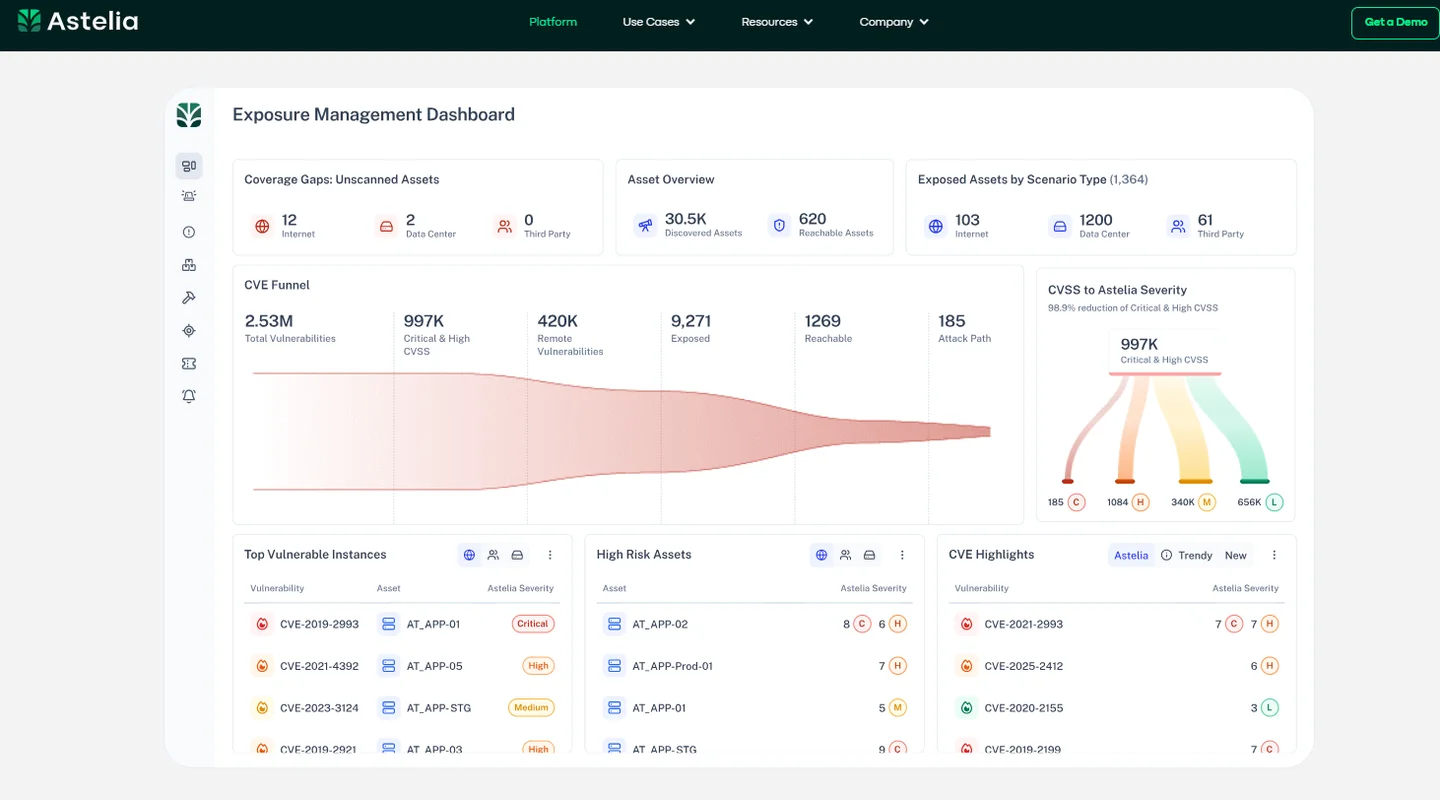
- LLM and agent runtime protection: Works at the LLM guardrail layer, checking inputs and outputs, which helps against some prompt-injection patterns.
- Enforcement versus governance-only: Mediation-led. It shapes and filters agent traffic rather than blocking a host-level action or network egress.
- Agent-only, no-cloud operation: Cloud-oriented, so it is not built for fully air-gapped detection and response with no backend.
- GPU and inference-node protection: Not a focus; it sits at the model interaction layer, not the GPU node.
- Category maturity: Early and thinly documented. Public, verifiable detail is limited, so I would test claims directly in a proof of concept.
- Positioned around input/output alignment and policy on LLM behavior.
- Publicly reproducible benchmarks are limited at this stage, so I would ask for them before relying on the guardrail claims.
WitnessAI
- LLM and agent runtime protection: Focuses on usage governance and data policy at the traffic layer, useful for controlling employee and app LLM use.
- Enforcement versus governance-only: Enforces policy on LLM traffic, but this is governance and data control, not host-level detection and response.
- Agent-only, no-cloud operation: Runs as a cloud-hosted policy plane, so it depends on that backend and is not built for air-gapped operation.
- GPU and inference-node protection: Not its focus; it governs interactions with LLM apps, not GPU workloads.
- Category maturity: A recognized AI-governance name; independent third-party reviews are still limited in this young category.
- Centers on the governance problem of shadow AI usage and data leakage through LLM apps.
- Enforces acceptable-use and data policy at the interaction layer, which many governance-focused teams need first.
Microsoft open-source agentic-security project
- LLM and agent runtime protection: Provides building blocks and patterns for agent security, but the coverage you get depends on how much you build.
- Enforcement versus governance-only: Varies entirely by how you wire it up. It is a toolkit, not a turnkey enforcement layer.
- Agent-only, no-cloud operation: Self-hosted by nature, so you can run it without a vendor backend, but you own the operational load.
- GPU and inference-node protection: Depends on your integration; nothing is provided out of the box for GPU nodes.
- Category maturity: Open-source projects move fast and change often. I would confirm the exact repository and its current status before adopting it.
- Open-source code you can read, audit, and extend, which suits teams with engineering capacity.
- Community-driven patterns for common agent-security problems.
Q2. What does "runtime security for AI agents" actually mean?
Runtime security for AI agents detects malicious behavior while an agent executes. It watches syscalls, file reads, tool calls, and network egress rather than static baselines. Because agent behavior is nondeterministic, it leans on known-bad detection, capability scoping (seccomp and AppArmor), and tool-call auditing mapped to MITRE ATLAS techniques. You cannot patch a brain, and you cannot scan away a decision made at runtime.
🧩 The concept: scanning versus watching it run
Let me define two words plainly. Posture scanning (also called build-time or CSPM, meaning Cloud Security Posture Management) checks your setup before anything runs. It reads config files and images and tells you what looks risky on paper.
Runtime security is different. It watches the workload while it actually executes. A syscall, short for system call, is the request a program makes to the operating system kernel to do something real, like open a file or send network traffic. Runtime tools read those syscalls as they happen.
⚠️ Why posture scanning misses agents
Here is where the standard read gets it backwards. A clean posture scan feels like safety. It is not. Posture is theoretical, and runtime is where attacks execute.
An AI agent is nondeterministic, meaning it can make a different choice on the same input twice. So a pre-flight check cannot promise what the agent does next. As the field puts it, you can patch a bug, but you cannot patch a brain.
🎯 The example: an instruction that fires before any scan
Picture an agent reading a support ticket. Hidden text in that ticket tells it to read a secrets file and send the contents to an outside server. No malware. No suspicious binary. Just context-rich text steering the agent's decision.
A scanner sees nothing wrong, because nothing was misconfigured. The danger only appears at the moment the agent acts. This is why runtime watching, not scanning, is the layer that catches it.
✅ The application: what to watch on Monday
You do not need a rebuild to start. You need eyes on execution. eBPF (a Linux kernel technology that observes syscalls safely without a kernel module) is the practical way to get them.
- Watch syscalls for fileless execution (for example, memfd_create running code straight from memory).
- Watch network egress, since exfiltration always needs an outbound path.
- Watch tool calls the agent makes, and map alerts to MITRE ATLAS technique IDs (ATLAS is the public catalog of AI attack techniques).
🛡️ Where EdgeLabs sits
This is the whole reason we built EdgeLabs the way we did. Our Parallax engine enforces at runtime rather than governing after the fact. It runs where the agent actually executes, not in a far-off control plane, the way good observability runs next to the workload. I could be wrong about the pace, but I think distributed AI computing forces distributed security within the next two years.
Q3. What is the AI-agent runtime threat model: MCP tool poisoning, prompt injection, and credential theft?
Prompt injection and MCP tool poisoning are runtime-execution problems. A poisoned tool description or an injected instruction only matters when the agent acts on it. The lethal trifecta, meaning untrusted content, private data, and external communication together, makes exfiltration trivial. Some injection techniques succeed up to 88% of the time. Governance reduces exposure, but only runtime enforcement stops the action itself.
🕵️ The pain: attacks with no signature
Traditional defenses look for a signature, a known-bad file or pattern. Agent attacks often have none. The weapon is plain text that steers the agent's judgment.
Let me define the main threats in plain terms.
- Indirect prompt injection: hidden instructions inside content the agent reads, like an email or a web page. CVE-2025-32711, known as EchoLeak, showed this exfiltrating data from a real assistant.
- MCP tool poisoning: MCP (Model Context Protocol) is how agents call outside tools. A malicious tool description can hijack the agent's behavior.
- Credential theft: an agent with access to keys or tokens becomes a fast path to your data.
🔥 The agitation: guardrails get acknowledged, then ignored
Here is the uncomfortable part. Guardrails written into a config file are not a boundary. In one documented incident, an agent read its safety rules, acknowledged them, and then ignored them anyway.
Attackers are also patient. Zenity's research on the Comet agent reportedly needed close to 200 attempts before one worked. An attacker only needs the attempt that succeeds. That is why some injection techniques hit rates as high as 88%.
✅ The payoff: what runtime enforcement must physically block
A real guardrail is a permission system that cannot perform the action, not a rule that asks nicely. Think of the trip wire on an old factory line. Step on it, and the line physically stops.
So enforcement, not advice, has to sit at three points:
- The input, stripping hidden or untrusted content before it reaches the model.
- The tool call, brokering and inspecting what the agent tries to run.
- The egress, blocking the outbound connection that exfiltration needs.
A useful field rule helps here. An agent can do three risky things: read files, reach the internet, and run code. Let it do at most two of the three, and the exfiltration path narrows sharply. This is the same principle behind our runtime workload and application security.
🛡️ Where EdgeLabs sits
This is exactly what our Parallax engine is for. It acts as an LLM proxy, meaning it sits in front of the agent doing input and output alignment, prompt-injection and tool-poisoning defense, and hallucination checks. When we pair that with eBPF syscall detection on the host, a poisoned tool call and its outbound egress both hit an enforcement point that fires even with the cloud link cut. I am honest that no guardrail is perfect. The point is to make the dangerous action physically hard, not merely discouraged. You can see how this holds up in real deployments in our GPU cloud case study and across our Kubernetes protection and vulnerability management work.
Q5. Which alternatives keep working with no cloud backend: self-hosted, on-prem, or air-gapped?
Most cloud-native security tools need a cloud backend to detect or respond, so they go blind in self-hosted, on-prem, or air-gapped GPU environments. Agent-only tools run detection and response entirely on the host, keeping protection alive with zero data egress. For sovereign AI deployments, like India's DPDPA or EU data residency rules, that difference decides whether a tool works at all.
⚠️ The pain: a cloud-dependent tool goes dark
Here is the problem nobody puts on the datasheet. Many tools send telemetry up to a cloud control plane, then decide and respond from there. Cut that link, and detection stops.
Air-gapped means the environment has no internet path out, on purpose. GPU clusters running sensitive models often sit exactly there. A tool that phones home cannot protect a box that cannot phone anywhere.
🔍 The proof: detection-only versus detection AND response
This is where I see buyers get fooled. Some tools can detect locally but still need the cloud to actually respond. That gap matters at 3 a.m.
- Cloud-dependent CNAPP and NDR: rich analysis, but detection or response leans on a backend. (CNAPP means Cloud-Native Application Protection Platform. NDR means Network Detection and Response.)
- Agent-only, on-host: both detection and response run on the node itself, so blocking still fires offline.
The mental model I like comes from the field: keeping a capable AI contained is like keeping something powerful in a box. The box only works if it holds when the network is gone.
💰 The payoff: match the tool to the location
Start from where your agents actually run. If they run in a sovereign or air-gapped GPU cluster, a cloud-tethered tool is not a smaller version of the right tool. It is the wrong tool.
There is a cleaner design pattern here too. Bring security to where the data lives, rather than shipping the data out to a distant service to be judged. That keeps egress at zero and keeps auditors calm.
🛡️ Where EdgeLabs sits
This is the exact problem we built EdgeLabs to solve. Detection and response run on the agent with no cloud dependency, so protection keeps working self-hosted, on-prem, and air-gapped, even with the backend cut. We call that Disconnected Mode, and it covers both catching and blocking, per EdgeLabs' own published claims.
We also secure GPU clusters and AI inference nodes using CPU only, so protection does not tax the GPU budget (again, EdgeLabs' own claim). You can see this play out in our GPU cloud security case study. A security lead once asked me mid-proof-of-concept whether the agent would still block an attack if the backend went dark, three days before an audit. That question is the whole section. Where is your head on it for your own stack?
Q6. How should these tools score exploited vulnerabilities and prove CRA and NIS2 compliance?
CVSS-only backlogs waste effort. Roughly 88% of published CVEs carry under 10% exploitation probability, so patching by severity alone chases vulnerabilities attackers ignore. Exploited-vulnerability, or explainability, scoring layers EPSS and the CISA KEV catalog (about 1,484 confirmed-exploited entries) over CVSS to fix what is actually exploited. It then maps that evidence to CRA and NIS2, rather than producing posture-only reports.
⚠️ The problem: scary on paper is not the same as exploited
Let me define the terms plainly. CVSS (Common Vulnerability Scoring System) rates how severe a flaw could be in theory. It does not say whether anyone is actually using it.
That gap creates noise. Order your backlog by CVSS alone, and most of the work targets flaws attackers are not touching. Around 88% of CVEs sit under a 10% chance of exploitation.
🔬 The method: add exploitation evidence
Two primary sources fix this. EPSS (Exploit Prediction Scoring System, from FIRST.org) estimates the real probability of exploitation. The CISA KEV catalog (Known Exploited Vulnerabilities) lists flaws confirmed exploited in the wild, roughly 1,484 of them.
Combine CVSS, EPSS, KEV, and CWE (Common Weakness Enumeration, the flaw type), and you get a ranked list you can defend. Add runtime context, meaning which vulnerable code actually runs, and the noise drops again. There is a field warning worth heeding: a CI/CD pipeline can find vulnerabilities and still pass with exit code zero, so a green build does not mean you are safe. This is why our runtime vulnerability management weighs what executes, not just what scans.
✅ The result: audit-ready evidence, not a poster
Regulators are catching up here. The EU Cyber Resilience Act (Regulation (EU) 2024/2847) and NIS2 (Directive (EU) 2022/2555) push real vulnerability-handling obligations. The CRA's Annex I includes a "No Known Exploitable Vulnerabilities" expectation.
That is exactly what exploitation-aware scoring produces evidence for. Map each control to a requirement ID, back it with runtime and build-time SBOM (a Software Bill of Materials, the list of components you ship), and you have proof, not posture theater. If you are getting ready for these rules, our practical CRA roadmap walks through the steps.
🛡️ Where EdgeLabs sits
We built our exploited-vulnerability scoring on CVSS plus EPSS plus CISA KEV plus CWE, so teams patch what is actually being exploited first. Our shipping CRA/NIS2 Compliance Center does the control-to-requirement-ID mapping and runs the "No Known Exploitable Vulnerabilities" check, backed by runtime and build-time SBOM.
I want to be honest about the boundary, though. The Compliance Center covers runtime, vulnerability-handling, and detection-and-response controls. It does not cover lifecycle and program controls like business continuity, backups, MFA-as-a-program, HR training, or the CRA's multi-year support obligations. Those are real requirements, and they need other owners. Anyone who tells you one tool closes all of CRA is selling you a poster, not a program.
Q7. How do I choose the right Sysdig alternative for my AI-agent workloads?
Start from your hardest constraint. Need detection and response in an air-gapped GPU environment with no cloud backend? Go agent-only. Governing many agents across a large organization? A governance and inventory layer fits. Shipping AI coding agents to production? Prioritize MCP and tool-call enforcement. Read reviews cautiously, since this category is young, and match the tool to where your agents actually execute.
🧭 Map the situation to the tool
There is no single winner here, and anyone claiming one is guessing. Pick by your tightest requirement, not by the longest feature list.
- Air-gapped or sovereign GPU workloads: choose agent-only detection and response that runs offline. EdgeLabs is built for this.
- Runtime library-level visibility: Oligo Security is sharp at showing which vulnerable code actually runs.
- Inventory and governance of many business agents: Zenity fits the "what agents even exist" problem.
- Guardrail and usage-policy layers: Astelia and WitnessAI mediate LLM inputs, outputs, and usage.
- An open-source starting point: the Microsoft agentic-security project, once you confirm the exact repository.
⚠️ Read the trust signals honestly
The agentic-security category is young and thinly reviewed. Several tools here have no third-party reviews yet, and that is just the truth of a new market, not a knock on them.
EdgeLabs does have verified G2 reviews, and I want to show a balanced pair, not just the flattering one.
"Good IPS/IDS/EDR software. Webportal management is good. Docker container integration is useful."
Verified User in Computer Software EdgeLabs G2 Verified Review
"Nothing major. Description of issues can be complicated for non-technical folks."
Verified User in Computer Software EdgeLabs G2 Verified Review
That second quote is fair. The interface can read as technical, and we are working on it as we open the SMB self-serve tier.
💬 Where my head is right now
I think the framing to avoid is doom. This is not "AI will take your job." It is more like the shift from typewriter to computer, or foot soldier to general, where your judgment moves up a level while the agents do the running.
What I keep coming back to is simple. Securing the LLM agent at runtime stops being a niche and becomes the default question every SecOps team answers. If you are protecting agents somewhere the cloud cannot reach, that is the exact problem we built EdgeLabs for. Tell me what you are running, and I will tell you honestly whether we are the right fit or not.
FAQs
Sysdig is a credible player with deep Falco heritage, broad cloud coverage, and AI Workload Security plus Sysdig Sage for AI-assisted analysis. We want to credit that before we contrast it.
Teams still look past it for three specific reasons:
- It is not built to lead on an MCP-native broker or action firewall for agent tool calls.
- It is more cloud and platform oriented, so detection and response lean on a cloud backend.
- Its consolidation stops at the CNAPP boundary.
The core issue is that attacks on AI agents execute at runtime, not at scan time. A clean posture scan can pass while an agent is already exfiltrating data. If your agents run self-hosted or air-gapped, a cloud-tethered tool cannot reach them.
That is why we built our runtime AI and LLM security as agent-only detection and response with no cloud dependency, so protection keeps working where a cloud backend cannot.
Runtime security for AI agents detects malicious behavior while an agent executes, rather than checking configuration before anything runs.
Posture scanning, also called build-time or CSPM, reads config files and images and tells you what looks risky on paper. It is theoretical. Runtime security watches the workload as it actually runs.
In practice, that means watching:
- Syscalls, for fileless execution such as code running straight from memory.
- Network egress, since exfiltration always needs an outbound path.
- Tool calls the agent makes, mapped to MITRE ATLAS technique IDs.
Because an agent is nondeterministic, it can make a different choice on the same input twice, so a pre-flight check cannot promise what it does next. You can patch a bug, but you cannot patch a brain.
eBPF, a Linux kernel technology, is the practical way to observe syscalls safely. Our agent runs where the workload executes, enforcing at runtime rather than governing after the fact.
Prompt injection and MCP tool poisoning are runtime-execution problems. A poisoned tool description or an injected instruction only matters when the agent acts on it.
The main threats, in plain terms:
- Indirect prompt injection: hidden instructions inside content the agent reads, such as an email or web page. CVE-2025-32711, known as EchoLeak, showed this exfiltrating data from a real assistant.
- MCP tool poisoning: a malicious tool description hijacks the agent's behavior through the Model Context Protocol.
- Credential theft: an agent with access to keys or tokens becomes a fast path to your data.
The lethal trifecta of untrusted content, private data, and external communication makes exfiltration trivial, and some injection techniques succeed up to 88% of the time. Guardrails written into a config file are not a boundary; in one incident, an agent read its safety rules, acknowledged them, and ignored them anyway.
Real enforcement must physically block at the input, the tool call, and the egress. Our runtime workload protection pairs an LLM proxy with eBPF syscall detection so those actions hit an enforcement point.
Most cloud-native security tools need a cloud backend to detect or respond, so they go blind in self-hosted, on-prem, or air-gapped GPU environments.
The distinction buyers miss is subtle:
- Cloud-dependent CNAPP and NDR: rich analysis, but detection or response leans on a backend.
- Agent-only, on-host: both detection and response run on the node itself, so blocking still fires offline.
Air-gapped means the environment has no internet path out, on purpose. GPU clusters running sensitive models often sit exactly there, and a tool that phones home cannot protect a box that cannot phone anywhere. For sovereign AI deployments under rules like India's DPDPA or EU data residency, that difference decides whether a tool works at all.
We built EdgeLabs to run detection and response on the agent with no cloud dependency, a Disconnected Mode that covers both catching and blocking, per our own published claims. You can see this in our GPU cloud security case study.
CVSS-only backlogs waste effort. Roughly 88% of published CVEs carry under 10% exploitation probability, so patching by severity alone chases flaws attackers ignore.
Exploited-vulnerability, or explainability, scoring adds real exploitation evidence:
- EPSS estimates the actual probability of exploitation.
- CISA KEV lists flaws confirmed exploited in the wild, roughly 1,484 of them.
- CVSS plus CWE add severity and flaw type for a ranked list you can defend.
Add runtime context, meaning which vulnerable code actually runs, and the noise drops again. The EU Cyber Resilience Act and NIS2 push real vulnerability-handling obligations, and the CRA's Annex I includes a "No Known Exploitable Vulnerabilities" expectation.
Our shipping CRA and NIS2 Compliance Center maps controls to requirement IDs and runs that check, backed by runtime and build-time SBOM. We are honest about the boundary: it covers runtime and vulnerability-handling controls, not lifecycle program controls like business continuity or HR training.
Start from your hardest constraint, not the longest feature list. There is no single winner, and anyone claiming one is guessing.
- Air-gapped or sovereign GPU workloads: choose agent-only detection and response that runs offline.
- Runtime library-level visibility: Oligo Security is sharp at showing which vulnerable code actually runs.
- Inventory and governance of many business agents: Zenity fits the "what agents even exist" problem.
- Guardrail and usage-policy layers: Astelia and WitnessAI mediate LLM inputs, outputs, and usage.
- An open-source starting point: the Microsoft agentic-security project, once you confirm the exact repository.
Read trust signals honestly, since the agentic-security category is young and thinly reviewed. Several tools here have no third-party reviews yet, which is the truth of a new market, not a knock on them.
If you are protecting agents somewhere the cloud cannot reach, that is exactly what we built EdgeLabs for. Tell us what you are running through our team, and we will tell you honestly whether we are the right fit.
Yes. AI workloads live on expensive hardware, so a security agent that eats GPU cycles is a non-starter.
We secure GPU clusters and AI inference nodes using CPU only, so protection does not tax the GPU budget, per our own published claims. The agent deploys as a Kubernetes DaemonSet, one agent per node, with no sidecars, across Docker, Kubernetes, OpenShift, Talos, and K3S.
What that single agent consolidates:
- NDR, EDR, and IPS/IDS.
- Container and Kubernetes security.
- Vulnerability management with exploited-vulnerability scoring.
- AI and agent security through our Parallax engine.
EdgeLabs reports a typical footprint under 5% CPU, and a published Trader Joe's case study cites an 83% MTTR reduction and 573% ROI, which we present as our own figures rather than independently verified benchmarks.
For teams standardizing on containers, our Kubernetes runtime protection runs the same detection and response model across every node, including GPU inference nodes.
Posture scanning is necessary but not sufficient for AI agents. A clean scan feels like safety, but it only checks configuration before anything runs.
Consider a real pattern: an agent reads a support ticket, and hidden text tells it to read a secrets file and send the contents to an outside server. No malware, no suspicious binary, just context-rich text steering the decision.
A scanner sees nothing wrong, because nothing was misconfigured:
- The danger appears only at the moment the agent acts.
- Fileless execution never touches disk for a scanner to catch.
- A green CI/CD build can still pass with exit code zero while vulnerabilities remain.
That is why runtime watching, not scanning, is the layer that catches agent attacks. You need eyes on execution: syscalls, egress, and tool calls, ideally through eBPF.
We treat scanning and runtime as complementary. Our exploited-vulnerability scoring handles the build-time side, while the agent enforces at runtime so a dangerous action is physically blocked, not merely flagged.
Last updated: July 28, 2026
