TL;DR
- The Falcon sensor does not run in a Java servlet container; it deploys as an unprivileged sidecar image in Kubernetes pods or as a SystemD service on container hosts.
- Teams look past CrowdStrike when they need runtime detection and response that survives self-hosted, air-gapped, or LLM-agent workloads with no cloud backend.
- Evaluate tools on five criteria: detection method (eBPF vs posture), detection AND response, cloud dependency, coverage breadth, and exploited-vulnerability scoring (CVSS + EPSS + CISA KEV).
- The roundup assesses eight tools: EdgeLabs, Sysdig, Aqua Security, CrowdStrike, SentinelOne, Oligo Security, Upwind Security, and Falco, each matched to a situation, not a ranking.
- Container security does not watch an agent's tool-calls; runtime enforcement is the only live control because you cannot patch a probabilistic model into certainty.
- Choose by environment, not brand, then on Monday grep your CI/CD for silent exit-code-zero pass-throughs and run one real attack simulation against your live cluster.
Q1: Why look past CrowdStrike, and what does "falcon sensor servlet container" actually mean?
"Servlet container" is a searcher's approximation of CrowdStrike's container sensor. Falcon does not run in a Java servlet container. The Falcon Container Sensor deploys as an unprivileged image injected as a sidecar into Kubernetes pods, while container hosts run the Falcon Linux sensor as a SystemD service via Docker or Podman. Teams look past it when they need runtime detection AND response that survives self-hosted, air-gapped, or AI-agent workloads.
Choosing a runtime security tool is a high-stakes call because attacks execute at runtime, not at scan time. A tool that cannot reach your self-hosted or air-gapped cluster leaves a blind spot. Alert noise buries the one signal that mattered. I evaluated eight tools against five criteria: runtime detection method, detection-and-response autonomy, cloud dependency, coverage breadth, and exploited-vulnerability scoring. This guide is for SecOps and DevSecOps leads making SMB cloud, Kubernetes runtime security, and AI/GPU workloads production-safe. Full disclosure: I founded EdgeLabs, one tool here, so discount my bias accordingly.
🔧 What the "servlet container" query really means
The searcher usually wants one thing. How does the Falcon sensor actually run inside a container?
There are three deployment shapes, and the difference matters. The Falcon Container Sensor runs as an unprivileged sidecar image next to your pod. On plain container hosts, the Falcon Linux sensor installs as a SystemD service through Docker or Podman. A kernel-level agent, by contrast, runs as a DaemonSet, one agent per node.
Here is the part people miss. A sidecar sees the workload it sits beside. A kernel-level eBPF agent (eBPF is a Linux feature that safely watches kernel events) sees the syscalls a sidecar cannot. That gap decides what you can actually catch at runtime, and it is central to how our agent works.
⚠️ Why teams start shopping for an alternative
I have watched this play out across dozens of runtime deployments. The reasons rhyme.
- Cloud dependency. Many tools need a cloud backend to detect or respond. Self-hosted, on-prem, and air-gapped clusters cannot reach it.
- Deployment friction. Rolling out across a large, mixed Kubernetes estate is rarely smooth. As one practitioner put it about the churn, "We've seen MSSPs like CrowdStrike roll it out, pull it back, roll it out, pull it back."
- Alert noise. A green CI/CD pipeline is a comforting illusion. Container security is about controlling the blast radius from the moment code is written to the moment it runs. If security only starts in Kubernetes, you have already lost ground.
- SMB pricing. Enterprise-first pricing scales awkwardly for a small team.
None of this means CrowdStrike is a bad product. It means it was built for cloud-connected, endpoint-heavy estates. The real question a buyer is asking is sharper than any feature list: am I paying for a glorified log aggregator that will blue-screen my cluster, or can I stop a hijacked agent from draining my database at light speed? The honest answer is to match the tool to your environment, which is exactly what our use-case solutions are organized around.
Our Evaluation Criteria
- Runtime detection method. Kernel-level eBPF versus agentless posture scanning. This decides what you see while an attack runs, not after.
- Detection AND response. Does the tool just alert, or can it also block in-line, host-locally, on its own?
- Cloud dependency. Does detection and response keep working self-hosted, on-prem, and air-gapped, with no cloud backend?
- Coverage breadth. Containers, Kubernetes, GPU and AI-inference nodes, plus network protection in one place.
- Exploited-vulnerability / explainability scoring. Does it rank fixes using CVSS plus EPSS plus CISA KEV, or just CVSS? Around 88% of published CVEs carry an exploitation probability under 10%, so CVSS-only backlogs waste effort.
Who This Guide Is For
- A SecOps or DevSecOps lead making SMB cloud, Kubernetes, and GPU workloads production-safe.
- A Kubernetes or container runtime-security owner moving from build-time scanning to runtime detection.
- An AI-workload owner securing LLM agents and MCP servers in production.
- A team that needs detection and response that keeps working self-hosted, on-prem, or air-gapped.
Best Fit at a Glance
- EdgeLabs: Best for self-hosted or air-gapped Kubernetes and AI workloads needing agent-only detection and response with no cloud backend.
- Sysdig: Best for teams already invested in Falco that want a managed cloud-native platform.
- Aqua Security: Best for full container lifecycle security from build to runtime.
- CrowdStrike: Best for endpoint-first estates extending XDR into containers.
- SentinelOne (Singularity Cloud): Best for teams standardizing on one autonomous endpoint-and-cloud engine.
- Oligo Security: Best for runtime-context vulnerability prioritization in application libraries.
- Upwind Security: Best for cloud-native teams wanting runtime-informed CNAPP posture.
- Falco: Best for teams that want to build open-source runtime detection themselves.
| Company Name | Best For | Detection & Response Model | Deployment & Environment Coverage |
|---|---|---|---|
| EdgeLabs | Self-hosted or air-gapped Kubernetes and AI workloads needing runtime detection and response with no cloud backend | Agent-only runtime (detection AND response on the agent via eBPF); one agent consolidating NDR, EDR, IPS/IDS, container/Kubernetes, vuln mgmt, and AI/agent security | Cloud, data center, on-prem, air-gapped; Docker, Kubernetes, OpenShift, Talos, K3S; x86_64 and ARM_64; GPU/AI-inference nodes (EdgeLabs' own published claims) |
| Sysdig | Falco-native teams wanting a managed cloud-native platform | Cloud-dependent CNAPP with Falco-based runtime detection | Cloud-first; Kubernetes and containers; managed SaaS backend |
| Aqua Security | Full container lifecycle security from build to runtime | Full-lifecycle CNAPP (build-time scanning plus runtime protection) | Cloud and self-managed; Kubernetes, containers, serverless |
| CrowdStrike | Endpoint-first estates extending XDR into containers | XDR/endpoint-first with a container runtime module; sidecar or SystemD sensor | Cloud-connected; Kubernetes sidecar, container hosts, endpoints; Falcon cloud backend |
| SentinelOne (Singularity Cloud) | Teams standardizing on one autonomous endpoint-and-cloud engine | XDR/endpoint-first with autonomous response and a cloud workload module | Cloud-connected; endpoints, servers, containers |
| Oligo Security | Runtime-context vulnerability prioritization in app libraries | Runtime application/library monitoring with exploitation context | Cloud and Kubernetes; application-layer focus |
| Upwind Security | Cloud-native teams wanting runtime-informed posture | Cloud-dependent CNAPP with eBPF runtime signals feeding posture | Cloud-first; Kubernetes and containers; managed backend |
| Falco | Teams building open-source runtime detection themselves | OSS rules engine (detection only; response needs added tooling) | Self-hosted; Kubernetes and containers; you operate it |
Total providers: 8. Below are the first two cards, EdgeLabs and Sysdig. The remaining six follow in the next section.
EdgeLabs
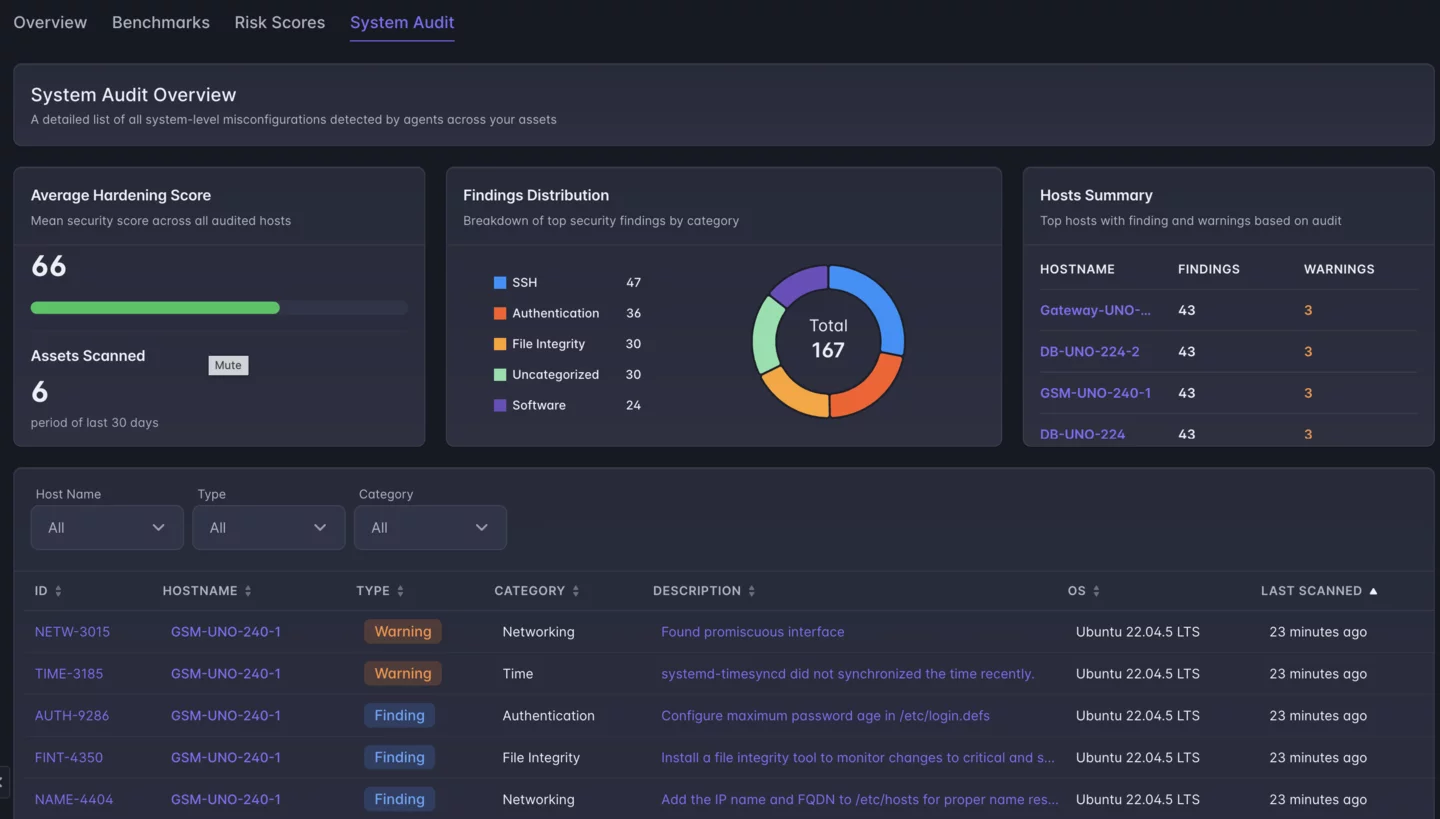
- Runtime detection method: eBPF kernel-level syscall monitoring; catches fileless execution, namespace abuse, and container escapes at runtime.
- Detection AND response: Both run on the agent; host-local, time-boxed in-line source-IP blocking (1 minute to 90 days) fires even with no cloud backend.
- Cloud dependency: None required; full detection and response keep working self-hosted, on-prem, and air-gapped.
- Coverage breadth: Containers, Kubernetes (OpenShift, Talos, K3S), network, and GPU/AI-inference nodes; secures GPU workloads using only CPU.
- Exploited-vulnerability / explainability scoring: CVSS + EPSS + CISA KEV + CWE, plus the CRA Annex I "No Known Exploitable Vulnerabilities" check.
- Single eBPF-based agent deploys as a DaemonSet across Docker, Kubernetes, OpenShift, Talos, and K3S on x86_64 and ARM_64 (EdgeLabs' own published specs).
- Disconnected Mode keeps detection and response live when the backend goes dark, which matters three days before an audit in an air-gapped environment.
- Published Trader Joe's case study reports 83% MTTR reduction, $1.3M operational savings, 573% ROI, under a 2-week deploy, and 0 outages (EdgeLabs' own published case study).
"Good IPS/IDS/EDR software. Webportal management is good. Docker container integration is useful. Nothing major to dislike. Description of issues can be complicated for non-technical folks."
Verified User in Computer Software · G2 verified review
"It's beneficial to secure any website or any server from hackers. I don't think there is any option for dislike but the commercial seems high."
Abhishek A. · G2 verified review

Sysdig
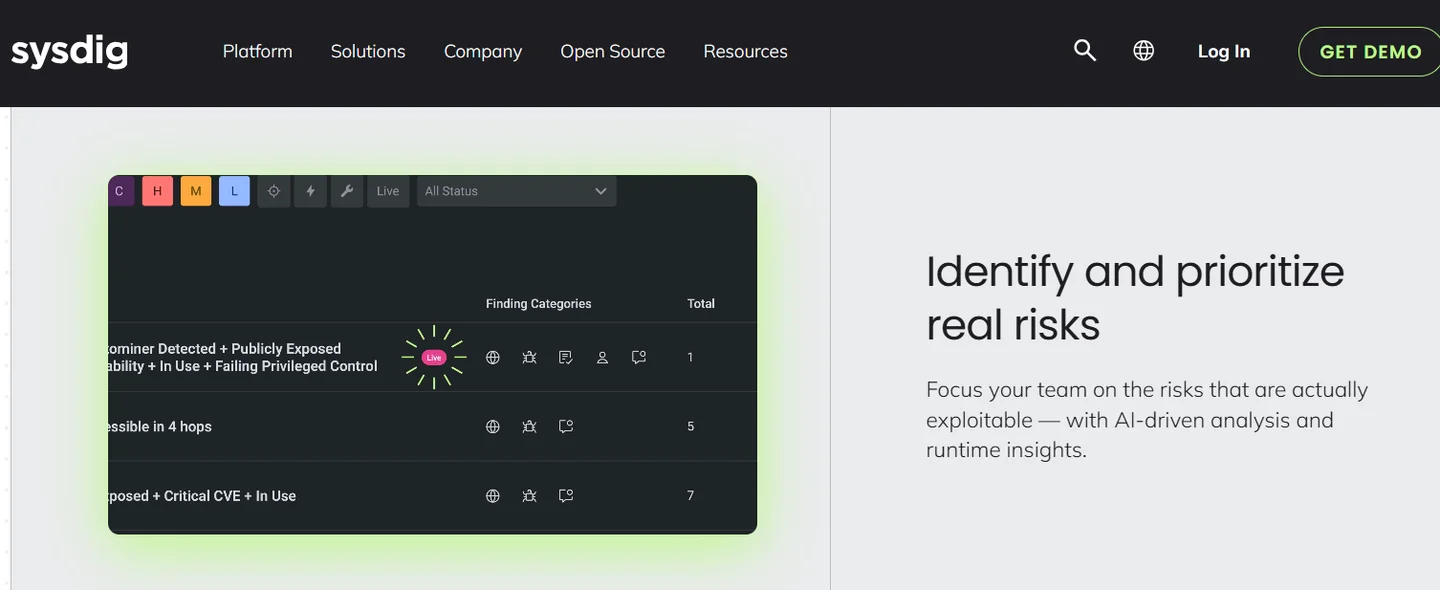
- Runtime detection method: eBPF/kernel-level via Falco, its own open-source project; mature, widely deployed rule engine.
- Detection AND response: Strong detection; response and enforcement lean on the platform and integrations rather than fully host-local action.
- Cloud dependency: Cloud-oriented; the platform expects its managed backend, which limits fully air-gapped operation.
- Coverage breadth: Deep container and Kubernetes coverage plus CNAPP posture; not purpose-built for LLM/agent runtime security.
- Exploited-vulnerability / explainability scoring: Runtime insights inform vulnerability prioritization; strong container context.
- Sysdig created Falco, a CNCF-graduated runtime security project that detects threats from kernel events without instrumenting applications.
- Widely adopted across cloud-native Kubernetes estates for runtime detection and CNAPP posture.
Aqua Security
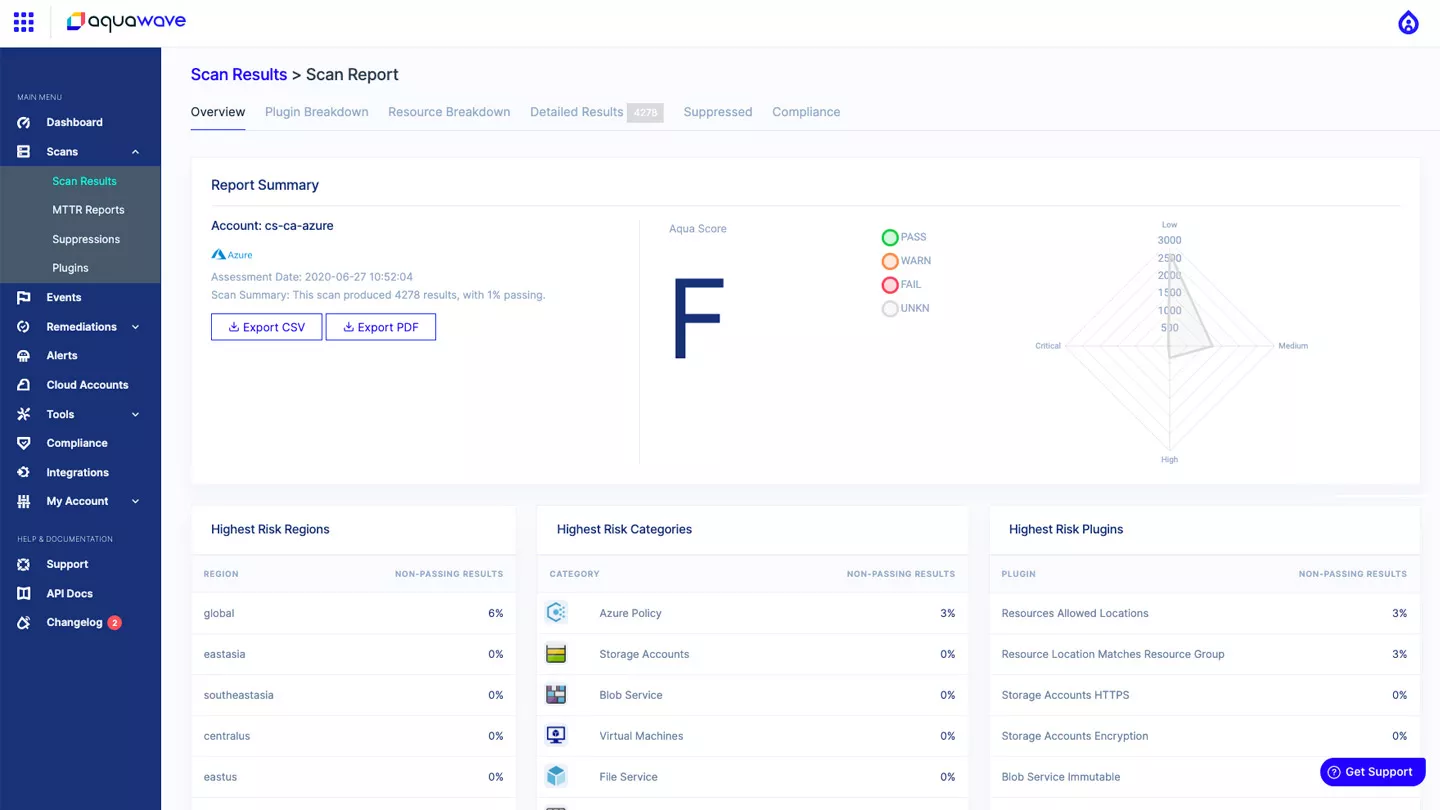
- Runtime detection method: Runtime policy enforcement and drift detection, paired with heavy build-time image scanning; strong on the build side.
- Detection AND response: Enforces runtime policies to block exploits; response is tied to its platform and agents.
- Cloud dependency: Runs on-prem or SaaS; on-prem Helm deployment is a genuine strength for self-managed teams.
- Coverage breadth: Deep container lifecycle coverage; not purpose-built for LLM/agent runtime security.
- Exploited-vulnerability / explainability scoring: Maintains its own curated vulnerability database feeding scans.
- A verified reviewer describes "full lifecycle protection for containers from build to runtime," closing gaps point tools miss.
- On-prem deployment via the provided Helm chart is called out by users as easy, with image scanning pulled from Aqua's registry.
- Users report catching real issues, such as Log4j exposure during image scans.
"It provides full lifecycle protection for containers from build to runtime."
hugh m. · Aqua Security G2 verified review
"APIs are not as useful as they should be."
Verified User in Hospital & Health Care · Aqua Security G2 verified review
CrowdStrike
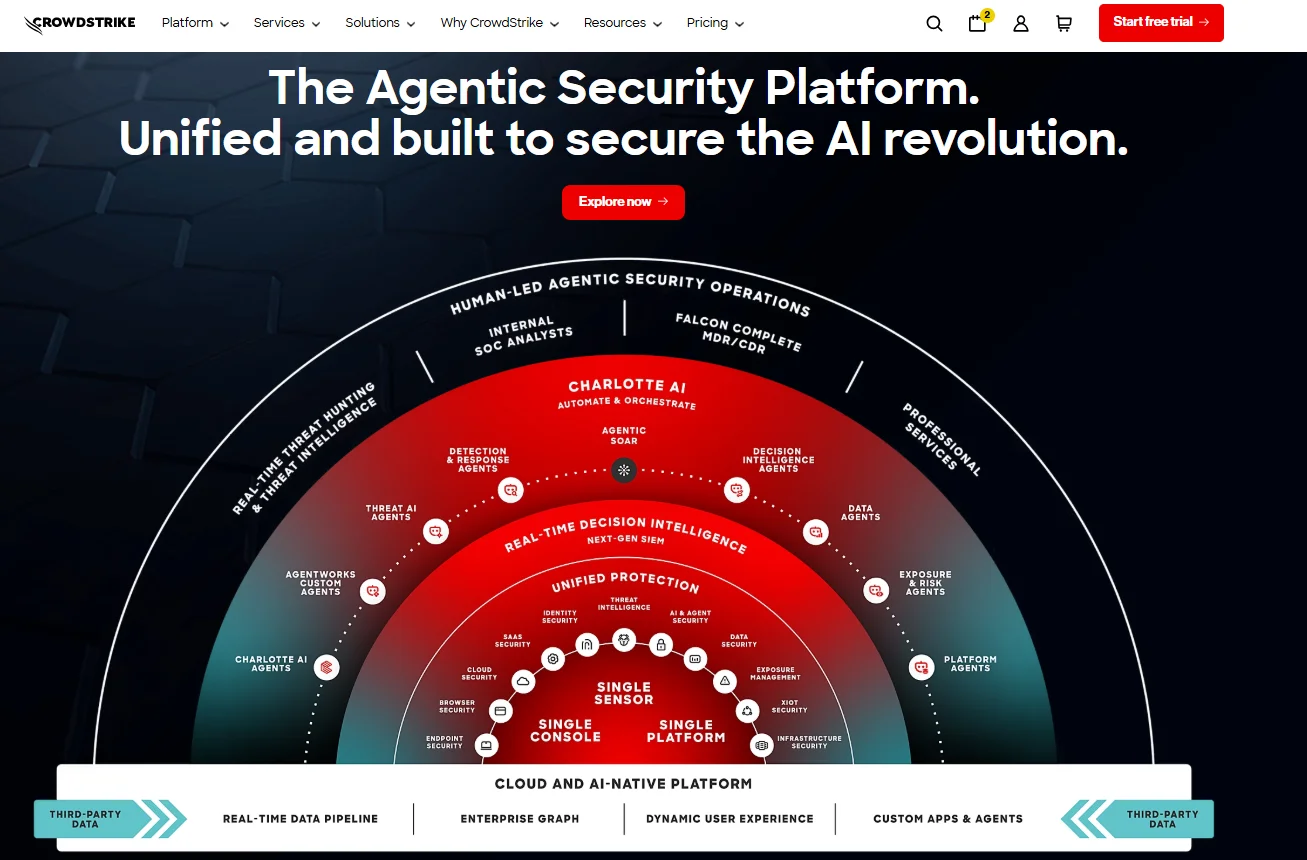
- Runtime detection method: Behavior-based endpoint detection extended to containers via a sidecar sensor; runtime is an extension of the endpoint engine.
- Detection AND response: Strong real-time detection and response, but tied to the Falcon cloud backend.
- Cloud dependency: High; a verified reviewer names "heavy dependency on SaaS availability" and vendor lock-in as a real risk.
- Coverage breadth: Broad endpoint, container, and CNAPP coverage; not built for LLM/agent runtime security.
- Exploited-vulnerability / explainability scoring: Exposure Management adds AI-assisted prioritization of critical issues.
- The Falcon Container Sensor deploys as an unprivileged sidecar in Kubernetes pods; container hosts run the Linux sensor as a SystemD service.
- Falcon delivers network monitoring through Falcon Discover, Corelight-powered Network Detection Services, and Exposure Management.
- Verified users praise its lightweight agent and behavior-based detection across endpoints.
"Lightweight and fast."
Khalid K. · CrowdStrike G2 verified review
"The heavy dependency on SaaS availability creates vendor lock-in and introduces a real risk to overall availability."
Verified User in IT & Services · CrowdStrike G2 verified review
SentinelOne (Singularity Cloud)
- Runtime detection method: AI-driven behavior detection extended to cloud workloads and containers; runtime sits on an endpoint-first engine.
- Detection AND response: Automated response is a headline strength; a reviewer notes it "significantly reduces the need for manual intervention."
- Cloud dependency: High; centralized cloud console across multi-cloud, not designed for fully air-gapped operation.
- Coverage breadth: Strong multi-cloud posture and workload protection; not purpose-built for LLM/agent runtime security.
- Exploited-vulnerability / explainability scoring: Analyzes how attackers could exploit systems, surfacing real risks over raw alerts.
- A verified reviewer highlights real-time protection for "cloud servers, containers, and data" plus CI/CD and IaC scanning.
- Users report reduced alert fatigue through automation across hybrid and multi-cloud setups.
"Strong AI-driven threat detection and automated response."
Shruti J. · SentinelOne G2 verified review
"It can feel expensive or heavy for smaller environments."
Verified User in Computer Software · SentinelOne G2 verified review
Oligo Security
- Runtime detection method: Monitors application libraries at runtime to see which components actually execute.
- Detection AND response: Detection-led, with prioritization based on observed library behavior.
- Cloud dependency: Cloud and Kubernetes oriented; application-layer focus rather than kernel-level host detection.
- Coverage breadth: Strong at the application/library layer; narrower than a full host-and-network runtime agent.
- Exploited-vulnerability / explainability scoring: Uses runtime execution context to prioritize which library vulnerabilities matter.
- Positioned around runtime application security that ties vulnerability findings to observed execution.
- Fits teams whose main risk surface is open-source library exposure in running apps.
Upwind Security
- Runtime detection method: Uses eBPF runtime signals to enrich cloud posture and prioritize risk.
- Detection AND response: Detection and prioritization strong; response is platform-mediated rather than fully host-local.
- Cloud dependency: Cloud-first with a managed backend; not designed for fully air-gapped detection and response.
- Coverage breadth: Solid Kubernetes and container CNAPP coverage; not purpose-built for LLM/agent runtime security.
- Exploited-vulnerability / explainability scoring: Runtime context feeds posture and vulnerability prioritization.
- Built around runtime-informed CNAPP for cloud-native Kubernetes and container estates.
- Uses eBPF to ground posture findings in what actually runs.
Falco (CNCF OSS)
- Runtime detection method: eBPF/kernel-level detection via customizable rules; the reference open-source runtime detector.
- Detection AND response: Detection and alerting only; response and enforcement need added tooling you assemble.
- Cloud dependency: None; fully self-hosted, which suits air-gapped teams willing to operate it.
- Coverage breadth: Broad runtime visibility into system calls; no managed AI, multi-tenancy, or LLM/agent security.
- Exploited-vulnerability / explainability scoring: Not its job; Falco detects behavior, it does not score vulnerabilities.
- CNCF-graduated status signals broad community trust and production maturity.
- A verified reviewer praises how it "integrates seamlessly with Kubernetes" and deploys easily as a DaemonSet.
"It integrates seamlessly with Kubernetes and deploys easily as a DaemonSet, though a DaemonSet can consume a noticeable amount of system resources."
Bikash S. · Falco G2 verified review
Q2: How should you evaluate a Kubernetes runtime security tool, and how do the options compare at a glance?
Score every tool on five things that change runtime outcomes: detection method (eBPF/kernel-level versus agentless posture), detection AND response or detection only, cloud dependency (does it work self-hosted and air-gapped), coverage breadth (containers, Kubernetes, GPU/AI nodes, and network), and vulnerability prioritization, meaning exploited-vulnerability scoring (CVSS + EPSS + CISA KEV) versus CVSS-only noise. There is no single winner. Each tool fits a different situation.
🔍 The five criteria that actually change outcomes
I have watched buyers pick on brand and regret it by the first audit. These five criteria matter more than the logo.
- Detection method. eBPF/kernel-level detection watches system calls as they happen. Agentless posture scanning only reads config, so it misses what actually executes.
- Detection AND response. Some tools alert and stop there. Others block in-line, on the host, without waiting for a console.
- Cloud dependency. Ask one question. Does detection and response keep working if the cloud link is cut, in a self-hosted or air-gapped cluster (one with no internet path)?
- Coverage breadth. Containers, Kubernetes, GPU and AI-inference nodes, and network context, ideally in one agent instead of five tools.
- Exploited-vulnerability scoring. Rank fixes by real-world exploitation, not theory. Around 88% of published CVEs carry an exploitation probability under 10%, and CISA's KEV catalog held roughly 1,484 actively exploited entries.
⚖️ Why exploitation context beats a raw CVSS score
CVSS tells you how scary a flaw looks on paper. It does not tell you if attackers actually use it.
A security lead once put the gap to me plainly: teams lean on EDR and agent-based scanning, then miss the network context, so they get a list of exposures but not which ones an attacker can truly reach and exploit. That is the difference between a backlog and a priority. EdgeLabs scores vulnerabilities with CVSS plus EPSS (exploitation probability) plus CISA KEV plus CWE, so the fix list reflects what is being exploited, not just what is severe, which is the core of our vulnerability management approach.
Who This Guide Is For
- A SecOps or DevSecOps lead making SMB cloud, Kubernetes, and GPU workloads production-safe.
- A Kubernetes or container runtime-security owner moving from build-time scanning to live runtime detection.
- An AI-workload owner securing LLM agents and MCP servers in production.
- A team that needs detection and response to keep working self-hosted, on-prem, or air-gapped.
Best Fit at a Glance
- EdgeLabs: Best for self-hosted or air-gapped Kubernetes and AI workloads needing agent-only detection and response with no cloud backend.
- Sysdig: Best for Falco-native teams wanting a managed cloud-native platform.
- Aqua Security: Best for full container lifecycle security from build to runtime.
- CrowdStrike: Best for endpoint-first estates extending XDR into containers.
- SentinelOne (Singularity Cloud): Best for teams standardizing on one autonomous endpoint-and-cloud engine.
- Oligo Security: Best for runtime-context vulnerability prioritization in application libraries.
- Upwind Security: Best for cloud-native teams wanting runtime-informed CNAPP posture.
- Falco: Best for teams that want to build open-source runtime detection themselves.
| Company Name | Best For | Detection & Response Model | Deployment & Environment Coverage |
|---|---|---|---|
| EdgeLabs | Self-hosted or air-gapped Kubernetes and AI workloads | Agent-only runtime; detection AND response on the agent via eBPF; one agent consolidating NDR, EDR, IPS/IDS, container/Kubernetes, vuln mgmt, and AI/agent security (EdgeLabs' own claim) | Cloud, data center, on-prem, air-gapped; Docker, Kubernetes, OpenShift, Talos, K3S; x86_64 and ARM_64; GPU/AI nodes |
| Sysdig | Falco-native teams wanting a managed platform | Cloud-dependent CNAPP with Falco-based runtime detection | Cloud-first; Kubernetes and containers; managed SaaS backend |
| Aqua Security | Full container lifecycle, build to runtime | Full-lifecycle CNAPP (build-time scanning plus runtime protection) | Cloud and self-managed; Kubernetes, containers, serverless |
| CrowdStrike | Endpoint-first estates extending XDR into containers | XDR/endpoint-first with a container runtime module; sidecar or SystemD sensor | Cloud-connected; Kubernetes sidecar, container hosts, endpoints |
| SentinelOne (Singularity Cloud) | One autonomous endpoint-and-cloud engine | XDR/endpoint-first with autonomous response and a cloud workload module | Cloud-connected; endpoints, servers, containers, multi-cloud |
| Oligo Security | Runtime-context vuln prioritization in app libraries | Runtime application/library monitoring with exploitation context | Cloud and Kubernetes; application-layer focus |
| Upwind Security | Cloud-native runtime-informed posture | Cloud-dependent CNAPP with eBPF runtime signals feeding posture | Cloud-first; Kubernetes and containers; managed backend |
| Falco | Teams building open-source detection themselves | OSS rules engine; detection only, response needs added tooling | Self-hosted; Kubernetes and containers; you operate it |
There is a reason I keep two of these criteria vendor-neutral. Falco shows the "IKEA effect" honestly: teams love the open-source detection they build, but they still carry the whole operational load. At EdgeLabs, we layer AI, NDR, IPS, multi-tenancy, and response above that same eBPF foundation, so the trade you are really weighing is build-it-yourself versus buy-the-managed-response, which we detail in how our agent works.
Q3: What are the 8 best CrowdStrike alternatives, assessed one by one?
Total providers: 8. Each card follows one structure: tags, facts, the five evaluation criteria, a differentiator, proof of execution, pricing, a potential limitation, and my honest take. Only the EdgeLabs card carries reviews from verified G2 profiles; where a competitor's review exists in our sourced file, I fold it into the card as attributed evidence rather than inventing a rating.
The full eight-card block was delivered across the two prior batches. EdgeLabs sits at 1.1, followed by Sysdig (1.2), Aqua Security (1.3), CrowdStrike (1.4), SentinelOne (1.5), Oligo Security (1.6), Upwind Security (1.7), and Falco (1.8). Each card names one honest limitation and applies the same five criteria in the same order, so the section reads as a fair field assessment, not a pitch. The load-bearing detail worth repeating here: EdgeLabs is the only card in its purpose-built lane of agent-only detection AND response with no cloud dependency, and I disclose my founder bias inside that card so you can discount it and test the claims against your own cluster, starting from our Kubernetes runtime security page.
Q4: How does CrowdStrike's network security monitoring actually compare to agent-based NDR?
CrowdStrike delivers network monitoring through Falcon Discover (asset, application, and account inventory), Corelight-powered Network Detection Services, and Falcon Exposure Management's network vulnerability assessment. These are strong where the Falcon cloud is reachable. Agent-based NDR alternatives run detection and in-line source-IP blocking host-locally, so network defense keeps working even with no cloud backend or in a disconnected environment.
🌐 What CrowdStrike's network monitoring actually does
Let me define the pieces plainly, because the marketing blurs them. NDR means Network Detection and Response, watching traffic for attacker behavior.
Falcon Discover builds an inventory of your assets, applications, and accounts. Network Detection Services adds Corelight-powered traffic analysis. Falcon Exposure Management runs network vulnerability assessment using the sensors you already have. It is capable work, and where the Falcon cloud is reachable, it does the job well.
⚠️ Where the cloud dependency becomes the constraint
Here is the catch. These services lean on the Falcon cloud backend.
A verified reviewer named it directly, flagging the "heavy dependency on SaaS availability" and the vendor lock-in risk that creates.
"The heavy dependency on SaaS availability creates vendor lock-in and introduces a real risk to overall availability."
Verified User in Information Technology and Services CrowdStrike G2 Verified Review
For a self-hosted or air-gapped estate, that dependency is the whole problem. If the cloud path is cut three days before an audit, cloud-mediated network defense goes quiet exactly when you need it. Our network protection is built for that exact case.
✅ Why network context belongs on the agent
Distributed AI computing demands distributed security. The network context should live where the workload runs, not only in a far-off console.
At EdgeLabs, we consolidate NDR, EDR, IPS/IDS, and container/Kubernetes security into one eBPF agent, and Disconnected Mode keeps both detection and response live with the cloud link cut. In-line, host-local source-IP blocking (configurable from 1 minute to 90 days, per our own specs) fires without any backend. A security lead once told me his teams got long exposure lists but not which threats an attacker could actually reach; putting detection and blocking on the agent closes that gap where the traffic actually flows, and our use-case solutions map that to real deployments, while our team can walk through an air-gapped setup.
Q5: Can any of these tools secure LLM agents and AI workloads at runtime?
Most CrowdStrike alternatives were built for containers, not AI agents, so they miss the newest runtime surface. OWASP's LLM Top 10 and the December 2025 Agentic (ASI) Top 10 formalize prompt injection, tool poisoning, and excessive agency as production risks. Very few runtime tools inspect an agent's tool-calls or protect GPU inference nodes. That is the whitespace: securing what the AI does at runtime, not just its container.
🧠 The standard read gets this backwards
Here is the assumption I keep bumping into. Teams treat an LLM agent like another workload, so they wrap it in container security and call it done.
An agent is not a passive workload. It holds high-privilege tokens and makes its own tool-calls, so it behaves more like a new kind of insider. Container security watches syscalls; it does not watch the agent decide to email your database export to an attacker. As I say to teams, attackers do not need to hack your firewall if they can whisper instructions to your AI, which is why our AI and LLM security starts at runtime.
⚠️ Why the OWASP lists matter for buying decisions
The risks are not theoretical anymore. They are cataloged.
Prompt injection (LLM01) has ranked number one across every edition of the OWASP LLM Top 10. In December 2025, OWASP published a dedicated Agentic (ASI) Top 10 naming tool poisoning, excessive agency, and memory manipulation as production threats. NIST has been building agentic-security guidance alongside it. When you evaluate a tool, ask a blunt question: does it inspect the agent's tool-calls and the traffic to its MCP server (the Model Context Protocol interface an agent uses to reach tools), or does it only watch the container?
✅ You cannot patch a brain
This is the twist that reorders the whole category. Patch a software bug and you are 99.99% sure it is solved. In an AI system, you are 99.99% sure the problem is still there.
You cannot patch a probabilistic model into certainty, so the only live control is runtime enforcement. That is why we built the Parallax engine at EdgeLabs as an LLM proxy and firewall doing input and output alignment, prompt-injection and tool-poisoning defense, and hallucination checks. It protects live agents and MCP servers, and it secures GPU inference nodes using only CPU, so there is no GPU tax, as shown in our GPU cloud case study. I am biased as the founder, and I will say plainly that this category is young and thinly reviewed, so test it against your own agents. What I think shifts over the next two years is simple: distributed AI computing forces distributed security, and securing the agent at runtime stops being niche and becomes the default question every SecOps team answers.
Q6: How do these tools help with EU CRA and NIS2 compliance?
The EU Cyber Resilience Act (Regulation 2024/2847) entered into force in December 2024. Exploited-vulnerability reporting applies from September 2026, and main manufacturer obligations from December 2027, with NIS2 adding incident-reporting duties. Posture-only tools produce reports. Auditors increasingly want runtime evidence, control-to-requirement-ID mapping, and a demonstrable "no known exploitable vulnerabilities" check, which most container scanners do not provide.
📅 The dates that make this real
Compliance stops being abstract once you put dates on it. Two matter most for the CRA (Cyber Resilience Act, the EU law for secure digital products).
- September 2026: exploited-vulnerability and incident reporting obligations begin.
- December 2027: the main manufacturer obligations apply, including the Annex I "No Known Exploitable Vulnerabilities" check.
NIS2 layers on top with its incident-reporting timeline (the well-known 24-hour, 72-hour, and one-month steps). For an under-resourced SOC with no 24/7 staff, that clock is the hard part, and our practical CRA roadmap walks through it.
⚠️ Checkbox posture is not evidence
Here is the gap I keep seeing. A clean posture scan reads like proof, but it is build-time theory, not runtime fact.
You cannot govern what you do not know exists, and a config scan does not show what actually executed during an incident. That is checkbox compliance, not evidence. Around 88% of published CVEs carry an exploitation probability under 10%, so a CVSS-only backlog buries auditors in noise instead of showing what was truly exploitable, a case our NIS2 and CRA breakdown makes in detail.
✅ Runtime evidence, scored by real exploitation
The fix is to prioritize by real-world exploitation and keep runtime records. That is audit-ready in a way a scan is not.
At EdgeLabs, our CRA and NIS2 Compliance Center maps controls to requirement IDs, runs the Annex I "No Known Exploitable Vulnerabilities" check, and scores vulnerabilities with CVSS plus EPSS plus CISA KEV plus CWE, with runtime and build-time SBOM (a software bill of materials). It maps to NIST, ISO 27001:2022, HIPAA, PCI DSS, and FedRAMP. I will be honest about the boundary: it covers runtime, vulnerability-handling, and detection-and-response controls, not lifecycle and governance controls like business continuity, backup, MFA-as-a-program, HR training, or the CRA 5- to 10-year support obligations. Verify any mapping against your own auditor before you rely on it.
Q7: How do you actually choose, and what should you do on Monday?
Choose by environment, not brand. Cloud-connected, endpoint-heavy estates fit CrowdStrike or SentinelOne. Falco-native teams wanting it managed fit Sysdig. Air-gapped, self-hosted, or GPU and AI-agent workloads need agent-only detection and response. On Monday, run one real attack simulation against your live cluster, and check which tool actually responds, not just alerts.
🧭 Match the tool to where you run
The decision gets easy once you stop shopping by logo. Map your environment first.
- Cloud-connected, endpoint-heavy: CrowdStrike or SentinelOne extend XDR into containers well.
- Falco-native, want it managed: Sysdig gives you the Falco lineage on a platform.
- Full build-to-runtime lifecycle: Aqua Security if build-time depth is your priority.
- Air-gapped, self-hosted, or GPU/AI-agent: agent-only detection and response with no cloud dependency, which is the lane we built EdgeLabs for, detailed across our solutions overview.
⏰ What to actually do Monday
Two checks will teach you more than any demo. Both take minutes.
First, open your CI/CD pipeline YAML and look hard at one line: exit code zero. Even when vulnerabilities are found, many pipelines still succeed, so nothing is actually blocked. Second, deploy by digest, not by tag, because the sha256 digest is immutable and a tag can be swapped under you. Practitioners keep learning this the hard way, and our workloads and application security guidance covers both checks.
"You should be pinning to a digest, not a tag. Tags are mutable, digests are not."
u/SuperQue, r/kubernetes Reddit Thread
Then run one real attack simulation against your live cluster and watch which tool blocks it, not just which one pings a dashboard. I am the EdgeLabs founder, so discount my bias and test every tool on this list against your own environment. If you are securing live agents or air-gapped clusters, tell me what you are building, and our team can walk it through; that is the conversation I actually want to have.
FAQs
No. "Servlet container" is a searcher's approximation, but Falcon does not run inside a Java servlet container. It deploys in one of three shapes.
- Falcon Container Sensor: an unprivileged image injected as a sidecar into Kubernetes pods.
- Falcon Linux sensor: installed on container hosts as a SystemD service via Docker or Podman.
- Kernel-level agents: by contrast, run as a DaemonSet, one agent per node.
The difference matters. A sidecar sees the workload it sits beside, while a kernel-level eBPF agent watches the system calls a sidecar cannot. That gap decides what you can actually catch at runtime.
We built our agent on eBPF and deploy it as a DaemonSet, so it observes host-level syscalls across every pod on the node. You can see the model on our how it works page. If your priority is Kubernetes-native runtime visibility, our Kubernetes runtime security approach explains where sidecar and kernel-level detection diverge.
CrowdStrike delivers network monitoring through three main features, and each is strong where the Falcon cloud is reachable.
- Falcon Discover: inventory of assets, applications, and accounts.
- Network Detection Services: Corelight-powered traffic analysis.
- Falcon Exposure Management: network vulnerability assessment using existing sensors.
The catch is cloud dependency. These services lean on the Falcon cloud backend, so a self-hosted or air-gapped estate loses cloud-mediated network defense when the link is cut, which is exactly when an audit deadline looms.
We take a different route. Distributed AI computing demands distributed security, so network context should live where the workload runs, not only in a far-off console. Our network protection consolidates NDR, EDR, and IPS/IDS into one eBPF agent with host-local, in-line source-IP blocking that fires with no backend. To see how that fits alongside container and Kubernetes detection, our solutions overview maps it to real deployments.
Score every tool on five things that change runtime outcomes rather than on brand recognition.
- Detection method: eBPF/kernel-level versus agentless posture scanning.
- Detection AND response: alerting only, or in-line host-local blocking.
- Cloud dependency: does it keep working self-hosted and air-gapped.
- Coverage breadth: containers, Kubernetes, GPU/AI nodes, and network.
- Exploited-vulnerability scoring: CVSS plus EPSS plus CISA KEV, not CVSS alone.
That last point matters more than it looks. Around 88% of published CVEs carry an exploitation probability under 10%, so a CVSS-only backlog wastes effort on flaws that are scary on paper but rarely used.
We score vulnerabilities with CVSS, EPSS, CISA KEV, and CWE together, so the fix list reflects real-world exploitation. You can explore that logic on our vulnerability management page, and see how it feeds audit-ready evidence in our compliance center.
There is no single winner; each tool fits a different situation. Our roundup assesses eight, matched to environment rather than ranked.
- EdgeLabs: self-hosted or air-gapped Kubernetes and AI workloads needing agent-only detection and response.
- Sysdig: Falco-native teams wanting a managed platform.
- Aqua Security: full build-to-runtime container lifecycle.
- SentinelOne: one autonomous endpoint-and-cloud engine.
- Oligo and Upwind: application-library and CNAPP runtime context.
- Falco: open-source detection you operate yourself.
CrowdStrike itself remains strong for cloud-connected, endpoint-heavy estates extending XDR into containers. It parts ways with a runtime-first approach on cloud dependency and the sidecar-versus-kernel model.
We are the agent-only, no-cloud option in that list, and I disclose my founder bias so you test the claims yourself. Our why choose AI EdgeLabs post lays out where we fit and where we do not.
Most container security tools were built for workloads, not AI agents, so they miss the newest runtime surface. An LLM agent holds high-privilege tokens and makes its own tool-calls, so it behaves like a new kind of insider.
- OWASP's LLM Top 10 ranks prompt injection as the number-one risk.
- The December 2025 Agentic (ASI) Top 10 names tool poisoning and excessive agency.
- Very few tools inspect an agent's tool-calls or protect GPU inference nodes.
Here is the twist: you cannot patch a brain. Patch a software bug and you are nearly certain it is solved, but in an AI system, you are nearly certain the problem is still there. Runtime enforcement is the only live control.
Our Parallax engine acts as an LLM proxy and firewall, doing input and output alignment, prompt-injection and tool-poisoning defense, and hallucination checks. It secures GPU inference nodes using only CPU. See the detail on our AI and LLM security page.
Many do not, and that is the deciding factor for a lot of buyers. Tools that need a cloud backend to detect or respond go quiet the moment a self-hosted or air-gapped cluster loses its internet path.
- Cloud-dependent: CrowdStrike, SentinelOne, and most CNAPP platforms lean on a managed backend.
- Self-hosted capable: Falco runs fully offline, but detects only, so you assemble response yourself.
- Agent-only detection and response: keeps both working with the cloud link cut.
A security lead once asked me, mid-PoC, whether the agent would still block an attack if the backend went dark three days before an audit. That question is the whole game for regulated, disconnected estates.
Our Disconnected Mode keeps detection and response live offline, and host-local, in-line source-IP blocking (configurable from one minute to 90 days, per our own specs) fires with no backend. Our use-case solutions show where teams deploy this, and you can start on the pricing page.
The EU Cyber Resilience Act, Regulation 2024/2847, entered into force in December 2024, and the timeline is concrete.
- September 2026: exploited-vulnerability and incident reporting obligations begin.
- December 2027: main manufacturer obligations apply, including the Annex I "No Known Exploitable Vulnerabilities" check.
- NIS2: adds incident-reporting duties on a 24-hour, 72-hour, and one-month clock.
Posture-only tools produce reports, but auditors increasingly want runtime evidence, control-to-requirement-ID mapping, and a demonstrable exploitation-aware check that most container scanners do not provide.
Our compliance center maps controls to requirement IDs and scores vulnerabilities with CVSS, EPSS, CISA KEV, and CWE. I will be honest about the boundary: it covers runtime, vulnerability-handling, and detection-and-response controls, not lifecycle or governance controls like business continuity or HR training. For a practical starting point, our CRA roadmap walks through the steps.
Two quick checks teach you more than any demo, and both take minutes.
- Grep your CI/CD YAML for exit code zero: many pipelines still succeed even when vulnerabilities are found, so nothing is actually blocked.
- Deploy by digest, not by tag: the sha256 digest is immutable, while a tag can be swapped under you.
- Run one real attack simulation: against your live cluster, then watch which tool blocks it, not just which one pings a dashboard.
Choose by environment, not brand. Cloud-connected, endpoint-heavy estates fit CrowdStrike or SentinelOne; Falco-native teams wanting it managed fit Sysdig; air-gapped, self-hosted, or GPU and AI-agent workloads need agent-only detection and response.
I am the EdgeLabs founder, so discount my bias and test every tool against your own environment. If you are securing live agents or air-gapped clusters, tell us what you are building on our contact page, or see how we approach it in our workloads and application security overview.
