TL;DR
- Attacks on AI systems execute at runtime, not at scan time, so image scanning, AI-SPM, and red teaming never intervene mid-attack. Only a runtime control can block while the workload runs.
- The guide compares 12 platforms against six criteria: agent and LLM runtime protection, enforcement versus reporting, detection mechanism, cloud dependency, deployment reach, and audit evidence.
- The lethal trifecta governs agent risk: untrusted content, private data, and outbound communication. Allow any two, never all three, and exfiltration becomes far harder to achieve.
- A real runtime control must see six layers: platform, compute, network, container, application, and AI agent. Prompt firewalls cover one of the six.
- EdgeLabs runs detection and response on the agent itself, so in-line blocking still fires in Disconnected Mode with no cloud backend, across on-prem and air-gapped sites.
- Filter findings by CISA KEV membership first, then EPSS probability, then CVSS. Prioritizing theoretical severity is the most expensive habit in security operations.
Q1. Why the AI runtime security decision cannot wait for your next budget cycle
Attacks on AI systems execute at runtime, not at scan time. An LLM agent holding file access, network access, and code execution can wipe a production database faster than a person can read a Slack message, and no image scan or posture dashboard intervenes mid-execution. OWASP's 2025 list for LLM applications ranks prompt injection first and adds excessive agency as a new production risk, both of which only surface while the system is running.
Attacks on AI systems run at runtime, not at scan time. An agent with file access, network access, and code execution can wipe production in seconds, and one reported incident saw a small SaaS team lose its database and its co-located backups in nine seconds. No image scan or posture dashboard steps in mid-execution. This guide characterises five platforms against six criteria: agent and LLM runtime protection, enforcement versus reporting, detection mechanism, cloud dependency, deployment reach, and audit evidence. It is written for the person who owns LLM-agent and AI-workload runtime security in production, and who answers for what executes.
🧭 Our Evaluation Criteria
- LLM and agent runtime protection. Does the tool watch live prompts, tool calls, and MCP (Model Context Protocol) traffic, or only the code around them? OWASP's 2025 update treats prompt injection and excessive agency as runtime problems, so this is the first filter.
- Enforcement versus reporting. Can it block, quarantine, or kill during an attack, or does it only raise an alert and a ticket?
- Detection mechanism. eBPF (a Linux kernel feature that reads system calls safely) and kernel-level telemetry behave differently from API polling or a proxy in front of a model.
- Cloud dependency. If the vendor's cloud is unreachable, does detection stop? Does response stop?
- Deployment reach. Cloud, data center, on-prem, air-gapped, Kubernetes, and GPU inference nodes all count. Many AI workloads sit where a cloud-only tool cannot go.
- Audit evidence. Whether runtime findings map to named requirement IDs under the EU Cyber Resilience Act (CRA) and NIS2, and whether vulnerability scoring is exploitation-aware (CVSS plus EPSS plus CISA KEV).
👥 Who This Guide Is For
- AI-workload and LLM-agent runtime-security owners putting agents and agentic systems into production.
- Kubernetes and container runtime-security owners moving past build-time scanning.
- GPU-cloud and AI-infrastructure security leads protecting inference nodes and shared clusters.
- Security teams that need detection and response to keep working self-hosted, on-prem, or air-gapped.
Where the category actually stands
The AI-runtime and agentic-security category is young and thinly reviewed. Several vendors in this lane, including Oligo, Astelia, and Zenity, carry few or zero third-party reviews, so buying decisions here lean on primary technical documentation and reproducible testing rather than review counts. That is a fact about the market, not a knock on any product.
⚠️ Posture scans are not runtime evidence
A clean posture scan tells you what your images and configs looked like before deployment. It does not tell you which process opened a socket at 2am, or which agent called a tool it had no business calling. Runtime and build-time answer different questions, and only one of them is live when an attack lands.
Tools covered in this guide
- EdgeLabs: Best for runtime detection and response on self-hosted, on-prem, or air-gapped AI and Kubernetes workloads where no cloud backend is available.
- Oligo Security: Best for cutting a huge vulnerability backlog down to what actually executes, using eBPF runtime context wired into developer tooling.
- Zenity: Best for securing agents built on enterprise agent platforms, with in-line controls at the agent layer.
- Astelia: Best for exposure management and attack-path analysis where reachability-based vulnerability classification is the buying requirement.
- WitnessAI: Best for governing how employees and applications use AI, including shadow-AI discovery and an AI firewall.
| Company Name | Best For | Detection & Response Model | Deployment & Environment Coverage |
| EdgeLabs | Self-hosted or air-gapped AI, container, and Kubernetes workloads that need detection and response without a cloud backend | Agent-only runtime detection and response executed on the agent at kernel level, with in-line IPS blocking that fires offline | Cloud, data center, on-prem, air-gapped; Docker, Kubernetes, OpenShift, Talos, K3S; x86_64 and ARM64; GPU inference nodes secured using CPU only |
| Oligo Security | Teams drowning in scanner findings that want to fix only what runs in production | eBPF-based runtime application and cloud detection and response, with AI-SPM and AI-DR modules; findings surfaced into IDEs via MCP | Cloud-native and Kubernetes environments; cloud-delivered platform; developer tooling integrations |
| Zenity | Agents built and run on enterprise agent platforms such as Microsoft Foundry | Agentic-AI observability, governance, and in-line runtime prevention at the agent layer | Platform-integrated for hosted agent platforms and enterprise AI stacks |
| Astelia | Exposure management where reachability-based vulnerability classification drives triage | Reachability-based vulnerability classification, agentic vulnerability analysis, and attack-path analysis; inside-out exposure discovery via read-only firewall APIs | Reads existing network infrastructure via read-only APIs rather than deploying a workload agent |
| WitnessAI | Governing and gating how employees and applications use AI models | AI-governance and AI-firewall layer covering shadow-AI discovery, prompt-injection defense, and red teaming | Deployed in front of AI usage paths, with marketplace and network-integration surfaces |
Research Integration
The standards anchor here is OWASP's Top 10 for LLM Applications, 2025 edition. Prompt injection holds the number one slot, and excessive agency is a new 2025 entry, both describing failures that happen while the model is deciding and acting, not while it is being scanned. That is the whole argument for runtime in one document. The nine-second database loss cited above is a reported operator incident, not a benchmark, and it should be read as an illustration of blast radius rather than a measured statistic.
🧪 The "prove it detects" test
Before you trust any tool in this lane, run its own documented detections in your environment. Ask the vendor for a reproducible test battery and a documented pattern library. EdgeLabs publishes reproducible EDR and NDR attack-simulation tests with expected alerts per script, which makes detection claims checkable rather than assertable.
Author's Perspective
EdgeLabs' read is that the standard advice gets this backwards. The usual sequence is scan, then harden, then think about runtime later, and I have watched that ordering fail in deployments where the incumbent tool needed a cloud link that the site did not have. What surfaces in EdgeLabs' deployments is that the offline question arrives late and hurts: a security lead once asked me mid-PoC whether the agent would still block an attack if the backend went dark, three days before an audit.
EdgeLabs' own data points one way on exploitation-aware scoring, though I might be reading it too strongly. Teams that switch from CVSS-first triage to CVSS plus EPSS plus CISA KEV stop patching what is frightening on paper and start patching what is being exploited. I could be off on how durable that gain is across smaller fleets.
Where my head is right now: the LLM agent is a new kind of insider. It has credentials, it takes actions, and it does not pass a pre-flight check twice. Supervising it needs to look like observability, running where the workload runs, not in a control plane three networks away.
EdgeLabs runs detection and response entirely on the agent, so both continue in Disconnected Mode when the cloud link drops, and the CRA/NIS2 Compliance Center maps controls to specific requirement IDs including the CRA Annex I "No Known Exploitable Vulnerabilities" check. We are candid about the boundary: it covers runtime, vulnerability-handling, and detection-and-response controls, not lifecycle or governance controls such as backup, MFA-as-a-program, or training.
Total providers: 5
1 out of 5EdgeLabs
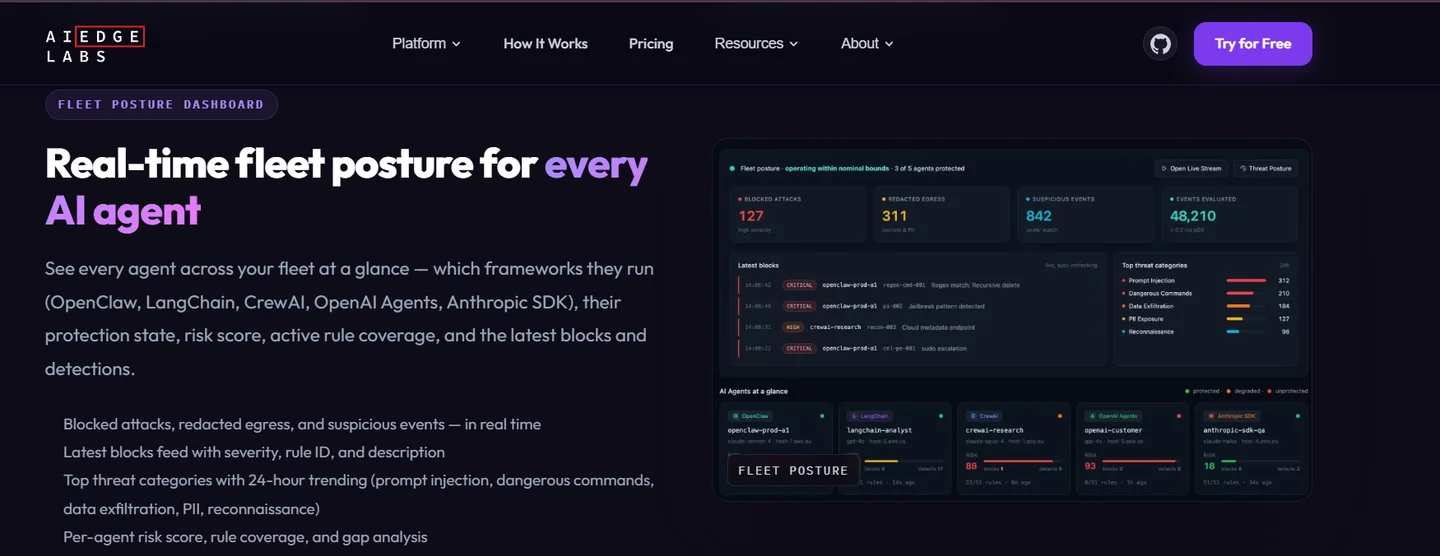
- LLM and agent runtime protection: Parallax engine plus an LLM proxy and firewall doing input/output alignment, prompt-injection and tool-poisoning defense, and hallucination checks for live agents and MCP servers.
- Enforcement versus reporting: Two modes, Detection and IPS. In IPS mode the agent denies traffic from an attacker source IP for a configured window, from 1 minute to 90 days, and a Prevention flag in the alert list shows a block actually fired.
- Detection mechanism: eBPF kernel-level syscall analysis. Named detections include memfd_create fileless execution, PTRACE anti-debug, unshare namespace abuse, container escape, and Kubernetes audit rules for kubectl exec/attach, sensitive hostPath mounts, and kubectl cp control-plane exfiltration.
- Cloud dependency: None for detection or response. Disconnected Mode keeps both running locally on preloaded models; only sync pauses.
- Deployment reach: Docker, Kubernetes, OpenShift, Talos, K3S, on x86_64 and ARM64, across cloud, data center, on-prem, and air-gapped sites. GPU inference nodes are protected using CPU only, with no GPU consumed.
- Audit evidence: A shipping CRA/NIS2 Compliance Center maps controls to requirement IDs (CRA Annex I Parts I and II, NIS2 Articles 21 to 23) and runs the CRA "No Known Exploitable Vulnerabilities" check. Vulnerability scoring combines CVSS, CWE, EPSS, and CISA KEV.
- Trader Joe's, per EdgeLabs' published case study: runtime security across roughly 20,000 POS endpoints, 83% MTTR reduction, 8x reduced CAPEX/OPEX, 1.3M USD operational savings, 573% ROI, under two weeks to fleet-wide deployment, and zero outages during deployment. Attribute as EdgeLabs' own published figures, not independently audited.
- Rekor, per EdgeLabs' published case study: GPU-based AI and computer-vision workloads protected using CPU only, across roughly 21,000 units, with zero outages reported since deployment.
- Reproducible self-validation: a published EDR and NDR test battery where each benign script maps to an exact expected alert, plus support for Falco's event-generator syscall patterns.
"Good IPS/IDS/EDR software. Webportal management is good. Docker container integration is useful. Nothing major. Description of issues can be complicated for non-technical folks."
Verified User in Computer Software · EdgeLabs G2 Verified Review
"It's beneficial to secure any website or any server from hackers. I don't think there is any option for dislike but the commercial seems high."
Abhishek A. · EdgeLabs G2 Verified Review

Oligo Security
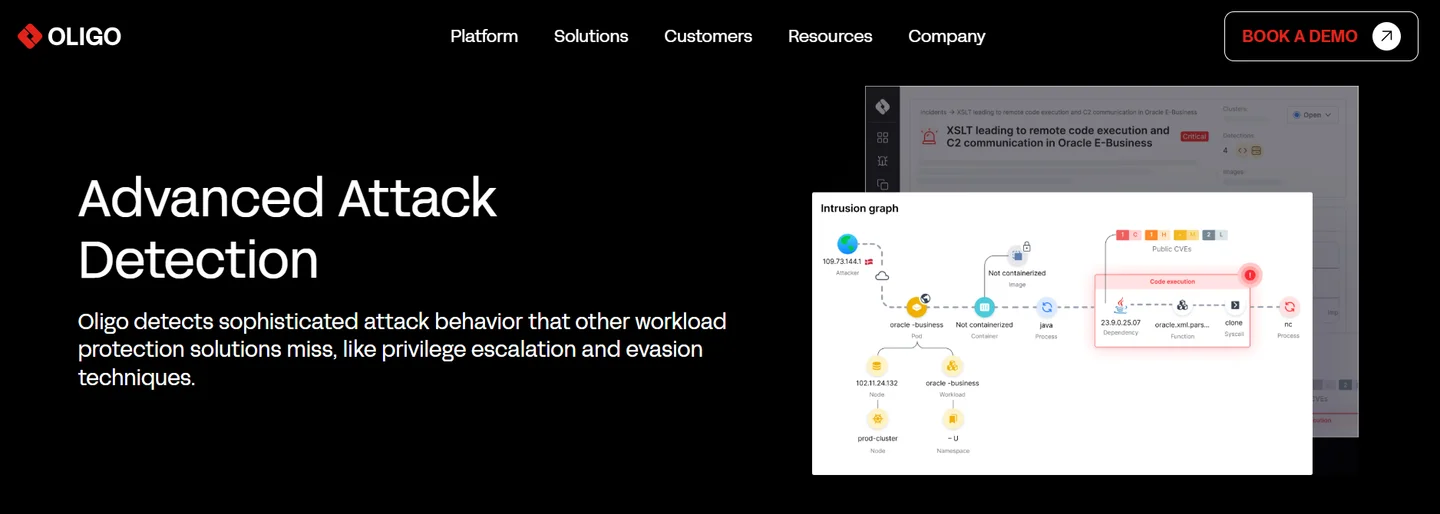
- LLM and agent runtime protection: AI-DR and AI-SPM address AI application risk, and findings reach developers through IDE integrations over MCP, including Cursor, VS Code, Windsurf, Claude Code and Desktop, and OpenAI Codex.
- Enforcement versus reporting: Positioned around detection and response for running applications. Treat any prevention claim as something to test in a PoC rather than assume.
- Detection mechanism: eBPF runtime instrumentation. The core wedge is "only fix what executes," with a claimed 70% to 99% reduction in findings versus traditional SCA. That figure is Oligo's own claim.
- Cloud dependency: Cloud-delivered platform. Self-hosted and air-gapped operation is not a publicly claimed strength, so confirm it directly if that is your constraint.
- Deployment reach: Cloud-native and Kubernetes workloads. Not publicly claimed for air-gapped or GPU-only inference-node coverage.
- Audit evidence: Vulnerability noise reduction is the stated outcome. Named CRA or NIS2 control-to-requirement-ID mapping is not a publicly claimed capability.
- eBPF and Falco-ecosystem foundation, documented publicly.
- AI-DR shipped in October 2025, extending the runtime approach to AI applications.
- MCP-based delivery of findings into developer IDEs, which is an unusually direct route from runtime signal to the person who fixes it.
Zenity
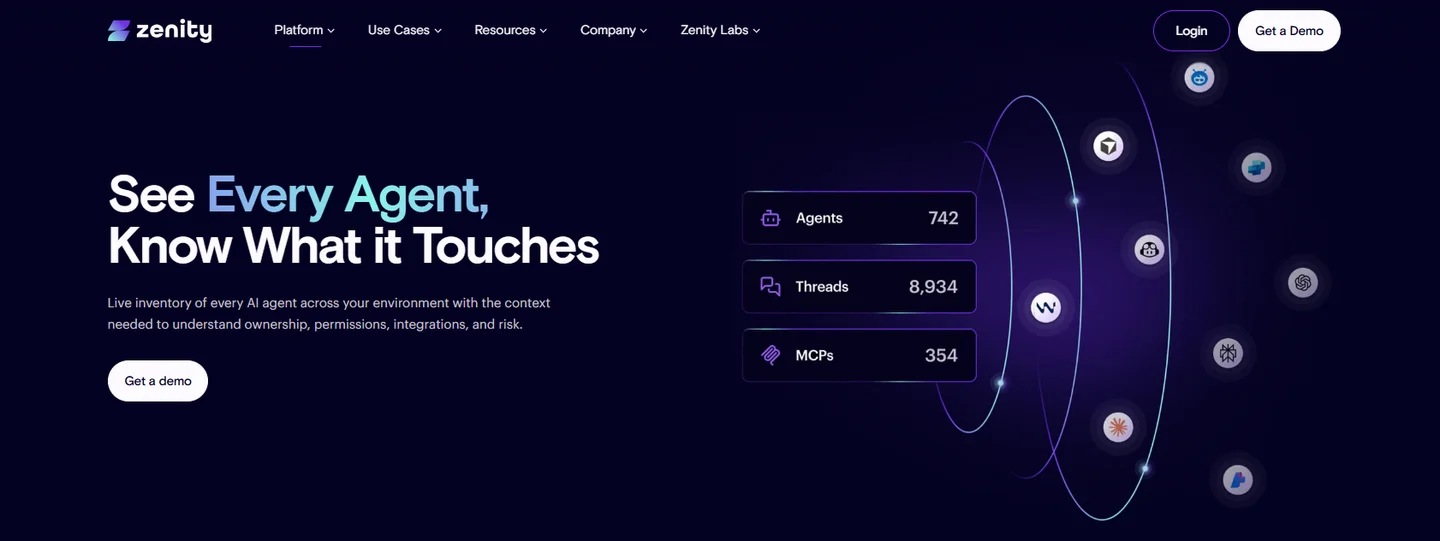
- LLM and agent runtime protection: This is Zenity's core job. It monitors agent behavior continuously, detects anomalies in real time, and rebuilds what an agent did and why.
- Enforcement versus reporting: Both. Zenity ships an AI firewall and AIDR (AI detection and response), plus in-line prevention for agents running on Microsoft Foundry.
- Detection mechanism: Agent-layer telemetry rather than kernel-level syscall inspection. It watches what the agent connects to and calls, not what the host kernel is doing.
- Cloud dependency: Cloud-delivered and platform-integrated. Self-hosted or air-gapped operation is not a publicly claimed capability, so confirm it if that is a hard requirement.
- Deployment reach: Enterprise agent platforms and hosted AI stacks. Not positioned for Kubernetes node-level runtime, GPU inference nodes, or disconnected sites.
- Audit evidence: Risk is prioritized on real signals rather than theoretical vulnerability, and findings feed back into prevention controls. Named CRA or NIS2 requirement-ID mapping is not a publicly claimed feature.
- Publicly documented in-line prevention for agents on Microsoft Foundry, covering data leakage, prompt injection, and tool misuse.
- Listed on AWS Marketplace with agent discovery, posture management, and runtime detection delivered into Security Hub.
- Agent-trajectory reconstruction, which gives an investigator a readable sequence of agent actions after an incident.
Astelia
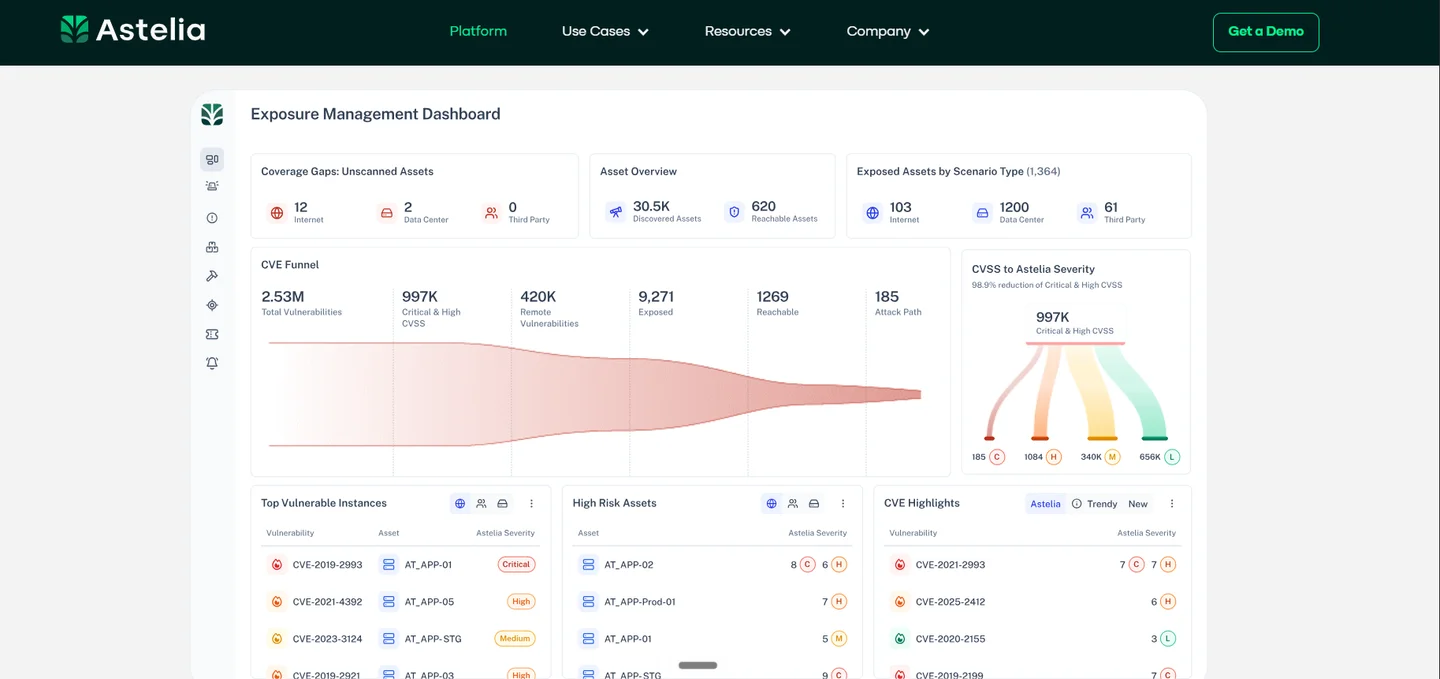
- LLM and agent runtime protection: Not the product's job. Astelia added agentic AI exposure management in July 2026, meaning agentic AI is used to analyze exposure, and the platform also covers exposure of AI-related assets.
- Enforcement versus reporting: Reporting and remediation guidance. It recommends firewall policy changes and other compensating controls where patching is not feasible. It does not block an attack mid-execution.
- Detection mechanism: Network-topology modeling correlated with each CVE's exploit prerequisites, analyzed with agentic AI. No workload agent, no kernel telemetry.
- Cloud dependency: Ingests configuration through read-only APIs against existing infrastructure such as FortiGate and FortiManager, and Check Point.
- Deployment reach: Wherever the network control plane can be read. It does not install on hosts, so it also does not see hosts execute anything.
- Audit evidence: Strong on defensible risk decisions and evidence-based vulnerability classification, which helps board-level and audit conversations.
- Published joint solution briefs with Fortinet and Check Point, both describing the read-only API ingestion model.
- Agentic AI exposure management capabilities announced in July 2026.
- Public technical writing on reachability analysis as an alternative to probability-based scoring.
WitnessAI
- LLM and agent runtime protection: Yes, at the traffic layer. The AI firewall blocks prompt injections and protects sensitive data at runtime, and Agentic Control extends this to AI agents and MCP servers.
- Enforcement versus reporting: Enforcement. Intent-based policies can allow, warn, block, or route based on conversational context. That is real gating, applied to AI usage rather than to host processes.
- Detection mechanism: Network and traffic visibility with policy inspection of prompts and responses, plus data tokenization. Not kernel-level, not eBPF.
- Cloud dependency: Deployed in the AI usage path, with network integrations. Air-gapped operation is not a publicly claimed capability.
- Deployment reach: Employees, models, applications, and agents across the enterprise. It does not cover Kubernetes node runtime, container escapes, or GPU inference-node compromise.
- Audit evidence: Strong on AI-usage governance and visibility. Independent analysis notes that intent-based control differs from identity-bound authorization, which matters if your auditor wants a per-decision record.
- Two publicly announced product launches inside twelve months, covering the AI firewall and agentic control for MCP servers.
- Documented three-module architecture with published third-party technical analysis of how its controls behave.
- European channel distribution presence, which suggests real deployment outside pilot accounts.
⚖️ How these five actually divide the work
Three of the five here (Zenity, Astelia, WitnessAI) sit at the agent, exposure, or traffic layer. Two (EdgeLabs, Oligo) sit at the kernel and workload layer using eBPF, a Linux feature that reads system calls safely. That split, not the marketing category, is the real decision.
🧾 A note on comparing this list fairly
Only Astelia publishes a hard triage number, the 1% to 2% of vulnerabilities that are reachable and exploitable, and it appears in a joint vendor brief rather than an independent test. Only Zenity publishes list pricing, through a marketplace listing. Treat both as vendor-stated, and design your PoC to check them.
Author's Perspective
EdgeLabs' read is that the standard advice gets this backwards. Buyers are told to start with AI governance, then add runtime later. What surfaces in EdgeLabs' deployments is the reverse order of pain: the incident that costs money is code executing where nobody was watching, not a prompt that slipped past a policy.
I could be off on how long that stays true. If agent platforms absorb runtime enforcement natively, the agent-layer vendors get much stronger, and the sequence flips. Where my head is right now is that host-level truth ages well, because the kernel does not care which framework you picked last quarter.
Edge Labs AI runs detection and response entirely on the agent, so an in-line source-IP block still fires with the cloud backend unreachable, and the CRA/NIS2 Compliance Center maps controls to named requirement IDs. We are open about the boundary: it does not cover lifecycle or program controls such as backup, training, or MFA-as-a-program.
Q2. What exactly is AI runtime security, and how is it different from AI-SPM, model scanning, and CNAPP?
AI runtime security protects AI applications, models, agents, and the infrastructure they run on while they are executing, at inference time and at tool-call time. It inspects prompts, outputs, tool invocations, and workload behavior to detect and stop threats in progress. Build-time scanning inspects artifacts before deployment. AI-SPM assesses configuration. Red teaming tests before release. Only runtime controls intervene mid-attack.
The concept, in one plain sentence
Runtime is the window between "the workload started" and "the workload stopped." Everything else in AI security happens outside that window, either before it opens or after it closes. That timing difference is the whole distinction.
⏰ Why timing decides everything
You can patch a bug in software and be nearly certain it is gone. Try that with an AI system and the behavior often persists, because the failure lives in how the model reasons over its context, not in a line of code. OWASP's 2025 list for LLM applications puts prompt injection at number one precisely because it is an execution-time steering problem, not a build artifact.
The five things people call "AI security"
| Approach | When it acts | What it catches | What it misses | Can it intervene mid-attack? |
| Build-time model and image scanning | Before deployment | Known CVEs, unsafe serialization formats, and malicious model files | Anything introduced or triggered after deployment | No |
| AI-SPM (AI security posture management) | Continuously, on configuration | Misconfigured model endpoints, over-broad permissions, and shadow AI inventory | Live behavior; a correct config can still be abused | No |
| AI red teaming | Before release, and periodically | Weaknesses your prompts and tools expose under adversarial testing | Novel payloads that arrive after the test window closes | No |
| CNAPP and CDR (cloud-native application protection, cloud detection and response) | Continuously, mostly from the cloud control plane | Cloud misconfiguration, identity risk, and some workload signals | Kernel-level execution detail; anywhere the cloud cannot reach | Partly, usually cloud-dependent |
| Runtime detection and enforcement | While the workload executes | Prompt injection in flight, tool misuse, container escape, and fileless execution | Design flaws, model quality, and program-level governance | Yes |
NIST's Cybersecurity Framework separates Detect, Respond, and Recover as distinct functions for a reason. Posture tools live almost entirely in Identify and Protect. Only a runtime control gets to act inside Respond while the event is still happening.
⚠️ Scanning images is not container security
A common misconception is that container security means scanning images. Scanning tells you what was inside the image at build. It does not tell you what the process did with a socket, a namespace, or the host filesystem after it started. This is the gap that container runtime security tools exist to close.
The six layers a real runtime control has to see
An AI system is not one surface. Break it into layers and the gaps in single-layer tools become obvious:
- Platform: the orchestrator itself, including Kubernetes API activity.
- Compute: the host, its kernel, and its system calls.
- Network: what the workload connects to, inbound and outbound.
- Container: escapes, privilege abuse, and namespace manipulation.
- Application: the running service and its memory.
- AI agent: prompts, retrieved context, tool calls, and outputs.
Edge Labs AI's platform is documented as one agent covering all six of those layers, with the AI-agent layer handled by the Parallax engine. A prompt-layer firewall covers exactly one of the six, which is useful and not sufficient.
✅ A test you can run this week
Pick your current AI security tool. Ask it a single question: can it stop something, or can it only tell you about it? If the honest answer is "tell you," you have a reporting layer, and you still need an enforcement layer under it.
🧾 What runtime security does not fix
This is where most vendor content goes quiet, so it is worth stating plainly. Runtime controls do not fix:
- Model quality, accuracy, or hallucination in the general case.
- Business continuity, backup, and restore.
- Security awareness training and HR processes.
- Access control as an organizational program, including MFA rollout.
- Technical documentation and long-term product support obligations.
- Design flaws you shipped on purpose, such as an agent with far too much authority.
Edge Labs AI's own published CRA and NIS2 control mapping states this subtractively: the Compliance Center covers runtime, vulnerability-handling, and detection-and-response controls, and explicitly not lifecycle, governance, or program controls. I would rather name that boundary here than have a reader discover it three weeks into an audit.
Author's Perspective
Edge Labs AI's read is that the standard advice gets the sequence backwards. Teams are told to establish posture first and add runtime later, and I have watched that ordering produce a clean dashboard next to a live compromise. Posture describes intent. Runtime describes reality.
What surfaces in Edge Labs AI's deployments is a specific moment: the customer with a perfect scan result and a privileged pod that escaped on day one. I could be reading that pattern too strongly, since the teams that call us are self-selected for having a runtime problem. Still, the pattern repeats often enough that I trust it.
Where my head is right now is that the honest framing is not "runtime versus posture." It is "one of these can intervene and the other cannot," and you need both, in that awareness.
Edge Labs AI publishes clause-level CRA and NIS2 mapping that names which requirements fall outside its scope, including business continuity, backup, and training. We would rather concede those rows than let a buyer assume a runtime agent closed them.
Q3. What actually goes wrong at runtime when an LLM agent is hijacked?
Three capabilities in combination create the failure: untrusted content, private data, and outbound communication. Give an agent all three and exfiltration becomes trivial. OWASP's 2025 LLM list names the mechanisms, including LLM01 Prompt Injection and LLM06 Excessive Agency, and its December 2025 Agentic Top 10 adds tool misuse, memory poisoning, and rogue agents as separate failure modes.
The governing frame: the lethal trifecta
Simon Willison's framing is the most useful threat model in this space. An agent that can read untrusted content, reach private data, and communicate outward can be steered into leaking that data by an attacker who never touches your infrastructure. The attack arrives as text.
✅ The Monday action: two of three, never all three
Agents commonly do three things: read files, reach the internet, and write and run code. Allow any two. Not all three. That single architectural rule removes more risk than any detection rule you will write this quarter.
Injection arrives indirectly, and signatures cannot see it
The dangerous form is indirect. The payload sits in an email body, a fetched web page, a retrieved document, a PDF's OCR text, or even a tool-call result, and the agent reads it as instruction. There is no malware file, no unusual binary, and nothing for a signature engine to match.
That is why coverage-percentage claims deserve skepticism. Trusted and untrusted content share one context window, so a 95% guardrail is a failing grade when the attacker can retry.
❌ Rules in a config file are not a guardrail
A reported incident illustrates it cleanly. Safety rules sat in a config file, the agent acknowledged them, and then it acted against them anyway. A guardrail is a permission system that physically cannot perform the action, enforced outside the model.
Agency, tools, and the MCP supply chain
MCP (Model Context Protocol) is how many agents discover and call tools. Tool poisoning hides malicious instructions inside a tool's description or metadata, so the agent obeys text the approving human never reads. OWASP's Agentic Top 10 tracks this as ASI04, Agentic Supply Chain Vulnerabilities, citing a real GitHub MCP exploit.
The mitigations that hold are boring and structural:
- Allow-list tools explicitly rather than accepting whatever a server advertises.
- Authorize consequential calls per invocation, not once at session start.
- Scan advertised tool definitions before an agent ever loads them, as covered in our MCP security best practices.
- Give each agent its own identity, since inherited credentials become ASI03 privilege abuse.
🔍 How input and output inspection actually enforce
Input inspection strips what the agent does not need before it reaches the context: HTML comments, hidden elements, and invisible instruction text. Output inspection scans the response for sensitive data and unsafe content before any tool call fires. Edge Labs AI's LLM proxy performs input and output alignment, prompt-injection detection, and hallucination checks in this position.
The layer prompt firewalls never see
Once an agent can execute code, the problem becomes an infrastructure problem. OWASP's ASI05, Unexpected Code Execution, describes agent-generated code running without sandbox or review, and cites an AutoGPT RCE case. What follows looks like ordinary intrusion: container escape, privilege abuse, memory-level exploitation, and crypto-mining on idle GPU capacity.
At the kernel these have concrete signatures. Fileless execution via memfd_create and fexecve. PTRACE_TRACEME anti-debug behavior. Namespace abuse through unshare. Execution from /dev/shm. Log truncation on /var/log. Edge Labs AI publishes a Threat Detection Pattern Library documenting which of these are caught via eBPF, alongside Kubernetes audit detections for exec and attach, port-forward, privileged pods, and sensitive hostPath mounts.
⚠️ Every single layer has a ceiling
Prompt-based defenses have been known to be weak since early 2023, and any vendor claiming full coverage is overselling. One widely shared figure puts prompt-injection success near 88%, but the honest reading is closer to persistence than certainty: in the Comet case, the query had to run roughly 200 times before it landed. That is still a breach. It is not a 9-in-10 coin flip.
Human-in-the-loop genuinely helps here, and it fights what people actually want, which is agents that just go and do things. I do not think that tension resolves cleanly in the next two years.
What practitioners say about the noise
"Most of the time in security ops is spent tuning out false positives, not catching attackers."
u/Mindless_Consumer, r/cybersecurity Reddit Thread
Take that as directional practitioner sentiment rather than measurement. It matches what I hear in PoCs: the tool that raises everything gets muted, and a muted tool detects nothing.
Author's Perspective
Edge Labs AI's data points one way here, though I might be reading it too strongly. The incidents that cost real money in our deployments start as ordinary execution on a host, not as a clever prompt. The prompt is the entry. The host is where the loss happens.
I keep coming back to a cross-domain parallel. The LLM agent is a new kind of insider. It has credentials, it takes actions, and it does not sit a second background check. You supervise an insider continuously, not with a pre-flight questionnaire.
Where my head is right now is that distributed AI computing forces distributed security. The attack does not land at a perimeter or in a cloud control plane. It lands on the node.
Edge Labs AI runs detection and response on the agent itself, so an in-line source-IP block still fires when the cloud backend is unreachable, with configurable durations from 1 minute to 90 days. We built it that way because the offline question always arrives late, and usually right before an audit.
Q4. How did we evaluate these platforms, and who is this guide written for?
Six criteria were applied identically, and in the same order, to every platform in this guide: agent and LLM runtime protection, enforcement versus reporting, detection mechanism, cloud dependency, deployment reach, and audit evidence. Two secondary criteria were added where they change the purchase: exploited-vulnerability and explainability scoring, plus audit-evidence export. Each criterion is written as a test a reader can run on any vendor, including Edge Labs AI.
The six criteria, and the test behind each
1. Agent and LLM runtime protection. Does the tool observe live prompts, retrieved context, tool calls, and MCP traffic? OWASP's Agentic Top 10 treats tool misuse, memory poisoning, and inter-agent communication as separate risks, so a single prompt filter does not satisfy this. Test: ask which of the ten ASI categories it detects, and which it prevents. Our guide to agentic AI security covers those categories in depth.
2. Enforcement versus reporting. Can it block, quarantine, kill, or isolate during an event? NIST's CSF separates Detect from Respond, and most AI security tools live entirely in Detect. Test: ask for a product screenshot showing a block that fired, not an alert that fired.
⚠️ Why we ask "does it block" instead of "what is your coverage rate"
Coverage percentages are unfalsifiable in this category, and vendors claiming they catch everything are not being straight with you. Enforcement is binary and demonstrable. That makes it the better question.
3. Detection mechanism. eBPF (a Linux kernel technology for safely observing system calls) behaves very differently from API polling or a network proxy. The CNCF Falco project and the eBPF community document this substrate publicly, which makes claims checkable. Edge Labs AI runs eBPF syscall monitoring and is Falco-ecosystem compatible, accepting Falco's event-generator patterns for validation. Test: ask what the sensor reads, and at which privilege level.
4. Cloud dependency. If the vendor's cloud is unreachable, does detection stop? Does response stop? Those are two separate answers, and many vendors only answer the first. Test: unplug it in a PoC and try an attack.
💰 Why there is no pricing column
Runtime security pricing is largely custom and usage-based. A pricing column would manufacture false comparability between a per-node agent, a per-token proxy, and a per-resource platform. There are also no stars, no scores, and no numeric rankings anywhere in this guide. Our own pricing page follows the same custom model.
5. Deployment reach. Cloud, data center, on-prem, air-gapped, Kubernetes, containers, and GPU inference nodes. Edge Labs AI documents deployment across Docker, Kubernetes, OpenShift, Talos, and K3S, on x86_64 and ARM64, as a DaemonSet with one agent per node and no sidecars. Test: name your hardest environment and ask for the install path.
6. Audit evidence. Does the tool map runtime findings to named requirement IDs under the EU Cyber Resilience Act and NIS2, and can you export the evidence? Test: ask to see a control drilled down to a requirement ID with host pass and fail counts.
The two secondary criteria
- Exploited-vulnerability and explainability scoring. CVSS alone ranks what is frightening on paper. Adding EPSS (exploitation probability) and the CISA KEV catalog (vulnerabilities confirmed exploited in the wild) ranks what is actually being used against people. Edge Labs AI's internal competitor worksheet concedes it leans heavily on CVSS and EPSS, and that runtime-context vulnerability scoring is a gap rather than a strength. That is our own note, not a rival's.
- Audit-evidence export. An incident record with an attack timeline, what changed, process attribution, and the response taken is the artifact an auditor asks for. Screenshots are not evidence.
⭐ The alert-cannon problem behind criterion two
Years of generating millions of security alerts taught me one thing worth repeating: most teams do not need another alert cannon. Operational cost belongs in the rubric alongside detection. A tool your team mutes has a coverage rate of zero.
Who this guide is for
- You already run agents or MCP servers in production. You need to know what watches tool calls and what stops them, not what scans a model file before release.
- You lead SecOps or DevSecOps at an SMB with cloud and GPU workloads. You cannot run a 12-month procurement cycle, so self-serve entry and honest scope boundaries matter more than analyst placement.
- You own Kubernetes or container security and are moving past build-time scanning. Your images are clean and your runtime is unmonitored, and you already know those are different facts.
- You need detection and response that keeps working self-hosted, on-prem, or air-gapped. Cloud-dependent tools fail your hardest sites, and those sites are usually the ones under regulatory scrutiny. See how this plays out in our GPU cloud case study.
Author's Perspective
Edge Labs AI both appears in this guide and publishes it, which is a conflict worth naming rather than hiding. Every criterion above is therefore written as something you can run yourself, including the two where our own documentation concedes a gap.
What surfaces in Edge Labs AI's evaluations is that buyers rarely lose on features. They lose on an assumption nobody tested, usually about offline behavior or about which layer a tool actually watches. I could be wrong about how common that is outside our pipeline.
Where my head is right now is that a rubric is only honest if it can produce a result the publisher dislikes. If none of these six criteria could ever go against us, they would not be criteria.
Edge Labs AI publishes a reproducible test battery of roughly 25 to 33 EDR and NDR scenarios, each mapping a benign script to an exact expected alert. We would rather you verify detection in your own cluster than take our word for a coverage number. Talk to us through our team if you want the battery run against your environment.
Q5. Which 12 AI runtime security platforms protect LLMs, agents, and the infrastructure beneath them?
Twelve platforms, each built for a different situation. Four operate on the machine where the workload executes. Four govern what agents are permitted to do. Four defend the prompt and model boundary. The structural question that separates them is not feature count but where detection happens and whether response survives losing the vendor's cloud.
Total providers: 12.
The short list
- EdgeLabs: Best for self-hosted, on-prem, or air-gapped AI workloads needing detection and response on the agent.
- Oligo Security: Best for teams wanting runtime application and library behavior tied to what actually executes.
- Sysdig: Best for container-heavy estates needing syscall-level visibility into what containers do.
- Astelia: Best for exposure and attack-path analysis layered over existing network enforcement points.
- Zenity: Best for discovering and controlling agents already built on enterprise AI platforms.
- WitnessAI: Best for governing employee and application AI usage through policy over AI traffic.
- Lakera: Best for a dedicated model-boundary classifier tuned against injection attempts.
- Prompt Security: Best for enforcing data-loss controls across AI application traffic at the prompt boundary.
- Straiker: Best for adversarial testing of AI applications before and after release.
- Noma: Best for AI data and pipeline visibility across model development into production.
- Microsoft PyRIT (open source): Best for teams wanting shared, inspectable agentic-security tooling.
- Falco (CNCF): Best for teams wanting the open-source syscall rules engine commercial tools are measured against.
Master comparison
| Company | Best For | Detection and Response Model | Deployment and Environment Coverage |
| EdgeLabs | Air-gapped and self-hosted AI workloads | Agent-only runtime detection and response, eBPF kernel level, response holds with no cloud backend | Cloud, data center, on-prem, air-gapped; Docker, Kubernetes, OpenShift, Talos, K3S; x86_64 and ARM64 |
| Oligo Security | Runtime application and library behavior | eBPF sensor at library and workload level, detection with response actions | Cloud-native and Kubernetes environments; platform-managed |
| Sysdig | Container-heavy estates | Syscall capture with Falco heritage, cloud-oriented CNAPP and CDR platform | Cloud, Kubernetes, multi-cloud; cloud backend expected |
| Astelia | Exposure and attack-path analysis | Read-only config ingestion, analysis and remediation guidance, no in-line blocking | Wherever the network control plane can be read; no host agent |
| Zenity | Agents on enterprise AI platforms | Agent-behavior monitoring plus AI firewall and in-line prevention on Microsoft Foundry | Enterprise agent platforms; cloud-delivered, AWS Marketplace |
| WitnessAI | Employee and app AI usage governance | Bidirectional AI firewall with intent-based allow, warn, block, or route | Enterprise AI traffic paths; cloud and network integrations |
| Lakera | Model-boundary injection defense | Real-time input and output classification, flag or block before the model | SaaS API or self-hosted in your environment |
| Prompt Security | Prompt-boundary data-loss control | AI runtime inspection of prompts and responses, now inside SentinelOne | Enterprise AI usage paths; vendor-hosted platform |
| Straiker | Adversarial testing of AI apps | Runtime guardrails plus adversarial testing and agent-behavior visibility | AI applications, coding assistants, multi-agent systems; cloud |
| Noma | AI pipeline and lifecycle visibility | Real-time monitoring of AI interactions with detect and block actions | Build through deploy, applications through agents; platform-delivered |
| Microsoft PyRIT | Inspectable agentic-security tooling | Framework for automated and human-led AI red teaming, not a runtime control | Runs wherever you run Python; self-hosted by design |
| Falco (CNCF) | Open-source syscall detection | Kernel syscall rules engine, detection only, response via integrations | Self-hosted anywhere Linux runs; you operate it |
Agent-resident and kernel-level tools come first below.
⭐ 5.1 EdgeLabs
Tags: Runtime AI security, Agent-only detection and response, eBPF, and CRA and NIS2 compliance.
Facts: Position 1 out of 12. Category: runtime security for AI workloads, agents, and infrastructure. Substrate: single privileged container sharing host PID and network namespaces, deployed as a Kubernetes DaemonSet, one agent per node, no sidecars. AI layer: the Parallax engine plus an LLM proxy doing input and output alignment.
Evaluated on the basis of:
- Agent and LLM runtime protection: Parallax covers prompt injection, tool poisoning, and hallucination checks against live agents and MCP servers.
- Enforcement versus reporting: Both. Host-local, time-boxed source-IP blocking with durations from 1 minute to 90 days, plus process termination and workload isolation.
- Detection mechanism: eBPF syscall monitoring, Falco-ecosystem compatible and layered above Falco rather than replacing it.
- Cloud dependency: None for detection or response. Disconnected Mode keeps both running from preloaded local models with an encrypted local alert queue.
- Deployment reach: Cloud, data center, on-prem, and air-gapped; six documented install paths; GPU workloads protected using only CPU.
- Audit evidence: The CRA and NIS2 Compliance Center maps controls to requirement IDs with per-control host pass and fail counts.
Differentiator: Edge Labs AI is the only platform in this roster whose detection and response both execute on the agent, so enforcement continues when the backend is unreachable.
Proof of execution: A published EdgeLabs case study for Trader Joe's records an 83% MTTR reduction, 1.3 million USD in operational savings, a 573% ROI, deployment in under two weeks, and zero outages.
Pricing: Free and self-serve entry tier, with paid enterprise tiers. The free tier is intentionally limited against enterprise. Details sit on our pricing page.
Potential limitation: Linux-first, so Windows workloads are out of scope. Self-serve activation is currently email-gated rather than fully open. The Compliance Center does not cover lifecycle or program controls such as backup, training, or MFA-as-a-program. Published agent RAM figures vary across our own materials, so treat the footprint as a range under verification.
My take: I built the offline behavior because a security lead asked me mid-PoC whether the agent would still block with the backend dark, three days before an audit. That question keeps arriving. If your hardest site has no reliable egress, this is the design decision that matters most.
✅ 5.2 Oligo Security
Tags: CADR, Library-level eBPF, and Runtime prioritization.
Facts: Position 2 out of 12. Category: cloud application detection and response. Sensor: eBPF tracing at kernel level covering the host, not one application. Products include ADR and Focus for prioritization.
Evaluated on the basis of: Agent and LLM runtime protection is not the headline; the focus is application and library behavior. Enforcement and reporting are both present, with detect, investigate, and stop actions in production. Detection is deep eBPF inspection, and Oligo argues publicly that shallow eBPF produces false positives. Cloud dependency is platform-oriented, so confirm offline behavior. Deployment reach is cloud-native and Kubernetes. Audit evidence centers on runtime context for vulnerability prioritization rather than named CRA requirement IDs.
Differentiator: Library-level visibility, meaning it sees which dependency function actually ran, not just which package shipped.
Proof of execution: Published technical writing on eBPF sensor depth and full-stack runtime coverage.
Pricing: Not publicly listed.
Potential limitation: No meaningful third-party review presence yet. AI-agent and MCP coverage is thinner than the application-layer story.
My take: Oligo and Edge Labs AI sit closest together in mechanism, and I respect the eBPF-depth argument because it is testable. If your pain is "which vulnerable library is actually executing," start there.
⚠️ 5.3 Sysdig
Tags: CNAPP, Falco heritage, and Container runtime.
Facts: Position 3 out of 12. Category: runtime security and CNAPP. Origin: created the Falco project, now CNCF-governed. Framing: what containers do, not only what they contain.
Evaluated on the basis of: AI-agent runtime protection is not its historical lane. Enforcement and reporting are both available across a broad platform. Detection is syscall capture, mature and well documented. Cloud dependency is real, since the platform is central to the experience. Deployment reach is broad across clouds and Kubernetes. Audit evidence and compliance reporting are extensive and enterprise-grade.
Differentiator: Depth of container runtime maturity, plus the credibility of having authored the open-source engine everyone benchmarks against. Our breakdown of Sysdig's AI agent security posture goes deeper on that lane.
Proof of execution: Falco's donation to CNCF and its adoption as a de facto standard.
Pricing: Not publicly listed; enterprise sales.
Potential limitation: Heavier and more platform-oriented, which raises the cost of entry for small teams. Self-hosted and air-gapped operation is not the design center.
My take: Sysdig is a genuinely strong product and the most credible direct comparison in this list. The honest split is architectural, not qualitative: platform-first versus agent-first. Pick by where your environment lives.
🔍 5.4 Astelia
Tags: Exposure management, Reachability, and Attack path.
Facts: Position 4 out of 12. Claim: surfaces the 1% to 2% of vulnerabilities both reachable and exploitable. Model: read-only API ingestion from firewalls and management planes. Added agentic AI exposure management in July 2026.
Evaluated on the basis of: No LLM or agent runtime enforcement. Reporting and remediation guidance only, including compensating firewall changes where patching is not possible. Detection is network-topology modeling correlated with exploit prerequisites. Cloud dependency runs through API integrations. Deployment reach follows the network control plane, not hosts. Audit evidence is strong on defensible risk decisions.
Differentiator: An inside-out view that surfaces externally exposed assets scanners never touched.
Proof of execution: Joint solution briefs with Fortinet and Check Point.
Pricing: Not publicly listed.
Potential limitation: Prioritization, not protection. No third-party reviews yet.
My take: Useful next to a runtime tool, never instead of one. A 98% smaller backlog is real relief and still answers nothing about 2am.
Agent governance and enforcement tools follow.
🤖 5.5 Zenity
Tags: Agentic AI security, Agent-layer runtime, and Buildtime to runtime.
Facts: Position 5 out of 12. Coverage spans agent discovery, posture, and runtime detection, normalized into OCSF. In-line prevention for Microsoft Foundry announced 2026.
Evaluated on the basis of: Agent runtime protection is the core job, including trajectory reconstruction. Enforcement exists via AI firewall and AIDR. Detection is agent-layer telemetry, not kernel syscalls. Cloud dependency is inherent. Deployment reach is enterprise agent platforms, not Kubernetes nodes. Audit evidence is prioritized on observed signals.
Differentiator: Working one layer above the model, at the agent and its tool connections, which is where agentic incidents actually unfold.
Proof of execution: Published research including the Comet agent finding, with the honest caveat that the query needed roughly 200 attempts before it worked.
Pricing: 130 USD per resource per month, plus 16 USD per million tokens per month for runtime protection, with a 30-day trial.
Potential limitation: No third-party reviews yet. Token-metered cost is hard to forecast pre-pilot.
My take: Right layer, wrong altitude for anyone whose agents are containers on their own nodes. You cannot govern what you do not know exists, and you also cannot govern a kernel from an agent console.
🛡️ 5.6 WitnessAI
Tags: AI governance, AI firewall, Shadow AI, and Agentic control.
Facts: Position 6 out of 12. Three modules: Observe, Control, and Protect. Agentic Control for agents and MCP servers shipped June 2026.
Evaluated on the basis of: Runtime protection at the traffic layer, blocking prompt injection and data leakage. Enforcement is real, with allow, warn, block, or route by conversational context. Detection is network and traffic inspection with tokenization. Cloud dependency sits in the usage path. Deployment reach covers employees, apps, and agents, not node runtime. Audit evidence is strong on usage governance, though intent-based control differs from identity-bound authorization.
Differentiator: Shadow-AI discovery first, governance second.
Proof of execution: Two documented launches inside twelve months, plus European channel distribution.
Pricing: Not publicly listed.
Potential limitation: Not workload runtime security. No third-party reviews yet.
My take: Teams buy this and believe AI security is covered. It covers who talks to which model. Nobody is watching the process that answers.
Prompt and model boundary tools close the roster.
🧱 5.7 Lakera
Tags: Prompt defense, Classifier, and Gandalf threat data.
Facts: Position 7 out of 12. Lakera Guard analyzes every input and output in real time. Published figures include a 97.7% PINT score, under 17ms latency, and a 0.16% false-positive rate. Now part of Check Point.
Evaluated on the basis of: Model-boundary protection against direct and indirect injection, jailbreaks, and leakage. Enforcement includes flag or block modes. Detection is classifier-based, trained on data from the Gandalf game with over 1 million players. Cloud dependency is optional, since self-hosting is offered. Deployment reach is SaaS API or in-environment. Audit alignment cites OWASP LLM Top 10, MITRE ATLAS, and NIST AI RMF.
Differentiator: A published prompt-injection attack taxonomy and a live adversarial data source most vendors cannot match.
Proof of execution: A public demo covering stored injection and poisoned MCP documents.
Pricing: Enterprise; not publicly listed.
Potential limitation: One layer only. Vendor-published benchmark scores are not independent tests.
My take: Best-fit classifier in this roster, and still a classifier. Treat those numbers as vendor-stated and re-run them on your own traffic.
🔐 5.8 Prompt Security
Tags: Prompt boundary, AI DLP, and Now SentinelOne.
Facts: Position 8 out of 12. Acquired by SentinelOne, announced August 2025. Positioned as AI runtime security giving visibility and control over AI use.
Evaluated on the basis of: Runtime inspection at the prompt boundary for AI applications and employee usage. Enforcement is present. Detection is proxy and traffic inspection, not kernel-level. Cloud dependency is inherent to the platform. Deployment reach now follows SentinelOne's enterprise footprint. Audit evidence rolls into the parent platform's reporting.
Differentiator: Distribution. A standalone prompt-boundary product now sits inside a major XDR platform.
Proof of execution: The acquisition itself, plus published transition material.
Pricing: Sold through SentinelOne; not publicly listed.
Potential limitation: Independent roadmap is gone. Endpoint-first platforms treat runtime as an extension of an endpoint engine, so container and node coverage is a bolt-on rather than the starting point.
My take: If you already run SentinelOne, this is the path of least resistance and probably the right call. If you do not, you are buying a platform to get a layer.
🎯 5.9 Straiker
Tags: Adversarial testing, Runtime guardrails, and Agent visibility.
Facts: Position 9 out of 12. Secures AI coding assistants, multi-agent systems, and AI-native products. Combines runtime guardrails with adversarial testing.
Evaluated on the basis of: Agent runtime protection via guardrails, plus visibility into agent behavior. Enforcement and testing are both present, which is unusual in this group. Detection is application and agent-layer, not kernel. Cloud dependency is standard for the delivery model. Deployment reach targets SaaS and AI-native enterprises. Audit evidence comes largely from test results rather than compliance mapping.
Differentiator: Pairing continuous adversarial testing with runtime enforcement, so findings feed controls.
Proof of execution: Published industry-specific coverage for high-tech and SaaS environments.
Pricing: Not publicly listed.
Potential limitation: No third-party reviews yet. Testing before release does not catch payloads arriving after the test window closes.
My take: Red teaming is genuinely undervalued and it is not a control. Test findings age the moment your prompt template changes.
🧬 5.10 Noma
Tags: AI lifecycle, Pipeline visibility, and Runtime protection.
Facts: Position 10 out of 12. Founded 2023, launched with 32 million USD to secure the data and AI lifecycle. Runtime protection monitors AI interactions in real time and blocks threats. Published mapping to OWASP's Agentic Top 10.
Evaluated on the basis of: Runtime defense against prompt injection, jailbreaks, and data leakage. Enforcement includes blocking. Detection is interaction monitoring across the pipeline. Cloud dependency follows the platform model. Deployment reach spans build to deploy, and applications to agents. Audit evidence includes explicit OWASP agentic-risk mapping.
Differentiator: Coverage from data pipeline through production, which suits teams that train or fine-tune rather than only consume models.
Proof of execution: Published OWASP Agentic Top 10 mapping and documented posture-to-runtime workflow.
Pricing: Not publicly listed.
Potential limitation: No third-party reviews yet. Breadth across the lifecycle means less depth at the kernel.
My take: The right answer if your risk lives in the pipeline. The wrong answer if your risk is a container escaping on an inference node.
🧪 5.11 Microsoft PyRIT
Tags: Open source, AI red teaming, and Extensible framework.
Facts: Position 11 out of 12. PyRIT is Microsoft's Python Risk Identification Tool for generative AI. It supports automated and human-led red teaming at scale. Scoring options include true or false, Likert, classification, and custom logic.
Evaluated on the basis of: Not a runtime control. It tests systems, it does not guard them. No enforcement. Detection is offline assessment. No cloud dependency, since you run it. Deployment reach is anywhere Python runs, including air-gapped labs. Audit evidence comes from reproducible test artifacts, which auditors do like.
Differentiator: Inspectable and free. You can read exactly what the test does, which no commercial red-team service offers.
Proof of execution: Public documentation and an active open-source release cadence.
Pricing: Free and open source.
Potential limitation: You supply the expertise, the harness, and the time. It produces findings, not protection.
My take: Every team shipping agents should run something like this quarterly. Budget the engineer-days honestly, because that is the real price.
🪶 5.12 Falco (CNCF)
Tags: CNCF open source, Syscall rules engine, and Detection only.
Facts: Position 12 out of 12. Kernel-level syscall monitoring using eBPF, governed by CNCF. It is the reference engine commercial runtime tools are benchmarked against, and it sits alongside the other open-source Kubernetes security tools teams assemble. Edge Labs AI's agent is Falco-ecosystem compatible and accepts Falco event-generator patterns for validation.
Evaluated on the basis of: No AI-agent layer. Detection only, with response handled by integrations you build. The detection mechanism is exactly the substrate everyone else describes. No cloud dependency. Deployment reach is anywhere Linux runs, self-hosted. Audit evidence requires you to build the reporting.
Differentiator: It is the standard. Free, transparent, and widely understood.
Proof of execution: CNCF graduation and ecosystem-wide adoption.
Pricing: Free and open source.
Potential limitation: Rules tuning, alert routing, multi-tenancy, and response are all your problem. That labor is the real cost.
My take: Start here if you have engineering time and no budget. It is an honest baseline, and it will tell you quickly whether runtime detection is a priority you can actually staff.
Author's Perspective
Edge Labs AI's read is that column three of that table is the whole article. Feature lists converge every quarter. Architecture does not.
What surfaces in Edge Labs AI's deployments is that buyers change their shortlist the moment they ask one question out loud: does response survive losing your cloud? I might be over-weighting that, since teams with air-gapped sites find us disproportionately.
Edge Labs AI publishes a reproducible battery of roughly 25 to 33 EDR and NDR test scenarios, each pairing a benign script with the exact expected alert. We would rather you run those in your own cluster than trust our placement in anyone's table, including this one.
Q6. How do you choose between them for your own environment?
Start with the question that eliminates most of the market: does detection and response still work if the vendor's cloud is unreachable? Then ask where the prompt physically goes, whether the tool blocks or only reports, and whether it can export a per-incident timeline an auditor would accept. Feature grids rarely change a decision. Those four questions usually do.
Branch by situation, not by vendor
🔌 Air-gapped or sovereign environments
The disqualifying question: can the tool detect and respond with zero egress? Most cannot, because analysis happens in the vendor's cloud. Only agent-resident models survive this branch, which narrows the roster to Edge Labs AI, Falco with self-built response, and self-hosted Lakera at the prompt layer only.
📦 Kubernetes and container-heavy estates
The disqualifying question: does it see syscalls, or only API events? Kernel-level engines see the escape; control-plane tools see the aftermath. One immediate hardening step costs nothing: deploy production by digest, not by tag, because a sha256 digest is immutable and a tag is not. Image signing does not stop container security vulnerabilities, it stops impersonation.
🤖 Agent- and MCP-heavy stacks
The disqualifying question: does it authorize each tool call, or trust the session? OWASP's ASI04 documents malicious MCP servers altering behavior at runtime, so tool definitions need scanning before load, as covered in our MCP security best practices. Think of agents as foot soldiers and your engineers as the generals directing them, which means the permission boundary lives outside the model, not in its instructions.
🎮 GPU inference nodes
The disqualifying question: what does the sensor cost you in GPU cycles? Cryptomining on idle GPU capacity is the common loss here, and a security agent that taxes the GPU defeats the purpose. Edge Labs AI runs on-host ONNX inference using CPU only, so GPU-based workloads are protected without consuming GPU budget, as documented in our GPU cloud case study.
📋 Compliance-driven buys
The disqualifying question: can it produce control-to-requirement-ID evidence, not a dashboard screenshot? Regulation (EU) 2024/2847 Annex I requires products to ship with no known exploitable vulnerabilities, and NIS2 Articles 21 and 23 set risk-management and reporting duties. Ask Edge Labs AI's Compliance Center to drill a control to its CRA Annex I or NIS2 article with per-control host pass and fail counts, then ask every other vendor for the same artifact. Our CRA readiness roadmap walks through that request.
Where does your prompt go?
| Approach | SaaS-only | Hybrid | Self-hosted | Air-gap capable | Detection degrades offline? |
| Edge Labs AI | No | Yes | Yes | Yes | No, Disconnected Mode keeps detection and response |
| Lakera | Yes | Yes | Yes | Confirm with vendor | Depends on deployment mode |
| Zenity | Yes | No | No | No | Yes, cloud-delivered with marketplace activation |
| WitnessAI | Yes | Yes | Not published | Not published | Yes, enforcement sits in the traffic path |
| Noma | Yes | Yes | Not published | Not published | Yes, platform-delivered |
| Falco | No | No | Yes | Yes | No, but you build the response yourself |
Read column five first. Onboarding that requires cloud account activation or marketplace deployment is a hard constraint dressed as a convenience.
💸 Prioritizing what any of these tools finds
Every platform here will produce more findings than you can fix. Filter before you queue.
- Start with CISA KEV membership, since that catalog lists vulnerabilities confirmed exploited in the wild.
- Add a high EPSS score from FIRST.org, which estimates exploitation probability in the next 30 days.
- Only then look at CVSS, which measures theoretical severity and nothing about real attacker behavior.
- Demand an explainable score. "Critical, 9.8" is not a reason. "Exploited in the wild, reachable, running on 14 nodes" is, which is how our vulnerability management scoring is built.
One category note: heavyweight, cloud-dependent, network-first tools like Vectra and Darktrace do useful work at the network layer, and they are a different purchase from anything on this list.
Author's Perspective
Edge Labs AI's own competitor worksheet concedes we lean on CVSS and EPSS, and that runtime-context vulnerability scoring is a gap rather than a strength. I am telling you that because a rubric you cannot lose by is not a rubric.
Where my head is right now is that CVSS-first patching is the most expensive habit in security. Teams burn a quarter on frightening paper scores while a KEV-listed bug sits on a production node.
Edge Labs AI separates theoretical CVEs from actively exploited ones inside the Compliance Center, which is what the CRA Annex I no-known-exploitable-vulnerabilities check actually asks for. We built it that way because auditors ask for the exploited list, not the long one. If you want that walked through against your estate, talk to our team.
FAQs
AI runtime security protects AI applications, models, agents, and the infrastructure they run on while they are executing, at inference time and at tool-call time. It inspects prompts, outputs, tool invocations, and workload behavior to detect and stop threats in progress.
The distinction is timing, not feature count:
- Build-time model and image scanning inspects artifacts before deployment and catches known CVEs and unsafe serialization formats. It cannot see anything triggered after deployment.
- AI-SPM assesses configuration continuously and finds over-broad permissions and shadow AI. A correct configuration can still be abused at runtime.
- AI red teaming tests before release and misses novel payloads arriving after the test window closes.
- CNAPP and CDR watch mostly from the cloud control plane and miss kernel-level execution detail.
- Runtime detection and enforcement is the only layer that can block, quarantine, kill, or isolate mid-attack.
EdgeLabs runs eBPF syscall monitoring plus the Parallax engine so the same agent covers the kernel and the agent layer together, which is why we describe AI workload security as a six-layer problem spanning platform, compute, network, container, application, and AI agent. A prompt-layer firewall covers exactly one of those six layers, which is useful and not sufficient.
Three capabilities in combination create the failure: untrusted content, private data, and outbound communication. Give an agent all three and exfiltration becomes trivial for an attacker who never touches your infrastructure, because the attack arrives as text.
The sequence usually looks like this:
- Indirect injection lands first. The payload sits in an email body, a fetched page, a retrieved document, a PDF's OCR text, or a tool-call result, and the agent reads it as instruction. There is no malware file for a signature engine to match.
- Tool misuse follows. Tool poisoning hides malicious instructions inside a tool's description or metadata, so the agent obeys text the approving human never reads.
- Then it becomes ordinary intrusion. Agent-generated code runs without a sandbox, and what follows is container escape, privilege abuse, memory-level exploitation, and crypto-mining on idle GPU capacity.
At the kernel these have concrete signatures: fileless execution via memfd_create and fexecve, PTRACE_TRACEME anti-debug behavior, namespace abuse through unshare, execution from /dev/shm, and log truncation on /var/log. EdgeLabs publishes a Threat Detection Pattern Library documenting which of these are caught via eBPF, alongside Kubernetes audit detections. Our guide to prompt injection attacks covers the entry point in detail.
For most platforms, no, and this is the question that eliminates the largest share of the market. Analysis usually happens in the vendor's cloud, so losing egress means losing detection, response, or both. Those are two separate answers, and many vendors only address the first.
Ask it as two questions in a proof of concept:
- Does detection stop? If telemetry ships out for scoring, an offline node goes blind.
- Does response stop? An alert queued for a cloud workflow engine is not an enforcement action.
EdgeLabs runs detection and response entirely on the agent, so an in-line source-IP block still fires when the backend is unreachable, with configurable durations from 1 minute to 90 days and an encrypted local alert queue that syncs when connectivity returns. Disconnected Mode operates from preloaded local models rather than a remote scoring service. Deployment covers cloud, data center, on-prem, and air-gapped sites across Docker, Kubernetes, OpenShift, Talos, and K3S, on x86_64 and ARM64, as documented in our platform architecture. The honest test is simple: unplug the tool in a pilot and try an attack. Onboarding that requires cloud account activation or marketplace deployment is a hard constraint dressed as a convenience.
The disqualifying question for GPU environments is what the sensor costs you in GPU cycles. Cryptomining on idle GPU capacity is the common loss in these estates, and a security agent that taxes the GPU to prevent that loss defeats its own purpose.
What to verify before you deploy:
- Where inference for detection runs. A sensor performing model inference on the GPU competes directly with your workload.
- Whether the sensor is a sidecar or a node agent. Per-pod sidecars multiply footprint across a dense inference cluster.
- Whether it sees container escape, not just API events. Kernel-level engines see the escape; control-plane tools see the aftermath.
EdgeLabs runs on-host ONNX inference using CPU only, so GPU-based workloads are protected without consuming GPU budget, and the agent deploys as a Kubernetes DaemonSet with one instance per node and no sidecars. A published case study covering roughly 21,000 units of GPU-based AI and computer-vision workloads reports zero outages since deployment. Our documented work on securing a GPU cloud computing service shows the install path in practice. Also deploy production images by digest rather than tag, since a sha256 digest is immutable and a tag is not.
Every platform in this category will produce more findings than any team can fix, so filtering has to happen before anything reaches a queue. The order matters more than the tooling.
- Start with CISA KEV membership, since that catalog lists vulnerabilities confirmed exploited in the wild.
- Add a high EPSS score from FIRST.org, which estimates exploitation probability over the next 30 days.
- Only then look at CVSS, which measures theoretical severity and says nothing about real attacker behavior.
- Demand an explainable score. "Critical, 9.8" is not a reason. "Exploited in the wild, reachable, running on 14 nodes" is.
CVSS-first patching is the most expensive habit in security. Teams burn a quarter on frightening paper scores while a KEV-listed bug sits on a production node. EdgeLabs combines CVSS, CWE, EPSS, and CISA KEV in its scoring and separates theoretical CVEs from actively exploited ones inside the Compliance Center, which is what the CRA Annex I no-known-exploitable-vulnerabilities check actually asks for. We are candid that runtime-context vulnerability scoring remains a gap rather than a strength in our own worksheet. See how our vulnerability management approach handles exploitation-aware triage, and note that a tool your team mutes has a coverage rate of zero.
