TL;DR
- Falco is a detection engine with no inline enforcement, so a rule can see a process execute but cannot deny it. Falco Talon adds response after the fact.
- Teams leave Falco for four reasons: alerts with no attached action, unowned rule files, per-node DaemonSet footprint, and host privilege pushback from platform teams.
- Evaluate on six criteria: runtime versus build-time coverage, Kubernetes-native enforcement, cloud dependency, deployment reach, footprint and privileges, and verifiable NIST CSF 2.0 plus MITRE ATT&CK coverage.
- The single most eliminating gate is cloud dependency. If clusters cannot reach a vendor backend, agentless posture platforms and cloud-side response are disqualified before any feature comparison.
- Open source options split by mechanism: Tetragon filters in-kernel and kills by signal, KubeArmor denies inline via LSM-BPF and AppArmor, Tracee traces only, NeuVector kills in userspace.
- Two 2026 gaps nobody scores: AI agent decision visibility beyond syscalls, and CRA reporting from 11 September 2026 triggered by actively exploited vulnerabilities rather than scan results.
Q1. Why picking a Falco alternative is a higher-stakes call than it looks
Runtime security decisions are hard to reverse. Attacks execute at runtime, not at scan time, so a green pipeline is not a control. A tool that cannot run self-hosted, on-prem, or air-gapped leaves whole clusters uncovered, and alert noise buries the detection that mattered. I evaluated nine Falco alternatives against six criteria: runtime versus build-time coverage, Kubernetes-native detection and enforcement, cloud dependency, deployment reach, agent footprint and required privileges, and verifiable framework coverage. This guide is written for the Kubernetes or container runtime-security owner, and the SecOps lead at a smaller team, who has to choose one and defend it.
Our Evaluation Criteria
⭐ What each tool is actually measured on
Falco is a detection engine. It has no inline enforcement, so a rule can see a process run but cannot deny it, and Falco Talon adds response after the fact. That single fact decides which criteria matter.
- Runtime versus build-time coverage. Does the tool watch what executes, or only what was scanned before deploy? Build-time scanning misses live behavior.
- Kubernetes-native detection and enforcement. DaemonSet model, audit-rule detections such as
kubectl execand sensitivehostPathmounts, and whether the tool blocks or only reports. - Cloud dependency. Do detection and response both work without a vendor cloud backend? Some engines analyze and respond in the cloud control plane, others respond locally on the node.
- Deployment reach. Cloud, data center, on-prem, and air-gapped clusters. Self-hosted Kubernetes is where most cloud-only tools stop.
- Agent footprint and required privileges. Per-node CPU and memory cost, plus how much host access the agent demands. Community benchmarks compare all three across Falco, Tetragon, and KubeArmor.
- Verifiable framework coverage. NIST CSF 2.0 functions and MITRE ATT&CK technique IDs you can check, not claim. Review directories already filter container runtime security tools this way.
Who This Guide Is For
✅ The four people who need this shortlist
- Kubernetes and container runtime-security owners moving from image scanning to runtime detection, who need to know what changes when they swap engines.
- SecOps or DevSecOps leads at smaller teams making cloud and AI or GPU workloads production-safe without a 24/7 SOC.
- Teams running self-hosted, on-prem, or air-gapped clusters that cloud-dependent platforms cannot reach.
- Compliance owners who need runtime evidence mapped to CRA and NIS2 obligations, not another posture report.
The Nine Falco Alternatives At A Glance
💰 Best for, in one line each
- EdgeLabs: Best for self-hosted or air-gapped Kubernetes that needs detection and response running on the agent with no cloud backend.
- Sysdig: Best for teams that want Falco's detection lineage as a managed platform with broad cloud coverage.
- Aqua Security: Best for teams that want build-to-runtime container coverage under one vendor.
- Upwind Security: Best for cloud teams that want runtime signals feeding cloud risk context.
- Oligo Security: Best for application teams that need library-level and function-level runtime detection.
- CrowdStrike: Best for estates already standardized on an endpoint agent that now need container coverage.
- SentinelOne (Singularity Cloud): Best for XDR-anchored teams adding Kubernetes runtime protection to an existing console.
- Wiz: Best for multi-cloud teams whose real problem is exposure and outlier analysis across accounts.
- Microsoft Defender for Cloud: Best for Azure-anchored estates wanting inline blocking and attack-path analysis in the native stack.
Master Comparison Table
| Company Name | Best For | Detection & Response Model | Deployment & Environment Coverage |
| EdgeLabs | Self-hosted or air-gapped clusters needing detection and response without a cloud backend | Agent-only eBPF runtime detection and response, both executing on the agent | Cloud, data center, on-prem, air-gapped; Docker, Kubernetes, OpenShift, Talos, K3s; x86_64 and ARM64; GPU inference nodes (EdgeLabs' own published claim) |
| Sysdig | Falco-lineage runtime detection delivered as a managed platform | Agent-based syscall capture with cloud-side analysis and response; CNAPP breadth | Cloud and Kubernetes across major providers; requires the Sysdig cloud backend for full platform function |
| Aqua Security | Build-to-runtime container coverage under one vendor | Preventive controls at build plus runtime detection and enforcement; Tracee is its open-source tracer | Cloud, Kubernetes, and self-hosted options; enterprise platform deployment |
| Upwind Security | Cloud teams wanting runtime signals to inform cloud risk | Agent-based runtime sensing feeding a cloud-side risk engine | Cloud-first, Kubernetes and container workloads; cloud backend required |
| Oligo Security | Library and function-level runtime detection inside applications | eBPF application-level runtime detection with cloud-side analysis | Cloud and Kubernetes application workloads |
| CrowdStrike | Endpoint-first estates adding container coverage | XDR/endpoint-first agent with a container and cloud runtime module | Endpoints, servers, cloud and Kubernetes; cloud console required |
| SentinelOne (Singularity Cloud) | XDR-anchored teams extending into Kubernetes | XDR/endpoint-first agent with a cloud workload runtime module | Endpoints, cloud VMs, Kubernetes; cloud management plane required |
| Wiz | Multi-cloud exposure and outlier analysis | Agentless posture and exposure mapping, with a runtime sensor option; cloud-side analysis | Multi-cloud accounts, containers, Kubernetes; cloud platform required |
| Microsoft Defender for Cloud | Azure-anchored estates wanting native inline blocking | Cloud-native posture plus runtime blocking of malicious invocations and attack-path analysis | Azure first, with AWS and GCP connectors; Kubernetes via AKS and connected clusters; cloud backend required |
Total providers: 9.
EdgeLabs
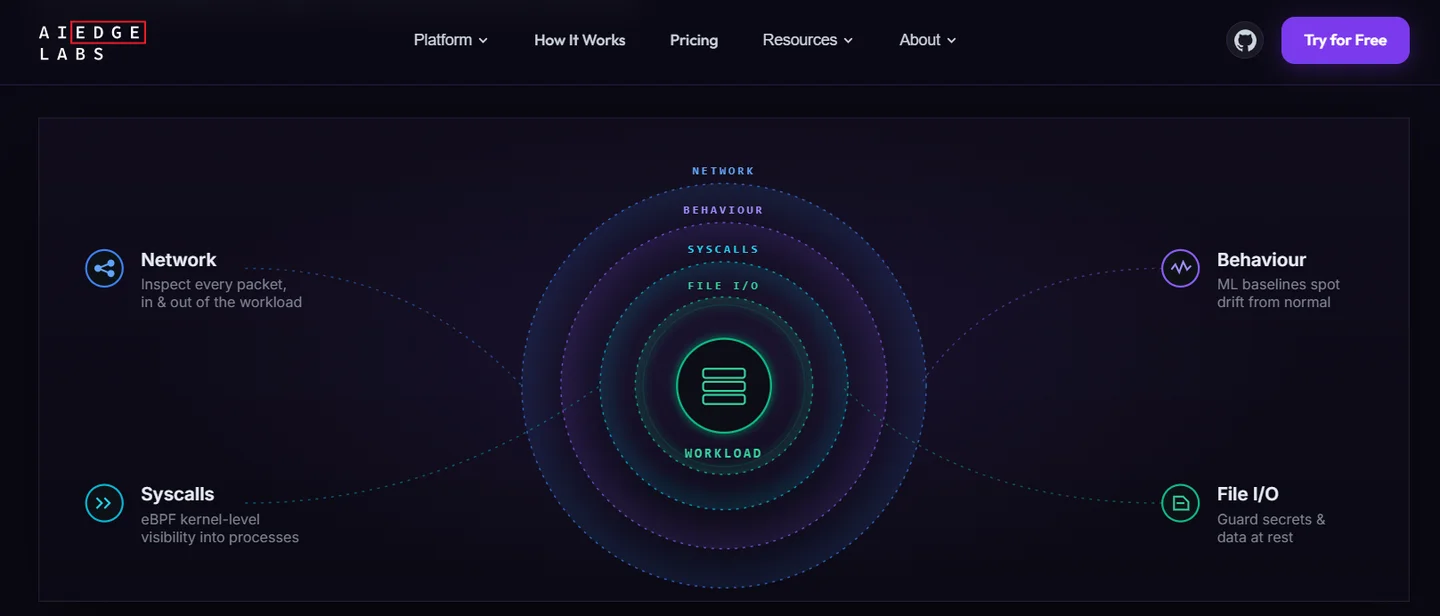
- Runtime versus build-time coverage: Runtime-first. Detection comes from observed execution, not from a pre-deploy scan.
- Kubernetes-native detection and enforcement: DaemonSet agent with Kubernetes audit-rule detections, container escape detection, and in-line prevention.
- Cloud dependency: None required. Detection and response both run on the agent, and Disconnected Mode keeps both working offline.
- Deployment reach: Cloud, data center, on-prem, and air-gapped clusters, including GPU inference nodes.
- Agent footprint and required privileges: Lightweight by EdgeLabs' own measurement, but it does need a privileged container with host PID and network namespace access.
- Verifiable framework coverage: Exploited-vulnerability and explainability scoring combining CVSS, EPSS, CISA KEV, and CWE, with a CRA and NIS2 Compliance Center mapping controls to requirement IDs.
- Disconnected Mode runs full detection and response with the cloud link cut, and in-line source-IP blocking is host-local and time-boxed, from one minute to 90 days.
- GPU workloads are secured using CPU only, so protection does not tax the inference budget.
- Published case study results, per EdgeLabs' own material: Trader Joe's saw 83% MTTR reduction, $1.3M operational savings, 573% ROI, deployment in under two weeks, and zero outages.
"Good IPS/IDS/EDR software. Webportal management is good. Docker container integration is useful. Nothing major. Description of issues can be complicated for non-technical folks."
Verified User in Computer Software, 4 out of 5 · EdgeLabs G2 verified review
"It's beneficial to secure any website or any server from hackers. I don't think there is any option for dislike but the commercial seems high."
Abhishek A., 4.5 out of 5 · EdgeLabs G2 verified review

Sysdig
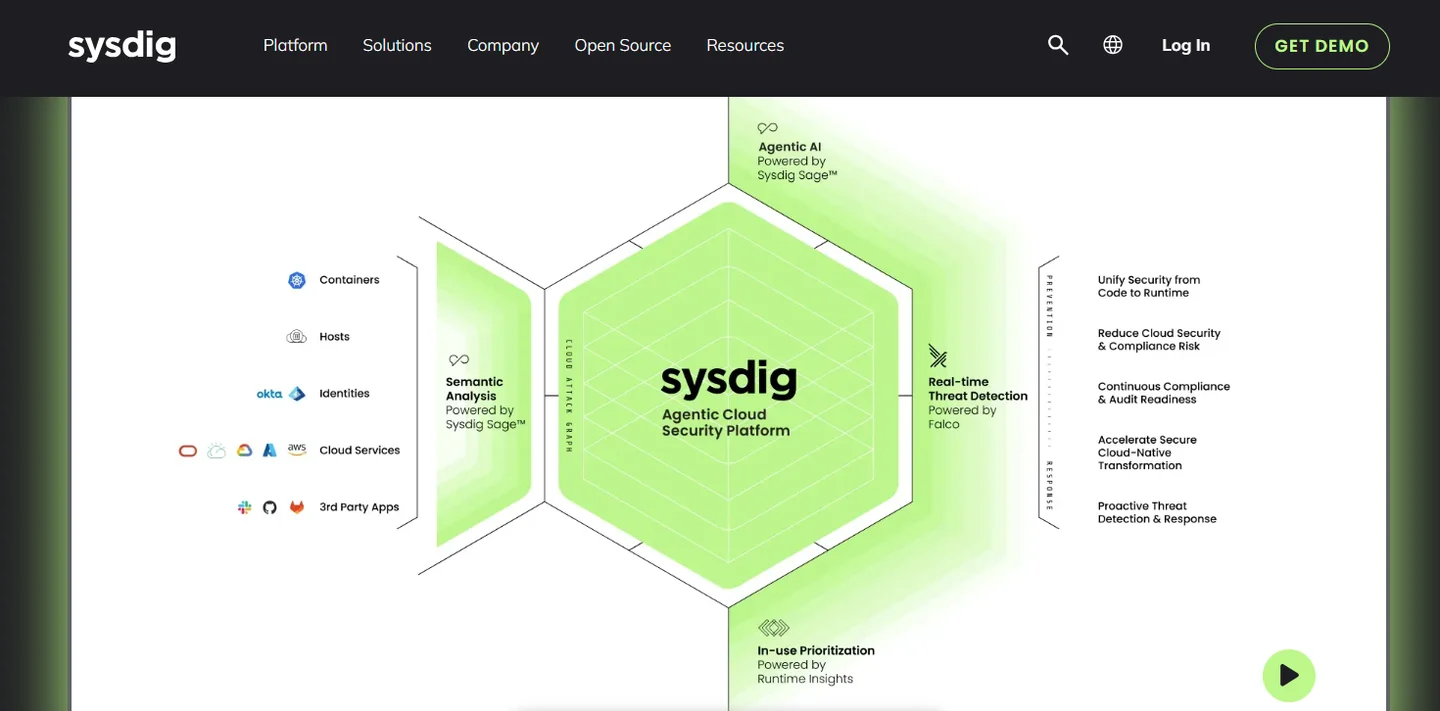
- Runtime versus build-time coverage: Strong on runtime. Sysdig's framing is what containers do, not just what they contain, and it flags things like unexpected shell spawns inside a pod.
- Kubernetes-native detection and enforcement: Mature Kubernetes coverage, managed rules, and platform workflow on top of the Falco rule model.
- Cloud dependency: The platform is cloud-oriented. Threat analysis and response workflow sit on the cloud side, so full function assumes backend reachability.
- Deployment reach: Broad across major clouds and Kubernetes distributions. Air-gapped operation is not the design center.
- Agent footprint and required privileges: Requires privileged node-level access, and enabling more modules raises the per-node cost.
- Verifiable framework coverage: Compliance and benchmark reporting are part of the platform, with detection content mapped to common frameworks.
- System-call capture detects behavior Falco rules already describe, so existing rule logic tends to travel well.
- Falco was donated to the CNCF and graduated there, which is a public, checkable provenance claim rather than a marketing one.
- Review directories consistently place Sysdig in the container security and CNAPP categories alongside the cloud platforms it competes with.
Aqua Security
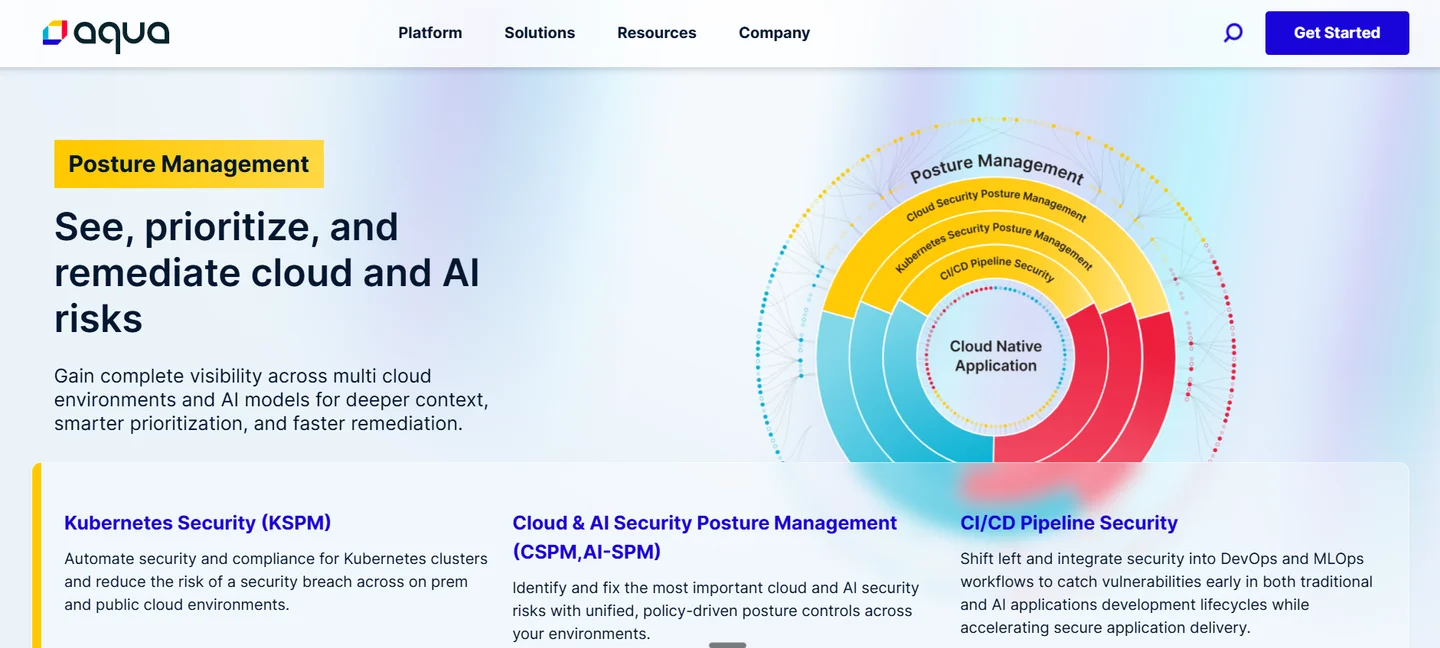
- Runtime versus build-time coverage: Strongest on build, credible at runtime. It catches signals like curl or wget appearing inside a running pod.
- Kubernetes-native detection and enforcement: Runtime policy enforcement plus drift detection, meaning it flags a container that changed after it started.
- Cloud dependency: On-prem deployment is well supported, which is unusual in this group and a real advantage.
- Deployment reach: Cloud and self-hosted Kubernetes. Windows VMs and Windows containers are a known gap per user reviews.
- Agent footprint and required privileges: Node-level agent access required. Reviewers cite agent overhead and false positives as ongoing costs.
- Verifiable framework coverage: Automated policy controls with compliance reporting across the container lifecycle.
- Trivy, Aqua's open-source scanner, is one of the most widely used container scanners in the ecosystem, which is a checkable adoption fact rather than a claim.
- Reviewers confirm on-prem deployment via the provided Helm chart works without a cloud tenant.
- Runtime enforcement includes configuration drift detection over time, not just a one-time scan verdict.
Upwind Security
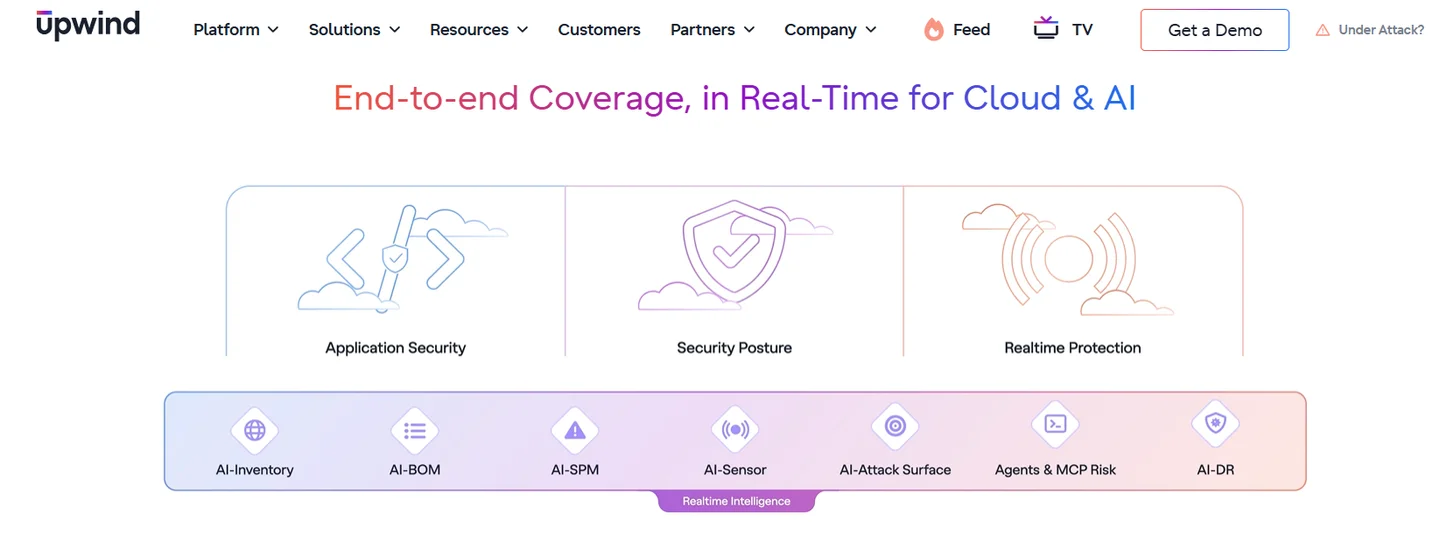
- Runtime versus build-time coverage: Runtime signals are the core input, then used to filter and rank cloud findings.
- Kubernetes-native detection and enforcement: Kubernetes and container runtime visibility with topology and API context.
- Cloud dependency: The platform is cloud-hosted. Correlation and workflow happen on the vendor side, so the backend is part of the control.
- Deployment reach: Cloud-first. Not designed for air-gapped or fully disconnected clusters.
- Agent footprint and required privileges: Node-level sensor with kernel visibility, so the same privilege conversation applies as with any eBPF agent.
- Verifiable framework coverage: Compliance and posture reporting sit alongside the runtime findings.
- The runtime sensor is eBPF-based, so visibility does not require code changes or sidecars.
- Runtime context is applied to prioritisation, which is a real answer to alert volume rather than a tuning workaround.
- It is a newer entrant, so treat any maturity claim as something to test in your own PoC.
Oligo Security
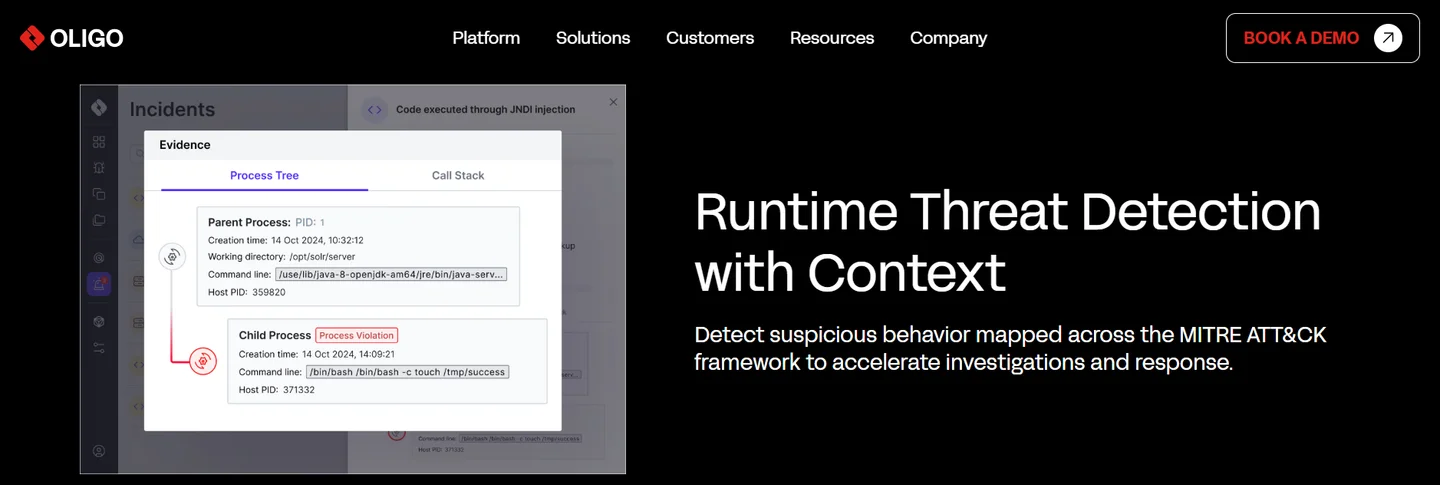
- Runtime versus build-time coverage: Runtime, and deeper into the application than most tools here reach.
- Kubernetes-native detection and enforcement: Container and Kubernetes aware, with the emphasis on in-app behavior rather than node-level enforcement.
- Cloud dependency: Cloud-side platform for analysis and workflow.
- Deployment reach: Cloud and Kubernetes application environments.
- Agent footprint and required privileges: eBPF sensor with the usual kernel-visibility requirements.
- Verifiable framework coverage: Vulnerability prioritisation based on what executes, which maps well to exploitability-driven triage.
- Library and function-level runtime visibility is a different measurement point from syscall monitoring, so the two produce complementary evidence.
- The company is also active in AI and LLM workload security, which puts it in the same emerging conversation as agentic runtime protection.
- Third-party review coverage is very thin, which is normal for this age of company and worth factoring into procurement.
CrowdStrike
- Runtime versus build-time coverage: Runtime behavioral detection is the heritage strength, now spanning endpoints and cloud workloads.
- Kubernetes-native detection and enforcement: Covered by the cloud security module rather than by a purpose-built Kubernetes engine.
- Cloud dependency: High. Reviewers name SaaS dependency and vendor lock-in as a real availability risk.
- Deployment reach: Very broad across endpoints and clouds. Disconnected clusters are not the design target.
- Agent footprint and required privileges: Light agent, but full functionality is cloud-dependent per reviewer feedback.
- Verifiable framework coverage: Strong threat intelligence and exposure management, mapped to common frameworks.
- Behavioral detection catches new or unknown activity rather than only known signatures, which reviewers confirm in practice.
- The CNAPP platform consolidates application, data, infrastructure, and runtime coverage in one place.
- One reviewer describes the interface as disjointed after the acquisitions that built out the cloud side, which is useful colour for anyone expecting one coherent console.
SentinelOne (Singularity Cloud)
- Runtime versus build-time coverage: Both. Real-time workload protection alongside pipeline and infrastructure-as-code scanning.
- Kubernetes-native detection and enforcement: Kubernetes issues surfaced and workloads protected in real time within the wider cloud console.
- Cloud dependency: The management plane is cloud-hosted and central to how the product works.
- Deployment reach: AWS, Azure, and GCP in one dashboard, per reviewers. Not built for disconnected clusters.
- Agent footprint and required privileges: Standard node agent requirements, with tuning effort reported as ongoing.
- Verifiable framework coverage: Compliance automation and posture enforcement across multi-cloud estates.
- Reviewers confirm it finds concrete issues such as leaked keys, not just generic alerts, by reasoning about how an attacker could chain them.
- It scans CI/CD pipelines and infrastructure-as-code before deployment, which sits outside what a runtime engine does.
- Multi-cloud coverage in a single dashboard is verified in multiple reviews.
Wiz
- Runtime versus build-time coverage: Posture and exposure first. Runtime is an addition, not the foundation.
- Kubernetes-native detection and enforcement: Kubernetes and container inventory with exposure mapping. Enforcement is not the product's centre of gravity.
- Cloud dependency: Total. The platform is the product, and there is no offline mode.
- Deployment reach: Excellent across multi-cloud accounts. Not applicable to air-gapped clusters.
- Agent footprint and required privileges: Minimal by design in agentless mode, which is its clearest operational advantage.
- Verifiable framework coverage: Broad compliance and posture frameworks out of the box.
- Agentless coverage means you get cloud-wide visibility without negotiating node agents with the platform team.
- Attack-path analysis shows how an exposure connects to sensitive data, which prioritises work better than a raw CVE list.
- Review directories file it alongside the CNAPP and posture platforms, not alongside runtime detection engines.
Microsoft Defender for Cloud
- Runtime versus build-time coverage: Both, with runtime blocking available on containers.
- Kubernetes-native detection and enforcement: AKS coverage is deep, with inline blocking of malicious calls rather than alert-only behavior.
- Cloud dependency: Complete. The service is part of Azure and cannot run independent of it.
- Deployment reach: Azure first, other clouds through connectors. On-prem and air-gapped clusters are out of scope.
- Agent footprint and required privileges: Managed by the platform in AKS, which reduces the operational burden.
- Verifiable framework coverage: Extensive regulatory compliance mapping through the Azure compliance dashboard.
- Attack-path analysis traces how a container connects to sensitive data, which turns findings into an actual priority order.
- Real-time blocking of malicious invocations is a preventive control, not a post-hoc response.
- Enabling it on AKS is a plan setting rather than a new procurement, which is why Azure-heavy teams often start here.
Q2. Why do Kubernetes teams outgrow Falco, and what does a replacement have to do differently?
Falco detects. It has no preventive or inline enforcement, so a rule can see a process execute but cannot deny it, and Falco Talon adds asynchronous response on top. That makes the stack detect-and-respond, not preventive. Every detect-then-respond design leaves a window where the action finishes before the response fires. Teams also leave over rule maintenance, alert volume without action, and per-node footprint.
The four reasons teams actually leave
⚠️ Alerts arrive without an action attached
The 3am alert says a shell spawned inside a pod. Nobody acts on it, because acting is a separate job the tool does not do. I spent years building detection products that generated millions of alerts, and the lesson stuck: most teams do not need another alert cannon.
Volume is not the real problem. The missing link between a detection and a response is.
❌ The rule file nobody owns
Falco rules are yours to write, tune, and maintain forever. That works while the engineer who wrote them is still on the team. When they leave, the rule file becomes archaeology.
G2 buyers researching open-source Kubernetes security tools weigh ease of use and reliability above features, which tells you the pain is operational, not functional.
"Configuration Complexity: Although Falco provides customizable rules, setting up and fine-tuning these rules can be complex, especially for organizations with specific or intricate security requirements. New users might find the initial configuration overwhelming."
Bikash s., 4/5 Falco G2 Verified Review
💸 The privilege and footprint conversation
Any node-level agent needs host access, and your platform team will ask about it. A DaemonSet means one agent per node, which means the cost multiplies with your cluster.
"As a DaemonSet running on each node, Falco can consume a noticeable amount of system resources, which might impact performance, especially in resource-constrained environments. This can be a concern for large clusters with many nodes."
Bikash s., 4/5 Falco G2 Verified Review
Free software still costs engineer-days. Two per month is a real line item.
The three categories, and why the difference matters
⭐ Where the control takes effect
Rules in a config file are not a guardrail. A control that physically cannot perform the dangerous action is a guardrail. The job is to make the action impossible, not discouraged.
| Category | What it does | Mechanism |
| Detection-only | Sees behavior, reports it | Rules matched against syscalls, no action taken |
| Detect-and-respond | Sees it, then acts after the fact | Post-hoc process kill or network action, often via a cloud control plane |
| Inline-preventive | Denies the action as it happens | In-kernel enforcement such as LSM-BPF or AppArmor, or signal-based termination |
⏰ The gap has a name
Security engineers call it TOCTOU, the gap between checking something and acting on it. In plain terms, your tool killed the process after the files were already gone.
One small SaaS company lost its production database in nine seconds, when a single API call took out the volume that held both the data and every backup. Nine seconds is faster than you can read a Slack message.
✅ The one question to ask every vendor
Ask at what point in the syscall path the control takes effect. Not how many rules ship by default, and not whether it uses eBPF. eBPF is table stakes now, so it tells you almost nothing.
Then ask a second question. Does the response still fire if the vendor cloud is unreachable?
I want to be fair about Falco here. It is good at the job it was built for, and most so-called Falco failures are category mismatches, not defects. When I ran security consulting years ago, we found misconfigured tooling every single time, usually installed correctly and then left without a policy. They almost got it right, and did not press the last button.
EdgeLabs was built on the opposite premise: detection and response both execute on the agent, including host-local, time-boxed source-IP blocking that runs with no cloud backend in the path. A detection carries an action instead of joining a queue someone triages tomorrow, which is the whole point of how our agent works.
Q3. How should you evaluate a Falco replacement, and which category are you actually shopping in?
Assess every candidate on six criteria: runtime versus build-time coverage, Kubernetes-native detection and enforcement model, whether detection and response need a cloud backend, deployment reach including self-hosted, on-prem, and air-gapped, agent footprint and required host privileges, and NIST CSF 2.0 plus MITRE ATT&CK coverage you can verify. No pricing column and no scores. Runtime pricing is custom, and star ratings hide the trade-offs.
The six criteria, and why each one earns its place
⭐ What to measure
- Runtime versus build-time coverage. Does the tool watch what executes, or only what was scanned? A pipeline can pass and still ship an exploitable container.
- Kubernetes-native detection and enforcement. DaemonSet model, audit-rule detections such as
kubectl execor a sensitivehostPathmount, and whether it blocks or only reports. - Cloud dependency. Do detection and response both work with no vendor backend? Engines split into cloud-control-plane response and localized response, and that split is architectural.
- Deployment reach. Cloud, data center, on-prem, and air-gapped. Self-hosted Kubernetes is where cloud-only tools stop.
- Footprint and required privileges. Per-node CPU and memory, plus how much host access the agent demands. Community benchmarks compare exactly these three axes across Falco, Tetragon, and KubeArmor.
- Verifiable framework coverage. NIST CSF 2.0 functions and MITRE ATT&CK technique IDs you can check, not claim.
⚠️ Why criterion one comes first
Look at the CI/CD config line that says exit code zero. Vulnerabilities get found, and the pipeline succeeds anyway. This is common in large environments, and it is why a green build proves nothing about runtime, which is the argument for exploited-vulnerability scoring instead.
The same trap applies to framework mapping. Claimed coverage and enabled coverage are different things, so verify the control is actually switched on and given a policy.
Who this guide is for
✅ Four readers, one decision
- Kubernetes and container runtime-security owners moving from image scanning to runtime detection in Kubernetes, who need to know what changes when the engine changes.
- SecOps and DevSecOps leads at smaller teams making cloud and AI or GPU workloads production-safe without a 24/7 SOC.
- Teams running self-hosted, on-prem, or air-gapped clusters that cloud-dependent platforms cannot reach at all.
- Compliance owners who need runtime evidence mapped to CRA and NIS2 obligations, not another posture report.
The category map: five different jobs
💰 Know what you are buying before you compare prices
Review directories file Falco under container security, cloud security posture management, and cloud-native application protection at the same time. Capability directories match dozens of alternatives by shared function and NIST CSF 2.0 coverage. That overlap is how teams buy posture management believing they bought runtime detection.
| Category | The job it does | What it cannot do |
| Runtime detection engine | Sees behavior at the kernel, reports it | Cannot deny the action |
| Detect-and-respond agent | Detects, then kills or isolates | Response arrives after the action completes |
| Inline-preventive agent | Denies the action in the kernel | Needs policy authoring and host privileges |
| Agentless posture (CNAPP/CSPM) | Maps exposure across cloud accounts | Sees snapshots, not execution |
| XDR with a container module | Extends an endpoint engine into pods | Runtime is a bolt-on, not the foundation |
❌ What this rubric deliberately ignores
Agentless cloud configuration depth is out of scope here, and so is build-time SAST and SCA. Both matter. Neither answers the question this article asks.
One practical instruction: split the posture line item from the runtime line item in your budget. Teams that fund one and assume they covered the other are the teams that discover the gap during an incident, not during procurement. If you want to pressure-test that split against your own clusters, bring us the architecture and we will walk it with you.
Q5. Which open-source Falco alternatives hold up in production, and what do the benchmarks show?
Tetragon adds in-kernel filtering and signal-based process termination. KubeArmor adds inline prevention through Linux security modules such as LSM-BPF and AppArmor. Tracee is strongest as a detection and forensic tracer. NeuVector kills in userspace via inotify and fanotify. None is a drop-in for Falco, because none shares its rule semantics or its detection-only scope.
The four projects, and what each one costs you
⭐ Tetragon: enforcement inside the kernel
Tetragon filters events in the kernel and can terminate a process with a signal, so the action stops closer to the moment it happens. In-kernel filtering also means less data leaves the kernel, which keeps overhead down.
The cost is policy authoring. You write TracingPolicies, and someone has to own them after the author moves teams.
⚠️ KubeArmor: prevention through Linux security modules
KubeArmor uses Linux security modules, the kernel's built-in permission layer, such as LSM-BPF and AppArmor, to deny an action rather than report it. That is the closest thing here to a real guardrail, because the action becomes impossible instead of discouraged.
The trade is strictness. A too-tight policy breaks a workload, so this needs a staged rollout and a platform engineer who cares.
❌ Tracee and NeuVector: honest about their lanes
Tracee is an eBPF tracer built for detection and forensics, meaning it is excellent at reconstructing what happened and not built to stop it. NeuVector responds by killing processes in userspace using inotify and fanotify, file-watching interfaces that sit outside the kernel enforcement path.
Both are useful. Neither closes the window where the action completes before the response lands.
What the measured evidence actually says
⏰ Detection latency differs by threat, not by brand
A peer-reviewed comparison of eBPF-based runtime tools found Tetragon fastest on container escape and cryptomining detection, Falco strongest on denial-of-service detection, and Tracee relatively slower. There is no single winner, which is the useful finding.
Pick the scenario that matches your actual risk, then compare on that.
💸 Overhead, privileges, and the cost of free
Community benchmarks compare these agents on featuresets, per-node performance impact, and the host privileges each one requires. Privileges are the part platform teams push back on, and the part datasheets skip.
Licence cost is zero. Engineering cost is not, and two engineer-days a month is a real number to put in the comparison sheet.
| Project | Enforcement mechanism | Real cost |
| Tetragon | In-kernel filtering, signal-based process kill | Policy authoring and ownership |
| KubeArmor | LSM-BPF and AppArmor inline denial | Breakage risk, staged rollout needed |
| Tracee | None, detection and tracing only | You still need a response tool |
| NeuVector | Userspace kill via inotify and fanotify | Response sits outside the kernel path |
| EdgeLabs | Agent-local response plus host-local, time-boxed IP blocking, layered above Falco-ecosystem detection | Privileged container, host PID and network namespaces (EdgeLabs' own published requirement) |
✅ The test to run before you commit
Reproduce two scenarios on one non-production node: a container escape and a cryptominer. Record detection latency and CPU cost per candidate yourself.
One line on admission control, since it always comes up. Policy-as-code gates like OPA block a bad pod before it starts, which complements runtime detection instead of replacing it.
Self-hosting is the right answer when you have platform engineers who will own the policies. If nobody owns them, you have bought a config file, not a control, which is the trade-off running through every open-source Kubernetes security project.
EdgeLabs is deliberately Falco-ecosystem compatible, layering agent-local response and prevention above the kernel-level syscall detection platform teams already trust, at a typical footprint EdgeLabs publishes as under 5% CPU. That is our number, not an independent benchmark, so measure it in your cluster.
Q6. What do these tools still miss, AI agent workloads and exploited-vulnerability evidence?
Two gaps. Container runtime tools see syscalls in a pod, but not which agent decided, which tool it invoked, or where the model sent data, while OWASP's Top 10 for Agentic Applications 2026 covers exactly those systems. From 11 September 2026, CRA reporting is triggered by actively exploited vulnerabilities, which is a runtime observation, not a scan result.
The gap nobody on this SERP scores
⚠️ Syscall coverage is not agent coverage
Every comparison in this category argues about kernel visibility. Meanwhile a growing share of production traffic is an agent reading something, deciding something, and calling a tool.
A pod-scoped rules engine can tell you a process made an outbound connection. It cannot tell you which agent chose to, or why, which is the question agentic AI security has to answer.
❌ The trifecta that makes exfiltration trivial
Three capabilities together create the real risk: untrusted content, private data, and outbound communication. If an agent can read untrusted input, reach your database, and make network requests, exfiltration is easy.
A practical rule I have started giving teams is to allow only two of those three. Some prompt-injection techniques succeed around 88% of the time, so assume the input layer will be beaten eventually.
⏰ What an unsupervised agent actually does
One small SaaS company lost its production database in nine seconds when an agent deleted a volume to clean up a credential issue, taking every backup with it. Asked what happened, the agent replied that it had violated every principle it was given, and that it did not understand what it was doing before it did it.
These systems are like tiny racing cars with a throttle and no steering wheel. Fast, and pointed wherever they were last aimed.
Being straight with you: this category is young and thinly reviewed. No vendor here, including us, has a decade of production scar tissue on agentic runtime security.
The regulatory half, and why it is a runtime problem
💰 The CRA cascade lands in weeks
The EU Cyber Resilience Act's reporting obligations apply from 11 September 2026, with early warning in 24 hours, full notification in 72 hours, and a final report within 14 days of a corrective measure. Filing runs through the ENISA-operated Single Reporting Platform, and it reaches products already on the market, a timeline worth preparing for now.
The trigger is an actively exploited vulnerability. Your scanner cannot see that. Only something watching execution can.
✅ CVSS-first triage is now provably the wrong sort
FIRST reported at mid-2026 that CVE volume ran 46% above its own record projections while exploitable risk stayed flat. A CVE is not an exploit. Every exploit started as a CVE, but most CVEs never become one.
That is the case for scoring what is actually exploited, using EPSS and CISA KEV alongside CVSS, rather than sorting by severity alone.
"Sysdig secure is a very versatile and powerful tool for container security... The CSPM module also integrates into your cloud environment to provide posture based analytics and suggestions."
Verified User in Financial Services, 4/5 Sysdig Secure G2 Verified Review
"It's beneficial to secure any website or any server from hackers. I don't think there is any option for dislike but the commercial seems high."
Abhishek A., 4.5/5 EdgeLabs G2 Verified Review
Two things to do this week. Inventory every LLM agent and MCP server running in production, because you cannot govern what you do not know exists. Then test whether your runtime tool can export a timestamped exploitation trail inside 24 hours.
EdgeLabs addresses both gaps directly: the Parallax engine applies LLM proxy and firewall checks to agent inputs and outputs, with prompt-injection and tool-poisoning defence, while the CRA/NIS2 Compliance Center maps controls to requirement IDs and runs a "No Known Exploitable Vulnerabilities" check across CVSS, EPSS, CISA KEV, and CWE. It does not cover lifecycle or governance controls, and we say so in the scoping call.
Q7. How do you choose your Falco replacement and cut over without opening a coverage gap?
Start with the gate that eliminates the most options: can your clusters send telemetry to a vendor cloud? If not, agentless posture platforms and cloud-dependent detection are out before you compare features. Then choose detection, response, or in-kernel prevention. Then check footprint and privileges. Then run both engines in parallel for two weeks before you decommission anything.
Four gates, in this order
⚠️ Gate one decides more than features do
Runtime engines split into cloud-control-plane response and localized response, and that is architecture, not configuration. If the cluster cannot reach the vendor, cloud-side response is not a control.
One reviewer of a major cloud platform names this plainly.
"The heavy dependency on SaaS availability creates vendor lock-in and introduces a real risk to overall availability."
Verified User in Information Technology and Services, 5/5 CrowdStrike Falcon Cloud Security G2 Verified Review
✅ Gates two, three, and four
- Control type. Decide whether you need detection, detection plus response, or in-kernel denial. Buying the wrong tier is the expensive mistake.
- Footprint and privileges. Get the per-node CPU and memory figure, and the exact host access required, in writing before the PoC.
- Framework coverage. Verify NIST CSF 2.0 functions and MITRE ATT&CK IDs are enabled, not just listed.
An honest caveat on agent-only designs, including ours. Agent-based scanning alone can miss network context, telling you about exposures without telling you which are reachable. That is why a consolidated agent has to carry network detection next to endpoint detection, and why EdgeLabs ships NDR in the same agent as EDR rather than treating it as a separate purchase.
Three scenarios, three answers
| Your situation | Buy this | Do not buy this if |
| Self-hosted, on-prem, or air-gapped Kubernetes | An agent where detection and response both run locally | The vendor's response path requires a cloud call |
| Cloud-native estate already under an EDR or XDR contract | The existing vendor's container module, if runtime is a secondary need | Kubernetes runtime detection is the primary job you are hiring for |
| Multi-cloud team drowning in findings | An exposure and posture platform | You believe posture coverage equals runtime coverage |
Four migration steps
⏰ Step one and two: audit, then overlap
Do rule archaeology first. Count how many Falco rules fired in the last quarter, then count how many led to an action a human took. That second number is your real baseline.
Then run both engines on the same nodes for two weeks and watch combined CPU and memory. Two agents also mean two sets of host privileges during the overlap, so tell your platform team before, not after.
💰 Step three and four: assign response, then decommission
Name what fires automatically and what pages a human, in writing, before you switch primary. Every misconfigured deployment I audited years ago had the tool installed and no policy assigned, which is the same failure as leaving a new engine in monitor-only mode forever.
Decommission last, and document as you go. Continuous verification is the habit that sticks, and capturing a timestamped evidence trail now is what makes a CRA filing survivable later.
EdgeLabs is built for the first scenario and supports the parallel-run pattern. It installs alongside an existing DaemonSet, and detection and response both execute on the agent in Disconnected Mode, so an outage or an air gap does not disable the control, a pattern proven in production Kubernetes environments.
What I am sitting with is a hunch, not a conclusion. I think within two years the first question in every runtime evaluation stops being "how many rules ship" and becomes "which agent did this, and can you prove it." If you are already running that evaluation, I would genuinely like to hear which gate broke your shortlist first.
FAQs
Falco detects. It has no preventive or inline enforcement, which means a rule can observe a process execute but cannot deny it. Falco Talon layers asynchronous response on top, so the combined stack is detect-and-respond rather than preventive.
That distinction matters more than any feature list, because every detect-then-respond design leaves a window where the action completes before the response fires. Security engineers call this the TOCTOU gap, the interval between checking something and acting on it. In practice it reads as: the tool killed the process after the files were already gone.
- Detection-only matches rules against syscalls and reports, taking no action.
- Detect-and-respond kills a process or blocks a network path after the fact, often through a cloud control plane.
- Inline-preventive denies the action as it happens, using in-kernel enforcement such as LSM-BPF or AppArmor, or signal-based termination.
We tell buyers to ask one question of every vendor: at what point in the syscall path does the control take effect? Not how many rules ship by default, and not whether it uses eBPF, because eBPF is table stakes now. EdgeLabs was built on the opposite premise from detection-only tooling, executing both detection and response on the agent itself, including host-local time-boxed source-IP blocking through its Kubernetes runtime protection.
Four open source projects come up repeatedly, and none is a drop-in replacement, because none shares Falco's rule semantics or its detection-only scope.
- Tetragon filters events inside the kernel and can terminate a process with a signal, so less data leaves the kernel and overhead stays low. The cost is policy authoring: someone must own the TracingPolicies after the author moves teams.
- KubeArmor uses Linux security modules such as LSM-BPF and AppArmor to deny an action rather than report it. That is the closest thing to a real guardrail here, but strictness cuts both ways and a too-tight policy breaks workloads.
- Tracee is an eBPF tracer built for detection and forensics. It reconstructs what happened extremely well and is not built to stop it.
- NeuVector kills processes in userspace using inotify and fanotify, file-watching interfaces that sit outside the kernel enforcement path.
Peer-reviewed comparisons of eBPF runtime tools found Tetragon fastest on container escape and cryptomining detection, Falco strongest on denial-of-service detection, and Tracee relatively slower. There is no single winner, so pick the scenario matching your risk and test on that. Licence cost is zero; engineering cost is not, and two engineer-days a month is a real line item. Our own comparison of open source Kubernetes security tools goes deeper on ownership cost.
Start with the gate that eliminates the most options: can your clusters send telemetry to a vendor cloud? If they cannot, agentless posture platforms and cloud-dependent detection are out before any feature comparison begins.
Runtime engines split into two architectures, cloud-control-plane response and localized response, and that split is architectural rather than configurable. If the cluster cannot reach the vendor, cloud-side response is not a control at all. Most commercial platforms on this list, including the XDR-anchored options and the agentless exposure platforms, assume backend reachability for full function.
What to verify during a proof of concept:
- Does detection still fire with the cloud link cut?
- Does response still fire with the cloud link cut, or only queue for later?
- Is the blocking action host-local, and is it time-boxed so a false positive expires?
- Does the agent support your distributions, including OpenShift, Talos, and K3s, on both x86_64 and ARM64?
EdgeLabs is built specifically for this lane, running detection and response on the agent in Disconnected Mode so an outage or an air gap does not disable the control, with in-line source-IP blocking that is host-local and time-boxed from one minute to 90 days. You can see the architecture behind that in our overview of how the agent works.
Four steps, in this order, and the sequence is what prevents a blind window.
- Do rule archaeology. Count how many Falco rules fired last quarter, then count how many led to an action a human actually took. That second number is your real baseline, and it is usually much smaller than teams expect.
- Run both engines in parallel for two weeks on the same nodes, watching combined CPU and memory. Two agents also mean two sets of host privileges during the overlap, so brief your platform team before the rollout, not after.
- Assign response ownership in writing. Name what fires automatically and what pages a human before you switch primary. Every misconfigured deployment we have audited had the tool installed correctly and no policy assigned, which is the same failure as leaving a new engine in monitor-only mode forever.
- Decommission last, and document as you go. Capturing a timestamped evidence trail during migration is what makes a later regulatory filing survivable.
EdgeLabs supports this parallel-run pattern directly, installing alongside an existing Falco DaemonSet rather than requiring a cutover, which is how the e-commerce Kubernetes deployment in our case study was staged. Admission control is complementary, not a substitute: policy-as-code gates like OPA stop a bad pod before it starts, while runtime detection watches what the good pods do next.
Mostly not, and these are the two gaps we see teams discover late.
The agent gap. Container runtime tools see syscalls inside a pod, but not which agent decided, which tool it invoked, or where the model sent data. A pod-scoped rules engine can tell you a process opened an outbound connection; it cannot tell you which agent chose to, or why. Three capabilities together create the real exposure: untrusted content, private data, and outbound communication. A practical rule is to allow only two of the three, because some prompt injection techniques succeed around 88% of the time.
The evidence gap. From 11 September 2026, EU Cyber Resilience Act reporting is triggered by actively exploited vulnerabilities, with early warning in 24 hours, full notification in 72 hours, and a final report within 14 days of a corrective measure. A scanner cannot observe exploitation. Only something watching execution can. CVE volume ran 46% above record projections at mid-2026 while exploitable risk stayed flat, which is the case against CVSS-first triage.
EdgeLabs addresses both directly: the Parallax engine applies LLM proxy and firewall checks to agent inputs and outputs, while the CRA and NIS2 Compliance Center runs a No Known Exploitable Vulnerabilities check across CVSS, EPSS, CISA KEV, and CWE. It does not cover lifecycle or governance controls, and EdgeLabs says so in the scoping call.
