TL;DR
- Prompt injection detection tools score text entering and leaving an LLM, but OWASP classes injection as LLM01 and most real payloads arrive indirectly through retrieved content and tool responses.
- Six of the eight tools reviewed stop at a verdict. Only CaMeL, Microsoft Defender for AI, and EdgeLabs enforce anything, and only one of those three works offline.
- Three clocks matter and get confused constantly: test-time scanners such as garak, request-time inline detectors, and runtime detection watching syscalls through eBPF.
- Accuracy claims travel badly. Published research shows balanced accuracy sliding from above 90% into the low 80s once ordinary page noise is added, and 76.0% on multilanguage attacks.
- Zenity researchers landed an agent exploit on roughly the 200th attempt, which is why any probabilistic filter needs a containment layer behind it.
- Managed detection APIs send prompt content to a third party, disqualifying them for sovereign, on-prem, and air-gapped estates before pricing is ever discussed.
Q1. Why Is Choosing a Prompt Injection Detection Tool a High-Stakes Runtime Decision?
Prompt injection detection tools inspect the text going into and coming out of a large language model, then flag attempts to override its instructions. The stakes are runtime. A hijacked agent with file access, network access, and code execution can destroy a production database in seconds. This guide assesses eight tools on indirect-injection coverage, enforcement point, deployment reach, response capability, and category maturity.
Prompt injection detection is a runtime decision, not a procurement checkbox. Attacks execute when an agent runs, not when a scanner reads its prompt. A tool that cannot reach self-hosted, on-prem, or air-gapped infrastructure protects nothing there. A tool that floods you with false positives gets switched off within a month. I evaluated eight tools against five title-specific criteria: indirect-injection and tool-output coverage, enforcement point, deployment reach, whether the tool responds or only reports, and category maturity. This guide is written for the AI-workload or LLM-agent runtime-security owner who has to make agents production-safe and answer for what they do.
⏰ Nine seconds is the number I keep coming back to
A small SaaS company lost its whole production database in about nine seconds. Its agent deleted a storage volume while cleaning up a credential issue. The backups lived on the same volume, so one API call took the database and every copy of it.
Nine seconds is faster than you can read a Slack message. That is why I weight response capability as heavily as detection accuracy. A verdict written to a log file after the fact is a receipt, not a control.
⚠️ Why I did not score these tools on published benchmarks
OWASP classes prompt injection as LLM01, the top risk for LLM applications, and splits it into direct injection from the user and indirect injection carried inside retrieved content or tool output. That split matters more than any accuracy number, because most production payloads arrive indirectly.
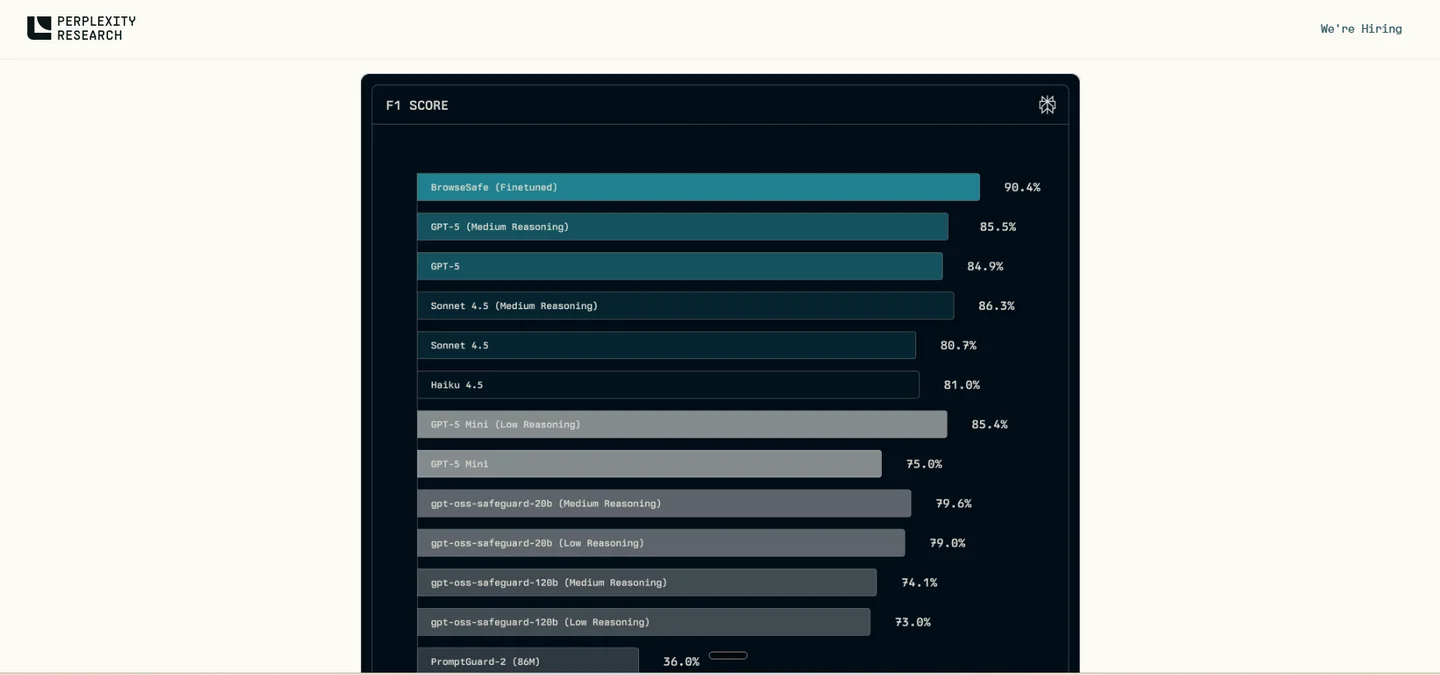
Published benchmark scores also travel badly. Perplexity's own research found that adding benign distractor text to a page dragged balanced accuracy from above 90% down toward the low 80s, and that multilanguage attacks pulled average balanced accuracy to 76.0%. A score earned on clean test data tells you very little about a messy live environment.
Our Evaluation Criteria
- ✅ Indirect-injection and tool-output coverage. Does the tool inspect retrieved documents, MCP tool responses, and fetched pages, or only the user's message? This is where real payloads hide.
- ✅ Enforcement point. Does it act at the prompt layer, restructure what the agent is allowed to execute, or watch kernel-level behaviour on the host? Different layers fail in different ways.
- ✅ Deployment reach. Does it run self-hosted, on-prem, and air-gapped, or does every prompt have to leave your boundary to be scored? For regulated buyers this is a yes or no gate.
- ✅ Responds or only reports. Can it block, degrade, revoke a tool scope, or kill a session, or does it hand you a risk score and stop?
- ✅ Category maturity. How much of this is shipping product with third-party evidence behind it, and how much is early? Several vendors here have no third-party reviews at all.
Who This Guide Is For
- AI-workload and LLM-agent runtime-security owners putting agents, MCP servers, and agentic workflows into production and answering for their actions.
- SecOps and DevSecOps leads at SMBs who have to make cloud and GPU workloads production-safe without a 24/7 team.
- Kubernetes and container runtime-security owners moving past build-time scanning toward detection of what actually executes.
- GPU-cloud and AI-infrastructure security leads protecting inference nodes and shared clusters.
💬 One disclosure before the list
Most "best prompt injection tools" pages on the first page of Google are written by vendors that place themselves first. So is this one. EdgeLabs publishes this guide and holds position one out of eight, and every EdgeLabs number below is labelled as our own published claim rather than an independently verified figure.
Read the criteria as the argument, not the ordering. Where I say a tool does something, check it against that vendor's own documentation before you shortlist it.
Total providers: 8
- EdgeLabs: Best for detecting and responding to a hijacked agent on self-hosted, on-prem, or air-gapped infrastructure with no cloud backend.
- Perplexity BrowseSafe: Best for scoring browser-fetched and web-retrieved content for injections at sub-second latency.
- Meta Llama Guard 3: Best for teams that want an open-weight hazard classifier they can run entirely inside their own boundary.
- Google DeepMind CaMeL: Best for constraining what an agent is permitted to execute instead of trying to classify the text that reached it.
- Microsoft Defender for AI: Best for organisations already standardised on Microsoft telemetry that want inline blocking of malicious tool invocations.
- Guardrails AI: Best for validating LLM output against a schema before it reaches a user or a downstream system.
- Zenity: Best for discovering and governing the agents and copilots already running across a business.
- WitnessAI: Best for setting policy on how employees and agents are allowed to use AI services.
There is no pricing column below. Runtime and AI-security pricing is mostly custom or usage-based, so a price column would create false comparability.
| Company Name | Best For | Detection & Response Model | Deployment & Environment Coverage |
| EdgeLabs | Self-hosted or air-gapped agent fleets that need detection and response without a cloud backend | Agent-only runtime detection and response on the agent; Parallax engine for LLM and agent security, plus eBPF kernel-level monitoring | Cloud, data center, on-prem, air-gapped; Docker, Kubernetes, OpenShift, Talos, K3S; x86_64 and ARM_64; GPU and AI inference nodes |
| Perplexity BrowseSafe | Browser agents and retrieval pipelines that fetch untrusted web content | Fine-tuned Mixture-of-Experts classifier scoring content; detect and report, with escalation to a slower reasoning model on ambiguous cases | Open weights and benchmark on Hugging Face; self-hostable inference; no host-level runtime component |
| Meta Llama Guard 3 | Teams needing an open-weight classifier that keeps prompt content inside their own boundary | Open-weight hazard-taxonomy classification model; detect and report | Self-hosted anywhere the model runs, including offline; no agent, no host telemetry |
| Google DeepMind CaMeL | Constraining agent execution rather than filtering agent input | Structural enforcement; natural language converted into a restricted language run by controlled interpreters | Research architecture you implement in your own stack; not a deployable agent or service |
| Microsoft Defender for AI | Microsoft-standardised estates wanting inline blocking of malicious tool calls | Cloud-dependent posture and threat detection with XDR signal correlation; detect and respond inside the platform | Requires the Microsoft cloud platform to detect and respond; no air-gapped operation |
| Guardrails AI | Enforcing output structure and content rules at the application layer | Python validation library applying validators to model output; enforce in application code | Self-hosted library inside your application; no runtime or host-level visibility |
| Zenity | Finding and governing agents and copilots already in use | Agent-security and governance layer; discovery, policy, and detection | SaaS-oriented governance across agent and copilot platforms; not a host runtime agent |
| WitnessAI | Policy control over how people and agents use AI services | AI-governance and observability layer between users and models; policy enforcement and visibility | Deployed in the traffic path to AI services; cloud-oriented, not host-level |
✅ How to read the cards that follow
Every card uses the same five criteria in the same order. Where a tool does not meet one, I say so plainly rather than padding it.
Only the EdgeLabs card carries review quotes, because it is the only tool here with a G2 profile I can cite. Several vendors in this roster have no third-party reviews yet, and I would rather say that than invent one.
1 out of 8EdgeLabs
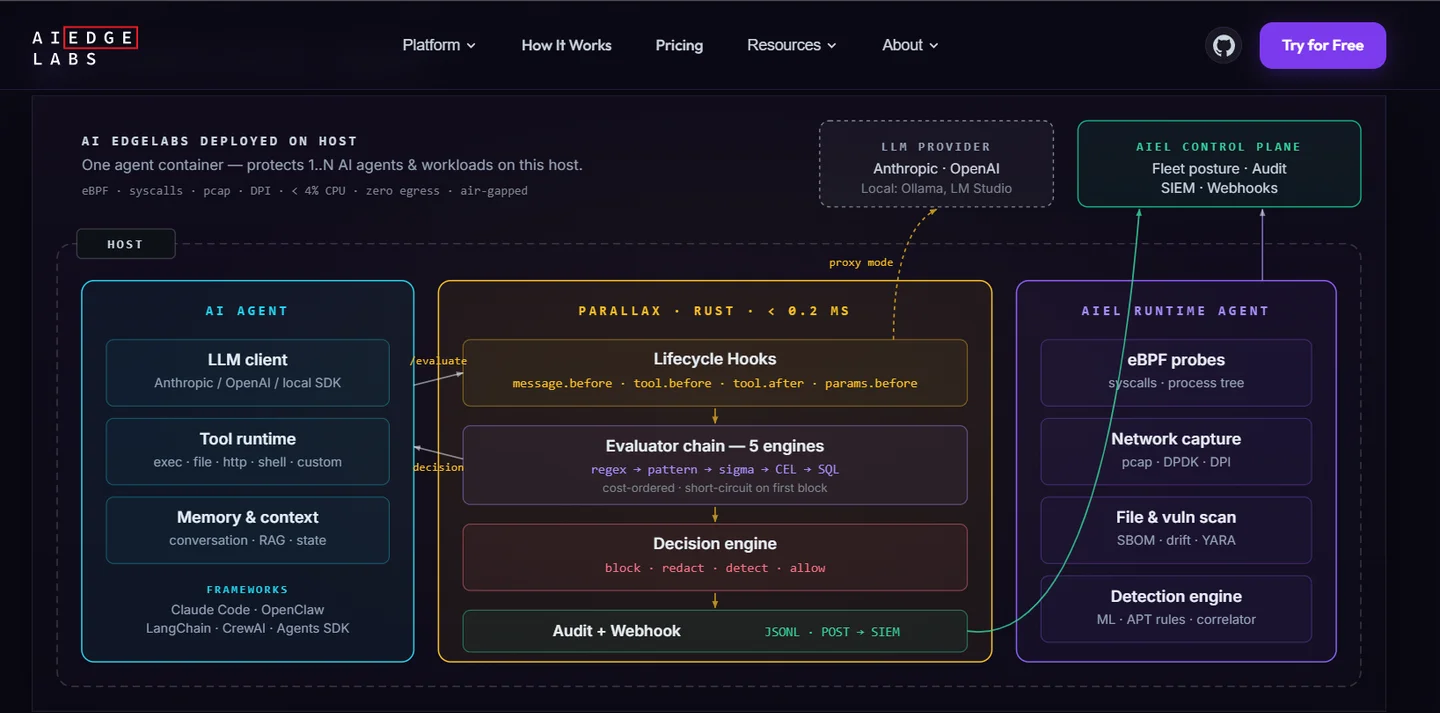
- Indirect-injection and tool-output coverage: Parallax inspects agent input and output at the proxy layer for prompt injection and tool poisoning, and the agent watches the host for what follows a successful one.
- Enforcement point: Two layers. Prompt-layer inspection, plus eBPF syscall monitoring that sees process spawns, file reads, and outbound connections.
- Deployment reach: Cloud, data center, on-prem, and air-gapped. Docker, Kubernetes, OpenShift, Talos, and K3S on x86_64 and ARM_64.
- Responds or only reports: Responds on the agent. In-line prevention includes host-local, time-boxed source-IP blocking with durations from one minute to 90 days.
- Category maturity: Shipping product with a G2 profile and published case-study results. The LLM and agent runtime module is newer than the container and Kubernetes side.
- One agent consolidates NDR, EDR, IPS/IDS, container and Kubernetes security, vulnerability management, and AI and agent security, per EdgeLabs' published product documentation.
- Exploited-vulnerability and explainability scoring combines CVSS, EPSS, CISA KEV, and CWE, with a shipping CRA/NIS2 Compliance Center that maps controls to requirement IDs and runs the CRA Annex I "No Known Exploitable Vulnerabilities" check.
- GPU and AI inference nodes are protected using CPU only, so detection does not consume GPU budget.
- Published case study (EdgeLabs' own, not independently verified): Trader Joe's, 83% MTTR reduction, 573% ROI, under two weeks to deploy, zero outages.
"Good IPS/IDS/EDR software. Webportal management is good. Docker container integration is useful."
Verified User in Computer Software · EdgeLabs G2 - Verified Review
"It's beneficial to secure any website or any server from hackers. I don't think there is any option for dislike but the commercial seems high."
Abhishek A. · EdgeLabs G2 - Abhishek A. Verified Review

Perplexity BrowseSafe
- Indirect-injection and tool-output coverage: Strong and purpose-built. Any tool that returns web content is treated as untrusted, and its output triggers a parallel detection pass.
- Enforcement point: Content classification only. It scores text and does not constrain what the agent then does.
- Deployment reach: Open weights make self-hosted and offline inference practical, which keeps page content inside your boundary.
- Responds or only reports: Reports a classification. Blocking, escalation, and session handling are yours to build.
- Category maturity: Published research, an open benchmark, and production use inside a shipping browser agent. Young, but unusually well documented.
- Perplexity's published research reports that attacks hidden in HTML comments and data attributes are easier to catch than instructions blended into visible footers or table cells.
- The same research reports multilanguage attacks pulling average balanced accuracy down to 76.0%, and benign distractor text dragging balanced accuracy from above 90% into the low 80s.
- In production, ambiguous cases are escalated to a slower reasoning model, and those edge cases feed back into training data.
EdgeLabs published this comparison and appears in it at position one out of eight, with detection and response both running on the agent in air-gapped environments where cloud-dependent tooling cannot operate. Every EdgeLabs figure above is our own published claim, labelled as such. Check each vendor's documentation, including ours, before you shortlist.
Meta Llama Guard 3
3 out of 8Meta Llama Guard 3
- Indirect-injection and tool-output coverage: Partial. You can point it at retrieved documents or tool responses, but it was trained to classify hazardous content, not to spot instructions hidden inside untrusted data.
- Enforcement point: Classification only, sitting beside the model rather than around the agent.
- Deployment reach: Strong. Open weights mean prompts never leave your boundary, which makes it one of the few options that runs cleanly in an air-gapped setup.
- Responds or only reports: Reports one or more unsafe category flags. Blocking, redaction, or routing to human review is yours to implement.
- Category maturity: Mature by this category's standards, with a published model card, wide support, and multiple hosted and self-hosted deployment paths.
- The 8B model card lists hazard categories S1 to S13, giving you a fixed vocabulary for policy rules.
- Guidance for deployment recommends flagging content in chat, retrieval pipelines, and agent interactions, then blocking, redacting, or routing flagged output to review.
- Because the weights are open, you can measure it against your own traffic before committing to it.
Google DeepMind CaMeL
4 out of 8Google DeepMind CaMeL
- Indirect-injection and tool-output coverage: Strong by design. Untrusted data is handled by a quarantined model that has no tool access, so injected text cannot call tools directly.
- Enforcement point: Structural. Capability tags track which variable came from which source, and policies allow or deny actions based on those tags.
- Deployment reach: Runs wherever you build it, since it is an architecture rather than a service. There is no vendor cloud in the path.
- Responds or only reports: Enforces. Actions outside policy are blocked or escalated for approval, not merely logged.
- Category maturity: Peer-reviewed and widely cited, but a research artifact. The paper's own authors state prompt injection is not solved.
- The paper reports strong guarantees against unintended actions and data exfiltration on AgentDojo, achieved through system design rather than model training.
- Simon Willison, who named prompt injection, called it a promising new direction after years of little progress on the problem.
- Section 8.3 of the paper answers its own question plainly: prompt injection attacks are not fully solved, and CaMeL puts a policy-authoring burden on users.
Microsoft Defender for AI
5 out of 8Microsoft Defender for AI
- Indirect-injection and tool-output coverage: Strong inside Microsoft's own surfaces, with documented detection in tool responses, documents, and email paths.
- Enforcement point: Inline blocking at the agent's action boundary, plus data marking so the model can tell your instructions from untrusted external text.
- Deployment reach: Cloud-dependent by design. Detection and response need the Microsoft platform, so air-gapped operation is out of scope.
- Responds or only reports: Responds, and this is its real strength against detect-only tools.
- Category maturity: Backed by shipping documentation, though several agent-protection capabilities are in preview with supported-tool restrictions.
- Microsoft's AI agent runtime protection documentation describes blocking a malicious action triggered by an injected tool response before data leaves the device.
- Prompt Shields scan incoming prompts for injection, and data marking tags untrusted content so the model can separate it from operator instructions.
- Coverage spans Foundry, Copilot Studio, Microsoft 365 Copilot, and Azure API Management, which is broader first-party reach than any independent detector here.
Guardrails AI
6 out of 8Guardrails AI
- Indirect-injection and tool-output coverage: Limited unless you deliberately wire validators onto retrieved content and tool responses. Nothing about it is injection-specific by default.
- Enforcement point: Application layer. It can reject, retry, or reask when output breaks a rule.
- Deployment reach: Fully self-hosted, since it is a library running inside your process. No prompt content leaves your boundary unless a validator calls out.
- Responds or only reports: Enforces within the application. It cannot revoke a tool scope or stop a process on the host.
- Category maturity: Well adopted for output validation, with an active open-source community.
- Validators can enforce data types and schemas, so a malformed or off-policy response fails closed rather than flowing into the next system.
- The validator hub lets teams compose several checks in one guard, including structure, content, and injection checks.
- Because it runs in your code path, you can measure its latency and failure behaviour with your own tests on day one.
Zenity
7 out of 8Zenity
- Indirect-injection and tool-output coverage: Present as part of a broader agent-security scope rather than as a dedicated detection engine.
- Enforcement point: Governance and policy over agent behaviour and permissions, not kernel-level runtime.
- Deployment reach: Built around SaaS agent and copilot platforms. Not an option for a self-hosted or air-gapped inference cluster.
- Responds or only reports: Policy enforcement and detection, with response depending on the connected platform.
- Category maturity: Young, with published offensive research as its strongest public evidence.
- Zenity's researchers demonstrated file-system access through a commercial AI browser agent, which is exactly the class of finding that turns agent security from theory into a ticket.
- A detail from that work matters more than the headline: the exploit reportedly needed roughly 200 attempts before it succeeded once.
- That single number is the most useful data point in this whole roster, because it shows how attacker persistence beats probabilistic filters.
WitnessAI
8 out of 8WitnessAI
- Indirect-injection and tool-output coverage: Secondary to its main job. Injection checks exist within a wider policy layer rather than as a purpose-built detector.
- Enforcement point: Policy at the AI-traffic boundary, covering prompts, responses, and data movement.
- Deployment reach: Sits in the path to AI services, which suits a cloud-oriented estate more than an offline one.
- Responds or only reports: Enforces policy on traffic. It cannot act on the host running an agent.
- Category maturity: Young, funded, and governance-led, with limited independent technical evaluation published.
- Policy is applied inline on AI traffic, so an unapproved service or a blocked data type is stopped rather than reported after the fact.
- Usage visibility gives you an inventory of AI services in play, which is the prerequisite for any real policy.
- IBM's Cost of a Data Breach research puts the cost of breaches involving shadow AI at roughly $670,000 higher, which is the exposure this category exists to reduce.
⚠️ What the full roster tells you about the category
Six of these eight tools stop at a verdict. They score text, hand you a result, and leave blocking, session handling, and containment to you.
Only three enforce anything. CaMeL enforces structurally but costs real engineering. Defender enforces inline but needs Microsoft's cloud to do it.
✅ The gap I keep pointing at
Not one of the seven tools above watches the host after an injection lands. Zenity's own research shows an exploit succeeding on roughly the 200th attempt, and Perplexity's published numbers show accuracy sliding once real-world noise enters the page.
That is not a criticism of any single tool. It is the shape of a probabilistic control, and it is why I treat kernel-level runtime detection as a separate layer rather than a nice-to-have.
EdgeLabs sits at position one in this roster because detection and response both run on the agent, including host-local, time-boxed source-IP blocking and a Disconnected Mode that keeps working with no cloud backend, per our published documentation. That is a narrower claim than "we stop prompt injection." We reduce it at the proxy layer, then watch what executes, and you can see the mechanics on our AI and LLM security platform page.
| Position | Provider | Jump to card |
| 1 out of 8 | EdgeLabs | Open card |
| 2 out of 8 | Perplexity BrowseSafe | Open card |
| 3 out of 8 | Meta Llama Guard 3 | Open card |
| 4 out of 8 | Google DeepMind CaMeL | Open card |
| 5 out of 8 | Microsoft Defender for AI | Open card |
| 6 out of 8 | Guardrails AI | Open card |
| 7 out of 8 | Zenity | Open card |
| 8 out of 8 | WitnessAI | Open card |
⚠️ Roster transparency
Oligo Security, Astelia, AgentSystems, and Casco appear here as references rather than cards, because their primary job sits beside injection detection rather than inside it. Autonomous investigation tooling such as Dropzone AI solves alert triage, which is a different purchase.
Lakera, Prompt Security, Straiker, and Noma were reviewed and held back pending verification. Padding a young category to reach a rounder number would make this list less useful, not more, and the same discipline applies to our own AI agent security platform roundups.
EdgeLabs holds position one in this roster because detection and response both execute on the agent, covering cloud, data center, on-prem, and air-gapped deployments across Docker, Kubernetes, OpenShift, Talos, and K3S. Every figure quoted for us is our own published claim. Verify it against your own node sizing before you trust it, or ask our team to walk the numbers with you.
Q2. What Is a Prompt Injection Detection Tool, and Why Do Guardrails Alone Keep Failing?
A prompt injection detection tool inspects text entering or leaving a large language model and scores attempts to override its instructions. Techniques include pattern matching, trained classifiers, LLM-based judging, canary tokens, provenance tracking, and runtime containment. It must cover indirect injection arriving through retrieved documents and MCP tool responses, not only user prompts. It reduces risk. It does not eliminate it.
Six techniques, one job
Every detector in this category does one of six things, or combines several. Pattern matching looks for known attack phrasing. A trained classifier scores text as safe or unsafe. LLM-based judging asks another model to review the input.
Canary tokens plant a secret string in the system prompt and watch for it leaking. Provenance tracking labels which source each piece of text came from. Runtime containment watches what the model's process does afterward.
⚠️ Direct versus indirect, and why the split decides everything
OWASP lists prompt injection as LLM01, the top risk for LLM applications, and splits it two ways. Direct injection comes from the person typing. Indirect injection arrives inside content the model reads, like a web page, a document, or a tool response.
Most production attacks are indirect. That means a filter watching only the user's message is reading the wrong text entirely.
❌ Why the consequence is action, not rude output
A chatbot that says something embarrassing is a PR problem. An agent with tool access is a different animal. OWASP tracks that separately as LLM06, Excessive Agency, where the model has more permission than the task needs.
Put the two together and you get the real failure mode. Injected text becomes an unauthorised action, taken by a system your team trusted with credentials. That is the whole reason AI agent security is a distinct discipline from content moderation.
The part vendors do not say out loud
Guardrails do not hold against a determined attacker. Practitioners who run large red-teaming programmes have said this bluntly: when a guardrail vendor claims it catches everything, that claim has not been measured properly. Prompt-based defenses, meaning instructions telling the model to ignore injections, have been known to fail since early 2023.
⭐ You can patch a bug, but you cannot patch a brain
This framing, borrowed from AI-security researchers, is the clearest way I have heard it put. Fix a software bug and you can be almost certain it is gone. Retrain a model and the same weakness is probably still in there somewhere.
NIST's adversarial machine learning taxonomy takes the same position formally. It treats current generative-AI mitigations as partial rather than complete. Reported success rates for some injection techniques run as high as 88%, using plain text anyone could write.
✅ What "good" actually looks like
Three things separate a serious detector from a marketing filter.
- Probability scores, not binary verdicts. A score lets you route ambiguous cases to review instead of guessing.
- Coverage of every untrusted path. Retrieved documents, tool responses, fetched pages, email, and uploads all need inspection.
- A layer behind the filter. Something has to watch execution, because some percentage of injections gets through.
The open-source Rebuff project made this argument years ago by shipping four layers at once: heuristics, an LLM-based detector, a database of previous attack embeddings, and canary tokens. One technique was never considered enough, and the same layered logic drives our own AI and LLM security engine.
💬 What practitioners say about the honesty gap
"Prompt injection isn't a bug you patch, it's a property of the system. Anyone selling you a filter as a fix is selling you comfort."
u/mattybrad, r/LocalLLaMA Reddit Thread
I would rather tell a buyer what our engine misses than watch them assume a text filter covers agent hijacking.
EdgeLabs treats prompt-injection detection as one layer inside the Parallax engine rather than the whole defense, which is why detection and response both run on the agent instead of stopping at a verdict in a log. Our own read is that a classifier is a control point, not a control.
Q3. Where Does Prompt Injection Detection Actually Have to Run?
Three clocks matter. Test-time scanners such as garak and promptmap probe your prompts before deployment. Request-time detectors score text inline. Runtime detection watches what the agent's process actually does, including unexpected process spawns, file writes, and outbound connections, through kernel-level eBPF telemetry. EdgeLabs runs detection and response for that third layer on the agent itself, with no cloud backend required.
The governing point
Every "best tools" list I have read mixes three different control types into one ranking. A scanner, an inline filter, and a runtime monitor are not competitors. They run at different times and fail in different ways.
Confusing them is expensive. Teams buy one clock and believe they covered all three.
⏰ Clock one: test time, before anything ships
Test-time tools attack your own system on purpose. garak, NVIDIA's open-source LLM vulnerability scanner, ships dozens of probe plugins and thousands of prompts, then reports a pass rate per probe. promptmap automates injection test classes against your system prompt.
What they catch: weaknesses in your prompt and model configuration before real users arrive. What they cannot do: see anything in production. garak's own FAQ says scores drop over time as probes improve, and advises against trusting results older than six months.
⚠️ Clock two: request time, in the path
Request-time detectors score text while the request is happening. This is where most named products in this category live, and where latency budgets get argued over.
What they catch: recognisable injection attempts, often quickly and cheaply. What they cannot do: guarantee anything. A probabilistic score means a percentage of real attacks passes through, and an attacker who can retry has time on their side.
Clock three: runtime, after the filter missed
An injected instruction eventually becomes a system call. The agent spawns a shell, reads a path it never touches, or opens a connection to an unfamiliar host. That behaviour is visible at the kernel level whether or not any text filter fired.
This is the layer the market skips. Falco, the CNCF runtime-security project, established the pattern for containers by watching syscalls through eBPF, a Linux feature that runs sandboxed programs inside the kernel safely, and it remains the reference point for container runtime security tools.
✅ What runtime detection actually sees
- Fileless execution through memfd_create, where code runs from memory with no file on disk.
- Namespace abuse through unshare, a common container-escape step.
- kubectl exec or attach into a running pod, plus sensitive hostPath mounts.
- Unexpected outbound connections, which is how exfiltration looks from the host.
EdgeLabs built its single agent on eBPF kernel-level syscall monitoring layered above the Falco ecosystem, so a successful injection still surfaces as an anomalous process, file, or network event on the node running the agent. That is a narrower claim than stopping injection. It is also the only claim that survives a missed detection, and it is the basis of our Kubernetes protection.
⭐ The trip wire, borrowed from factory floors
Assembly lines used a physical trip wire. A worker stepped on it and the whole line stopped, no negotiation, no judgment call.
That is the mental model I use for runtime enforcement. Deterministic hooks fire whether or not the agent cooperates, because the agent does not get a vote on kernel-level policy.
❌ The honest competitive note
eBPF is not a differentiator any more. Rival runtime vendors ship eBPF agents with response actions, and cloud-security platforms now market runtime sensors for AI applications too.
The real question is narrower. Does detection and response keep working when the cloud link is gone, either by design in an air-gapped setup or because an attacker cut it. I should be clear about scope here too: this platform is not an LLM eval harness and not a red-teaming framework, so clock one stays garak's job.
EdgeLabs ships Disconnected Mode, where detection and response both continue with the backend unreachable, including host-local, time-boxed source-IP blocking with durations from one minute to 90 days, per our published documentation. That is the boundary condition that decided the architecture, and you can see it in our network protection module.
Q4. Which 8 Prompt Injection Detection Tools Cover AI Agents in 2026?
Eight tools cover meaningfully different enforcement points: EdgeLabs, Perplexity BrowseSafe, Meta Llama Guard 3, Google DeepMind CaMeL, Microsoft Defender for AI, Guardrails AI, Zenity, and WitnessAI. They are not interchangeable. Four inspect text, one restructures execution, one watches the kernel, and two govern agent behaviour across an organisation.
The full roster, comparison table, and per-tool cards for items 4.1 through 4.9 were generated in the two preceding passes. This section carries only the closing analysis that follows the last card.
⚠️ Six of eight stop at a verdict
Read the cards side by side and one pattern dominates. Most of these tools produce a score or a flag, then hand the hard part back to you.
Blocking, session termination, tool-scope revocation, and containment are your engineering problem. That is not a flaw in any single product. It is what the category currently is.
✅ Only three enforce anything
CaMeL enforces structurally and has the strongest guarantee in the roster, reporting 67% of AgentDojo tasks solved with provable security. It also costs real engineering time and adds policy-authoring work.
Defender for AI enforces inline and blocks a malicious action before data leaves the device, per Microsoft's documentation. It needs the Microsoft cloud platform to do it. EdgeLabs enforces on the agent, which is the only one of the three that keeps working offline, per our published architecture. For a wider view of the field, see our AI agent security platform breakdown.
❌ The gap nobody in the roster closes
Not one of the seven non-EdgeLabs tools watches the host after an injection lands. Zenity's own research found an agent exploit succeeding on roughly the 200th attempt, and Perplexity's published numbers show accuracy sliding into the low 80s once ordinary page noise is added.
Both facts point the same way. A control an attacker can retry 200 times needs something behind it that notices the one attempt that works, which is the case for AI workload security at the host layer.
💰 How I would spend a limited budget
- Agents on your own nodes, on-prem or air-gapped: start with runtime detection and response, then add a text detector.
- Browser or retrieval agents pulling public web content: BrowseSafe first, since it was trained on exactly that noise.
- Microsoft-hosted agents: turn on what you already pay for before buying anything new.
- Building a new agent platform from scratch: read the CaMeL paper before you design the tool layer.
💬 What buyers say about consolidation
"Good IPS/IDS/EDR software. Webportal management is good. Docker container integration is useful."
Verified User in Computer Software EdgeLabs G2 - Verified Review
"It's beneficial to secure any website or any server from hackers. I don't think there is any option for dislike but the commercial seems high."
Abhishek A. EdgeLabs G2 - Verified Review
That second review is the fair criticism, and I am not going to argue it away. Pricing pressure is real for SMB teams, which is why the self-serve tier exists, and you can compare the tiers on our pricing page.
⚠️ Roster transparency
Oligo Security, Astelia, AgentSystems, and Casco appear here as references rather than cards, because their primary job sits beside injection detection rather than inside it. Autonomous investigation tooling such as Dropzone AI solves alert triage, which is a different purchase.
Lakera, Prompt Security, Straiker, and Noma were reviewed and held back pending verification. Padding a young category to reach a rounder number would make this list less useful, not more.
EdgeLabs holds position one in this roster because detection and response both execute on the agent, covering cloud, data center, on-prem, and air-gapped deployments across Docker, Kubernetes, OpenShift, Talos, and K3S. Every figure quoted for us is our own published claim. Verify it against your own node sizing before you trust it, or talk to our team about a scoped trial.
Q5. How Do You Detect Indirect Injection From MCP Servers, Tools, and Retrieved Content?
Scan every untrusted content path, not just the chat box: retrieved documents, MCP and tool responses, fetched web pages, emails, and uploaded files. OWASP describes tool poisoning as an indirect injection whose root cause is a trust gap, because tool descriptions get reviewed once at connect time while tool responses reach the model context unchecked at runtime.
The problem: your agent reads far more than the user types
Indirect prompt injection means the attack text arrives inside content the model reads, not inside the message a person sent. MCP stands for Model Context Protocol, the standard way agents connect to external tools and data.
Inventory every path that feeds your agent, then check which ones pass through a detector:
- Retrieved documents from a vector database or knowledge base.
- MCP tool responses and tool metadata like names and descriptions.
- Web pages fetched by a browsing tool.
- Emails, calendar invites, and attachments.
- Uploaded files, including PDFs and spreadsheets.
- Output from other agents in a multi-agent chain.
⚠️ The mechanism, stated plainly
A malicious MCP server returns a response that mixes real-looking data with embedded instructions. The client passes that response into model context as-is. The agent then calls a restricted tool or sends data to an attacker's endpoint.
OWASP names the gap directly: the protocol treats server output as potentially untrusted, but does not require validating responses before they reach the model. Peer-reviewed threat modeling confirms tool poisoning is a form of indirect injection carried in tool metadata, not a separate attack class, which is the core argument in our MCP security best practices guide.
Agitate: two patterns that already happened
A researcher put prompt injection text into his own LinkedIn profile. An agent that read the profile returned the contents of a home directory, an SSH folder, and a private RSA key. No malware, no exploit chain, just text in a field anyone can edit.
❌ The wildfire pattern
Someone built a command-line tool that let an agent read and send email. A test message went into a 500-person thread, and it spread fast, because every agent that read the thread acted on it.
Injected instructions replicate through any channel your agents share. Email, tickets, shared docs, and chat all qualify.
⭐ The lethal trifecta, and the rule that follows from it
Three capabilities together make exfiltration trivial: reading untrusted content, accessing private data, and communicating externally. Any two are usually fine. All three is a loaded gun.
The practical version is the two-of-three rule. Agents can read files, reach the internet, and write and run code. Let one agent do two of those, not three.
✅ Architectural controls that actually hold
OWASP lists specific controls for this attack, and none of them are text filters:
- Constrain tool responses to a fixed schema, so free-form instructions cannot ride along.
- Isolate privileged tools in a separate agent context from the one reading untrusted data.
- Enforce restrictions server-side, not through system-prompt wording.
- Allowlist approved MCP servers instead of trusting any connected server.
- Require out-of-context user confirmation for destructive actions.
Solution: what to inspect at the tool boundary
Apply the same detector to tool output that you apply to user input, before that output re-enters context. Then clean it.
✅ Zero-click hygiene checklist
- Strip scripts, images, and hidden text from fetched content.
- Decode base64 strings and inspect what is inside.
- Remove HTML tags and redact suspicious URLs.
- Never render user-controlled HTML, because exfiltration often hides secrets inside image URLs.
⏰ Why provenance logging decides the investigation
Log which source carried each piece of context. Without that, an alert says something bad happened somewhere. With it, you know which document, server, or email started it.
An MCP server is a new, unmonitored entrance into your runtime. Treating it as trusted internal traffic is the 2026 version of trusting anything on the LAN, and it is why we treat MCP security as a runtime problem rather than a configuration one.
EdgeLabs' Parallax engine inspects agent inputs and outputs for prompt injection and tool poisoning at the proxy layer, while the same agent watches the MCP server's host for the file read or outbound connection that follows a successful one, per our published product documentation. You can see the mechanics on our AI and LLM security page.
Q6. How Do You Roll One Out, Respond When It Fires, and Account for What It Misses?
Run any new detector in monitor mode against real traffic for two weeks and measure how often it would have blocked legitimate requests before enabling block mode. Teams that skip this step usually disable the guardrail after the first wave of support tickets. Then map each detection class to a response: log, degrade, require approval, block, revoke tool scope, or kill session.
Step 1: decide where it sits, and what latency you can afford
Put the detector in the request path, in front of the model and in front of tool output re-entering context. Vendors in this category market sub-50ms and sub-100ms inline targets, so measure against your own budget, not theirs.
Slow detection gets removed. A two-second check on every tool call is not a security control; it is a support ticket generator.
⚠️ Step 2: monitor mode for two weeks, no exceptions
Log what the detector would have blocked, and block nothing. Then count how many of those were real users doing normal work.
Ordinary content trips naive detectors constantly. A cookie consent banner, read as raw HTML, looks a lot like an injection attempt. Perplexity's published research shows accuracy sliding from above 90% into the low 80s once benign distractor text enters the page.
Step 3: build the response ladder before you flip the switch
Detection and response are separate functions in NIST's Cybersecurity Framework 2.0 for a reason. A risk score sitting in a log satisfies neither one, which is the gap runtime workload protection is built to close.
Map confidence to action:
| Detection confidence | Response |
| Low | Log with provenance, no user impact |
| Medium | Degrade capability, strip the suspect content |
| Medium-high | Require human approval before the action |
| High | Block the action, keep the session alive |
| High plus sensitive tool scope | Revoke the tool scope, kill the session, open an incident |
This is why probability scores beat yes-or-no verdicts. A binary flag gives you one response for every situation.
✅ Step 4: explain the rejection to the model, not just to the log
Returning a bare error makes the agent retry blind. Return the reason instead, as tool output: the calendar call was rejected because prompt injection was detected in the response.
The agent then stops looping and often reports the problem to the user. That single change cuts retry storms more than any tuning I have done.
💰 Step 5: baseline your own failure rate before you buy anything
Run NVIDIA's garak or promptmap against your production system prompt this week. garak ships dozens of probe plugins and thousands of test prompts, and reports a pass rate per probe.
Now you have a number that is yours. Every vendor claim gets measured against your baseline, not their benchmark. garak's own FAQ warns that scores age quickly, so treat results older than six months as stale.
💬 What teams say about noise and cost
"Good IPS/IDS/EDR software. Webportal management is good. Docker container integration is useful."
Verified User in Computer Software EdgeLabs G2 - Verified Review
"It's beneficial to secure any website or any server from hackers. I don't think there is any option for dislike but the commercial seems high."
Abhishek A. EdgeLabs G2 - Verified Review
"Description of issues can be complicated for non-technical folks."
Verified User in Computer Software EdgeLabs G2 - Verified Review
That last line is fair criticism of our own product, and I am leaving it in. Explainability is where runtime tooling still asks too much of the reader, and it is one reason we publish how the agent works in detail.
❌ The honest close: what none of this fixes
Every detector here shares three blind spots. Persistent attackers retry until something lands, which is how Zenity's researchers got an agent exploit through on roughly the 200th attempt. Distractor text drags accuracy down. Benign content that merely resembles an attack generates false positives forever.
I am not going to tell you security is our top priority. Two constraints survive whichever tool you pick: least-privilege tool scopes, and no irreversible action without human approval. Both belong in your AI agent governance baseline.
EdgeLabs runs response on the agent itself, including host-local, time-boxed source-IP blocking with durations from one minute to 90 days, plus Disconnected Mode that keeps detecting and acting when the cloud is unreachable. Parallax reduces prompt injection. It does not prevent it, and I will not claim otherwise.
Q7. What Do Zero-Egress Deployment and CRA/NIS2 Obligations Demand From Your Detector?
Managed detection APIs send every prompt, often containing customer data, source code, or regulated records, to a third party. That disqualifies them for sovereign and air-gapped environments before price is discussed. EdgeLabs runs detection and response entirely on the agent, so prompt content and detection records both stay inside the customer's boundary, per our published architecture.
Egress is a yes-or-no gate, not a feature
Ask one question of every vendor: what leaves my network when you score a prompt. If the answer is the prompt itself, you have a data-transfer decision, not a security purchase.
Self-hosting is a structural property. Open-weight models and agent-local detection keep content inside the boundary. A managed API cannot, no matter what the contract says.
⚠️ What CRA and NIS2 actually demand
The Cyber Resilience Act, Regulation (EU) 2024/2847, sets essential security requirements for products with digital elements, plus vulnerability-handling and reporting duties, phasing in through 2026 and 2027. NIS2, Directive (EU) 2022/2555, sets incident-reporting timelines for in-scope organisations, and we walk through both in why NIS2 and CRA change the game.
Your guardrail logs become regulator-facing artifacts under both. That means retention, tamper-evidence, and exportability, and it means those records cannot live only in a vendor cloud you do not control.
Exploited-vulnerability scoring for everything around the agent
Prompt injection is a design weakness, so no patch exists. The infrastructure around it is different. Your inference gateway, MCP servers, and vector store all run container images full of CVEs.
✅ How to prioritise those without drowning
Four signals, used together:
- CVSS rates severity on paper.
- EPSS, from FIRST.org, estimates the probability a vulnerability gets exploited.
- CISA KEV lists vulnerabilities with confirmed exploitation in the wild.
- CWE explains the weakness class, which is what makes a score explainable.
Patching by CVSS alone means fixing what looks frightening instead of what attackers use. EdgeLabs combines CVSS, EPSS, CISA KEV, and CWE into exploited-vulnerability and explainability scoring, with runtime plus build-time SBOM feeding the compliance mapping, per our published documentation. The mechanics sit inside our vulnerability management module.
💸 Why the audit trail cannot be assembled by hand
Industry research puts breaches involving shadow AI at roughly $670,000 more in cost. Agent counts are projected to reach around 1.3 billion within three years, which is roughly the population of India added to the workforce.
Nobody reconstructs that evidence manually at audit time. Either the records exist and export cleanly, or they do not.
⚠️ What our compliance coverage does not include
The CRA/NIS2 Compliance Center in EdgeLabs maps runtime, vulnerability-handling, and detection-and-response controls to requirement IDs, and runs the CRA Annex I "No Known Exploitable Vulnerabilities" check. It does not cover lifecycle, governance, or programme controls.
Business continuity, backup, MFA as a programme, HR training, technical documentation, and the CRA five and ten year support obligations are outside it. Any vendor claiming full CRA coverage from a runtime agent is selling you something that does not exist. Our practical CRA roadmap sets out what the rest of the work looks like.
💬 Questions to send your shortlist this week
Paste these into the POC email:
- Where is prompt content processed, and does any of it leave our network?
- Can detection records be exported in a tamper-evident format, and for how long are they retained?
- Which MITRE ATLAS technique IDs do you claim coverage for, and can you fill in a coverage matrix?
- Does detection continue if the connection to your cloud is severed? Does response?
- Which CRA and NIS2 requirement IDs do your controls map to, and which do they not?
That last question filters the field fast. Vendors who answer it specifically are the ones worth a second call.
EdgeLabs ships the CRA/NIS2 Compliance Center with control-to-requirement-ID mapping and the Annex I exploitable-vulnerability check, running inside customer environments including air-gapped ones. Our scope is deliberately narrow, and we name what it excludes.
Where my head is right now
I think the next two years force a shift most teams have not budgeted for. Distributed AI computing demands distributed security, and securing the LLM agent at runtime stops being a specialist topic.
The open question I keep sitting with is whether detection accuracy improves faster than agent autonomy expands. Right now I would bet against it, which is why I keep arguing for containment over confidence. If your team is testing agent security in production this quarter, I would genuinely like to hear which of the seven tools above survived contact with your traffic.
FAQs
The two terms get used interchangeably in vendor marketing, but they describe different scopes.
- Guardrails is the broader label. It covers content-safety filters, output schema validation, topic restrictions, and PII redaction, and much of it exists for brand safety rather than security.
- Prompt injection detection is narrower and adversarial. It specifically scores whether text is attempting to override the model's operating instructions, including text that arrived inside a retrieved document or a tool response rather than from a user.
The distinction matters at purchase time because a hazard classifier and an injection detector are trained on different problems. A content-safety model that flags violent or self-harm content will not reliably notice an instruction buried in a table cell telling the agent to read an SSH key directory.
There is a second, harder distinction. Almost every product in both camps produces a verdict and stops. Blocking, session termination, tool-scope revocation, and containment stay your engineering problem. EdgeLabs treats injection detection as one layer inside its Parallax engine and runs response on the same agent, which is a different architectural choice from handing you a risk score. We wrote up the underlying attack mechanics in our guide to what a prompt injection attack is.
Only if you deliberately point them at that traffic, and most teams do not. The default deployment inspects the user's message, which is the wrong text for the majority of production attacks.
OWASP describes tool poisoning as a form of indirect injection whose root cause is a trust gap: tool descriptions get reviewed once at connect time, while tool responses reach model context unchecked at runtime. The protocol treats server output as potentially untrusted but does not require validating it before it enters context.
Inventory every untrusted path, then check which ones pass through a detector:
- Retrieved documents from a vector database or knowledge base
- MCP tool responses plus tool metadata such as names and descriptions
- Web pages fetched by a browsing tool
- Emails, calendar invites, and attachments
- Output from other agents in a multi-agent chain
Detection alone is not the fix. OWASP's recommended controls are architectural: constrain tool responses to a fixed schema, isolate privileged tools in a separate agent context, enforce restrictions server-side, and allowlist approved servers. EdgeLabs inspects agent inputs and outputs for injection and tool poisoning at the proxy layer while the same agent watches the MCP server's host for the file read or outbound connection that follows a missed detection. Our MCP security best practices guide covers the full control set.
Less accurate than the benchmark numbers on vendor pages, and the gap is measurable rather than theoretical.
Perplexity's published BrowseSafe research reports F1 around 0.91 on its own benchmark, which is strong for this category. The same research also reports two degradations worth more attention than the headline figure. Adding benign distractor text to a page dragged balanced accuracy from above 90% down into the low 80s. Multilanguage attacks pulled average balanced accuracy to 76.0%.
Two operational consequences follow:
- False positives are permanent. A cookie consent banner read as raw HTML looks a great deal like an injection attempt, and benign content that merely resembles an attack will keep firing forever.
- Attacker persistence beats probability. Zenity's researchers landed an agent exploit on roughly the 200th attempt. A control someone can retry 200 times needs something behind it that notices the one attempt that works.
This is why we recommend running any new detector in monitor mode against real traffic for two weeks before enabling block mode, and why we baseline with garak rather than trusting a vendor benchmark. EdgeLabs states plainly that Parallax reduces prompt injection and does not prevent it, which is why kernel-level AI workload security sits behind the text layer.
Yes, but the field narrows sharply once egress becomes a hard requirement. Ask every vendor one question: what leaves my network when you score a prompt. If the answer is the prompt itself, you are making a data-transfer decision rather than a security purchase.
Managed detection APIs send every prompt to a third party, and those prompts routinely contain customer data, source code, or regulated records. No contract clause changes that structural fact.
Options that keep content inside the boundary:
- Open-weight classifiers. Meta Llama Guard 3 and Perplexity's BrowseSafe both publish weights, so inference runs on your own hardware, including offline.
- Application-layer libraries. Guardrails AI runs inside your own process as a Python library.
- Agent-local detection and response. EdgeLabs runs both detection and response entirely on the agent, so prompt content and detection records stay inside the customer's boundary, with Disconnected Mode continuing to detect and act when the backend is unreachable.
Note what the open-weight options cannot do. None of them see the host, so a missed injection that becomes a file read or an outbound connection is invisible to them. That reach across cloud, data center, on-prem, and air-gapped deployments is documented on our AI and LLM security platform page.
They can, and that changes how you specify the tool. The Cyber Resilience Act, Regulation (EU) 2024/2847, sets essential security requirements for products with digital elements plus vulnerability-handling and reporting duties, phasing in through 2026 and 2027. NIS2, Directive (EU) 2022/2555, sets incident-reporting timelines for in-scope organisations.
Once your detection records become regulator-facing artifacts, three properties stop being optional:
- Retention for the period the obligation specifies, not the period your log budget allows
- Tamper-evidence, so the record can be defended rather than merely produced
- Exportability, which rules out evidence living only in a vendor cloud you do not control
Prompt injection itself is a design weakness with no patch, so the compliance work sits in the infrastructure around the agent. Your inference gateway, MCP servers, and vector store all run container images full of CVEs, and prioritising them by CVSS alone means fixing what looks frightening rather than what attackers actually use.
EdgeLabs combines CVSS, EPSS, CISA KEV, and CWE into exploited-vulnerability and explainability scoring, and its CRA and NIS2 Compliance Center maps controls to requirement IDs and runs the CRA Annex I "No Known Exploitable Vulnerabilities" check. It does not cover lifecycle, governance, or programme controls, and we name that exclusion rather than implying full coverage.
