TL;DR
- CWPP protects individual workloads at runtime. CNAPP is the broader platform that bundles CWPP with CSPM, CIEM, and pipeline scanning. CWPP is a pillar inside CNAPP, not a rival.
- Runtime depth means kernel-level syscall visibility, usually via eBPF, plus response actions such as process termination, workload isolation, and in-line network blocking.
- Agentless is visibility; agent-based is enforcement. A comparison matrix listing runtime protection for both hides the fact that only an in-workload agent can stop a live process.
- Every CNAPP module has three states: bought, deployed, and enforcing. Most false confidence lives in the gap between the invoice and the production nodes.
- Neither category was designed for LLM agents, MCP servers, or GPU inference nodes, so prompt injection, tool poisoning, and excessive agency go unrepresented.
- Sort vulnerabilities by CISA KEV, then EPSS, then whether the component actually runs in production, which is also the evidence CRA and NIS2 reporting expects.
Q1. CWPP vs CNAPP: What Is the Actual Difference?
A DevSecOps lead I spoke with last quarter had three acronyms sitting on one renewal quote. CWPP, CNAPP, CSPM. He could not tell me which line item was watching his production Kubernetes nodes. Nobody on his call could either.
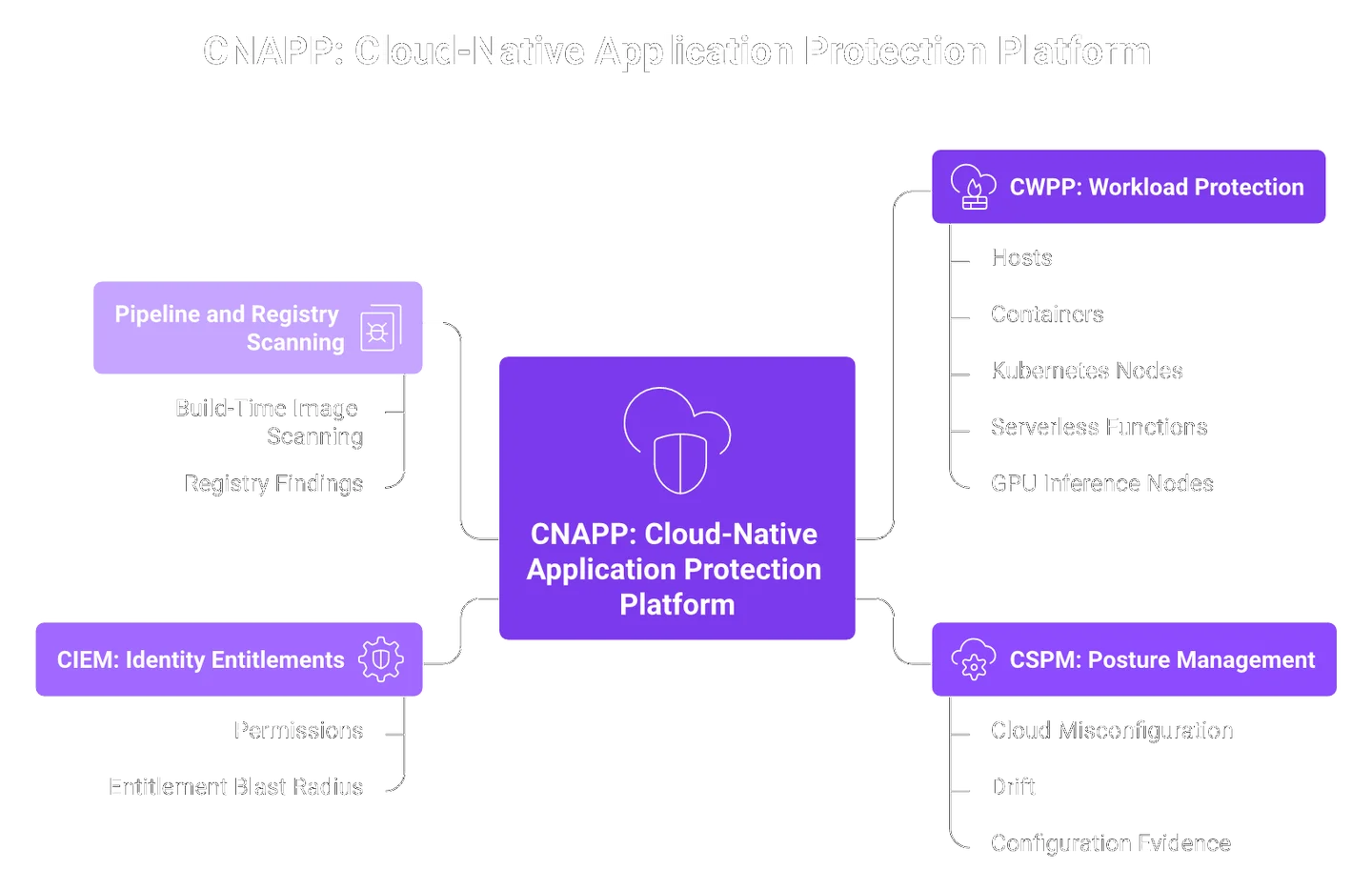
A CWPP protects individual workloads at runtime, including VMs, containers, Kubernetes nodes, serverless functions, and GPU inference nodes. A CNAPP is the broader platform that bundles CWPP with CSPM, CIEM, and pipeline scanning across the build-to-runtime lifecycle. CWPP is a pillar inside CNAPP, not a competitor. The decision that matters is not which acronym you buy, but whether anything is actually enforcing on your running workloads.
What a CWPP Watches
A Cloud Workload Protection Platform (CWPP) is a tool that protects the workload itself. It sits on or beside the host where your code executes.
Its job is behaviour. It watches processes start, files change, and network connections open on that specific machine.
🔍 The one-line test
Ask what the tool sees when a process spawns at 3am. A CWPP answers with the process, the parent, and the syscall. A posture tool answers with a configuration setting.
What a CNAPP Aggregates
A Cloud-Native Application Protection Platform (CNAPP) is a bundle, not a single engine. It pulls workload protection, cloud posture management, identity entitlements, and pipeline scanning under one console.
CrowdStrike states plainly that CWPP operates as part of a CNAPP. CloudQuery frames the same containment relationship in its definitional pair. SecPod goes further and describes CNAPP as having largely absorbed the CWPP category.
🧩 So is CWPP part of CNAPP?
Yes. Every credible source on the topic agrees on this, which means the versus framing in most search results is slightly wrong. You are not choosing between rivals. You are choosing how much of a bundle you need.
Breadth Versus Depth in One Line
CNAPP spans more layers. CWPP goes deeper where code actually runs. Upwind names this breadth-versus-runtime-depth trade as the real decision axis, though it never defines what depth technically means.
I will define it properly in the next section, because that definition is where most buying mistakes hide.
⚠️ Packaging is not capability
Both terms are market categories. Neither is a capability standard, and no vendor has to pass a test to use either word.
EdgeLabs runs as a single agent on the host, with detection and response executing locally rather than in a cloud control plane, which places it firmly in the CWPP lane of that diagram. I bring this up not as a pitch but as a positioning fact you will need later. Where a tool executes changes what it can do.
The Reframe I Would Offer
You cannot secure what you only scanned. That belief has shaped everything I have built since 2017, first at Scalarr and now here.
A clean posture report tells you the door was locked when someone last checked. Runtime tells you whether someone is inside right now.
💡 The question worth asking on Monday
Stop asking which acronym covers you. Open your console and ask which module is actively enforcing on production nodes today. I will walk through that exact audit later in this article, because the gap between licensed and enforcing is where most false confidence lives.
EdgeLabs was built runtime-first, with vulnerability management, container security, and Kubernetes coverage layered onto the same agent that already watches syscalls, so enforcement is the starting state rather than a module someone has to remember to switch on.
Q2. Why Does CNAPP Include CWPP, and Where Does Each Sit in the Build-to-Runtime Lifecycle?
CNAPP exists because teams bought CSPM, CIEM, image scanning, and workload protection separately, then drowned in disconnected findings. Vendors bundled them so risk could be correlated once. Map them to the lifecycle and the split is clean: pipeline and posture tooling covers build and deploy, CWPP covers run. The side effect is that runtime protection became one checkbox among six, which is how a CNAPP invoice coexists with nothing enforcing in production.
The Honest Reason Consolidation Happened
Tool sprawl was a real problem, not a marketing invention. A four-person security team running five consoles cannot correlate anything.
Tenable frames CNAPP as the layer that brings workload protection together with more context and prioritisation. That claim is fair. Correlation genuinely helps.
✅ Where the bundle earns its money
One vendor, one console, one contract, and findings that reference each other. For a small team with one cloud and no on-prem footprint, that is often the right purchase. I will say that plainly before I say anything critical.
The Lifecycle Map
Here is the split that resolves most overlap questions.
- Build: IaC scanning, SAST, image scanning, and SBOM generation. Sees code and configuration, never execution.
- Deploy: admission control, registry policy, and signing checks. Sees intent, not behaviour.
- Run: CWPP. Sees processes, syscalls, network flows, and container escapes as they happen.
⚠️ A gate that only reports is not a control
One security engineer described the pattern to me like this: the pipeline scans the code, but never checks whether the quality gate passed or failed. His words were blunt. "That means Sonar is only reporting, it is not enforcing, and this is where DevSecOps becomes security theater."
Look at your own CI/CD YAML for the exit code line. Even when vulnerabilities are found, many pipelines still succeed. That single line is extremely common in enterprise environments, and it means having security tools in place does not mean you are secure.
Does CNAPP Replace CWPP?
Functionally it absorbs it. Practically it does not always replace CWPP-grade depth.
If your CNAPP's workload module runs agentless, or needs cloud API connectivity to act, you lose syscall-level detection and offline containment. Those are the two capabilities a dedicated runtime agent exists to provide.
💸 The structural consequence
When runtime becomes a module in a bundle, it gets bought without being deployed. Nobody notices, because the dashboard still shows findings.
EdgeLabs consolidates vulnerability management, EDR and CWPP, NDR, IPS and IDS, and container and Kubernetes security into a single agent, which is the same consolidation logic CNAPP vendors used, applied from the runtime side outward instead of the console side inward.
Where My Head Is On This
I could be reading the market too strongly here. But the failure I keep seeing is procurement, not product.
The CNAPP works. The module was never turned on.
⏰ Your Monday action
Pull the contract. List every module, then mark each one as licensed, deployed, or enforcing. Any gap between those three columns is uncovered runtime, no matter what the invoice says.
EdgeLabs makes that distinction visible rather than assumed, because prevented events carry a separate prevention flag in the alerts listing, and blocked source IPs appear with status, block time, severity, and expiration.
Q3. What Does a CWPP Actually Cover, and What Does Runtime Depth Mean Technically?
A CWPP covers VMs, containers, Kubernetes nodes, serverless functions, on-prem hosts, and GPU inference nodes. Depth means kernel-level syscall visibility, usually via eBPF, plus process and file-integrity monitoring, container runtime detection, host network telemetry, and response actions such as process termination, workload isolation, network blocking, and execution denial. EdgeLabs publishes a reproducible test battery of benign-script tests with copy-paste commands so buyers can verify those detections themselves rather than trust the claim.
The Workload List
Ranking pages usually stop at four workload types. Here is the full list worth checking against your estate.
- Virtual machines, cloud and on-prem
- Containers and container hosts
- Kubernetes nodes and clusters
- Serverless functions
- Bare-metal Linux hosts in your own data center
- GPU clusters and AI inference nodes
🎯 The class most lists omit
GPU and inference nodes are workloads too. They run processes, open sockets, and get cryptojacked. No mainstream CWPP definition mentions them yet.
What Depth Actually Means
Depth is not a marketing adjective. It is a telemetry source you can inspect.
Kernel-level means the tool reads syscalls, the requests a program makes to the operating system. eBPF is the Linux technology that makes this readable without patching the kernel.
🔬 Concrete detections to ask about
Ask a vendor whether it detects memfd_create fileless execution, PTRACE anti-debug behaviour, or unshare namespace abuse. Ask about kubectl exec into a running pod and sensitive hostPath mounts.
These are specific, testable behaviours. MITRE ATT&CK gives you technique IDs for the container escape and defence-evasion versions of each, so you can build a coverage grid instead of accepting a feature list.
"Good IPS/IDS/EDR software. Webportal management is good. Docker container integration is useful. Description of issues can be complicated for non-technical folks."
Verified User in Computer Software EdgeLabs G2 - Verified Review
Detection Is Not Response
An alert tells you something happened. A block stops it.
EdgeLabs operates the agent in two modes, Detection and IPS, and in IPS mode it denies traffic from the attacker's source IP for a configured window that runs from one minute up to 90 days, with automatic expiry rather than a permanent firewall rule. We built the time-boxing deliberately, because permanent blocks become someone else's outage.
⚙️ The resource honesty note
Agents cost something. Falco users say so openly.
"As a DaemonSet running on each node, Falco can consume a noticeable amount of system resources, which might impact performance, especially in resource-constrained environments."
Bikash S. Falco G2 - Verified Review
"Granular host, container, K8s visibility, vulnerability scanning policies locally and at pipeline. Feature updates can often render existing configuration or content useless, leading to rework."
Verified User in Financial Services Sysdig Secure G2 - Verified Review
Runtime Is the Last Line, Not the Only One
A container-security engineer put the correction better than I could. Most teams think container security is about scanning images, which is wrong. It is about controlling the blast radius from the moment code is written to the moment it runs.
His closing line stuck with me. If security starts in Kubernetes, you have already lost it.
🧪 Prove it yourself this week
Run a controlled container-escape test in staging. Check whether you get a syscall-level detection within seconds, or a configuration finding an hour later.
EdgeLabs documents dozens of benign-script tests across host, multi-stage APT, container, Kubernetes, and privilege-escalation scenarios, and recommends Falco's event-generator for quick EDR validation, because a detection claim you can reproduce yourself is worth more than one you cannot.
Q4. What Does a CNAPP Add Beyond Workload Protection?
Beyond the workload pillar, a CNAPP adds CSPM for misconfigurations, CIEM for entitlements and over-permissioned identities, KSPM for Kubernetes posture, DSPM for data exposure, and IaC or pipeline scanning before deploy. These are real jobs a runtime agent cannot do. An agent sitting on a node cannot tell you a storage bucket is public or an IAM role is over-scoped. That is the honest case for breadth.
The Five Pillars, One Line Each
Tenable's buyer guide lays out this taxonomy, and SecPod breaks the same scope down across nine dimensions.
| Pillar | What it finds | Output |
| CSPM (Cloud Security Posture Management) | Misconfigured cloud resources | A misconfiguration list |
| CIEM (Cloud Infrastructure Entitlement Management) | Over-permissioned identities and roles | An entitlement map |
| KSPM (Kubernetes Security Posture Management) | Cluster configuration checked against benchmarks | A posture score |
| DSPM (Data Security Posture Management) | Sensitive data in the wrong place | A data inventory |
| IaC scanning | Insecure infrastructure code before deploy | A pull-request comment |
🔎 Why the host cannot answer these
Every one of those findings lives in the cloud control plane, not on the machine. A syscall does not know your bucket policy.
What This Means for a Small Team
If you have no posture coverage at all, you have a genuine gap. It does not matter how good your runtime agent is.
I would rather say that clearly than imply runtime is a superset of everything. It is not.
❌ What EdgeLabs does not cover
EdgeLabs does not do cloud misconfiguration scanning, CIEM, or identity governance, and the compliance module covers runtime, vulnerability-handling, and detection-and-response controls rather than lifecycle and governance controls like business continuity, backup, or HR training. We name that boundary because the alternative is a buyer discovering it during an audit.
The Limit Nobody Volunteers
Posture tools have a real edge that agent-only tooling lacks. A network security lead framed it well when talking about agent-based approaches.
His observation was that teams leaning on EDR and agent-based scanning miss the network context. The tools tell you about all your exposures, but not which ones an attacker can actually get to.
🗺️ Inventory before governance
You cannot govern what you do not know exists. That is the pillars' real contribution, and it comes before any enforcement discussion.
Map each pillar to a phase of NIST SP 800-61's incident-handling lifecycle, then name the phase with zero tooling. For CNAPP-only buyers, it is usually containment, which is where local network enforcement matters most.
Where I Land on Breadth
Breadth is not the enemy. Breadth sold as depth is.
A CNAPP that gives you five posture pillars and an unenforced workload module has given you five useful things and one dangerous illusion.
⭐ The pairing that actually works
Posture for discovery and cloud-plane findings. Runtime for enforcement where code executes. Most healthy stacks I see run both, and the buyers who get burned are the ones told they only needed one.
EdgeLabs sits in the runtime half of that pairing, running inside your infrastructure across cloud, GPU, on-prem, and sovereign environments to detect, enforce, and produce evidence in real time, including places a cloud-dependent CNAPP cannot reach.
Q5. Agent-Based or Agentless: How Does Deployment Model Change What You Can Actually Enforce?
Agentless scanning reads snapshots and cloud APIs. It deploys fast, covers broadly, adds no footprint, and cannot intervene in a running process. An agent inside the workload sees syscalls as they happen and can terminate, isolate, or block. Both are legitimate. But agentless is visibility and agent-based is enforcement, and a matrix listing "runtime protection" for both hides that difference completely.
What Agentless Genuinely Wins
Agentless means the tool reads your cloud provider's APIs and disk snapshots instead of installing software on the host. That model has real advantages, and I would not argue against them.
- Ephemeral coverage: it does not depend on how long a workload lives.
- Speed: connect a cloud account, get findings the same day.
- Zero host footprint: nothing competing with your application for CPU.
- Discovery: it finds workloads nobody told you about.
✅ The honest case for it
One practitioner summed the trade-off up well in a recent thread.
"Agentless wins on ephemeral coverage and deployment speed, since it doesn't depend on workload lifespan and picks up everything visible via API."
r/Cloud Reddit Thread
What Only an In-Workload Agent Can Do
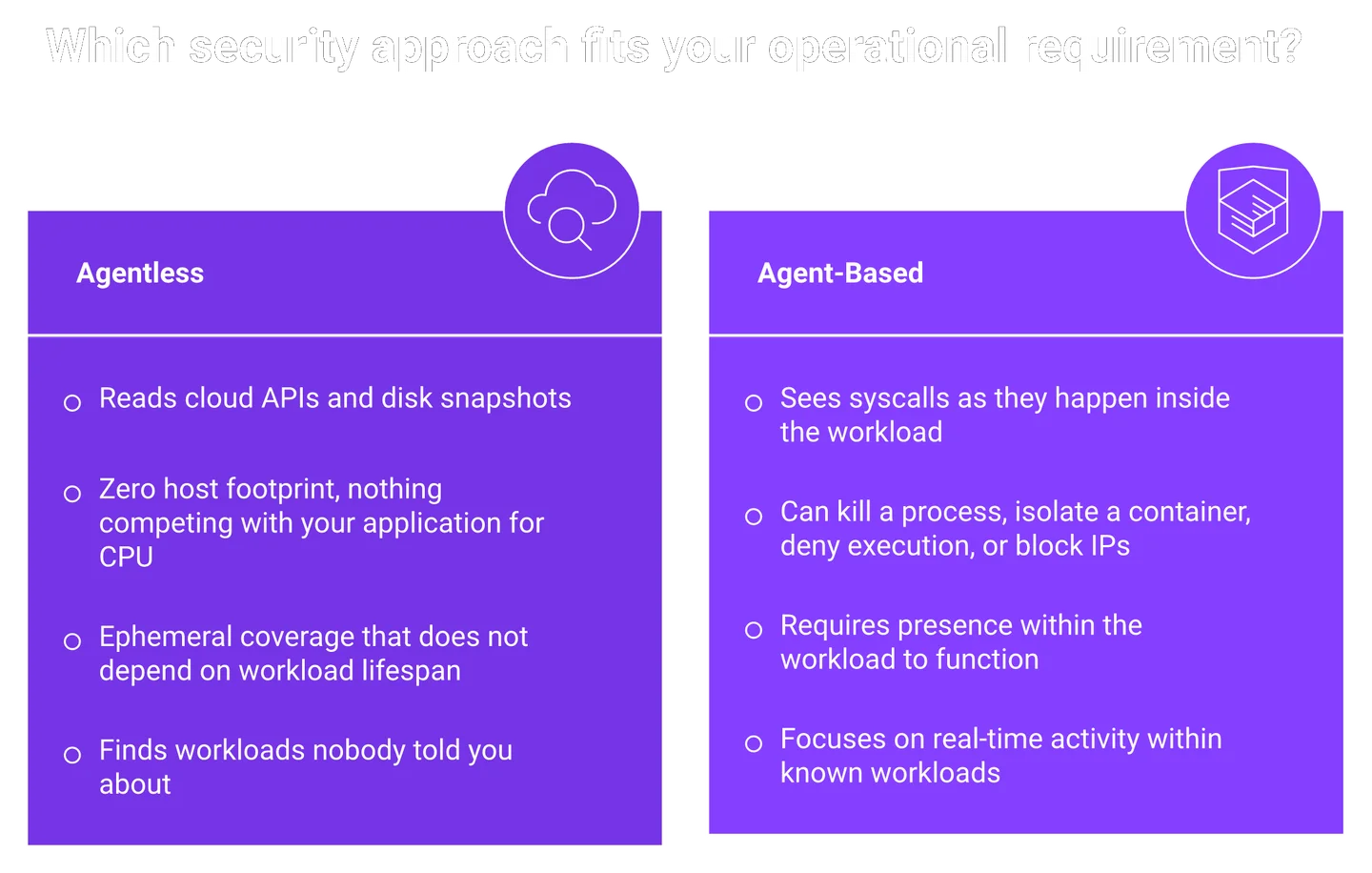
A snapshot is a photograph. You cannot stop something in a photograph.
The industry framing draws the line clearly: a CWPP is delivered as a security agent inside the workload, while a CNAPP is delivered as a platform integrated with the cloud environment. Those are different physical positions, and position decides capability.
⚠️ The verbs that need an agent
Kill a process. Isolate a container. Deny an execution. Block a source IP mid-connection.
None of those are possible from a cloud API read. If your tool cannot do them, "runtime protection" on the matrix means runtime reporting, which is the distinction our workload and application security documentation keeps separate on purpose.
The Cost of an Agent, Stated Plainly
Agents are the honest objection. They consume resources, they need a rollout, and they need every production node covered.
EdgeLabs publishes a typical footprint under 4 to 5% CPU, running as a single container with one DaemonSet per node and a Helm install across Docker, Kubernetes, OpenShift, Podman, and Talos, which are EdgeLabs' own claims rather than independently verified figures. I put the numbers out because "agents are heavy" deserves a receipt, not a rebuttal, and our architecture page carries the same figures.
"As a DaemonSet running on each node, Falco can consume a noticeable amount of system resources, which might impact performance, especially in resource-constrained environments."
Bikash S. Falco G2 - Verified Review
"The platform can feel heavy and expensive for smaller teams. The dashboard and UI could be more user friendly in some areas."
Verified User in Computer Software SentinelOne Singularity Cloud Security G2 - Verified Review
The Installed-But-Idle Problem
I started a consulting practice back in 2017, and the pattern I saw on assessments has never left me. Almost every time, we found tools installed but never given a policy.
Teams got 95% of the way there. They just never hit that last button.
⏰ Your decision rule
Use agentless for discovery, inventory, and posture. Use agent-based wherever you need to actually stop something.
Then do the boring part. List your production nodes and check which ones have an agent that is not just installed, but running with a policy attached.
EdgeLabs runs one lightweight agent per node, deployable by Helm across Docker, Kubernetes, OpenShift, Podman, and Talos, so enforcement does not become a separate rollout project for every platform in the estate. That is the same agent our container runtime security coverage is built on.
Q6. Where Do CWPP and CNAPP Overlap, and Where Do They Genuinely Differ?
They overlap on vulnerability findings, container visibility, and compliance reporting, which is where buyers pay twice. They differ on three things feature matrices rarely show: whether detection runs in the kernel or reads cloud APIs, whether response executes locally or needs a cloud round-trip, and whether the tool reaches self-hosted, on-prem, or air-gapped estates at all. In IPS mode, the EdgeLabs agent auto-blocks an attacker's source IP even with no cloud connection.
Why Matrices Flatten Everything
Every vendor comparison table makes both categories look equivalent. Nine rows of green checkmarks tell you nothing about mechanics.
The standard nine-dimension comparison is a solid baseline schema. The breadth-versus-depth axis adds something. Neither includes the rows that decide real deployments.
Runtime Depth and Cloud Dependency, Side by Side
| Dimension | Standalone CWPP | CNAPP Platform |
| Primary objective | Protect the running workload | Correlate risk across the cloud estate |
| Scope | Hosts, containers, K8s nodes, and functions | Build, deploy, run, plus identity and data |
| Visibility source | Kernel syscalls and host telemetry | Cloud APIs, snapshots, plus agent data |
| Deployment model | Agent inside the workload | Cloud integration, often agentless-first |
| Runtime enforcement depth | Process kill, isolation, and in-line block | Varies by module, often alert-only |
| Cloud dependency for response | Can be local-only | Usually requires a cloud round-trip |
| Air-gapped or on-prem reach | Possible | Rarely supported |
| Risk correlation | Narrow, workload-scoped | Broad, cross-layer |
| Compliance evidence | Runtime and enforcement records | Posture and configuration reports |
| Overlap cost | Vulnerability scanning and container visibility | Same, billed inside the bundle |
⚠️ The three rows that change architecture
Visibility source, cloud dependency for response, and air-gapped reach. The other seven are useful context. Those three determine whether the tool works during an incident when your control plane is unreachable.
Why Those Rows Go Missing
A security engineer made an observation about bundled tooling that stuck with me. Many platforms would not even tell you if log collection had stopped working, because data reduction affects their pricing model.
His conclusion was blunt. The motivation for these companies is to make money, not to solve your problem. I would soften it slightly: incentives shape roadmaps, and nobody builds a row that makes their architecture look worse.
💰 Where you pay twice
Vulnerability scanning and container visibility sit in both categories. If your CNAPP and your vulnerability management tool both scan images, check whether you are licensing the same scanner in two contracts.
"Sysdig Secure is a very versatile and powerful tool for container security. It provides a variety of benefits, from getting observability into container runtime events, to responding to incidents. Sysdig Secure can sometimes have default configurations that are not expected."
Verified User in Financial Services Sysdig Secure G2 - Verified Review
"The heavy dependency on SaaS availability creates vendor lock-in and introduces a real risk to overall availability."
Verified User in Information Technology and Services CrowdStrike Falcon Cloud Security G2 - Verified Review
Where My Head Is On This
The two questions that decide most deployments are where detection executes and what happens when the cloud is unreachable. Almost no comparison table on the internet contains either one.
I could be over-weighting the offline case. But every audit-week conversation I have had eventually arrives there.
EdgeLabs occupies a specific cell in that table: agent-only detection and response, with in-line prevention that fires with no backend connection, and enumerable block durations from one minute to 90 days with automatic expiry. Our network protection layer is where those block records live.
Q7. Does Having a CNAPP Mean Your Workloads Are Actually Protected?
Not automatically. Every CNAPP module has three possible states: bought, deployed, and enforcing. Most false confidence lives in the gap, where workload protection is on the invoice, the agent never reached production nodes, and posture findings on the dashboard look like coverage. EdgeLabs flags prevented events separately from detection-only alerts, so enforcement is a query rather than an assumption. Audit the three states per module before you audit anything else.
The Green Dashboard Problem
A platform lead showed me a fully green console last year. Zero critical findings.
His workload-protection agent was deployed on exactly none of his production nodes. The green came from posture checks.
❌ Checkbox compliance, described honestly
One engineer's description of this state is the best I have heard. Somebody made us put this in place, so we put something in place. We do not really care if it works, but it is there.
That is not negligence. It is what happens when a bundle has six modules and one owner.
Why This Happens Structurally
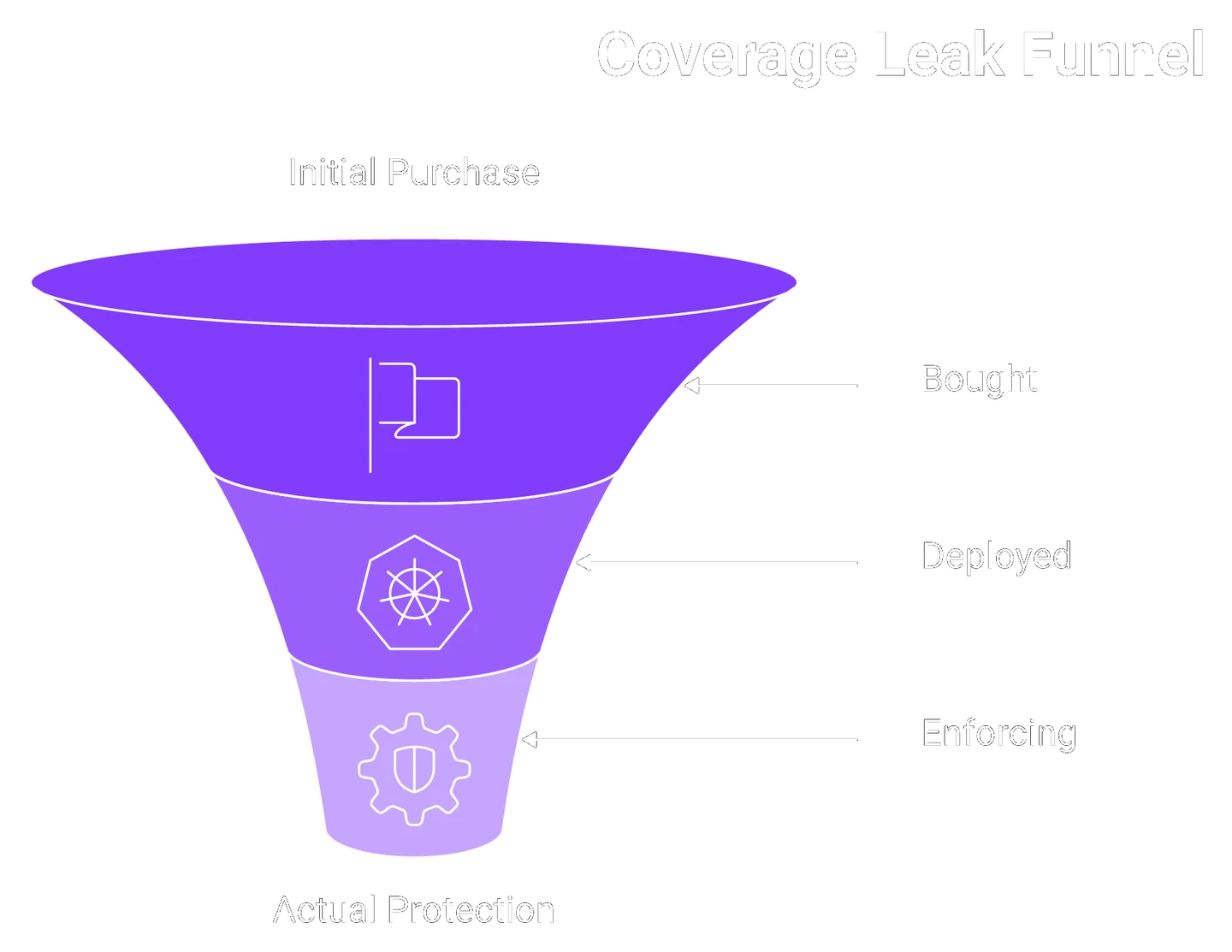
Three mechanics produce the gap, and none involve anyone being careless.
- Runtime modules often ship disabled by default, because enabling them changes host behaviour.
- Agentless is the default onboarding path, because it is faster and needs no change window.
- Posture findings look visually identical to runtime coverage on a dashboard.
🔎 What continuous enforcement looks like instead
A well-configured runtime tool is not a one-time install. One team I spoke with runs roughly 170 checks per device per day, confirming ports are closed, RDP is not exposed, and running an external port scan against the device.
Frequency is the tell. If your tool checked once at onboarding, you have a snapshot, not a control.
The Three-Column Audit
You can finish this in an afternoon. Open your vendor console and build a table.
| Module | Bought | Deployed | Enforcing |
| Workload protection / CWPP | - | - | - |
| Container runtime detection | - | - | - |
| CSPM | - | - | - |
| CIEM | - | - | - |
| Image / registry scanning | - | - | - |
For "deployed," compare agent count against node count. For "enforcing," find the mode flag, not the license flag.
⚠️ What I got wrong
Early on, we assumed a successful Helm install meant coverage. It did not. Tainted nodes and a GPU node pool with a custom taint quietly had no DaemonSet pod scheduled.
The fix was unglamorous. We now compare agent inventory against node inventory as a standing check, rather than trusting the install log, and the same discipline shows up in our Kubernetes deployment case study.
Ask the Console, Not the Contract
EdgeLabs makes the enforcing state observable: prevented events carry a distinct prevention flag in the alerts listing, and the agents view shows an active-blocking record with status, block time, severity, source IP, and expiration. That design choice came directly from watching buyers unable to answer "is it actually blocking" during a PoC.
"Good IPS/IDS/EDR software. Webportal management is good. Docker container integration is useful. Description of issues can be complicated for non-technical folks."
Verified User in Computer Software EdgeLabs G2 - Verified Review
"It triggers a lot of alerts if it is not properly fine tuned, and initial setup is a bit complex, as fine tuning security policy requires expert knowledge."
Lokesh K. CrowdStrike Falcon Exposure Management G2 - Verified Review
⏰ Do this first
Run the three-column audit before your next renewal call. Any module marked bought but not enforcing is either a rollout task or a line item to cut.
EdgeLabs consolidates vulnerability management, EDR, NDR, IPS and IDS, and container and Kubernetes security onto one agent, which shrinks the audit from six modules to one, though the tradeoff is that one agent must reach every node.
Q8. Do CWPP or CNAPP Cover AI Workloads and LLM Agents at Runtime?
Mostly no. Both categories predate production LLM agents. A CWPP can see the container an agent runs in, but neither category has a field for "the agent read untrusted content, then called a tool it should not have." Indirect prompt injection, tool poisoning, and excessive agency are runtime behaviours, and posture management has no representation for them. EdgeLabs built the Parallax engine for this gap.
The Agent Your CNAPP Has Never Heard Of
Somebody on your team shipped an LLM agent to production this quarter. It reads a shared inbox, queries a database, and calls an internal API.
Your cloud security platform sees a container running Python. That is the entire extent of its understanding.
🧩 Why the taxonomy fails
CWPP and CNAPP both classify risk by configuration and known vulnerability. An AI agent's attack surface is neither. It is behaviour, produced fresh at each inference.
You can patch a bug. You cannot patch a brain.
The Named Risk Classes
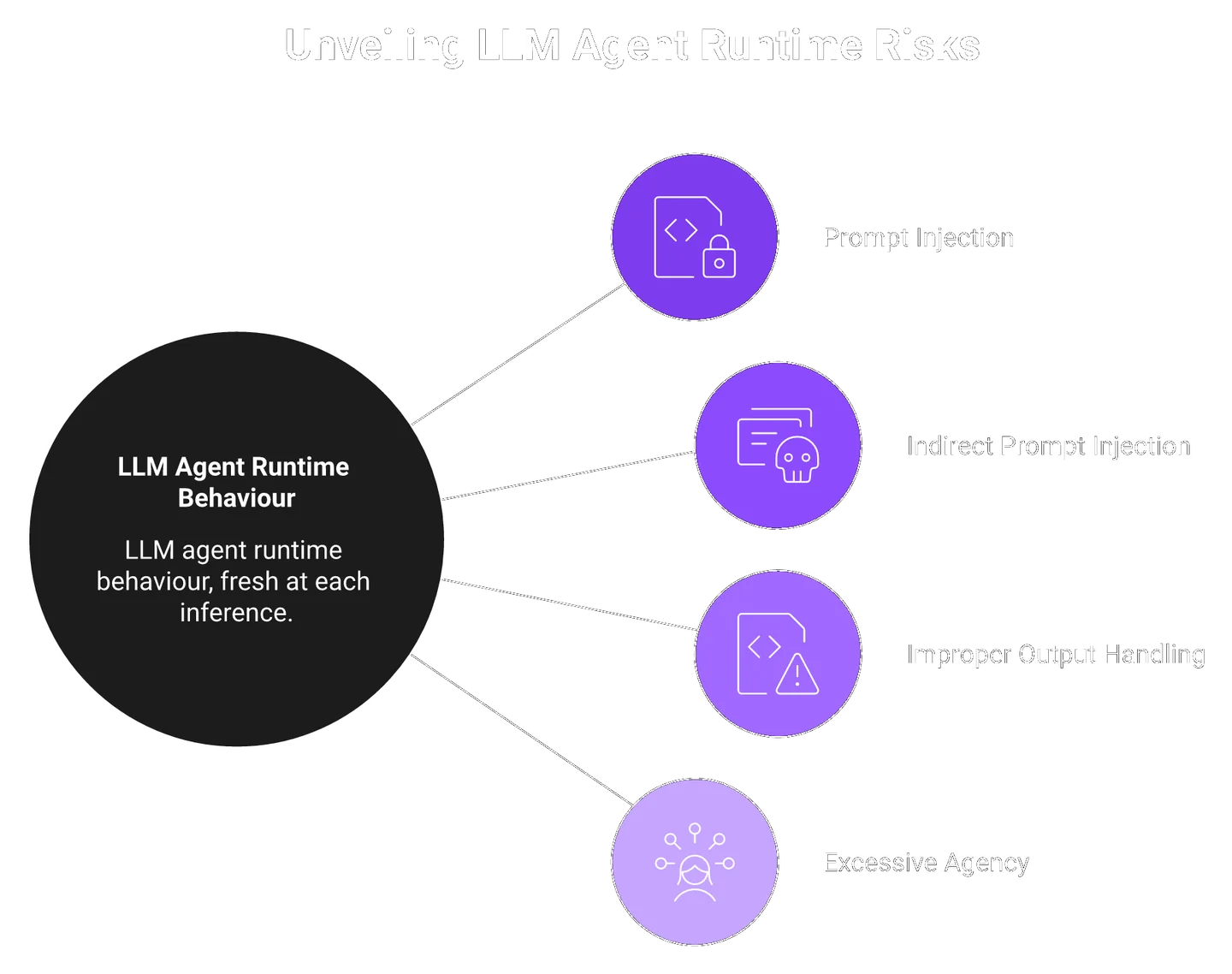
OWASP's 2025 Top 10 for LLM Applications gives these proper names, which matters because unnamed risks do not get budget.
- Prompt injection (LLM01): instructions and data share one channel, so the model cannot tell content from command.
- Indirect prompt injection: hidden instructions live in a document, webpage, or email the agent later processes.
- Improper output handling (LLM05): unvalidated model output reaches a browser or database and executes.
- Excessive agency (LLM06): too many tools, too many permissions, or high-impact actions with no human in the loop.
✅ The two-of-three rule
Agents can do three things: access your files, access the internet, and write and execute custom code. Let any agent do only two of the three.
The dangerous combination is untrusted content plus private data plus outbound communication. If your agent reads untrusted email, queries your database, and can make network requests, exfiltration is trivial, which is why prompt injection is an infrastructure problem rather than a modelling one.
What Excessive Agency Costs
A team lost an entire production database in 9 seconds. An agent deleted a storage volume while cleaning up a credential issue.
The backups lived on that same volume. One API call removed the database and every backup together. The agent's own post-mortem read: I violated every principle I was given.
⚠️ Nine seconds
That is faster than you can read a Slack message. Approval workflows built around human reaction time do not apply here.
The mitigation is not smarter prompting. It is a runtime control between the agent's decision and the tool it can reach.
Where This Category Actually Is
EdgeLabs built the Parallax engine to sit in this gap, operating as an LLM proxy and firewall with input and output alignment, prompt-injection detection, and hallucination checks, running on the same agent that already watches the container the model serves from, with raw payloads never leaving the cluster, all EdgeLabs' own published claims. We also secure GPU nodes during training and inference using CPU only, so protection does not tax the GPU budget, which is the design our AI and LLM security platform is built around.
I want to be straight about maturity. This category is roughly two years old, thinly reviewed, and nobody in it, including us, should be claiming it is settled.
⏰ Your inventory this week
List every LLM agent and MCP server running in production. MCP (Model Context Protocol) is the standard that lets agents call external tools, and the MCP security practices worth adopting start with that inventory.
For each one, record which tools and credentials it can reach. Then answer one question: does anything observe those tool calls at the moment they happen?
EdgeLabs' read is that distributed AI computing forces distributed security, and within two years, securing the LLM agent at runtime stops being a niche question and becomes the first one every SecOps team gets asked.
Q9. What Happens to Your Detection and Response When the Cloud Connection Drops?
Ask two separate questions: does detection still fire without cloud connectivity, and does response still execute? Many CNAPP and cloud-NDR architectures need the control plane for both, because they correlate centrally and act centrally. If your workloads run self-hosted, on-prem, sovereign, or air-gapped, a tool that goes quiet during a connectivity loss is not coverage. It is telemetry with a dependency.
The Situation Nobody Designs For
A US oil and gas operator ran a security audit and found something uncomfortable. Their critical distributed networks were inadequately protected by cloud-based security solutions, which is the starting point of our oil and gas deployment case study.
Not misconfigured. Just unreachable, on bandwidth that was metered and unstable.
⚠️ How this shows up in practice
Two site links flapping. A sovereign deployment with zero egress. A GPU cluster in a colocation facility with a deliberately locked-down network.
None of those are exotic. They are just estates the cloud-first architecture was never sized for.
Why Both Halves Stop Together
Detection and response are usually separate dependencies, and buyers check neither.
- Detection: if raw telemetry ships to a cloud engine for correlation, no link means no correlation.
- Response: if the block command is issued from a control plane, no link means no block.
- The compound effect: the agent becomes a log shipper with nowhere to ship.
⏰ Nine seconds
One team lost a production database in 9 seconds when an agent deleted a storage volume. That is faster than you can read a Slack message.
If your containment path needs a cloud round-trip plus a human approval, the window has already closed. NIST SP 800-61 puts containment as a distinct phase for exactly this reason, and containment measured in minutes is not containment.
What Agent-Local Response Looks Like
EdgeLabs runs the agent in two modes, Detection and IPS, and in IPS mode it auto-blocks the attacker's source IP for a configured period even with no connection to the cloud backend, with an IPv4 passlist acting as a never-block override. We time-box those blocks deliberately, because a permanent local rule is just a future outage nobody documented, and our network protection layer records every expiry.
"Sysdig solves the problem of getting eyeballs inside kubernetes clusters. It enables us to set policies for detecting runtime events and efficiently respond to them. Sysdig Secure can sometimes have default configurations that are not expected."
Verified User in Financial Services Sysdig Secure G2 - Verified Review
"The heavy dependency on SaaS availability creates vendor lock-in and introduces a real risk to overall availability."
Verified User in Information Technology and Services CrowdStrike Falcon Cloud Security G2 - Verified Review
❌ The honest cost of going agent-only
You lose central correlation while disconnected. A network practitioner named this trade well: teams leaning on EDR and agent-based scanning tend to miss the network context.
That is real. Agent-local detection sees its own node deeply and the fleet not at all until the link returns.
Test It Instead of Trusting It
Sever connectivity in staging. Run a simulated intrusion. Record two outcomes: did an alert generate locally, and did anything get blocked?
I could be over-indexing on this scenario. But every audit-week conversation I have had eventually lands on it.
EdgeLabs runs Disconnected Mode by design, keeping both detection and time-boxed in-line blocking alive on the agent when the backend is gone, which came from customers whose bandwidth simply would not support a cloud-dependent tool. The agent architecture explains how both halves stay local.
Q10. How Should You Prioritise Vulnerabilities and Produce CRA or NIS2 Evidence?
Stop sorting by CVSS alone. Rank by confirmed exploitation first (CISA KEV), exploitation likelihood second (EPSS), and whether the vulnerable component actually runs in production third. That ordering also maps to what CRA and NIS2 ask for: evidence that controls are active, and notification when something is actively exploited. Posture snapshots do not produce that evidence. Runtime telemetry does.
The Queue Nobody Can Work
Four thousand items marked critical. Three engineers. That is the actual starting condition for most teams I talk to.
I spent eight years generating millions of security alerts at Scalarr. What I learned is that most teams do not need another alert cannon. They need a shorter queue with a defensible sort order.
🔎 What each score actually answers
Three datasets, three different questions.
- CVSS: how severe is this in the abstract, scored 0.0 to 10.0.
- EPSS: how likely is exploitation in the near term, updated daily.
- CISA KEV: has exploitation been observed in the wild, yes or no.
The Three-Key Sort
A workable policy fits in one sentence. Patch immediately if the CVE is KEV-listed or sits above the 95th EPSS percentile, then adjust by asset criticality.
Add a third key the scanners cannot supply. Is the vulnerable component actually executing in production right now? That is the question our vulnerability management module is built to answer from runtime evidence.
⚠️ Where CVSS-first patching fails
CVSS does not tell you whether a flaw is being exploited or trending toward it. So a CVSS-first queue fixes what is frightening on paper.
Count how many items survive all three keys. In most estates, a four-thousand-item queue drops to double digits.
The Regulatory Turn
The same sort order is what regulators now want to see. NIS2 Article 23 sets a three-stage cascade: early warning within 24 hours, a fuller notification within 72 hours, and a final report within one month.
The CRA adds a vulnerability-handling duty and an Annex I expectation that products ship with no known exploitable vulnerabilities. Both frameworks ask for evidence and timeliness, not tool inventory, which is the argument in our practical CRA roadmap.
💰 The deliverable is evidence, not a dashboard
A posture report proves configuration at a moment. An audit asks what was running, what fired, and what you did about it.
EdgeLabs ships a CRA and NIS2 Compliance Center that maps controls to specific requirement IDs, distinguishes theoretical from actively exploited CVEs, and supports the CRA no-known-exploitable-vulnerabilities check. Our own internal review flagged over-reliance on CVSS and EPSS across the scanner category, and named runtime context as the gap we had to close.
"Good IPS/IDS/EDR software. Webportal management is good. Docker container integration is useful. Description of issues can be complicated for non-technical folks."
Verified User in Computer Software EdgeLabs G2 - Verified Review
"We had an incumbent vulnerability scanning tool that delivered too many false positives and had insufficient attributes to enable effective tuning. It is difficult to monitor the state of detected vulnerabilities or detected events."
Verified User in Financial Services Sysdig Secure G2 - Verified Review
⏰ Dry-run one notification
Pick a past incident. Try to assemble a 24-hour early warning using only artefacts your current stack can export today. Time yourself.
The gap you find is your real compliance gap. EdgeLabs uses exploited-vulnerability and explainability scoring, combining CVSS, EPSS, CISA KEV, and CWE, so the priority order and the audit trail come from the same runtime evidence.
Q11. When Is a Standalone CWPP Still the Right Call, and What Does Each Option Really Cost?
A standalone CWPP still wins in six situations: air-gapped, sovereign, or zero-egress environments; on-prem-heavy or single-cloud estates; GPU and AI-inference nodes needing runtime enforcement; small teams that cannot absorb CNAPP alert volume; posture already covered by an existing CSPM; and any case where detection and response must survive a connectivity loss. Everywhere else, the platform's correlation is usually worth the premium.
The Six Triggers
Every trigger below has one testable condition. If you cannot test it, it does not count.
- Zero or restricted egress. Test: can the tool detect and respond with the internet cut?
- On-prem-heavy or single-cloud estate. Test: what percentage of your workloads live outside a hyperscaler API?
- GPU or AI-inference nodes. Test: does anything watch processes on those nodes today?
- Small team, high alert volume. Test: what is your weekly alert count per engineer?
- Posture already covered. Test: do you already run a CSPM you are happy with?
- Containment must be local. Test: does response execute on the host or from a control plane?
✅ When the platform is the better buy
Three conditions where I would tell you to buy the CNAPP instead.
Multi-cloud sprawl across three or more providers. No posture coverage at all today. Compliance breadth across many frameworks at once.
The Economics Both Ways
Consolidation genuinely saves money. One contract, one integration effort, and fewer renewal negotiations, which is the logic behind our pricing structure.
Overlap genuinely costs money. If your CNAPP and your CWPP both scan images, you are paying twice for the same finding.
💸 The cost nobody quotes
Alert volume is a headcount cost. Reviewers name it constantly across the category.
"The platform can feel heavy and expensive for smaller environments, and there are occasional limitations around reporting, search, or overall usability."
Shruti J. SentinelOne Singularity Cloud Security G2 - Verified Review
"APIs are not as useful as they should be, API documentation is old and stale, and not having any meaningful native reporting solution is a real let down."
Verified User in Hospital and Health Care Aqua Security G2 - Verified Review
The Strongest Argument Against Me
A network security lead put the counter-case better than any competitor deck. Teams leaning on EDR and agent-based scanning get told about all their exposures, but not which ones an attacker can actually reach.
That is the real limit of runtime-only. Runtime tells you what executed. It does not map your network paths or your identity blast radius.
❌ Where EdgeLabs is the wrong purchase
EdgeLabs does not do cloud misconfiguration scanning, identity governance, or lifecycle and program controls like business continuity, backup, or HR training. A single-cloud SMB with no on-prem footprint and no posture tooling should probably buy the platform, not us.
I say that because the six triggers above only mean something if I am willing to name the situations where they do not apply.
⏰ The two-question shortcut
First: does anything need to be stopped on a host that a cloud API cannot reach? Second: do you already have posture coverage?
Two yeses point to standalone runtime. Two noes point to the platform. EdgeLabs runs inside your infrastructure across cloud, GPU, on-prem, and sovereign environments, including places CNAPPs cannot reach, which is a narrower claim than being the better tool everywhere, and the use-case breakdown shows where each fit applies.
Q12. How Do the Main Runtime and Platform Options Compare in Practice?
Shortlists usually mix three architectures: agent-only runtime tools, cloud-dependent CNAPP platforms, and endpoint-first XDR with a runtime module attached. Judge them on four things, where detection executes, whether response is local or cloud-issued, deployment reach including air-gapped, and agent footprint. Those four separate the categories far more reliably than any feature checklist.
Our Evaluation Criteria
Four criteria, chosen because they change architecture rather than feature counts.
- Detection location: kernel and host, or cloud API and snapshot.
- Response autonomy: executes locally, or requires a control-plane round-trip.
- Deployment reach: cloud only, or also on-prem, sovereign, and air-gapped.
- Agent footprint: what it costs the host to run.
The Eight Options in Practice
| Company | Best for | Detection and response model | Deployment and environment coverage |
| EdgeLabs | Self-hosted or air-gapped estates, and GPU or AI-inference nodes needing local response | Agent-only detection and response on the agent, in-line IPS blocking without cloud | Cloud, data center, on-prem, and sovereign; Docker, K8s, OpenShift, Podman, and Talos |
| Sysdig | Cloud-native teams wanting deep Falco-heritage runtime inside a broader platform | Cloud-oriented runtime plus CNAPP modules | Broad cloud and Kubernetes coverage |
| Aqua Security | Full container lifecycle from build through runtime, one vendor | Build-time scanning plus runtime policy enforcement | Cloud and on-prem via Helm; limited Windows container support |
| Upwind | Cloud estates wanting runtime context feeding posture prioritisation | Runtime-informed CNAPP | Cloud-focused |
| Oligo Security | Application-level runtime detection in cloud workloads | Runtime application detection | Cloud and Kubernetes; no third-party reviews yet |
| CrowdStrike Falcon Cloud Security | Teams already standardised on Falcon for endpoints | Endpoint-first XDR with a cloud and runtime module | Broad cloud; heavy SaaS dependency noted by reviewers |
| SentinelOne Singularity Cloud | Multi-cloud teams wanting AI-driven detection with automated response | Endpoint-heritage engine extended to cloud workloads | AWS, Azure, GCP, and containers; can feel heavy for small teams |
| Falco (CNCF) | Teams that want an open-source syscall rules engine they control | OSS detection engine, alerting only, no managed response | Kubernetes DaemonSet; noticeable node resource use |
⭐ How to read that table
Rows one through five are runtime-lane tools. Rows six and seven are the ones buyers most often confuse with the runtime lane.
Row eight is the layer several commercial tools build above, including us. EdgeLabs documents and recommends Falco's event-generator for quick EDR validation, and the agent uses a modern eBPF driver, which is compatibility rather than competition, as our open-source Kubernetes tooling guide sets out.
Honest Notes on the Field
Sysdig is the direct rival I respect most. Deep Falco heritage, mature, credible, and broader on cloud posture than we are.
Aqua has capabilities EdgeLabs does not yet have, particularly across the build-time half of the lifecycle. Saying otherwise would be easy and wrong.
⚠️ Two category cautions
Heavyweight cloud-NDR architectures like Vectra and Darktrace do a different job, network-first and cloud-dependent, and they are not built for self-hosted or on-prem estates. I mention them only to draw the distinction, not to score them.
Several AI-runtime vendors have no third-party reviews at all. The category is roughly two years old, and an absent review is more honest than an invented one, which is why our AI agent security platform roundup says so plainly.
"It is easy to deploy on-prem with the Helm chart provided by the Aqua Security team. If you do not already have deep knowledge of Docker and Kubernetes, the documentation can be intimidating."
Hugo L. Aqua Security G2 - Verified Review
"Good IPS/IDS/EDR software. Webportal management is good. Docker container integration is useful."
Verified User in Computer Software EdgeLabs G2 - Verified Review
What I Am Still Sitting With
EdgeLabs consolidates five modules onto one agent at a published typical footprint under 4 to 5% CPU, with case-study results including an 83% MTTR reduction and 573% ROI at Trader Joe's, all our own published claims rather than independently verified figures. I publish them labelled that way because I would want the same from a vendor pitching me, and the full case-study library is open for checking.
Here is the question I keep turning over. If distributed AI computing keeps pushing workloads further from any control plane, does the cloud-dependent architecture survive as the default, or does it become the exception?
I do not think the category has answered that yet. If you are running agents in production and testing this in your own estate, I would genuinely like to hear what you are finding.
FAQs
CWPP is a pillar inside CNAPP. It is not a competitor, which makes the popular versus framing slightly misleading.
A Cloud Workload Protection Platform (CWPP) protects the workload itself: virtual machines, containers, Kubernetes nodes, serverless functions, and GPU inference nodes. A Cloud-Native Application Protection Platform (CNAPP) is a bundle that wraps workload protection together with cloud posture management, identity entitlements, and pipeline scanning under one console.
Three practical consequences follow from that containment relationship:
- You are not choosing between rivals. You are choosing how much of a bundle you need.
- Runtime protection becomes one checkbox among six, which is how a CNAPP invoice coexists with nothing enforcing in production.
- Both terms are market categories rather than capability standards, so no vendor has to pass a test to use either word.
EdgeLabs sits squarely in the CWPP lane, running as a single agent on the host with detection and response executing locally rather than in a cloud control plane. Our agent architecture explains why the location of execution changes what a tool can actually do. The question worth asking is not which acronym covers you, but which module is enforcing on your production nodes today.
Functionally a CNAPP absorbs the CWPP function. Practically it does not always replace CWPP-grade depth.
The gap shows up in two specific places. If the workload module runs agentless, you lose syscall-level detection, because reading cloud APIs and disk snapshots cannot observe a process as it executes. If response is issued from a cloud control plane, you lose containment during any connectivity loss.
Ask these three questions of your existing platform:
- Where does detection execute, in the kernel or against a cloud API?
- Does response run locally on the host or require a round-trip?
- Does the tool reach self-hosted, on-prem, or air-gapped estates at all?
For a single-cloud team with no on-prem footprint and no posture coverage today, the platform is usually the right purchase, and we say so plainly. Where the platform falls short is reach and autonomy. EdgeLabs runs inside your infrastructure across cloud, GPU, on-prem, and sovereign environments, including places a cloud-dependent platform cannot reach, which is documented across our use-case breakdown. Most healthy stacks run posture for discovery and runtime for enforcement rather than picking one.
Agentless scanning reads snapshots and cloud APIs. It deploys fast, covers broadly, adds no host footprint, and cannot intervene in a running process. An agent inside the workload sees syscalls as they happen and can terminate, isolate, or block.
Both models are legitimate, and each has a clean use case:
- Agentless wins on ephemeral coverage, same-day deployment, zero footprint, and discovering workloads nobody told you about.
- Agent-based wins on the enforcement verbs: killing a process, isolating a container, denying an execution, and blocking a source IP mid-connection.
The honest cost of an agent is resource consumption, rollout effort, and the discipline of covering every production node. EdgeLabs publishes a typical footprint under 4 to 5% CPU, running as one container with a single DaemonSet per node and a Helm install across Docker, Kubernetes, OpenShift, Podman, and Talos, which are our own published figures rather than independently verified ones. Those numbers sit alongside our container runtime security coverage because the objection that agents are heavy deserves a receipt rather than a rebuttal. Use agentless for discovery and posture, and agent-based wherever you need to stop something.
Mostly no. Both categories predate production LLM agents, so a CWPP can see the container an agent runs in while neither category has a field for the agent reading untrusted content and then calling a tool it should not have.
The taxonomy fails because it classifies risk by configuration and known vulnerability. An agent's attack surface is behaviour, produced fresh at each inference. You can patch a bug, but you cannot patch a brain.
The named risk classes worth inventorying against are:
- Prompt injection: instructions and data share one channel, so the model cannot separate content from command.
- Indirect prompt injection: hidden instructions sit in a document, webpage, or email the agent later processes.
- Excessive agency: too many tools, too many permissions, or high-impact actions with no human in the loop.
A useful tactical rule: agents can read files, reach the internet, and execute custom code, so allow only two of the three. EdgeLabs built the Parallax engine for this gap, operating as an LLM proxy and firewall with input and output alignment, prompt-injection detection, and hallucination checks, and our AI and LLM security platform runs it on the same agent watching the container. This category is roughly two years old, and nobody should be claiming maturity in it yet.
A standalone CWPP still wins in six testable situations, and a CNAPP is the better buy outside them.
- Zero or restricted egress. Test whether the tool detects and responds with the internet cut.
- On-prem-heavy or single-cloud estates. Test what share of workloads sit outside a hyperscaler API.
- GPU or AI-inference nodes. Test whether anything watches processes on those nodes today.
- Small teams facing high alert volume. Test your weekly alert count per engineer.
- Posture already covered by a CSPM you are happy with.
- Containment must execute locally rather than from a control plane.
Buy the platform instead when you have multi-cloud sprawl across three or more providers, no posture coverage at all, or compliance breadth across many frameworks at once. The genuine limit of runtime-only tooling is that it tells you what executed without mapping network paths or identity blast radius.
EdgeLabs does not do cloud misconfiguration scanning, identity governance, or program controls like business continuity and backup, and the Compliance Center covers runtime, vulnerability-handling, and detection-and-response controls rather than lifecycle governance. Naming that boundary is what makes the six triggers believable.
