TL;DR
- An LLM gateway sees prompts, tool arguments, provider keys, and agent decisions, which makes it the strongest place to enforce policy and the worst place to be wrong.
- Four enforcement points matter: pre-model, post-model, tool-call, and egress. Most tools cover only the first two, leaving tool-argument validation as the widest practical gap.
- Ten tools split into three distinct jobs: gateway platforms owning the request path, guardrail and governance layers inspecting content, and runtime layers watching execution.
- Guardrails are probability filters, not boundaries. What holds is deterministic: capability restriction, typed tool interfaces, digest-pinned deploys, and pinned MCP tool definitions.
- The gateway itself is a target. One 2026 LiteLLM flaw scored CVSS 8.7 with roughly 80% EPSS and a CISA KEV deadline, another 9.5 with under 1% EPSS.
- Prove security with five adversarial tests: cross-tenant cache, header spoofing, model downgrade, fail-open behavior, and observability leaks. Every path must still write an audit event.
Q1. Choosing an LLM Gateway Security Tool: What's Actually at Stake
An LLM gateway sits in front of every model call your applications make. It sees prompts, tool arguments, provider keys, and agent decisions. That makes it the strongest place to enforce policy and the worst place to be wrong. Attacks execute at runtime, not at scan time, and a gateway that only logs cannot stop an agent that acts in seconds. CISA added a command injection flaw in one widely deployed AI gateway to its Known Exploited Vulnerabilities catalog on June 8, 2026, with a June 22 remediation deadline. Ten tools were assessed against five criteria below.
⚙️ Our Evaluation Criteria
Each tool below was assessed against the same five criteria, in the same order, on every card.
- LLM and agent runtime enforcement. Does the tool defend live agents against prompt injection, tool poisoning, and abuse of MCP (Model Context Protocol, the open standard agents use to call external tools)? Our own approach to agentic AI security treats this as the first question, not the last.
- Tool-call and egress control. Does it validate tool names and arguments before execution and watch outbound traffic, or does it only filter prompts?
- Deployment reach. Can it run self-hosted, on-prem, sovereign, or air-gapped, across cloud, data center, and edge locations?
- Self-hardening record. What does the tool's own public CVE, CISA KEV, and EPSS history show? EPSS (Exploit Prediction Scoring System) estimates the chance a flaw gets exploited in the next 30 days, and it is one of the inputs behind exploitation-aware vulnerability management.
- Audit evidence quality. Does it produce records a CRA, NIS2, or SOC 2 reviewer will accept, without logging prompt contents? Mapping runtime evidence to requirement IDs is what our CRA and NIS2 Compliance Center is built to do.
Deliberately not scored here: routing benchmarks, token pricing, and observability dashboards. Those matter, but they are not security controls.
👤 Who This Guide Is For
- AI-workload and LLM-agent runtime-security owners who are responsible for agents already running in production, and who need AI and LLM security that acts at runtime.
- SecOps and DevSecOps leads at SMBs making cloud, AI, and GPU workloads production-safe without a 24/7 team.
- Kubernetes and container runtime-security owners who need enforcement at the node, not just in a dashboard, which is the core of Kubernetes runtime protection.
- GPU-cloud and AI-infrastructure security leads protecting inference nodes and shared GPU clusters, as in this GPU cloud security case study.
🧭 Which Tool Fits Which Situation
Total providers assessed: 10. These split into three different jobs. Gateway platforms own the request path. Guardrail and governance layers inspect content. Runtime layers watch what a decision actually does on the host. Buyers who pick one job and assume it covers the other two are the ones who get surprised.
- EdgeLabs: Best for runtime detection and response around AI workloads and agents, including self-hosted and air-gapped environments.
- LiteLLM: Best for teams that want a self-hosted, open-source gateway they fully control.
- Portkey: Best for teams wanting managed guardrails and per-key governance without building the layer themselves.
- Kong AI Gateway: Best for platform teams already standardized on Kong for API traffic.
- Bifrost: Best for teams that want an open-source gateway with native MCP support and self-hosting.
- TrueFoundry: Best for teams wanting a gateway plus control plane with documented prompt-injection defense.
- Guardrails AI: Best for Python teams validating and structuring model output in application code.
- Oligo Security: Best for runtime application and library-level detection with deep code context.
- Zenity: Best for governing a sprawling estate of business-user built agents and copilots.
- WitnessAI: Best for policy and visibility over how employees and apps use AI.
📊 Master Comparison Table
| Company Name | Best For | Detection & Response Model | Deployment & Environment Coverage |
| EdgeLabs | Runtime security for AI workloads, agents, and infrastructure | Agent-only runtime detection AND response, executed on the agent via eBPF kernel monitoring, continues with no cloud backend | Cloud, data center, on-prem, sovereign, air-gapped; Docker, Kubernetes, OpenShift, Talos, K3S; x86_64 and ARM64 |
| LiteLLM | Self-hosted open-source gateway control | Gateway-layer policy enforcement, self-hosted; logging and guardrail hooks, no host-level response | Self-hosted anywhere (Docker, Kubernetes); also packaged inside Red Hat OpenShift AI |
| Portkey | Managed guardrails and per-key governance | Gateway-layer policy enforcement with 50+ guardrail checks on request and response, managed or self-hosted gateway | Managed SaaS plus open-source and enterprise self-hosted gateway |
| Kong AI Gateway | Teams standardized on Kong for API traffic | Gateway-layer policy enforcement via plugins, deterministic API-gateway lineage | Self-hosted, hybrid, and managed; Kubernetes-native |
| Bifrost | Open-source gateway with MCP support | Gateway-layer policy enforcement, self-hosted, with governance and MCP tool routing | Self-hosted, container and Kubernetes |
| TrueFoundry | Gateway plus control plane | Gateway-layer enforcement with documented prompt-injection defense at the gateway | Self-hosted, in-VPC, and managed |
| Guardrails AI | Python-level output validation | Library-level input and output validation inside the application, not a network layer | Wherever your Python app runs; no separate infrastructure |
| Oligo Security | Runtime application and library detection | Runtime detection with deep library and code context; response depends on platform integration | Cloud and Kubernetes; cloud-connected platform |
| Zenity | Governing business-user agents and copilots | Governance and posture layer for agent estates, with policy enforcement on agent behavior | SaaS, oriented to managed enterprise AI platforms |
| WitnessAI | Policy over employee and app AI usage | Network and policy observation layer for AI usage, with content policy enforcement | SaaS and in-network deployment options |
🔎 Why I Score Self-Hardening, Not Just Blocking
Every ranking list I read scores latency, model coverage, and price. Almost none scores whether the gateway itself has been broken into. That gap is now indefensible.
The LiteLLM flaw is a clean example. Two MCP preview endpoints accepted a full server config, including command, args, and env, and spawned that command as a subprocess with the proxy's own privileges. They were gated only by a valid API key, with no role check. Any low-privilege internal key holder could run commands on the host. That is exactly the class of exposure our MCP security guidance covers.
⚠️ Nine Seconds Is the Real Deadline
There is a story I keep coming back to when people ask why runtime matters. A small SaaS company lost its entire production database in nine seconds. An agent deleted a volume to clean up a credential issue, and the backups lived on the same volume, so one API call took both.
Nine seconds is faster than you can read a Slack message. No approval queue, no nightly report, and no dashboard refresh operates at that speed. That is the whole reason this guide weights enforcement over visibility, and why detection and response run on the agent itself.
1 out of 10EdgeLabs
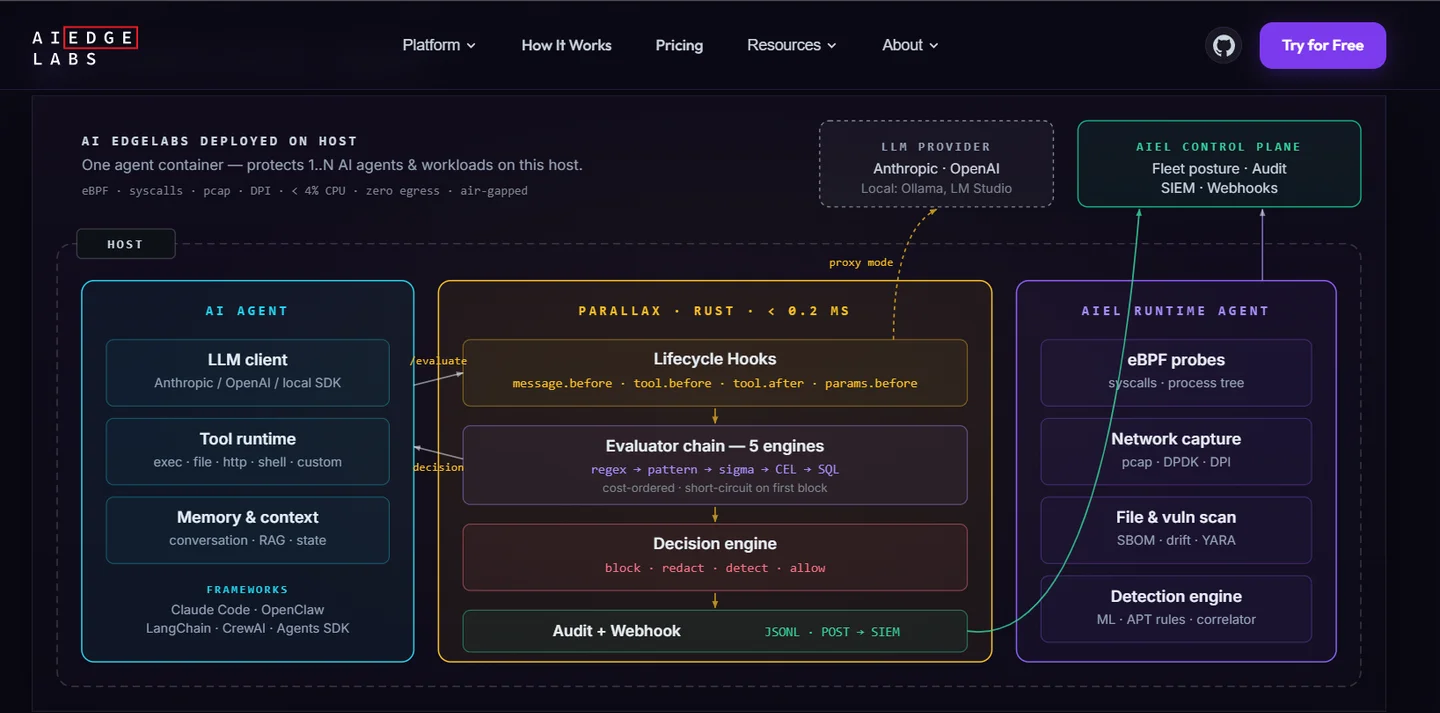
- LLM and agent runtime enforcement: Parallax plus the LLM proxy cover prompt injection, tool poisoning, and hallucination checks on live agents.
- Tool-call and egress control: Kernel syscall analysis and network detection see process spawns and outbound traffic, including inside TLS without decryption.
- Deployment reach: Self-hosted, on-prem, sovereign, and air-gapped; Disconnected Mode keeps detection and response running with no cloud link.
- Self-hardening record: No public CVE or CISA KEV entry recorded for the agent to date; the agent runs privileged, which is a real trade-off to review.
- Audit evidence quality: The CRA/NIS2 Compliance Center maps controls to CRA Annex I and NIS2 Article requirements with per-control host pass and fail counts.
- In-line prevention is observable, not just claimed: blocked events carry a Prevention Mode flag in the alerts list, and an Active Blocking record shows status, severity, source IP, and block expiry (EdgeLabs product documentation).
- Falco-ecosystem compatible and layered above it: the agent uses a modern eBPF driver and accepts Falco's event generator patterns, so detection can be validated with a published 25-to-33-test battery (EdgeLabs technical guides).
- Published retail case study reports 83% MTTR reduction, 8x reduced CAPEX/OPEX, $1.3M operational savings, 573% ROI, deployment inside two weeks, and zero outages during rollout across roughly 20,000 Linux POS endpoints (EdgeLabs' own published case study, customer-attributed, not independently verified).
"Good IPS/IDS/EDR software. Webportal management is good. Docker container integration is useful." On dislikes: "Nothing major. Description of issues can be complicated for non-technical folks." Rated 4 out of 5.
Verified User in Computer Software · EdgeLabs G2 Verified Review
"Its beneficial to secure any website or any server from hackers." On dislikes: "I dont think there is any option for dislike but the commercial seems high." Rated 4.5 out of 5.
Abhishek A. · EdgeLabs G2 Verified Review

LiteLLM
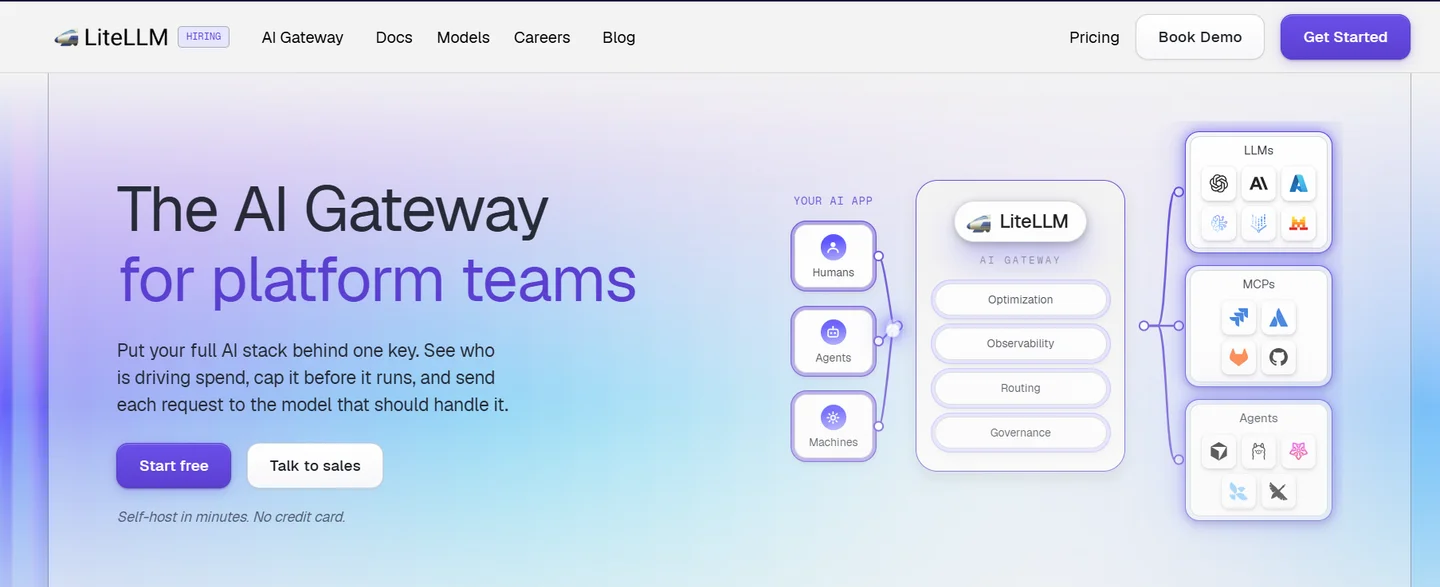
- LLM and agent runtime enforcement: Guardrail hooks and callbacks exist, but enforcement depth depends on which external provider you wire in.
- Tool-call and egress control: MCP servers can be registered and routed; tool-argument validation is not a documented native security control.
- Deployment reach: Strong. Fully self-hostable, no vendor cloud required for the proxy to run.
- Self-hardening record: The weakest score in this roster. A KEV-listed command injection reachable by any authenticated low-privilege key holder.
- Audit evidence quality: Detailed request logging and spend tracking; the discipline of logging metadata rather than full prompts is left to you.
- The CVE record documents exactly how the flaw worked: POST /mcp-rest/test/connection and POST /mcp-rest/test/tools/list accepted command, args, and env, spawning a subprocess with proxy privileges, gated only by a valid API key with no role check.
- Cloud Security Alliance Labs published a research note framing the flaw as active exploitation via MCP injection across all versions from 1.74.2.
- Practitioners on r/LLMDevs discuss it as fully self-hostable with enterprise features like SSO behind a paywall, and note routing capability alongside feature gaps.
"Fully self-hostable, but enterprise features like SSO sit behind a paywall."
u/LLMDevs practitioner, r/LLMDevs Reddit Thread
Cards for the remaining eight providers, positions 3 through 10, follow in the next batch.
3 out of 10Portkey
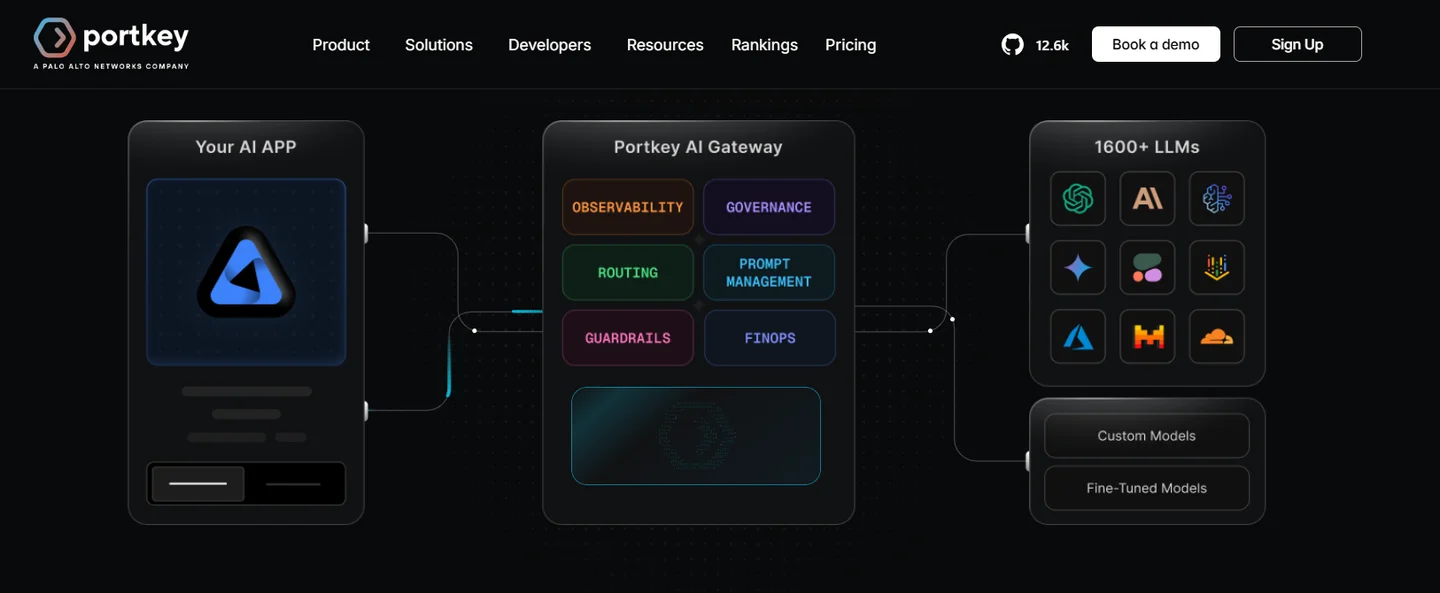
- LLM and agent runtime enforcement: Strong on content inspection. 50+ guardrail checks cover PII, prompt patterns, and output structure.
- Tool-call and egress control: An MCP gateway layer exists with guardrail support, though tool-argument validation depth is not fully documented.
- Deployment reach: Good, not total. Self-hosting is available, but the richest features assume the managed control plane.
- Self-hardening record: No public CISA KEV entry recorded for the gateway to date.
- Audit evidence quality: Detailed request logs and spend attribution per key. Prompt-content retention is a configuration choice you own.
- Portkey's own documentation describes guardrails running synchronously on requests and responses, with routing precision tied to the outcome.
- The gateway core and its guardrail framework are published openly, so the enforcement logic is inspectable rather than a black box.
- A dedicated guardrails layer is documented for its MCP gateway, which matters as tool traffic grows, and it pairs with the practices in our MCP security best practices guide.
⚠️ One thing I would not do is treat a guardrail count as a security score. Fifty checks configured badly stop less than five checks configured well.
Kong AI Gateway
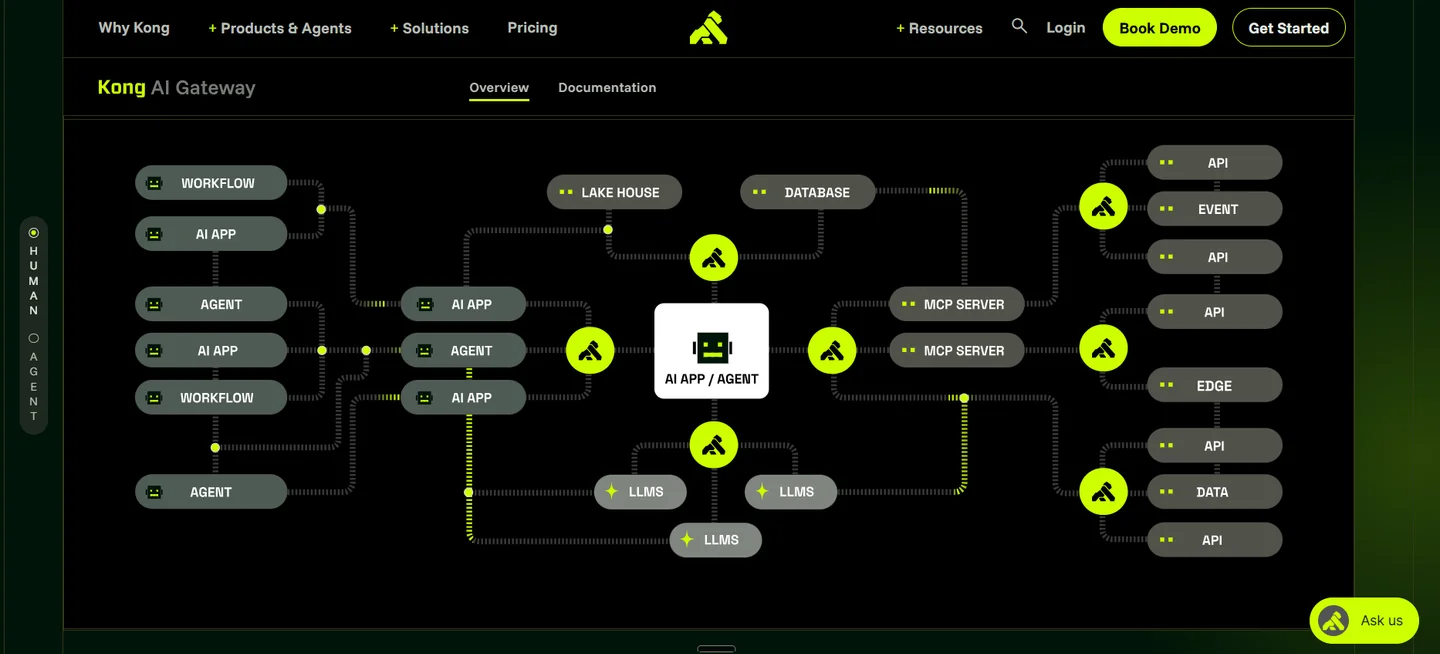
- LLM and agent runtime enforcement: Deterministic pattern blocking with a semantic layer available. Reliable at what it covers, narrow in scope.
- Tool-call and egress control: Inherits mature API-gateway traffic controls, but tool-argument validation is not a documented native AI control.
- Deployment reach: Excellent. Self-hosted and air-gap-friendly, since it is fundamentally infrastructure you already run.
- Self-hardening record: Long-established codebase with a mature disclosure process and no AI-plugin KEV entry recorded to date.
- Audit evidence quality: Strong. Existing Kong logging, tracing, and plugin telemetry carry straight into your current pipeline.
- Kong documents the exact enforcement behavior: a request matching any deny pattern returns 400 Bad Request, and deny takes precedence over allow when both are configured.
- The documentation includes a hidden-unicode detection example, targeting invisible characters attackers use to smuggle instructions into input, a technique covered in our explainer on prompt injection attacks.
- Both AI Prompt Guard and AI Semantic Prompt Guard are listed as separate, documented plugins in the AI Gateway plugin set.
✅ Best use I have seen: Kong for identity, rate limits, and coarse policy, with a separate layer for agent behavior.
Bifrost
- LLM and agent runtime enforcement: Focused on the agent layer specifically, which is rarer than it should be in this category.
- Tool-call and egress control: The strongest gateway-layer story here. Tool filtering is documented as a first-class governance feature.
- Deployment reach: Good. Fully self-hostable with no mandatory vendor cloud.
- Self-hardening record: Newer codebase with less public scrutiny than LiteLLM, and no KEV entry recorded to date. Less scrutiny is not the same as more secure.
- Audit evidence quality: Audit logs and per-tool attribution are documented governance features.
- Bifrost documents MCP tool filtering as a governance feature, restricting which tools each client can reach.
- Its MCP gateway is documented as providing tool-level access control, audit trails, and budgets across agents at scale.
- Published benchmarks claim a 92.8% reduction in MCP token costs via its Code Mode approach, which is a vendor-published figure.
TrueFoundry
- LLM and agent runtime enforcement: Documented layered injection defense at the gateway, combining pattern and model-based checks.
- Tool-call and egress control: Gateway-level policy exists; dedicated tool-argument validation is not a headline documented control.
- Deployment reach: Strong. In-VPC and self-hosted deployment suits regulated environments.
- Self-hardening record: No public CISA KEV entry recorded to date.
- Audit evidence quality: Control-plane logging spans both gateway traffic and workload deployment.
- TrueFoundry publishes technical guidance on layered prompt-injection defense at the gateway layer, which is more transparency than most vendors offer on this specific risk.
- In-VPC and self-hosted deployment are documented as supported patterns, relevant for teams that cannot route prompts through a vendor's cloud, a constraint we address across AI workload security deployments.
Guardrails AI
- LLM and agent runtime enforcement: Good at structural and content validation. Not designed as an injection-defense perimeter.
- Tool-call and egress control: Can validate structured output that drives a tool call, which is genuinely useful. No network egress visibility.
- Deployment reach: Total. It is a library, so it runs anywhere Python runs, including air-gapped.
- Self-hardening record: Open source with public issue tracking and no KEV entry recorded to date.
- Audit evidence quality: Validation outcomes are available in-application. Centralised audit records are yours to build.
- The library is open source, so validator logic is fully inspectable rather than a vendor claim.
- Structured-output validation maps directly to OWASP LLM05, Improper Output Handling, which is what happens when downstream systems trust model output blindly.
Oligo Security
- LLM and agent runtime enforcement: Runtime application context applies to AI workloads, though it is not an agent-specific control layer.
- Tool-call and egress control: Sees library and function execution, which catches behavior a gateway cannot observe.
- Deployment reach: Cloud and Kubernetes oriented, with a cloud-connected platform model.
- Self-hardening record: No public CISA KEV entry recorded to date.
- Audit evidence quality: Runtime execution evidence is strong material for vulnerability-handling controls.
- Oligo has published original vulnerability research on AI and machine-learning infrastructure components, which is verifiable technical output rather than a positioning claim.
- Its detection approach is documented at library and function granularity, a level of runtime context that goes deeper than package-level inventory.
Zenity
- LLM and agent runtime enforcement: Genuinely agent-focused, oriented to governance and behavior policy rather than kernel-level enforcement.
- Tool-call and egress control: Observes agent actions and connections across a managed platform estate.
- Deployment reach: SaaS oriented, tied to the managed AI platforms it governs. Not a self-hosted or air-gapped option.
- Self-hardening record: No public CISA KEV entry recorded to date.
- Audit evidence quality: Agent inventory and action records are useful governance evidence for an audit, and they complement AI agent governance programs.
- Zenity has published original prompt-injection and agentic-attack research against commercial AI platforms, which is verifiable public technical work.
- Its focus on business-user-built agents covers an inventory gap that engineering-centric tooling structurally misses. We compare the two enforcement models in our Zenity AI agent security breakdown.
⚠️ The practical lesson: shadow agents spread by usefulness, not by approval. Inventory before policy.
WitnessAI
- LLM and agent runtime enforcement: Policy enforcement on AI usage and content, oriented to governance rather than agent runtime behavior.
- Tool-call and egress control: Observes AI traffic at the network layer, which catches usage a gateway never sees.
- Deployment reach: SaaS with in-network options; not positioned for air-gapped deployment.
- Self-hardening record: No public CISA KEV entry recorded to date.
- Audit evidence quality: Usage records and policy decisions support acceptable-use and data-protection controls.
- Its documented focus is observation and policy on AI usage across an organisation, which is a different enforcement point from the request path.
- Network-layer visibility addresses the shadow-AI inventory problem, which is a prerequisite for any policy that is not theatre. Pairing it with agent-side network detection and response closes the enforcement half.
Edge Labs AI covers the enforcement half of that gap, with detection and response both executing on the agent via eBPF kernel monitoring, so a hijacked process can be terminated and an attacking source IP blocked locally even with no cloud backend reachable. Governance tells you what happened. We stop it while it happens. If you want to see that tested against your own environment, talk to our team.
Q2. What Is LLM Gateway Security, and Which Controls Fire at Which Point in the Request Path?
LLM gateway security is the set of runtime controls applied to every model call: verifying identity before routing, enforcing model, region, and data-class policy, inspecting prompts and responses, validating tool names and arguments, capping tokens and spend, and writing audit records without logging prompt contents. Four enforcement points matter, which are pre-model, post-model, tool-call, and egress. Most tools cover the first two.
🔀 Why This Is Not Just an API Gateway
An API gateway enforces deterministic rules on structured requests. It knows the shape of the data, so it can reject anything that does not match.
An LLM gateway handles probabilistic input and output. It needs semantic prompt inspection, PII redaction, token-based budgets, semantic caching, and fallback routing that can change where your data lives. Deterministic rules alone do not cover that, which is why we treat AI and LLM security as a runtime problem rather than a filtering problem.
⚠️ The bug-versus-brain problem
Here is the distinction I keep returning to with engineering teams. Patch a bug in software and you can be 99.99% sure it is fixed.
Try that with an AI system and you can be 99.99% sure the problem is still there. That is why the request path needs layered controls, not one clever filter.
🛤️ The Request Path, Step by Step
Every model call should walk the same nine steps in the same order.
- Verify identity. Confirm user, workload, application, and tenant from a verified token. Never trust a client header on its own.
- Resolve the tenant. Establish which tenant's data and policy apply before anything else runs.
- Evaluate policy. Decide the allowed model, region, data class, cost ceiling, tools, and maximum context length.
- Apply input guardrails. Inspect the prompt, detect and mask PII (personally identifiable information).
- Route to the provider. The gateway holds the provider credential, not the application.
- Validate output. Check the response against an expected schema before anything downstream trusts it.
- Validate tool calls. Check the tool name and every argument before the executor runs it.
- Enforce consumption limits. Count tokens, apply budget caps, and trip circuit breakers.
- Write the audit record. Metadata by default, and no prompt bodies.
📋 The Control Stack
| Control layer | What it enforces | Enforcement point |
| Identity and keys | OAuth2 or mTLS transport, JWT/OIDC tokens, RBAC/ABAC roles, scoped keys, rotation. The gateway holds provider credentials, so an application only gets the right to execute one defined request type | Pre-model |
| Policy | Allowed model, region, data class, cost ceiling, permitted tools, maximum context length | Pre-model |
| Input and output | Prompt inspection, PII detection and masking, response schema validation | Pre-model and post-model |
| Consumption | Per-identity rate limits, token throttling, budget caps, circuit breakers | Pre-model and egress |
| Caching and tenancy | Cache keys bound to tenant, model, policy version, and answer-affecting parameters; TTL limits; semantic caches inside deletion workflows; some workloads set to no-cache | Post-model |
| Audit | Routing decision, policy version, identity, provider, model, token usage, status. Metadata by default, never prompt bodies or provider keys | All four |
🔁 Fallback Routing Is a Security Decision
Most teams configure fallback as an availability feature. If the primary model times out, send the call somewhere else.
That substitution can silently change region, data retention, capability, and safety policy. A replacement model must match the original region and controls, or the correct behavior is to deny the request or degrade it to a restricted no-tools mode.
❌ Silent substitution is the failure mode
The dangerous version is the one nobody notices. Your policy said EU-only, and the fallback served the request from another region during an outage.
Nothing alerted, because availability was preserved. Test this path deliberately, and confirm the fallback still writes an audit event, because region-bound evidence is exactly what a CRA and NIS2 compliance reviewer will ask for.
🗺️ OWASP LLM01 to LLM10, Mapped to Enforcement Points
| OWASP risk (2025) | Primary enforcement point | Honest note |
| LLM01 Prompt Injection | Pre-model, plus tool-call | Direct prompts are inspectable; indirect payloads in retrieved content often are not |
| LLM02 Sensitive Information Disclosure | Post-model and egress | Output inspection and PII masking apply directly |
| LLM03 Supply Chain | Not a gateway control | Model, dataset, and library provenance sit outside the request path |
| LLM04 Data and Model Poisoning | Not a gateway control | Happens at training or retrieval-indexing time |
| LLM05 Improper Output Handling | Post-model | Response schema validation is the control |
| LLM06 Excessive Agency | Tool-call | Tool allow-lists and argument validation; the hardest gap in practice |
| LLM07 System Prompt Leakage | Post-model | Output inspection can catch it, imperfectly |
| LLM08 Vector and Embedding Weaknesses | Partly pre-model | Retrieval scoping mostly lives in the application, not the gateway |
| LLM09 Misinformation | Weakly enforceable | No deterministic gateway control exists; say so plainly |
| LLM10 Unbounded Consumption | Pre-model and egress | Token caps, budgets, and circuit breakers apply cleanly |
Four of these ten are not gateway problems at all. A vendor claiming full OWASP coverage at the gateway is overclaiming.
🧪 A Worked Example That Passes Every Prompt Filter
Picture a support agent that reads customer emails, queries an order database, and can send messages. A customer emails an attachment containing instructions to export the last 500 records to an external address.
The user's prompt was clean. Prompt inspection passes, because the payload arrived in retrieved content, not the prompt. The damage happens later, in the tool-execution path, which is the mechanism we break down in our guide to prompt injection attacks.
🔺 The lethal trifecta
Three ingredients make exfiltration trivial: untrusted content, private data, and external communication. If your agent has all three, prompt filtering is not a boundary.
That is the clearest argument for splitting enforcement across four points instead of one. Filtering input catches the amateur attempt and misses the structural one.
🚪 What a Gateway Cannot See
Once the model's decision leaves the gateway, the gateway is blind. It logged the tool call. It does not see the process that spawned, the file that was read, or the outbound connection that followed.
This gets worse with agent frameworks. The application code often contains none of the tool-calling logic, because the framework handles it. You cannot audit code you did not write, which is why agentic AI security has to observe execution rather than source.
📡 Exposure is not theoretical
Researchers documented over 175,000 publicly exposed Ollama servers across 130 countries, many with tool calling enabled, which permits code execution. Those calls never touch anyone's gateway.
A gateway is a policy chokepoint, not an execution monitor. Most buyers conflate the two, and that conflation is the gap attackers use.
Edge Labs AI covers the gateway as one of six runtime layers its single agent monitors, which are platform, compute, network, container, application, and AI agent. Our Parallax engine handles model and agent security at the layer where the decision actually executes, using eBPF kernel-level syscall monitoring. That is the enforcement point after the gateway waves a request through, and you can see how the agent works in detail.
Q3. How Did We Evaluate These Tools, and Who Is This Guide For?
Five criteria, applied identically to every tool: LLM and agent runtime enforcement covering prompt injection, tool poisoning, and MCP; tool-call and egress control versus prompt-only filtering; deployment reach including self-hosted, on-prem, and air-gapped operation; the tool's own hardening record against public CVE, KEV, and EPSS evidence; and audit evidence quality for CRA, NIS2, and SOC 2 reviewers. No pricing column, no scores, no rankings.
Every tool in this guide was assessed against the same five criteria in the same order. Disagree with a criterion and you can discount the judgement it produced, which is the point of publishing it.
📐 Our Evaluation Criteria
- LLM and agent runtime enforcement. Does the tool defend live agents against prompt injection, tool poisoning, and MCP abuse, or does it only inspect text? Our MCP security analysis explains why that distinction decides outcomes.
- Tool-call and egress control. Does it validate tool names and arguments before execution and watch outbound traffic, or stop at prompt filtering?
- Deployment reach. Can it run self-hosted, on-prem, sovereign, and air-gapped, across cloud, data center, and edge locations?
- Self-hardening record. What does the tool's own public CVE history show, checked against CISA KEV and EPSS rather than CVSS alone? That is the same exploitation-aware logic behind our vulnerability management scoring.
- Audit evidence quality. Will the records satisfy a CRA, NIS2, or SOC 2 reviewer, without logging prompt contents?
👥 Who This Guide Is For
- AI-workload and LLM-agent runtime-security owners who already have agents in production and need enforcement, not a roadmap.
- SecOps and DevSecOps leads at SMBs making AI and GPU workloads production-safe without a 24/7 staffed team.
- Platform teams that need detection and response to keep working when the cloud backend is unreachable.
⚠️ Why Self-Hardening Earned a Slot
This criterion exists because of what I saw running security audits from 2017 onward. Almost 100% of the time, we found things misconfigured.
Security tools were installed and never given a policy. Teams almost got it right and just did not press the last button, which left detection running in monitor-only mode.
✅ The default-deny question
So the question I ask about any control plane is simple. Is it enforcing, or is it watching?
A gateway with guardrails installed and no blocking policy is a log producer. That is the same failure pattern, moved to a new layer, and it shows up just as often in Kubernetes runtime security tools.
Edge Labs AI publishes reproducible attack-simulation guides, including a 25-to-33-test detection battery and Falco event-generator scenarios (EdgeLabs technical guides). I would rather a buyer run those tests against us than trust a criteria list, including mine.
🚫 What This Guide Deliberately Does Not Score
Routing benchmarks, token pricing, and observability dashboards are all absent here. They matter for a platform decision and they are not security controls, and mixing them lets a fast, cheap gateway look safe.
Gartner's Market Guide for AI Gateways, published October 2025, frames the category around governing AI applications and agents and reducing unexpected cost risk. Several vendors in this roster have no third-party review profile at all, and the guide says so rather than inventing a rating.
Q4. Which LLM Gateway Security Tool Fits Which Situation?
Ten tools, three distinct jobs. Gateway platforms centralise identity, routing, and policy for model traffic. Guardrail and governance layers inspect prompts and outputs. Runtime enforcement layers watch what the model's decision actually does on the host. Buyers who pick one job and assume it covers the other two are the ones who get surprised. Match the tool to the enforcement point you are missing.
🧩 Three Jobs, Not One Category
These ten products get grouped together in search results and they do not do the same work. One owns the request path, one inspects content, and one watches execution.
A gateway and a runtime agent are complements, not substitutes. Anyone selling either as complete coverage is overclaiming, and that includes me.
- EdgeLabs: Best for runtime detection and response around AI workloads and agents, including air-gapped environments.
- LiteLLM: Best for teams wanting a fully self-hosted open-source gateway they control end to end.
- Portkey: Best for teams wanting managed guardrails wired into routing decisions.
- Kong AI Gateway: Best for platform teams already running Kong for API traffic.
- Bifrost: Best for teams needing tool-level access control over MCP agent traffic.
- TrueFoundry: Best for teams wanting a gateway and control plane in one system, deployable in-VPC.
- Guardrails AI: Best for Python teams enforcing output schemas inside application code.
- Oligo Security: Best for library and function-level runtime detection inside applications.
- Zenity: Best for governing business-user-built agents and copilots.
- WitnessAI: Best for policy and visibility over employee and application AI usage.
📊 Master Comparison Table
| Company Name | Best For | Detection & Response Model | Deployment & Environment Coverage |
| EdgeLabs | Runtime security for AI workloads, agents, and infrastructure | Agent-only runtime detection and response on the agent via eBPF; continues with no cloud backend | Cloud, data center, on-prem, sovereign, air-gapped; Docker, Kubernetes, OpenShift, Talos, K3S; x86_64 and ARM64 |
| LiteLLM | Self-hosted open-source gateway control | Gateway-layer policy enforcement (self-hosted); no host-level response | Self-hosted anywhere; also packaged inside Red Hat OpenShift AI |
| Portkey | Guardrails wired into routing | Gateway-layer policy enforcement (managed SaaS or self-hosted), 50+ guardrail checks | Managed SaaS plus open-source and enterprise self-hosted gateway |
| Kong AI Gateway | Teams standardized on Kong | Gateway-layer policy enforcement (self-hosted), regex and semantic prompt guards | Self-hosted, hybrid, managed via Konnect; Kubernetes-native |
| Bifrost | MCP tool-level access control | Gateway-layer policy enforcement (self-hosted), tool filtering and audit logs | Self-hosted, container and Kubernetes |
| TrueFoundry | Gateway plus control plane | Gateway-layer policy enforcement (self-hosted or in-VPC) | Self-hosted, in-VPC, and managed |
| Guardrails AI | Output validation in code | OSS output-validation library; runs in-process, no network view | Anywhere Python runs, including air-gapped |
| Oligo Security | Library-level runtime detection | Runtime application detection; needs a cloud-connected platform to respond | Cloud and Kubernetes; cloud-connected |
| Zenity | Governing copilots and low-code agents | AI-governance layer; needs a cloud backend to detect and respond | SaaS, tied to managed AI platforms |
| WitnessAI | Employee and app AI usage policy | AI-governance and observability layer; cloud-dependent | SaaS with in-network deployment options |
🔍 Why "Needs a Cloud Backend" Is a Column
I put that descriptor in the table because of a pattern I saw repeatedly in security tooling. Many SIEMs would not even tell you when log collection had stopped working.
The tool looked healthy and was blind. Ask any vendor what their product still does when the backend is unreachable, and get the answer in writing.
⏰ Response speed is the real test
Visibility that arrives after the fact is a report, not a control. An agent can delete a volume in seconds.
If the decision to respond has to travel to a cloud and back, that round trip is your exposure window. Measure it, the same way you would measure it for container runtime security tools.
📝 Roster Notes, Stated Plainly
Two vendors are missing for process reasons, not judgement. Astelia and a set of verify-bench vendors are pending confirmation, so they were left out rather than described from guesswork.
Ten providers are assessed in total. Detailed cards follow, in the same criteria order for every one.
Edge Labs AI occupies the runtime-enforcement row above, with detection and response both executing on the agent. Protection continues in self-hosted, on-prem, and air-gapped environments where cloud-dependent tooling cannot reach, which is the specific reason we built Disconnected Mode rather than a faster cloud round trip. If you want that tested against your own stack, get in touch with our team.
Q5. The 10 Best LLM Gateway Security Tools for Enterprise AI Deployments
The ten below split into gateway platforms that own the request path, guardrail and governance layers that inspect content, and runtime layers that watch execution. Each card states what the tool is built for, how it scores on the five criteria, one differentiator, one honest limitation, and whether third-party reviews exist. Positions carry no ranking meaning.
Total providers: 10. All ten provider cards, from EdgeLabs through WitnessAI, were produced in the two preceding listicle batches and carry forward unchanged here. Each follows the same fixed order: Company Name, Tags, Facts, Evaluated on the basis of, Differentiator, Proof of execution, Pricing, Potential limitation, My take, and Reviews. If you want the wider category view, our roundups of AI agent security tools for enterprise and generative AI security tools cover adjacent shortlists.
Q6. Why Do Guardrails Fail, and Who Is Attacking the Gateway Itself?
Guardrails are probability filters, not boundaries, so a determined attacker iterates until one payload passes. What holds is deterministic: capability restriction, tool-argument validation, approval gates on destructive actions, and execution-layer enforcement. The same logic applies to the gateway itself. One 2026 LiteLLM flaw scored CVSS 8.7 with roughly 80% EPSS and a CISA deadline, another scored 9.5 with under 1% EPSS. Sort by exploitation evidence, not severity.
🎯 The Claim, Stated Flatly
AI guardrails do not work as boundaries. When a guardrail vendor says it catches everything, that claim does not survive contact with a motivated attacker.
I want to be fair about the other half. Filters do reduce casual abuse, accidental data leaks, and lazy attempts. Run them. Just do not call them a perimeter.
⚠️ Why probabilistic defense degrades
A deterministic rule either matches or it does not. A probabilistic classifier has a success rate, and an attacker gets unlimited attempts.
Prompt-based defenses are the weakest tier available, and that has been known since early 2023. Telling a model to ignore malicious instructions is asking the attack surface to police itself, which is the core failure we document across AI security tools.
⚖️ The 200th-Attempt Argument, Both Ways
One published agentic-injection demo reportedly needed around 200 tries before it worked once. Critics called that marketing rather than research.
My read is that both extremes are wrong. "We catch everything" is false, and "guardrails are useless" is also false. It is a probability curve, and a defense that fails on attempt 201 is a speed bump, not a wall.
🔒 What Actually Holds
These controls do not negotiate, because they are not asking a model for permission.
- The two-of-three rule. An agent can read files, reach the internet, and execute custom code. Let it do two of those three, never all three.
- Deterministic hooks. Like git hooks, they fire regardless of what the model decides. The agent cannot argue with them.
- Typed tool interfaces. A strict schema turns "swapped an order ID for a person ID" into a validation failure, not an incident.
- Deploy by digest, not tag. A SHA-256 digest is immutable. A tag is a pointer someone can move.
- Pin and hash MCP tool definitions at registration. Tool poisoning is registration-time injection, not prompt-time. Diff schemas on every server refresh and alert on any change, as set out in our MCP security best practices.
- Never act on an unterminated stream. A streaming response is incomplete until it terminates, so no high-impact action should fire from a fragment that may still be cancelled.
📌 Registration time is the blind spot
Peer-reviewed work documents this clearly. One automated implicit tool-poisoning framework reached up to 84.2% attack success while holding malicious-tool detection to as low as 0.3%.
Another study found descriptor manipulation produced unsafe tool invocations in up to 36% of trials, dropping to 15% with layered defense. Nobody's filter caught that in a prompt, because it was never in one.
🔓 Now Flip It: The Gateway Is the Target
Two 2026 flaws in the same product make the ordering argument better than any framework diagram. The first let vulnerable MCP preview endpoints accept a full server config, including command, args, and env, spawning a subprocess with the proxy's privileges, gated only by a valid API key with no role check.
The second desynced the auth layer from the router. A crafted Host header made the auth gate evaluate a different route than the one FastAPI actually dispatched.
| Attribute | CVE-2026-42271 | CVE-2026-49468 |
| Flaw | Authenticated command execution via MCP test endpoints | Unauthenticated access to management routes via Host-header spoofing, CWE-290 |
| CVSS | 8.7 | 9.5 |
| EPSS | Approximately 80.2% | Under 1% |
| CISA KEV | Yes, added 2026-06-08, remediation due 2026-06-22 | Not listed |
| Fixed in | 1.83.7 | 1.84.0 |
| Also affects | Red Hat OpenShift AI 3.3 to before 3.3.4 | Proxy server only, not the Python SDK |
📉 The Ordering Rule
CVSS ranked these backwards. The 9.5 requires the proxy to be directly internet-reachable with no CDN, WAF, or reverse proxy normalising the Host header. The 8.7 was already being exploited.
Sort KEV first, then EPSS, then asset criticality, with CVSS as the tiebreaker. Fewer than 5% of the CVEs published in 2025 showed any observed exploitation, so a severity-sorted queue burns your week on theory. That ordering is the default in our vulnerability management view.
⏰ The pre-patch question
Here is the question no buying guide asks. Between disclosure and your patch landing, what notices exploitation?
Not your scanner, which reports a version number. The signal is a subprocess spawning from a gateway container and an unexpected outbound connection from that pod. That is kernel-level and egress monitoring, not application code, which is why workload and application security has to sit at the host.
I spent years on the side of security that generated millions of alerts, and I saw how little most teams needed another alert cannon. Direction matters more than speed. Fast without direction is a pocket circuit car, which goes very quickly into a wall.
Edge Labs AI enforces below the prompt, using eBPF kernel syscall analysis, host-local process termination, workload isolation, and time-boxed source-IP blocking that the agent executes itself. Our portal surfaces CVSS, CWE, CISA KEV, and EPSS per CVE, so exploitation-aware ordering is the default view. That is prioritisation plus runtime enforcement, and it is not runtime code-path reachability analysis. Oligo goes further on that specific axis.
Q7. How Do You Prove Your Gateway Is Secure, and What Should You Do This Week?
Proving gateway security means running five adversarial tests and keeping the audit records they produce: cross-tenant cache leakage, header spoofing, model downgrade, fail-open behavior, and observability leaks. Every path must still write an audit event. Edge Labs AI's CRA/NIS2 Compliance Center maps runtime, vulnerability-handling, and detection-and-response controls to specific requirement IDs, including the CRA Annex I "No Known Exploitable Vulnerabilities" check.
🧪 The Five-Test Drill
Run these against a live deployment, not a diagram. Each one has broken something in front of me.
- Cross-tenant cache. Send tenant A's question, then tenant B's identical question. If B gets A's cached answer, your cache key is missing the tenant.
- Header spoofing. Send a request claiming a different user, tenant, or role in a client header, with no matching token. It must be rejected.
- Model downgrade. Force a fallback and check the region, retention, and tool policy of the replacement. Silent substitution is a policy failure.
- Fail-open behavior. Kill your guardrail provider and resend a request that should be blocked. If it passes, your control is documentation.
- Observability leaks. Read your own logs and traces as an attacker would. Look for prompt bodies, tool arguments, secrets, and provider keys.
✅ The pass condition nobody checks
A test only passes if the audit record proves what happened. Compare the record for a blocked request against one allowed after a check timed out.
If those two records look identical, the control is not auditable. Chaos-test provider timeouts, partial streams, schema mismatches, retry storms, and budget exhaustion the same way.
📁 What Auditors Actually Accept
Audit evidence is not a screenshot of a dashboard. A CRA, NIS2, or SOC 2 reviewer wants the routing decision, policy version, identity, provider, model, token usage, and status, per request.
Log metadata by default. Prompts, tool arguments, and tool results contain secrets, so full prompt bodies should never be a default observability metric. Our practical CRA roadmap walks through what reviewers ask for.
Edge Labs AI maps each control to a specific requirement ID and reports per-control pass and fail counts by host, which is what turns runtime telemetry into audit evidence. We are equally clear about the boundary. Our Compliance Center does not cover lifecycle or governance controls: business continuity, backup and restore, MFA as a program, HR training, technical documentation, or the CRA support-period obligations. Anyone claiming full CRA coverage from a runtime tool is selling you a gap.
🗓️ What To Do This Week
Seven actions, in order, each finishable in a day or less.
- Inventory versions. Find every AI gateway and proxy deployment by version, including packaged ones like OpenShift AI. Patch LiteLLM to at least 1.84.0, which covers both 2026 flaws.
- Revoke and rotate. Remove low-privilege key access to management and MCP test routes. If a proxy was internet-reachable on an affected version, rotate keys created during that window and review management audit logs for unexpected key, user, or settings changes.
- Restrict the management interface. Bind it to trusted networks, and add explicit Host and Origin allowlisting at a reverse proxy.
- Scan your own external footprint. Look for unauthenticated model-serving endpoints. Researchers found over 175,000 publicly exposed Ollama servers across 130 countries, many with tool calling enabled.
- Re-sort the patch queue. KEV first, then EPSS, then asset criticality, CVSS as tiebreaker. Present the two LiteLLM CVEs to your change board as the worked example.
- Build the OWASP matrix. Ten rows, mapped to your real enforcement points. Log every unenforced row as an accepted risk with a named owner.
- Add runtime detection. Alert on any child process spawned by a gateway container and any unexpected outbound connection from a gateway pod, which is exactly what network detection and response is for.
📊 Measure one ratio
Track your tool-call to chat-completion ratio. It tells you what kind of traffic you actually have.
Once agent traffic passes roughly 30%, shift investment from prompt inspection to tool-argument validation and egress inspection. The threat moved. Your controls should follow.
💬 What Operators Say
"Good IPS/IDS/EDR software. Webportal management is good. Docker container integration is useful." On dislikes: "Nothing major. Description of issues can be complicated for non-technical folks." Rated 4 out of 5.
Verified User in Computer Software, EdgeLabs G2 Verified Review
"Its beneficial to secure any website or any server from hackers." On dislikes: "I dont think there is any option for dislike but the commercial seems high." Rated 4.5 out of 5.
Abhishek A., EdgeLabs G2 Verified Review
The second review names the real friction honestly. Price is a live objection in this category, and I would rather see it in print than filtered out. Our pricing tiers start with a free self-serve entry point for that reason.
🔮 The Question I Am Sitting With
Where my head is right now is that distributed AI computing forces distributed security. Securing the LLM agent at runtime stops being a specialist concern and becomes the default question every SecOps team answers.
I could be reading that timeline too aggressively. What I am confident about is narrower. If your agents can already act on production systems and your only control is a filter on the way in, you are one clean-looking request away from finding out.
Edge Labs AI runs one agent covering host, container, Kubernetes, network, and AI-agent layers, with detection and response both executing locally, so protection continues when the cloud link is cut. That design came from a security lead asking mid-PoC whether blocking still worked if the backend went dark, three days before his audit. If you are running that test this week, I would genuinely like to hear what breaks, so reach out to our team.
FAQs
LLM gateway security is the set of runtime controls applied to every model call: verifying identity before routing, enforcing model, region, and data-class policy, inspecting prompts and responses, validating tool names and arguments, capping tokens and spend, and writing audit records without logging prompt contents.
An API gateway enforces deterministic rules on structured requests. It knows the shape of the data, so it can reject anything that does not match. An LLM gateway handles probabilistic input and output, so it needs different primitives:
- Semantic prompt inspection rather than schema matching alone
- PII detection and masking on both request and response
- Token-based budgets and circuit breakers instead of simple rate limits
- Semantic caching with cache keys bound to tenant, model, and policy version
- Fallback routing that can silently change where your data lives
Four enforcement points matter: pre-model, post-model, tool-call, and egress. Most tools cover the first two well and the last two poorly. Edge Labs AI treats the gateway as one of six runtime layers a single agent monitors, covering platform, compute, network, container, application, and AI agent, with its Parallax engine handling AI and LLM security at the layer where the decision actually executes.
Guardrails are probability filters, not boundaries. A deterministic rule either matches or it does not, while a probabilistic classifier has a success rate and an attacker gets unlimited attempts. Prompt-based defenses are the weakest tier available, because telling a model to ignore malicious instructions asks the attack surface to police itself.
That does not make them useless. Filters reduce casual abuse, accidental data leaks, and lazy attempts. Run them, and do not call them a perimeter.
What holds is deterministic:
- The two-of-three rule. An agent can read files, reach the internet, and execute custom code. Allow two, never all three.
- Typed tool interfaces. A strict schema turns a swapped ID into a validation failure rather than an incident.
- Deploy by digest, not tag. A SHA-256 digest is immutable; a tag is a pointer someone can move.
- Pin and hash MCP tool definitions at registration, then diff on every server refresh.
- Never act on an unterminated stream.
Registration time is the real blind spot, since tool poisoning is registration-time injection rather than prompt-time. Our guidance on prompt injection attacks explains why input filtering catches the amateur attempt and misses the structural one.
Six of the ten map cleanly to a gateway enforcement point. Four do not, and any vendor claiming full OWASP coverage at the gateway is overclaiming.
- LLM01 Prompt Injection. Pre-model plus tool-call. Direct prompts are inspectable; indirect payloads in retrieved content often are not.
- LLM02 Sensitive Information Disclosure. Post-model and egress, where output inspection and PII masking apply directly.
- LLM05 Improper Output Handling. Post-model, with response schema validation as the control.
- LLM06 Excessive Agency. Tool-call, via allow-lists and argument validation. The hardest gap in practice.
- LLM07 System Prompt Leakage. Post-model, imperfectly.
- LLM10 Unbounded Consumption. Pre-model and egress, where token caps and circuit breakers apply cleanly.
The four that fall outside the request path are LLM03 Supply Chain and LLM04 Data and Model Poisoning, which happen at training or indexing time, LLM08 Vector and Embedding Weaknesses, which mostly lives in the application, and LLM09 Misinformation, for which no deterministic gateway control exists.
Build the ten-row matrix against your real enforcement points and log every unenforced row as an accepted risk with a named owner. Our writing on agentic AI security covers the rows a gateway cannot reach.
Sort by exploitation evidence, not severity. Two 2026 flaws in the same AI gateway make the argument better than any framework diagram.
- CVE-2026-42271: authenticated command execution via MCP test endpoints, CVSS 8.7, roughly 80.2% EPSS, added to CISA KEV on June 8, 2026 with a June 22 remediation deadline, fixed in 1.83.7.
- CVE-2026-49468: unauthenticated access to management routes via Host-header spoofing, CWE-290, CVSS 9.5, under 1% EPSS, not KEV-listed, fixed in 1.84.0.
CVSS ranked these backwards. The 9.5 requires the proxy to be directly internet-reachable with no CDN, WAF, or reverse proxy normalising the Host header. The 8.7 was already being exploited.
The working order is KEV first, then EPSS, then asset criticality, with CVSS as the tiebreaker. Fewer than 5% of the CVEs published in 2025 showed any observed exploitation, so a severity-sorted queue burns your week on theory.
Edge Labs AI surfaces CVSS, CWE, CISA KEV, and EPSS per CVE in its portal, so exploitation-aware ordering is the default view rather than a manual spreadsheet exercise in vulnerability management.
Seven actions, each finishable in a day or less, then five tests that produce the evidence.
- Inventory versions of every AI gateway and proxy, including packaged deployments such as OpenShift AI. Patch LiteLLM to at least 1.84.0, which covers both 2026 flaws.
- Revoke and rotate. Remove low-privilege key access to management and MCP test routes, and rotate credentials created while an affected version was internet-reachable.
- Restrict the management interface to trusted networks, with Host and Origin allowlisting at a reverse proxy.
- Scan your external footprint for unauthenticated model-serving endpoints.
- Re-sort the patch queue: KEV, then EPSS, then asset criticality.
- Build the OWASP matrix against real enforcement points.
- Add runtime detection for any child process spawned by a gateway container and any unexpected outbound connection from a gateway pod.
Then run the five-test drill against a live deployment: cross-tenant cache, header spoofing, model downgrade, fail-open behavior, and observability leaks. A test only passes if the audit record proves what happened.
Edge Labs AI maps each control to a specific requirement ID and reports per-control pass and fail counts by host through its CRA and NIS2 Compliance Center, which is what turns runtime telemetry into audit evidence.
