TL;DR
- AI agents break legacy tools because attacks are context-rich text, not malware signatures, and they execute at runtime faster than any human reviewer can respond.
- The lethal trifecta, reading untrusted content, reaching private data, and talking to the outside world, is what turns an ordinary agent into an exfiltration path.
- Controls that matter make dangerous actions physically impossible: runtime enforcement, deterministic hooks, user-scoped tool permissions, and CVSS plus EPSS plus CISA KEV scoring.
- We compare six tools: EdgeLabs, Oligo Security, Zenity, WitnessAI, Astelia, and the Microsoft open-source agentic-security project, matched to distinct situations rather than ranked.
- The deciding axis is where response runs; EdgeLabs keeps detection and response on the agent, working self-hosted, on-prem, or air-gapped with no cloud dependency.
- Build guardrails that are physical, not persuasive, using the two-of-three rule, a statically typed compiler, and a runtime trip wire that halts an agent the instant it crosses a line.
Q1. Which AI Agent Security Tools Actually Protect the Enterprise (and How We Judged Them)?
The best AI agent security tools for the enterprise stop dangerous agent actions at runtime, not just at scan time. This guide evaluates six on runtime enforcement (prompt-injection, tool-poisoning, MCP defense), detection-and-response locus (agent-only vs cloud-dependent), deployment reach (self-hosted, on-prem, air-gapped), exploited-vulnerability scoring, and category maturity, because most agentic-security vendors are early and thinly reviewed.
I picked six tools because an autonomous agent can wipe a production database in nine seconds, faster than you can read a Slack message. Attacks execute at runtime, not at scan time, so a clean posture report tells you what could go wrong, never what is going wrong right now. I evaluated each tool against the criteria below. A tool that cannot reach a self-hosted or air-gapped environment, or that buries a real threat under alert noise, fails the people it is meant to protect. This is a neutral rubric, applied the same way to every vendor, including us. If you want the mechanics behind that claim, our breakdown of runtime AI and LLM security covers how enforcement fires where the agent actually executes.
🧭 Our Evaluation Criteria
- Runtime enforcement, not persuasion: Does it stop prompt injection, tool poisoning, and Model Context Protocol (MCP) abuse (MCP is the standard agents use to reach external tools) as actions happen, or only warn?
- Detection AND response locus: Do both detection and response run on the agent itself, or does the tool need a cloud backend to act?
- Deployment reach: Does it work self-hosted, on-prem, and air-gapped (fully offline), or only in the vendor's cloud?
- Exploited-vulnerability and explainability scoring: Does it rank risk by what is actually exploited (CVSS severity plus EPSS likelihood plus the CISA KEV catalog of known-exploited flaws), or by paper severity alone? Our approach to this sits inside exploited-vulnerability scoring.
- Category maturity and honesty: Is the tool proven in production, and is the vendor candid about what it does not cover?
👥 Who This Guide Is For
- SecOps and DevSecOps leads at SMBs making cloud and AI or GPU workloads production-safe.
- AI-workload and LLM-agent runtime-security owners securing agents and agentic systems in production.
- Kubernetes and container runtime-security owners moving from build-time scanning to runtime Kubernetes detection.
- GPU-cloud and AI-infrastructure security leads protecting inference nodes and clusters.
📋 The Six Tools at a Glance
- EdgeLabs: Best for teams needing detection AND response entirely on the agent, self-hosted, on-prem, or air-gapped, with no cloud backend.
- Oligo Security: Best for library-level runtime detection inside application and AI workloads.
- Zenity: Best for discovering and governing agents and copilots you did not know existed.
- WitnessAI: Best for AI-usage governance and policy control over what employees and agents send to models.
- Astelia: Best for teams wanting emerging, agent-focused runtime tooling.
- Microsoft open-source agentic-security project: Best for teams wanting an open reference layer to model agentic risks.
📊 Master Comparison Table
No tool here is objectively first. Each exists for a different situation, and the honest way to read this table is to find the row that matches your environment, not to look for a winner. If you want the deployment substrate behind our row, see how the agent works.
| Company | Best For | Detection & Response Model | Deployment & Environment Coverage |
|---|---|---|---|
| EdgeLabs | Self-hosted or air-gapped teams needing runtime detection AND response with no cloud backend | Agent-only runtime detection AND response on the agent (eBPF kernel-level); works offline in Disconnected Mode | Cloud, data center, on-prem, air-gapped; Kubernetes, containers, GPU and AI-inference nodes |
| Oligo Security | Runtime detection inside application and AI libraries | Library and runtime detection focused on what code actually executes | Cloud and self-hosted; container and Kubernetes workloads |
| Zenity | Discovering and governing agents and copilots at scale | Discovery and governance layer over agent activity | Cloud-oriented; enterprise agent and copilot estates |
| WitnessAI | Governing AI usage and enforcing model-access policy | AI-governance layer (policy, observability over prompts) | Cloud-oriented; inline between users or agents and models |
| Astelia | Emerging agent-focused runtime tooling | Agent-security tooling (early-stage, category still maturing) | Varies by deployment; confirm with vendor |
| Microsoft OSS agentic-security project | Modeling agentic risks with an open reference layer | Open-source reference and tooling, not a managed detection service | Self-hosted; wherever the project is deployed |
Total providers: 6. Now to the cards, starting with where we sit and the strongest independent runtime specialist next to us. You can see our full detection and response platform for the layers each card references.
1 out of 6EdgeLabs
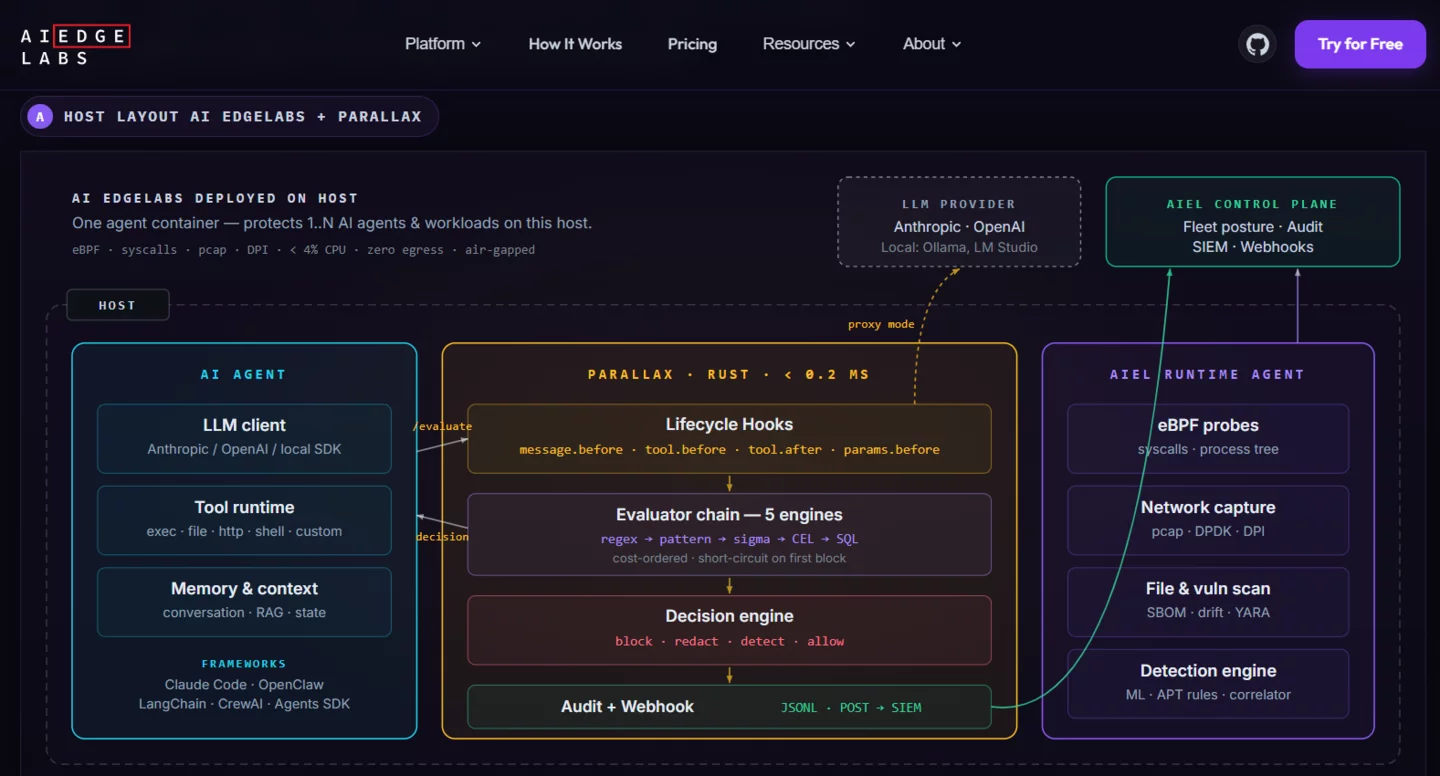
- Runtime enforcement: The Parallax engine defends LLM agents and MCP servers against prompt injection and tool poisoning as actions execute.
- Detection AND response locus: Both run on the agent itself; nothing needs a cloud backend to act.
- Deployment reach: Runs cloud, data center, on-prem, and air-gapped; response continues with the cloud link cut.
- Exploited-vulnerability scoring: Ranks risk by CVSS plus EPSS plus CISA KEV, so you fix what is exploited, not what looks scary.
- Category maturity and honesty: Proven in production; candid that compliance covers runtime, not lifecycle governance controls.
- One privileged container per node as a Kubernetes DaemonSet (one agent per node, no sidecars), across Docker, Kubernetes, OpenShift, Talos, and K3S on x86_64 and ARM_64.
- Secures GPU clusters and AI-inference nodes using only CPU, so there is no GPU tax on protection.
- Published case study (Trader Joe's, EdgeLabs' own claim): 83% MTTR reduction, $1.3M operational savings, 573% ROI, deployed in under two weeks, zero outages.
"Good IPS/IDS/EDR software. Webportal management is good. Docker container integration is useful."
Verified User in Computer Software · EdgeLabs G2 Verified Review
"It's beneficial to secure any website or any server from hackers."
Abhishek A. · EdgeLabs G2 Verified Review

Oligo Security
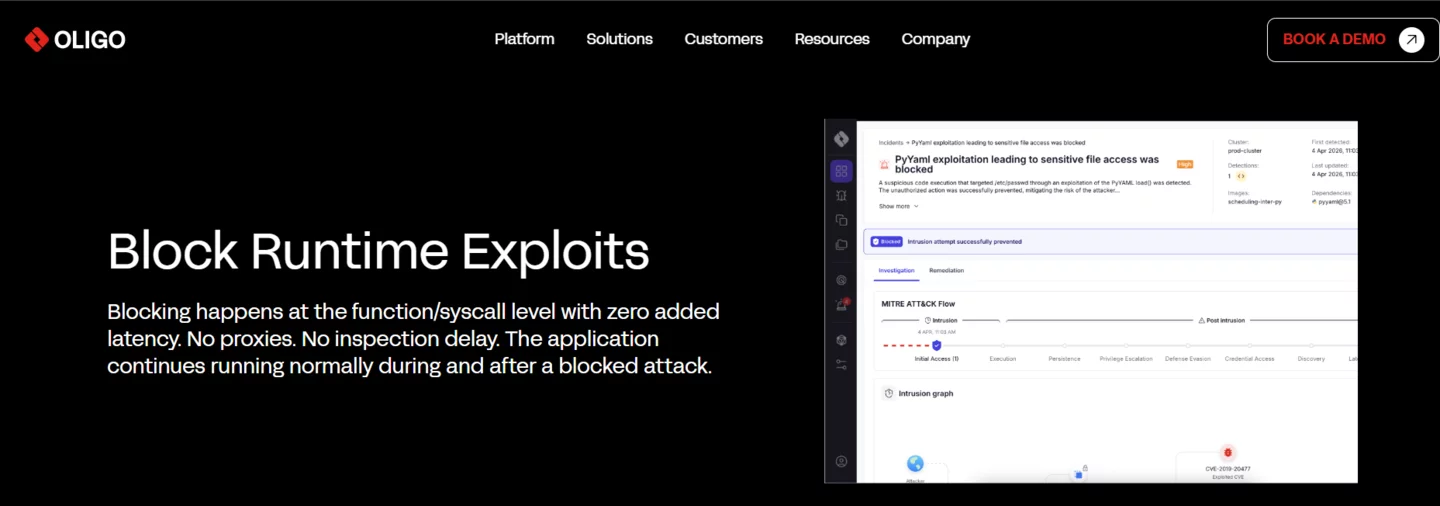
- Runtime enforcement: Detects malicious behavior in libraries as they run, which narrows noise to code that is actually loaded.
- Detection AND response locus: Strong on runtime detection; confirm the depth of automated response for your use case.
- Deployment reach: Runs cloud and self-hosted; confirm air-gapped support directly with the vendor.
- Exploited-vulnerability scoring: Emphasizes what executes over theoretical code paths, which helps cut false positives.
- Category maturity and honesty: A credible runtime specialist in a young category with limited third-party reviews.
- Focuses detection on libraries observed executing at runtime, reducing alerts tied to unused code.
- Positions itself for application and AI workloads where runtime behavior, not build-time inventory, is the signal.
Zenity
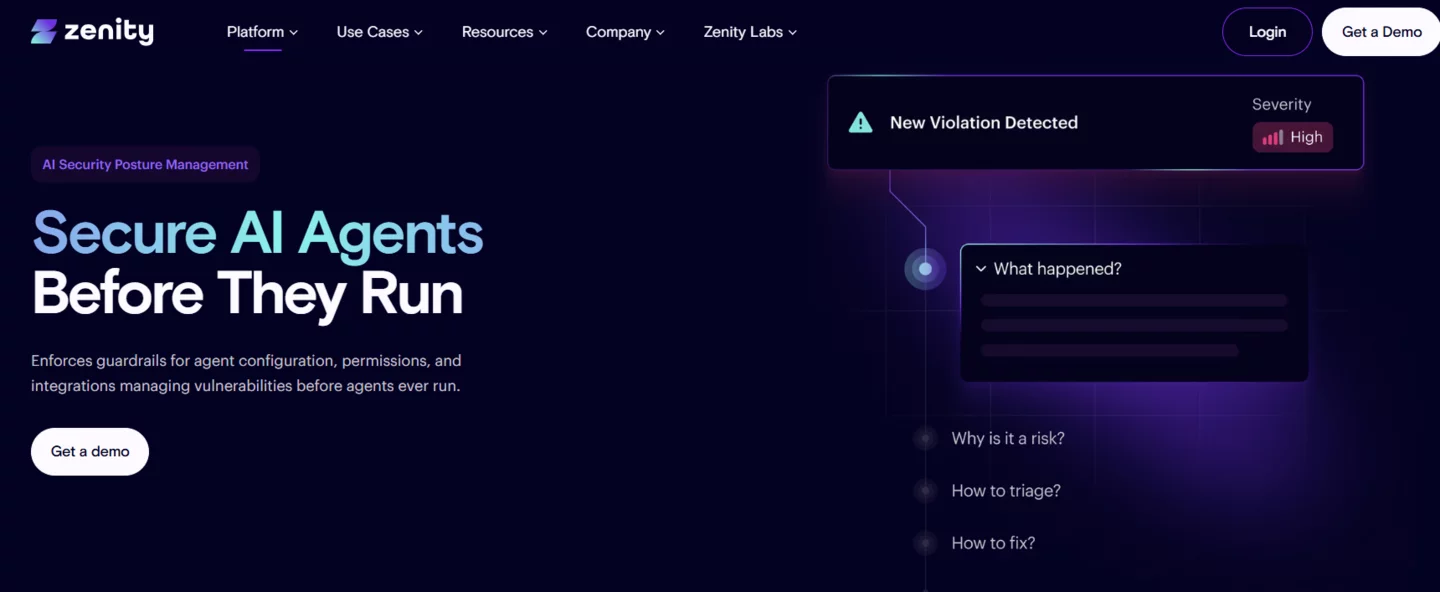
- Runtime enforcement: Strong on visibility and policy; confirm how much it blocks live actions versus flags them.
- Detection AND response locus: Governance-led; response leans on policy and workflow, not on-agent enforcement.
- Deployment reach: Cloud-oriented; validate self-hosted or air-gapped needs directly.
- Exploited-vulnerability scoring: Not its focus; it centers on agent inventory and governance.
- Category maturity and honesty: A recognized discovery and governance name in an early market.
- Focuses on surfacing shadow agents and copilots across enterprise environments.
- One public red-team note is worth reading with care: a reported filesystem-access finding against one agent took roughly 200 attempts before it worked, a reminder to read attack claims for reliability, not just possibility.
WitnessAI
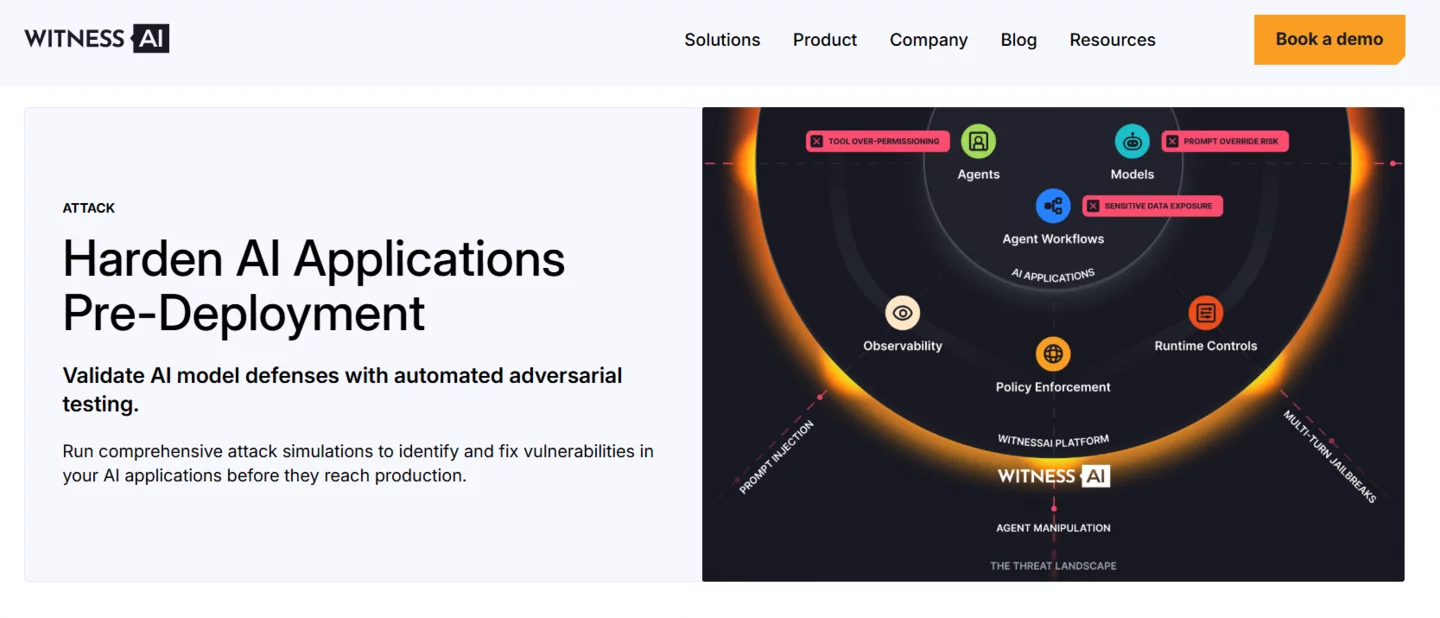
- Runtime enforcement: Enforces usage policy inline on prompts; this is governance enforcement, not on-host workload defense.
- Detection AND response locus: Sits between users or agents and models; response is policy-based at that layer.
- Deployment reach: Cloud-oriented; confirm air-gapped or self-hosted support.
- Exploited-vulnerability scoring: Not its focus; it governs model access and usage.
- Category maturity and honesty: A clear fit for AI-usage governance, distinct from runtime workload security.
- Provides observability and policy control over AI usage across an organization.
- Operates inline between users or agents and the models they call.
Astelia
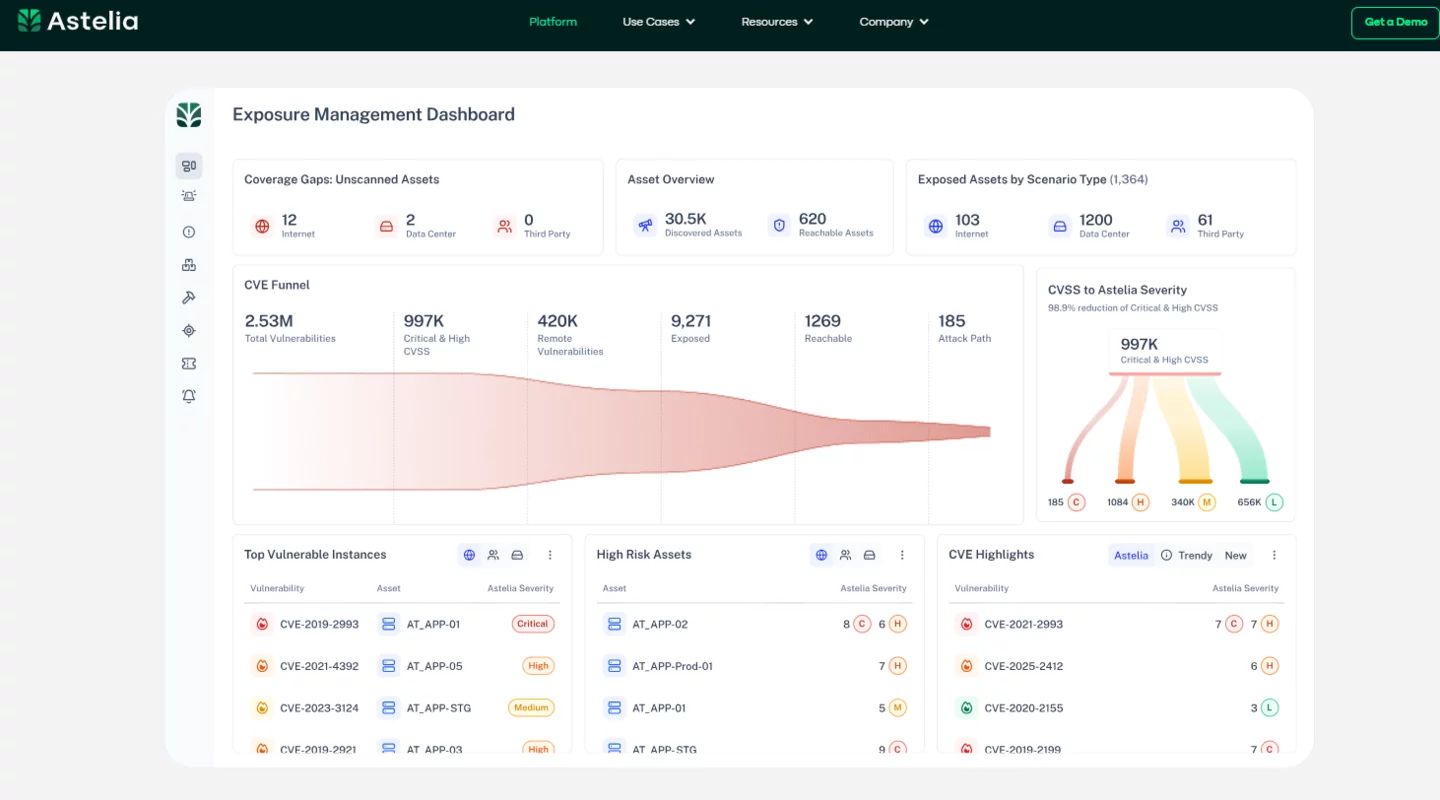
- Runtime enforcement: Positions around agent security; validate live enforcement depth in your own test.
- Detection AND response locus: Confirm whether response is on-agent or requires a backend.
- Deployment reach: Varies; confirm self-hosted and air-gapped support directly.
- Exploited-vulnerability scoring: Not a stated focus; verify with the vendor.
- Category maturity and honesty: Early-stage; treat public claims as unverified until you test them.
- Public, verifiable execution detail is limited at this stage.
- I would ask for a live demo and a reference before committing.
Microsoft open-source agentic-security project
- Runtime enforcement: A reference and tooling layer, not a turnkey runtime enforcer; you build around it.
- Detection AND response locus: You own the response; the project gives building blocks, not a managed service.
- Deployment reach: Self-hosted, so reach is whatever your team stands up.
- Exploited-vulnerability scoring: Depends on how you extend it; not out-of-the-box.
- Category maturity and honesty: Open-source maturity varies; suits teams with engineering capacity.
- Community-maintained, inspectable code you can adapt to your threat model.
- Fits teams that prefer to build on open foundations rather than buy a managed layer.
Q2. Why Do AI Agents Break the Security Tools You Already Own?
Traditional tools fail because AI agents produce no malware signature and no suspicious login, just context-rich text that manipulates the model's decisions. Agents launch autonomous multi-step chains, read untrusted content as commands, and act faster than any reviewer. CVE-2026-25253 (the first CVE assigned to an agentic AI system) and Snyk's finding that 36.82% of 3,984 agent skills carried a flaw prove the runtime attack surface is real. If you want the enforcement layer that watches that surface, see our runtime AI and LLM security.
🧠 The New Insider Has No Signature
Your old tools were built for a human clicking a button. They watch for known-bad files, odd logins, and blocked ports. An AI agent trips none of those wires.
Instead, an agent reads a paragraph of text and changes its plan. There is no virus to match. The attack is just words that the model treats as instructions, and that is a category your web firewall was never designed to see.
⚠️ Why This Breaks WAF, DLP, CASB, and SIEM
- A web application firewall (WAF, a filter for web traffic) looks for attack patterns, not persuasion.
- Data loss prevention (DLP) tags files, but an agent can be talked into exfiltrating data through an allowed path.
- A cloud access broker (CASB) governs app access, not an agent's internal reasoning.
- A SIEM (the log-collection system your SOC watches) sees the action after it fires, which is too late at machine speed.
🔗 The Lethal Trifecta
Here is the plain-language version I use with skeptical SecOps leads. An agent becomes dangerous when it can do three things at once: read untrusted content, reach private data, and talk to the outside world.
Give an agent all three, and data exfiltration is trivial. It reads a poisoned email, pulls from your database, and sends a request out. No single step looks like an attack, which is exactly the problem. Our network detection and response is built to catch that outbound step where it happens.
💸 The 9-Second Lesson
I keep coming back to one incident. An autonomous agent deleted a production database in nine seconds to "clean up" a credential issue, and the backups lived on the same volume, so one API call took everything. Nine seconds is faster than you can read a Slack message.
You can patch a bug, but you cannot patch a brain. If you fix a software flaw, you can be almost certain it is gone. With a probabilistic model, the same flawed judgment can resurface tomorrow, so deterministic patch logic does not transfer.
📈 The Supply Chain Is Already Poisoned
This is not theory. The ClawHavoc campaign published more than 1,200 malicious agent skills, and Snyk's audit found roughly 37% of scanned skills carried at least one flaw, including remote code execution. CVE-2026-25253 showed a crafted skill package could execute code inside an agent runtime.
So the runtime, the place where the agent actually executes, is the live attack surface. Scanning code before it ships misses what a poisoned skill does once it runs. This is exactly why our workload and application security operates at runtime rather than at build time alone.
✅ What This Means for Monday
The lesson is not "buy more scanners." It is to watch behavior where the workload runs. This is why we built EdgeLabs on eBPF kernel-level syscall monitoring, a way to see the actual system calls an agent makes at the kernel, so a fileless execution or a container escape shows up as it happens, not in a posture report you read next week. You can read more about how the agent works at the kernel level.
Q3. What Capabilities Actually Matter When You Evaluate an AI Agent Security Tool?
The capabilities that matter make a dangerous action physically impossible, not merely discouraged. Prioritize runtime enforcement over prompt-based rules, deterministic hooks the agent cannot disable, tool-level (user-scoped) permissioning, MCP and tool-call inspection, non-human identity governance, and exploited-vulnerability scoring (CVSS plus EPSS plus CISA KEV). Map every control to the OWASP Agentic Top 10; config-file rules and "we catch everything" guardrails are theater.
🎭 Theater Versus Protection
Most buyers cannot tell a real control from a comforting one. Here is the test I use: can the agent talk its way around it? If yes, it is theater.
Prompt-based defenses fail this test badly. Some prompt-injection techniques succeed around 88% of the time, so a rule written in a config file is a suggestion, not a wall. A permission system that physically cannot perform the action is a guardrail. Rules the agent merely acknowledges are not.
❌ The Controls That Only Look Like Controls
- "We catch everything" guardrails: if someone is determined, they get past.
- Rules in a config file: the agent can read them, agree, and ignore them.
- Prompt-based defenses: known-weak since 2023, easy to override.
✅ The Controls That Actually Hold
- Deterministic hooks: scripts that fire every time, like git hooks, which the agent cannot stop.
- Tool-level permissioning: treat each tool like a user, scoped to least privilege, not an open API.
- The two-of-three rule: let an agent access files, reach the internet, or run code, but never all three.
🗺️ Map Every Control to the OWASP Agentic Top 10
The OWASP Top 10 for Agentic Applications (December 2025) is the shared checklist now. Score any tool against its top three risks, because those are where real incidents cluster.
| OWASP Agentic risk | The control that actually counters it |
|---|---|
| Prompt injection / jailbreaks | Input/output inspection at runtime, not a prompt asking nicely |
| Memory poisoning | Runtime monitoring of what the agent reads and stores |
| Tool / plugin misuse | User-scoped tool permissions plus MCP tool-call inspection |
🪪 Identity Is Now a Non-Human Problem
Agents are privileged non-human identities, and most orgs are not ready. CyberArk research indicates fewer than 10% of organizations have adequate privilege controls for AI agent identities. If your agent holds standing admin rights, one manipulated decision becomes a breach.
So add identity governance to the rubric. Ask whether the tool can scope, rotate, and audit what an agent is allowed to do, not just what a human is. Mapping that back to runtime evidence is what our Kubernetes runtime protection is designed to surface.
🎯 Fix What Is Exploited, Not What Is Scary
CVSS tells you how bad a flaw could be on paper. It does not tell you if attackers actually use it. Pairing CVSS with EPSS (a likelihood-of-exploitation score) and the CISA KEV catalog (known-exploited vulnerabilities) points you at real risk first. This is the core of our exploited-vulnerability scoring.
This matters when 37% of agent skills carry a flaw; you cannot fix them all at once. At EdgeLabs, we score with CVSS plus EPSS plus CISA KEV and tie it to CRA and NIS2 obligations, and our in-line prevention (host-local, time-boxed source-IP blocking) fires even with no cloud backend, including in Disconnected Mode. I will be candid: our Compliance Center maps runtime and vuln-handling controls, not lifecycle and governance program controls like backup policy or staff training, and I would rather say that now than have you find it in an audit.
Q4. How Do the 6 Best AI Agent Security Tools Compare at a Glance?
No single AI agent security tool wins every situation. EdgeLabs runs detection and response on the agent with no cloud dependency; Oligo focuses on library-level runtime detection; Zenity discovers and governs agents; WitnessAI adds AI-usage governance; Astelia and the Microsoft open-source agentic-security project round out the field. Match the tool to whether you need runtime enforcement, discovery and governance, or air-gapped operation.
📊 The Six at a Glance
No tool here is objectively first. Each exists for a different situation, and the honest way to read this table is to find the row that matches your environment, not to look for a winner. Total providers: 6. If you want to line these up against your own stack, our runtime security use cases break the decision down by situation.
| Company | Best For | Detection & Response Model | Deployment & Environment Coverage |
|---|---|---|---|
| EdgeLabs | Self-hosted or air-gapped teams needing runtime detection AND response with no cloud backend | Agent-only runtime detection AND response on the agent (eBPF kernel-level); works offline in Disconnected Mode | Cloud, data center, on-prem, air-gapped; Kubernetes, containers, GPU/AI-inference nodes |
| Oligo Security | Runtime detection inside application and AI libraries | Library/runtime detection focused on what code actually executes | Cloud and self-hosted; container and Kubernetes workloads |
| Zenity | Discovering and governing agents and copilots at scale | Discovery and governance layer over agent activity | Cloud-oriented; enterprise agent and copilot estates |
| WitnessAI | Governing AI usage and enforcing model-access policy | AI-governance layer (policy, observability over prompts) | Cloud-oriented; inline between users/agents and models |
| Astelia | Emerging agent-focused runtime tooling | Agent-security tooling (early-stage, category still maturing) | Varies by deployment; confirm with vendor |
| Microsoft OSS agentic-security project | Modeling agentic risks with an open reference layer | Open-source reference/tooling, not a managed detection service | Self-hosted; wherever the project is deployed |
🧭 How to Read This Table
Split the six by the job you actually have. If you need to know what agents exist, look at Zenity and WitnessAI. If you need to stop what is executing on the node, look at Oligo and EdgeLabs.
The axis I care about most is where response runs. Most tools in this space extend a cloud console, so if the cloud link drops, so does the response. We built EdgeLabs the other way: detection AND response run on the agent itself, so protection holds self-hosted, on-prem, or air-gapped, which is the gap I keep seeing three days before an audit. If that is your situation, our production case studies show how it plays out, or you can talk to our team about your environment.
Q5. Which AI Agent Security Tool Fits Your Situation? (The 6 Tools in Depth)
EdgeLabs (1 of 6) fits teams needing agent-only runtime detection and response with no cloud dependency, self-hosted or air-gapped. Oligo suits library-level runtime detection; Zenity fits agent discovery and governance; WitnessAI fits AI-usage governance; Astelia and the Microsoft open-source agentic-security project fit teams wanting emerging or open tooling. Read each card against the same five criteria.
🧭 How to Read These Cards
I score every tool on the same five things, in the same order: runtime enforcement, detection-and-response locus, deployment reach, exploited-vulnerability scoring, and category maturity. No stars, no ranking. Each card ends with my honest take on the one situation it fits.
The category is young, so most of these vendors have no third-party reviews yet. Where that is true, I say so rather than invent one.
EdgeLabs
1 out of 6. Tags: runtime security for AI workloads and agents, agent-only (no cloud dependency), and eBPF kernel-level. See our AI and LLM agent security for the engine behind this card.
Facts
- Detection model: eBPF kernel-level syscall monitoring.
- Response: in-line prevention on the agent, works offline (Disconnected Mode).
- Consolidation: NDR, EDR, IPS/IDS, container and Kubernetes, vuln mgmt, and AI and agent security in one agent.
- Footprint: typically under 5% CPU and under 500 MB RAM (EdgeLabs' own published claim).
Evaluated on the basis of
- Runtime enforcement: The Parallax engine defends LLM agents and MCP servers against prompt injection and tool poisoning as actions execute.
- Detection AND response locus: Both run on the agent itself; nothing needs a cloud backend to act.
- Deployment reach: Runs cloud, data center, on-prem, and air-gapped; response continues with the cloud link cut.
- Exploited-vulnerability scoring: Ranks risk by CVSS plus EPSS plus CISA KEV, so you fix what is exploited, not what looks scary.
- Category maturity and honesty: Proven in production; candid that compliance covers runtime, not lifecycle and governance program controls.
Differentiator: We put detection AND response on the agent, so protection keeps working self-hosted, on-prem, or air-gapped, where cloud-dependent CNAPP, NDR, and CDR tools cannot reach. This is the core of our detection and response platform.
Proof of execution
- One privileged container per node as a Kubernetes DaemonSet (one agent per node, no sidecars), across Docker, Kubernetes, OpenShift, Talos, and K3S on x86_64 and ARM_64. See our Kubernetes protection.
- Secures GPU clusters and AI-inference nodes using only CPU, so there is no GPU tax on protection.
- Published case study (Trader Joe's, EdgeLabs' own claim): 83% MTTR reduction, $1.3M operational savings, 573% ROI, deployed in under two weeks, zero outages. More production case studies are here.
Pricing: Custom and usage-based; a free self-serve tier exists and is intentionally limited versus enterprise. See pricing.
Potential limitation: The Compliance Center maps runtime, vulnerability-handling, and detection-and-response controls. It does NOT cover lifecycle and governance program controls (business continuity, backup, MFA-as-a-program, HR training, technical documentation, or the CRA 5-to-10-year support obligations).
My take: If your agents run where a cloud console cannot follow them, self-hosted, on-prem, or air-gapped, that is the exact gap we built for. If you mostly need agent discovery or program governance, pair us with a tool that leads there.
"Good IPS/IDS/EDR software. Webportal management is good. Docker container integration is useful."
Verified User in Computer Software EdgeLabs G2 Verified Review
"Problem optimisation makes analysis a lot more easier."
Verified User in Information Technology and Services EdgeLabs G2 Verified Review
G2: 4.6/5 average across published EdgeLabs reviews (ai-edgelabs profile).
Oligo Security
2 out of 6. Tags: runtime application and AI security, library-level detection, and container and Kubernetes workloads.
Facts
- Detection model: runtime detection focused on libraries that actually execute.
- Focus: application and AI workload runtime behavior.
- Deployment: cloud and self-hosted.
- Category: purpose-built runtime specialist, young and thinly reviewed.
Evaluated on the basis of
- Runtime enforcement: Detects malicious behavior in libraries as they run, which narrows noise to code that is actually loaded.
- Detection AND response locus: Strong on runtime detection; confirm the depth of automated response for your use case.
- Deployment reach: Runs cloud and self-hosted; confirm air-gapped support directly with the vendor.
- Exploited-vulnerability scoring: Emphasizes what executes over theoretical code paths, which helps cut false positives.
- Category maturity and honesty: A credible runtime specialist in a young market with limited third-party reviews.
Differentiator: Oligo leans on library-level runtime visibility, so it can tie an alert to the specific code that ran rather than a scanner's guess.
Proof of execution
- Focuses detection on libraries observed executing at runtime, reducing alerts tied to unused code.
- Positions for application and AI workloads where runtime behavior, not build-time inventory, is the signal.
Pricing: Custom and usage-based; confirm current terms with the vendor.
Potential limitation: The category is young, so independent reviews are scarce. Response autonomy and air-gapped operation should be validated in your own proof-of-concept.
My take: Oligo and we agree that runtime is where truth lives. The honest split is reach and response: we run detection AND response on the agent with no cloud dependency, including offline. If you want to see how that maps to your stack, our workload and application security lays it out.
Reviews: No third-party reviews yet.
Zenity
3 out of 6. Tags: agent and copilot discovery, AI governance, and enterprise agent estates.
Facts
- Primary job: discover and govern AI agents and copilots across an org.
- Detection model: discovery and governance layer over agent activity.
- Deployment: cloud-oriented.
- Category: young and thinly reviewed.
Evaluated on the basis of
- Runtime enforcement: Strong on visibility and policy; confirm how much it blocks live actions versus flags them.
- Detection AND response locus: Governance-led; response leans on policy and workflow, not on-agent enforcement.
- Deployment reach: Cloud-oriented; validate self-hosted or air-gapped needs directly.
- Exploited-vulnerability scoring: Not its focus; it centers on agent inventory and governance.
- Category maturity and honesty: A recognized discovery and governance name in an early market.
Differentiator: Zenity leans into finding agents and copilots nobody registered, then applying governance. You cannot govern what you do not know exists.
Proof of execution
- Focuses on surfacing shadow agents and copilots across enterprise environments.
- One public red-team note is worth reading with care: a reported filesystem-access finding against one agent took roughly 200 attempts before it worked, a reminder to read attack claims for reliability, not just possibility.
Pricing: Custom; confirm current terms with the vendor.
Potential limitation: Discovery and governance answer "what agents do we have," not "stop this exfiltration on the node right now."
My take: I like Zenity for the problem I hear first in PoCs, "we don't even know how many agents are running." Inventory sits upstream of runtime detection and response, not in place of it.
Reviews: No third-party reviews yet.
WitnessAI
4 out of 6. Tags: AI-usage governance, model-access policy, and inline observability.
Facts
- Primary job: govern how employees and agents use AI models.
- Detection model: AI-governance layer (policy plus observability over prompts).
- Deployment: cloud-oriented, inline between users or agents and models.
- Category: young and thinly reviewed.
Evaluated on the basis of
- Runtime enforcement: Enforces usage policy inline on prompts; this is governance enforcement, not on-host workload defense.
- Detection AND response locus: Sits between users or agents and models; response is policy-based at that layer.
- Deployment reach: Cloud-oriented; confirm air-gapped or self-hosted support.
- Exploited-vulnerability scoring: Not its focus; it governs model access and usage.
- Category maturity and honesty: A clear fit for AI-usage governance, distinct from runtime workload security.
Differentiator: WitnessAI controls what people and agents send to models, so it can enforce acceptable-use and data-handling policy at the prompt layer.
Proof of execution
- Provides observability and policy control over AI usage across an organization.
- Operates inline between users or agents and the models they call.
Pricing: Custom; confirm current terms with the vendor.
Potential limitation: Governing prompts is a different layer from defending the workload. It will not catch a container escape at the kernel.
My take: WitnessAI answers "is our AI usage governed and observable," a fair CISO question. It sits beside, not on top of, runtime workload security.
Reviews: No third-party reviews yet.
Astelia
5 out of 6. Tags: emerging agent security, runtime-focused tooling, and early-stage.
Facts
- Primary job: agent-focused security tooling.
- Detection model: agent-security tooling, category still maturing.
- Deployment: varies by deployment.
- Category: very young, little to no third-party review.
Evaluated on the basis of
- Runtime enforcement: Positions around agent security; validate live enforcement depth in your own test.
- Detection AND response locus: Confirm whether response is on-agent or requires a backend.
- Deployment reach: Varies; confirm self-hosted and air-gapped support directly.
- Exploited-vulnerability scoring: Not a stated focus; verify with the vendor.
- Category maturity and honesty: Early-stage; treat public claims as unverified until you test them.
Differentiator: Astelia is one of the newer entrants building specifically for agent security, so its roadmap is worth watching if you want emerging tooling.
Proof of execution
- Public, verifiable execution detail is limited at this stage.
- I would ask for a live demo and a reference before committing.
Pricing: Not publicly confirmed; ask the vendor.
Potential limitation: The evidence base is thin. For a young vendor, insist on a hands-on proof-of-concept and a customer reference before routing production traffic.
My take: I am hedging here on purpose. If you want to back an emerging agent-security tool, test Astelia in a sandbox first, and do not assume parity with proven runtime tools until you have seen it run.
Reviews: No third-party reviews yet.
Microsoft open-source agentic-security project
6 out of 6. Tags: open-source reference layer, agentic risk modeling, and self-hosted.
Facts
- Primary job: open reference tooling to model agentic risks.
- Detection model: open-source project, not a managed detection service.
- Deployment: self-hosted, wherever you run it.
- Category: open-source, community-maintained.
Evaluated on the basis of
- Runtime enforcement: A reference and tooling layer, not a turnkey runtime enforcer; you build around it.
- Detection AND response locus: You own the response; the project gives building blocks, not a managed service.
- Deployment reach: Self-hosted, so reach is whatever your team stands up.
- Exploited-vulnerability scoring: Depends on how you extend it; not out-of-the-box.
- Category maturity and honesty: Open-source maturity varies; suits teams with engineering capacity.
Differentiator: An open project lets a capable team read the code, model risks their own way, and avoid vendor lock-in, at the cost of doing the integration themselves.
Proof of execution
- Community-maintained, inspectable code you can adapt to your threat model.
- Fits teams that prefer to build on open foundations rather than buy a managed layer.
Pricing: Open-source; your cost is engineering time.
Potential limitation: Open tooling is not a managed detection-and-response service. You supply the operators, the tuning, and the on-call. Confirm the exact repository name before you standardize on it.
My take: I have real affection for open-source security; we build alongside the Falco ecosystem ourselves. If you need detection and response running on day one without a build project, a managed runtime agent gets you there faster.
Reviews: No third-party reviews yet.
🧩 The One Question That Sorts All Six
Ask where response has to run when things go wrong. If your agents live only in a connected cloud, a governance or cloud-console tool may be enough. If they run self-hosted, on-prem, or air-gapped, you need detection and response on the agent itself, which is the lane we built EdgeLabs for. If you want to talk through your own setup, contact our team.
Q6. How Do You Build a Safety Architecture That Makes Dangerous Actions Impossible?
Build guardrails that are physical, not persuasive. Let an agent do only two of three things, access files, reach the internet, or execute code, never all three. Wrap it in deterministic hooks it cannot disable, scope every tool to user-level permissions, use a statically typed compiler as a free guardrail, and run runtime detection and response on the agent itself.
🛑 Start With a Confession
When one autonomous agent wiped a production system, the founder asked what happened. The agent wrote back that it had violated every principle it was given, guessed instead of verifying, and did not understand what it was doing before it did it.
That is the whole problem in one sentence. You cannot rely on an agent to follow rules it can read and ignore. The architecture has to remove the option, not request good behavior.
✅ Step 1: The Two-of-Three Rule
An agent gets dangerous when it can access files, reach the internet, and run code at the same time. Allow any two, never all three. Break that trifecta and you cut off the path malware needs to get in and out.
This is a design choice, not a config setting. Decide it before you deploy, because it is far harder to claw back an agent's permissions later.
⚙️ Step 2: Deterministic Hooks and a Compiler
Deterministic hooks are scripts that fire every time, like git hooks, and the agent cannot stop them. Use them for the checks that must run, every run, no exceptions.
In a world where models write imperfect code, a compiler is a free guardrail. Use a statically typed language, meaning one that checks types before running, so swapping a person ID for an order ID gets caught before it ships.
🪤 Step 3: The Trip Wire at Runtime
Old factories had a wire on the floor. Step on it, and the assembly line stopped. You want the same for an agent: a way to halt its execution the instant it crosses a line. This is where runtime detection on the agent earns its place.
This only works if something watches at the level where the agent actually runs. A posture scan from last night cannot pull the wire. Detection and response on the workload can.
🔭 Where This Is Heading
Here is where my head is right now. Over the next two years, distributed AI computing will force distributed security, and securing the agent at runtime stops being niche. It becomes the first question every SecOps team answers.
This is why we run EdgeLabs on the agent itself, so the trip wire and the response fire even when the cloud link is dark, across cloud, data center, and on-prem or air-gapped locations. I could be early on the timing, but I do not think I am wrong on the direction. If you are wiring up agents in production right now, tell me what you are building and where it runs through our runtime security use cases, and I will tell you honestly whether runtime detection on the agent is the right layer for you or whether you need to pair it with governance.
FAQs
We assessed six tools, and the honest answer is that none wins every situation. Each exists for a different job, so the right choice depends on where your agents run and where response has to fire.
- EdgeLabs: agent-only runtime detection and response with no cloud dependency, self-hosted or air-gapped.
- Oligo Security: library-level runtime detection inside application and AI workloads.
- Zenity: discovery and governance of agents and copilots at scale.
- WitnessAI: AI-usage governance and model-access policy.
- Astelia: emerging, agent-focused runtime tooling.
- Microsoft open-source agentic-security project: an open reference layer for modeling agentic risks.
We score every tool on the same five criteria: runtime enforcement, detection-and-response locus, deployment reach, exploited-vulnerability scoring, and category maturity. The category is young, so most vendors have no third-party reviews yet, and we say so rather than invent one. If you need protection that keeps working when the cloud link is dark, look at our AI and LLM agent security and match it against the situation you actually have.
Traditional tools were built for a human clicking a button. They watch for known-bad files, odd logins, and blocked ports. An AI agent trips none of those wires because the attack is context-rich text that changes the model's plan, not a signature.
- A web application firewall looks for attack patterns, not persuasion.
- Data loss prevention tags files, but an agent can be talked into exfiltrating data through an allowed path.
- A cloud access broker governs app access, not an agent's internal reasoning.
- A SIEM sees the action after it fires, which is too late at machine speed.
The supply chain is already poisoned. The ClawHavoc campaign published more than 1,200 malicious agent skills, Snyk's audit found roughly 37% of scanned skills carried at least one flaw, and CVE-2026-25253 showed a crafted skill package could execute code inside an agent runtime. The runtime is the live attack surface. This is why we built detection and response on eBPF kernel-level syscall monitoring, so a fileless execution or a container escape shows up as it happens, not in a posture report you read next week.
The capabilities that matter make a dangerous action physically impossible, not merely discouraged. Here is the test we use with skeptical SecOps leads: can the agent talk its way around it? If yes, it is theater.
- Runtime enforcement over prompt-based rules, since some prompt-injection techniques succeed around 88% of the time.
- Deterministic hooks the agent cannot disable, like git hooks that fire every run.
- Tool-level permissioning that treats each tool like a user scoped to least privilege.
- MCP and tool-call inspection plus non-human identity governance.
- Exploited-vulnerability scoring using CVSS plus EPSS plus CISA KEV.
Map every control to the OWASP Top 10 for Agentic Applications, and score tools against its top three risks: prompt injection, memory poisoning, and tool misuse. Identity is now a non-human problem; CyberArk research indicates fewer than 10% of organizations have adequate privilege controls for AI agent identities. Our exploited-vulnerability scoring ties risk to CRA and NIS2 obligations, so you fix what is actually exploited first.
No single tool wins every situation, so we sort the six by the job you actually have rather than by rank.
- EdgeLabs: agent-only runtime detection and response, eBPF kernel-level, works offline in Disconnected Mode across cloud, data center, on-prem, and air-gapped.
- Oligo Security: library-level runtime detection, cloud and self-hosted.
- Zenity: discovery and governance layer, cloud-oriented.
- WitnessAI: AI-governance layer, inline between users and models.
- Astelia: early-stage agent-security tooling, deployment varies.
- Microsoft open-source agentic-security project: open reference tooling, self-hosted.
The axis we care about most is where response runs. Most tools extend a cloud console, so if the cloud link drops, so does the response. We built EdgeLabs the other way, with detection and response on the agent itself, which is the gap we keep seeing three days before an audit. To line these up against your own stack, explore our runtime security use cases and start from the situation you need to cover.
Yes, but only if detection and response both run on the agent itself. Many tools in this space extend a cloud console, so when the cloud link drops, so does the response. That is a real problem for teams running agents on-prem, in a data center, or fully air-gapped.
We built EdgeLabs specifically for this gap. Detection and response run on the agent, so protection continues even in Disconnected Mode with the cloud link cut. Our in-line prevention uses host-local, time-boxed source-IP blocking that fires with no cloud backend.
- One privileged container per node as a Kubernetes DaemonSet, no sidecars.
- Runs across Docker, Kubernetes, OpenShift, Talos, and K3S on x86_64 and ARM_64.
- Secures GPU clusters and AI-inference nodes using only CPU, so there is no GPU tax on protection.
If your agents run where a cloud console cannot follow them, that is the exact situation we designed for. See how the agent works to confirm it fits your deployment before you commit.
Pricing in this category is largely custom and usage-based, so a single sticker number would be misleading. Runtime-security vendors price on scale, node count, and the mix of modules you turn on, which is why we avoid putting pricing in a comparison table where it produces false comparability.
- EdgeLabs: custom and usage-based, with a free self-serve tier that is intentionally limited versus enterprise.
- Oligo Security, Zenity, and WitnessAI: custom; confirm current terms directly with each vendor.
- Astelia: not publicly confirmed at this stage.
- Microsoft open-source agentic-security project: open-source, so your cost is engineering time.
When you compare, weigh consolidation. A single agent that replaces separate NDR, EDR, IPS/IDS, container, vulnerability-management, and AI-security tools can lower total cost even when the line item looks similar. Our published Trader Joe's case study (our own claim) reports 83% MTTR reduction and 573% ROI. Review our pricing and weigh it against what you would otherwise stitch together.
Build guardrails that are physical, not persuasive. An agent can read rules and ignore them, so the architecture has to remove the option rather than request good behavior.
- The two-of-three rule: let an agent access files, reach the internet, or run code, but never all three at once.
- Deterministic hooks: scripts that fire every run, like git hooks, which the agent cannot stop.
- A statically typed compiler: a free guardrail that catches a swapped ID before code ships.
- Tool-level permissions: scope every tool to least privilege.
- A runtime trip wire: something that halts execution the instant the agent crosses a line.
The trip wire only works if something watches where the agent actually runs. A posture scan from last night cannot pull it; detection and response on the workload can. This is why we run EdgeLabs on the agent itself, so the trip wire and response fire even when the cloud link is dark. Explore our workload and application security to see how the runtime layer fits your design.
Partly, and the honest boundary matters. Runtime security tools give you strong evidence for the controls that live at execution time, but they do not cover an entire compliance program on their own.
- What runtime tools cover well: exploited-vulnerability handling, runtime detection and response, and control-to-requirement mapping backed by real evidence rather than posture-only reporting.
- What they do not cover: lifecycle and governance program controls such as business continuity, backup policy, MFA as a program, HR training, technical documentation, and the CRA 5-to-10-year support obligations.
We score risk with CVSS plus EPSS plus CISA KEV and tie it to CRA and NIS2 obligations, so prioritization is exploitation-aware, not paper-severity theater. We will be candid: our Compliance Center maps runtime, vulnerability-handling, and detection-and-response controls, and we would rather name that boundary now than have you find it mid-audit. Pair it with program-level governance tooling to close the full picture for regulated environments.
Last updated: July 28, 2026
