TL;DR
- Twelve tools split across two layers: a GRC evidence layer that packages audit proof, and a runtime evidence layer that proves what actually executed on the host.
- Gartner's mandatory feature list for this market never included runtime detection, which is why most teams end up owning two tools rather than one.
- Green pipelines fail audits for two reasons: scanners that exit code zero with findings present, and agents installed in monitor mode with no enforcing policy attached.
- CRA reporting obligations begin 11 September 2026 with a 24-hour early warning, so KEV membership and EPSS percentile belong at step one of triage, not step four.
- Cloud-polling tools go silent when a link drops, and absence in an evidence record is indistinguishable from a missed attack, so ask about offline detection and timestamping.
- LLM agents, MCP servers, and GPU inference nodes are compliance assets now, yet most control inventories still have no row for them.
Q1. 12 Best Continuous Compliance Monitoring Tools for SOC 2, ISO 27001 and CRA
Twelve tools, each built for a different situation. EdgeLabs produces runtime control evidence mapped to CRA and NIS2 with no cloud backend. Drata automates SOC 2 and ISO 27001 evidence workflow. Heimdal generates NIS2 reporting inside an XDR. SonarQube Advanced Security enforces CRA release gates. ThreatLocker proves default-deny enforcement. Chainguard ships near-zero-CVE images. Commvault holds immutable recovery evidence.
1.1 Why This Choice Is High-Stakes
Compliance tooling is bought once and lived with for years, so the wrong pick costs more than money. Attacks execute at runtime, not at scan time, and a green dashboard proves intent rather than behaviour. Tools that need a vendor cloud go quiet inside self-hosted, on-prem, or air-gapped estates. Noisy findings bury the one exploited CVE an auditor will ask about. I evaluated twelve tools against five criteria: control-to-requirement mapping, evidence source, exploited-vulnerability scoring, deployment reach, and evidence portability. This guide is written for the compliance owner or SecOps lead carrying SOC 2, ISO 27001, and now CRA reporting obligations.
⚠️ The category boundary nobody draws
Gartner defines this market around automated compliance assessment, real-time reporting, and integration into DevOps toolchains. Runtime detection is not on that mandatory-feature list. That absence is why most teams end up owning two tools instead of one.
So I have split this list into two layers. The GRC-evidence layer collects, maps, and packages proof for auditors. The runtime-evidence layer proves what actually executed on the host.
1.2 Our Evaluation Criteria
Every profile below is assessed on the same five criteria, in the same order.
- Control-to-requirement-ID mapping. Does the tool tie a finding to a named clause, such as CRA Annex I or NIS2 Article 21, or does it stop at a generic control name?
- Evidence source. Does proof come from runtime execution, or from polling a cloud API and a ticket system? Posture describes intent. Runtime describes behaviour.
- Exploited-vulnerability and explainability scoring. Does the tool rank findings using CISA KEV and EPSS, or sort by CVSS alone? CISA publishes KEV as the authoritative record of vulnerabilities exploited in the wild, in CSV and JSON.
- Deployment reach. Does it keep working self-hosted, on-prem, or air-gapped? Or does a dropped cloud link create a hole in your evidence record?
- Evidence portability. Can findings leave the vendor in a machine-readable format such as OSCAL, the NIST-led initiative to automate security and compliance processes?
Pricing is deliberately not a criterion here. Runtime-security pricing is mostly custom and usage-based, so a price column produces false comparability, which is why our own deployment-based pricing is quoted rather than listed.
1.3 Who This Guide Is For
- Compliance owners mapping runtime evidence to CRA and NIS2 obligations before the 11 September 2026 reporting date.
- SecOps and DevSecOps leads at SMBs who carry the audit and the AI or GPU workloads at the same time.
- Kubernetes and container runtime-security owners moving from build-time scanning to runtime evidence.
- Teams whose environments are self-hosted, sovereign, or air-gapped, where cloud-polling tools simply cannot reach.
1.4 The 12 Tools at a Glance
Total providers: 12.
- EdgeLabs: Best for proving runtime control state for CRA and NIS2 when the cloud link cannot be relied on.
- Drata: Best for automating SOC 2 and ISO 27001 evidence collection across cloud accounts and HR systems.
- Heimdal: Best for generating on-demand NIS2 reports from telemetry an XDR is already collecting.
- SonarQube Advanced Security: Best for blocking a release that fails CRA-relevant code and dependency checks.
- ThreatLocker (DAC): Best for proving default-deny enforcement rather than monitor-only configuration.
- Microsoft Agent 365 and Purview: Best for inventorying and governing AI agents inside a Microsoft estate.
- Aqua Security (Trivy): Best for catching bad defaults and known CVEs in images before they ship.
- Wiz: Best for cloud-wide exposure analysis across accounts you did not know existed.
- Chainguard: Best for removing CVEs at the base-image layer instead of triaging them later.
- Commvault Air Gap Protect: Best for evidencing that recovery can come from an immutable, isolated copy.
- AgentSystems: Best for running third-party agents locally so sensitive data never leaves your infrastructure.
- SAMI by Codific: Best for small teams that need a structured path to a CRA-ready target posture.
📋 A note on what is not here
Vanta, Sprinto, and Secureframe are adjacent GRC-workflow options in this market. They are not profiled here, and I would rather say that plainly than pretend the list is exhaustive.
1.5 Master Comparison Table
| Company | Best For | Detection and Response Model | Deployment and Environment Coverage |
|---|---|---|---|
| EdgeLabs | Self-hosted or air-gapped estates needing runtime evidence for CRA and NIS2 | Agent-only runtime detection and response, executed on the agent | Cloud, data center, on-prem, air-gapped; Linux hosts, Kubernetes, containers, GPU inference nodes |
| Drata | SOC 2 and ISO 27001 audit programs run by a small compliance team | Agentless posture polling plus a device agent, cloud-required | SaaS only; read-only cloud integrations such as AWS IAM roles |
| Heimdal | NIS2 reporting where an XDR is already the telemetry source | XDR endpoint detection with on-demand compliance reporting | SaaS-managed endpoint agents across Windows-centric estates |
| SonarQube Advanced Security | Teams that must gate releases on code and dependency findings | Build-time analysis with quality gates on pull requests and releases | SonarQube Server (self-hosted) or SonarQube Cloud |
| ThreatLocker (DAC) | Proving allowlisting and configuration enforcement, not monitor mode | Endpoint agent with default-deny enforcement and daily configuration checks | SaaS-managed agents on Windows and macOS endpoints and servers |
| Microsoft Agent 365 and Purview | AI-agent inventory and data governance inside Microsoft 365 | Cloud control plane with governance and exposure graphing | Microsoft cloud tenant; cloud-required by design |
| Aqua Security (Trivy) | Catching CVEs and misconfigurations before images reach production | Scanner plus optional runtime enforcement; platform-oriented | Self-hosted or SaaS; Kubernetes, containers, CI pipelines |
| Wiz | Cloud-wide exposure and outlier analysis across many accounts | Agentless cloud scanning with an optional sensor, cloud-required | Multi-cloud; connects to cloud provider APIs |
| Chainguard | Reducing CVE count at the base-image layer | No detection; hardened image supply with provenance | Any container registry or Kubernetes platform |
| Commvault Air Gap Protect | Evidencing recoverability from an isolated, immutable copy | Backup and recovery, not detection | Cloud-managed isolated storage plus on-prem source estates |
| AgentSystems | Executing third-party AI agents without exporting data | Local agent runtime, not a security detection engine | Self-hosted, on-prem infrastructure |
| SAMI by Codific | Structuring a CRA-readiness programme with OWASP SAMM | Assessment framework, not runtime detection | SaaS assessment tooling |
✅ How to read the table
Column three is the one that decides your audit answer. A tool listed as cloud-required will stop producing evidence when the link drops. That is a gap in a report, not a minor inconvenience.
1 out of 12EdgeLabs
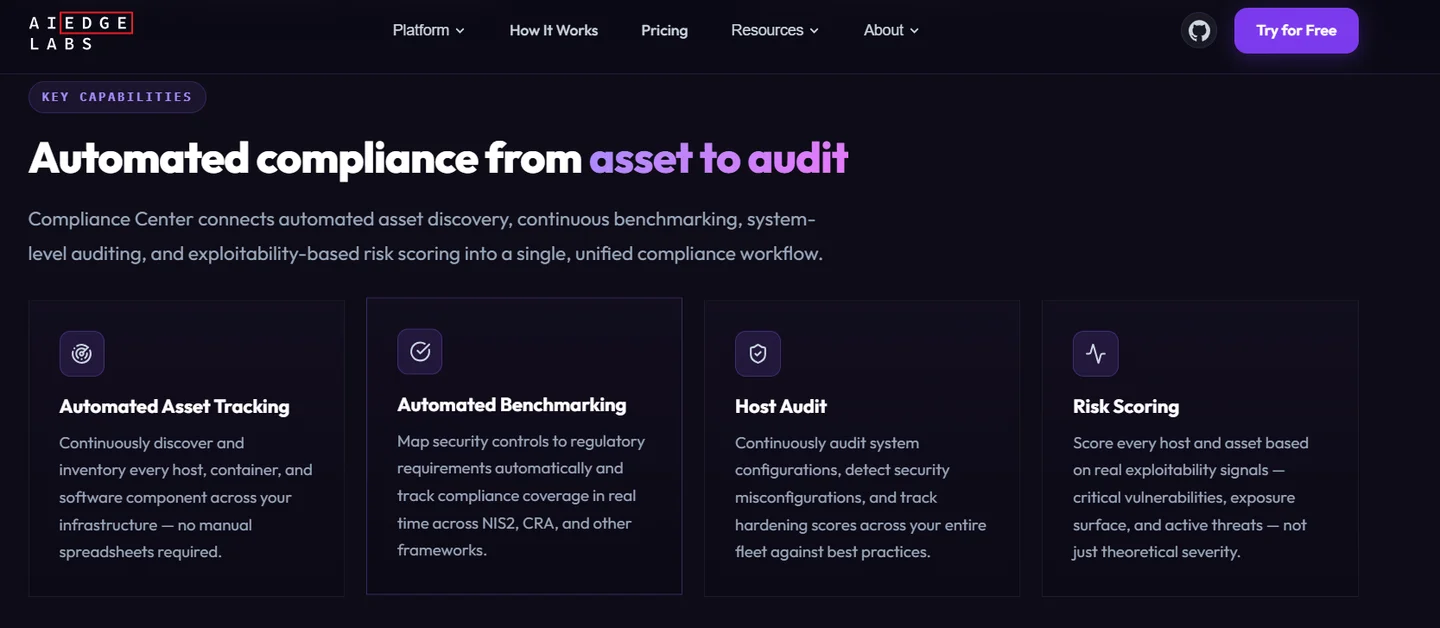
- Control-to-requirement-ID mapping: Maps controls to CRA Annex I Parts I and II and NIS2 Articles 21 to 23, with per-control host pass or fail counts.
- Evidence source: Runtime. Detection and response both execute on the agent, from observed syscalls rather than API polls.
- Exploited-vulnerability and explainability scoring: Shows CVSS, CWE, a risk score, CISA KEV status, and EPSS score with percentile per CVE.
- Deployment reach: Cloud, data center, on-prem, and air-gapped. Disconnected Mode keeps detection and IPS response running offline.
- Evidence portability: Exports via API and SIEM integration. OSCAL export is not among EdgeLabs' published capabilities.
- Trader Joe's published case study reports an 83% MTTR reduction, 573% ROI, and $1.3M operational savings across roughly 20,000 Linux POS endpoints (EdgeLabs' own published case-study figures, not independently verified).
- An anonymized US oil and gas operator sustained protection in offline mode in production during connectivity loss (EdgeLabs' published case study).
- Installs as a one-line script, Helm chart, OpenShift, or Talos; hosts appear in the portal within seconds and return a first vulnerability report inside an hour (EdgeLabs' installation guides).
"Good IPS/IDS/EDR software. Webportal management is good. Docker container integration is useful." Problems solved: "SOC2 compliance mainly."
Verified User in Computer Software, 4 out of 5 · EdgeLabs G2 Verified Review
2 out of 12"It's beneficial to secure any website or any server from hackers." On dislikes: "the commercial seems high."
Abhishek A., 4.5 out of 5 · EdgeLabs G2 Verified Review
Drata
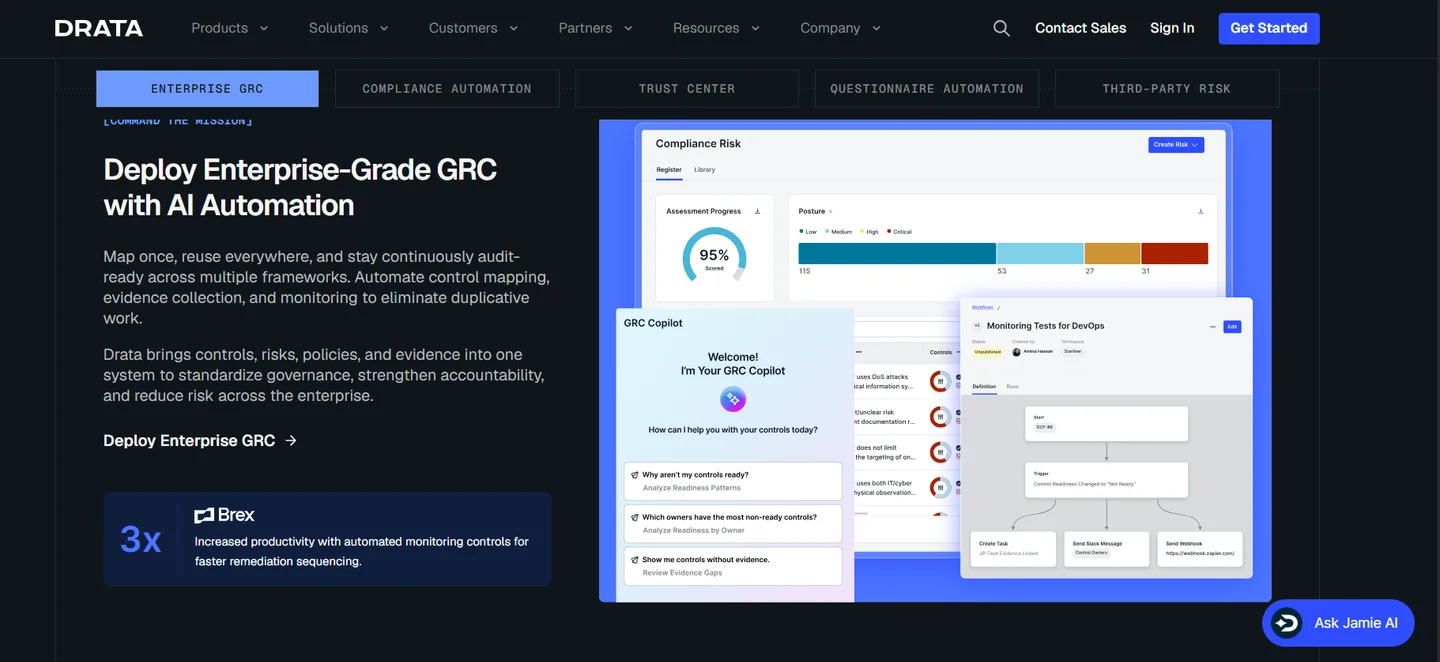
- Control-to-requirement-ID mapping: Strong. Controls map to framework requirements with evidence attached in a control detail view.
- Evidence source: Posture. Drata automates continuous monitoring and evidence collection through read-only cloud audits, not runtime syscalls.
- Exploited-vulnerability and explainability scoring: Not the product's job. Vulnerability data arrives from connected scanners.
- Deployment reach: Cloud-required. Integrations read AWS through an IAM role such as DrataAutopilotRole with SecurityAudit permissions.
- Evidence portability: Reports and evidence export from the platform; OSCAL is not a published capability.
- Documented AWS integration performs read-only audits and syncs identity data for user access reviews, driving specific numbered control tests.
- Adaptive Automation added deeper integrations and custom control tests for teams whose controls do not fit a template.
- Published support documentation shows continuous monitoring across compute, storage, and data environments.
⏰ What to do with this before Monday
Take your three most-failed controls and ask a simple question of each. Would the evidence still exist if your vendor's cloud went dark for a day? Then time a mock CRA early warning against the 24-hour clock that starts on 11 September 2026.
EdgeLabs holds position 1 out of 12 here for one reason: the title includes CRA, and it produces runtime control evidence and exploitation-aware prioritization from the agent itself, on cloud, data center, on-prem, and air-gapped hosts, including AI and LLM workloads. It maps controls to requirement IDs, and it will not write your business-continuity policy.
3 out of 12Heimdal
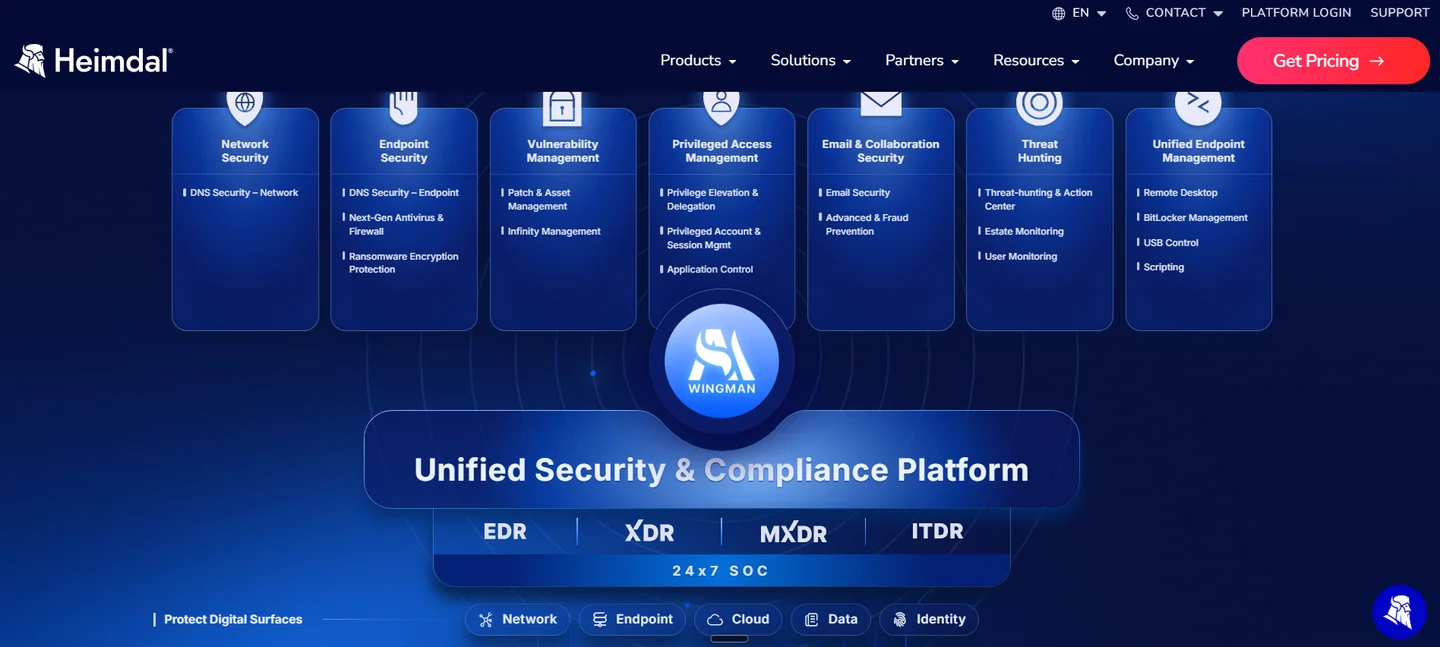
- Control-to-requirement-ID mapping: Report-level rather than clause-level. NIS2 reports are generated on demand from the Reports section.
- Evidence source: Endpoint telemetry the XDR already collects, so no separate connector layer is needed.
- Exploited-vulnerability and explainability scoring: Patch and vulnerability management is included, though scoring is not the focus.
- Deployment reach: Cloud-managed. Agents need the platform to report.
- Evidence portability: Standard report exports, not a machine-readable control format.
- Heimdal's own support documentation walks through generating an on-demand NIS2 compliance report from the Reports tab, Standard view.
- The XDR product sheet documents a unified agent covering patching, privilege management, and email security in one console.
SonarQube Advanced Security
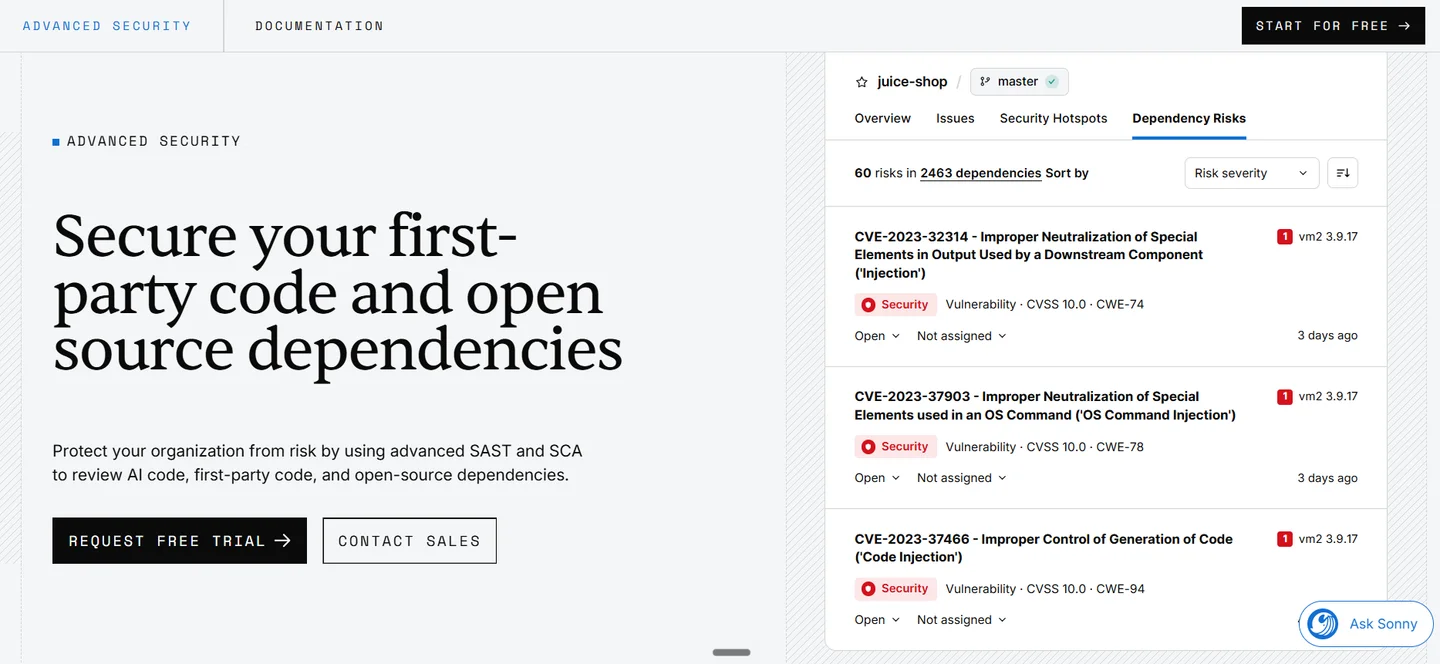
- Control-to-requirement-ID mapping: SonarSource publishes a documented Cyber Resilience Act capability mapping, which is unusually specific for this market.
- Evidence source: Build time. It proves the code and dependencies were checked, not what executed in production.
- Exploited-vulnerability and explainability scoring: Dependency findings with advisory context, not KEV-first ranking.
- Deployment reach: Self-hosted server option is genuinely useful for regulated teams.
- Evidence portability: Gate results and issue data export through APIs.
- SonarSource's public CRA capability mapping documentation instructs teams to use quality gates to enforce release and pull request controls.
- Advanced Security adds dependency and secrets analysis on top of the core code engine.
ThreatLocker (DAC)
- Control-to-requirement-ID mapping: Reports where configurations fall short of CIS Controls, FedRAMP, and CMMC.
- Evidence source: Endpoint configuration state plus enforcement, which is closer to real control state than a cloud API poll.
- Exploited-vulnerability and explainability scoring: Not the product's job. This is enforcement, not vulnerability ranking.
- Deployment reach: Cloud-managed agents on Windows and macOS.
- Evidence portability: Health Center reports and a downloadable sample report format.
- ThreatLocker's CEO and CPO demonstrated DAC running up to 170 checks per day per endpoint, including checks for monitor mode and default deny policy state, in a public product session.
- ThreatLocker cites 90% of successful ransomware attacks happening because security tools were not properly configured (ThreatLocker's own figure, presented at Black Hat 2025).
- DAC is offered free to existing customers and publishes a sample report.
Microsoft Agent 365 and Purview
- Control-to-requirement-ID mapping: Strong for data and privacy regulations inside Purview's compliance manager.
- Evidence source: Cloud control plane. It knows what agents exist and what data they touch.
- Exploited-vulnerability and explainability scoring: Out of scope.
- Deployment reach: Cloud-required by design. Nothing here works air-gapped.
- Evidence portability: Exports from the compliance manager, tenant-bound.
- Purview provides data governance and compliance management as a documented, generally available Microsoft service.
- Agent governance capabilities are published as part of Microsoft's agent management roadmap.
Aqua Security (Trivy)
- Control-to-requirement-ID mapping: Compliance packs cover common frameworks, with CIS benchmark reporting.
- Evidence source: Mostly build time, with runtime enforcement available in the commercial platform.
- Exploited-vulnerability and explainability scoring: Vulnerability data with severity and fix status.
- Deployment reach: Self-hosted deployment is supported, which many regulated teams need.
- Evidence portability: Trivy emits SBOMs and machine-readable scan output, which is genuinely useful for CRA evidence.
- Trivy is a widely adopted open source scanner with documented SBOM generation and Kubernetes manifest scanning.
- Aqua publishes compliance reporting packs mapped to standard benchmarks.
Wiz
- Control-to-requirement-ID mapping: Broad framework packs across standards and cloud benchmarks.
- Evidence source: Cloud posture. It reads the control plane rather than the kernel.
- Exploited-vulnerability and explainability scoring: Exposure context and attack path analysis are strong here.
- Deployment reach: Cloud-required. Self-hosted and air-gapped estates are outside its model.
- Evidence portability: API and integration exports.
- Agentless scanning and graph-based exposure analysis are documented core platform capabilities.
- Optional sensor extends detection where teams want runtime signal.
Chainguard
- Control-to-requirement-ID mapping: Indirect. It supports supply chain requirements rather than mapping clauses itself.
- Evidence source: Build time and provenance. Strong artifact evidence, no runtime signal.
- Exploited-vulnerability and explainability scoring: It removes CVEs instead of ranking them, which is a different and useful answer.
- Deployment reach: Works with any registry or Kubernetes platform.
- Evidence portability: SBOMs and signatures travel with the image.
- Chainguard's own documentation defines zero-CVE as no known CVEs at publish time, kept low by minimal design and continuous rebuilds.
- Images ship with low-to-zero known CVEs, SLSA provenance, signatures, and SBOMs, per the published marketplace listing.
Commvault Air Gap Protect
- Control-to-requirement-ID mapping: Supports backup and recovery controls that most frameworks require explicitly.
- Evidence source: Backup and restore records, not detection telemetry.
- Exploited-vulnerability and explainability scoring: Out of scope.
- Deployment reach: Cloud-managed target storage protecting on-prem and cloud source estates.
- Evidence portability: Job and retention reports for auditors.
- Commvault's own documentation describes Air Gap Protect as secure, air-gapped cloud storage for backups, with cyber resilience guidance.
- Third-party technical write-ups confirm the immutable, indelible, managed-service model.
AgentSystems
- Control-to-requirement-ID mapping: None. This is architecture, not compliance tooling.
- Evidence source: Execution logs from the local runtime.
- Exploited-vulnerability and explainability scoring: Out of scope.
- Deployment reach: Self-hosted and on-prem, which is the entire point.
- Evidence portability: Local logs you own outright.
- The project publishes an open runtime for executing third-party agents locally, with local data handling as its stated design goal.
SAMI by Codific
- Control-to-requirement-ID mapping: Maps practices to SAMM streams and toward CRA-relevant expectations.
- Evidence source: Self-assessment and programme records, not telemetry.
- Exploited-vulnerability and explainability scoring: Out of scope.
- Deployment reach: SaaS assessment tool.
- Evidence portability: Assessment exports and roadmaps.
- The tool is built on OWASP SAMM, an openly published maturity model maintained by OWASP.
⚠️ The pattern across cards 1.8 to 1.17
Read the limitation lines together and one shape appears. Nine of these ten tools produce evidence about intent, configuration, artifacts, or programme maturity.
Only two of them watch execution. That gap is where the CRA's 24-hour clock lands, because the trigger word in the regulation is "actively exploited". I could be reading my own bias into this, though the tool documentation keeps pointing the same way.
⏰ Pick two layers, not one
Most teams I talk to end up owning one GRC-evidence tool and one runtime-evidence tool. That is not a failure of shortlisting. It is what happens when the market's own mandatory-feature definition never included runtime detection.
EdgeLabs covers the runtime half of that pair, with detection and response both executing on the agent across cloud, data center, on-prem, and air-gapped hosts. Its Compliance Center maps controls to CRA and NIS2 requirement IDs, and separates theoretical CVEs from actively exploited ones. The other half of your pair, the policy and programme half, still has to come from this list.
Q2. What Is Continuous Compliance Monitoring, and How Does It Differ From Continuous Controls Monitoring?
Continuous compliance monitoring is the automated, ongoing testing of controls and collection of audit evidence, versus an annual sample. Continuous controls monitoring (CCM) focuses on whether each control is operating right now. Continuous compliance packages that state as framework proof. Gartner's market definition covers automated enforcement, assessment inside delivery workflows, and efficient generation of audit reports for audit consumers.
2.1 The Definition, and the CCM Distinction
An annual audit works by sampling. An auditor picks a few days out of 365 and checks whether your controls held on those days. Continuous monitoring flips that, testing controls on a schedule measured in hours.
The two terms below get used interchangeably in sales calls. They are not the same thing.
| Dimension | Continuous compliance monitoring | Continuous controls monitoring (CCM) |
|---|---|---|
| Core question | Can we prove conformance to a framework? | Is this specific control operating right now? |
| Primary output | Audit-ready evidence packages | Live control state and remediation guidance |
| Who reads it | Auditors, customers, procurement | Security and engineering owners |
⚠️ Most platforms claim both
Drata, for example, describes CCM as a constant automated loop of evidence collection and testing. That is fair. The useful distinction is emphasis, because CCM-first tools care about control state, and compliance-first tools care about audit packaging.
2.2 The Four Mechanics Every Tool Claims
Every vendor in this market sells the same four mechanics. What separates them is what happens when each one silently fails.
- Control-to-requirement mapping. Working: a finding names the clause it violates. Failing quietly: the mapping stops at a generic label like "access control", so nobody can trace it to a requirement ID.
- Automated evidence collection. Working: proof accumulates without anyone asking. Failing quietly: volume replaces relevance. EdgeLabs measures this differently, attaching per-control host pass and fail counts through its Compliance Center, so the evidence is a count, not a folder of logs.
- Drift and anomaly detection. Working: a config change raises a finding within hours. Failing quietly: the check runs against the console setting, not the running system.
- Remediation workflow. Working: the finding becomes an owned ticket with a due date. Failing quietly: it becomes a dashboard number nobody owns.
📦 The 20-million-log problem
A former SOC 2 auditor put the failure mode plainly. Somebody sends several zip files with 20 million logs, and then you spend two weeks reading them. That is what "automated evidence collection" looks like when nobody designed the output for the person receiving it.
Practitioners say the same thing from the other side. One recent thread put it as compliance evidence collection still being basically a manual nightmare that nobody has really fixed.
2.3 What Continuous Monitoring Does Not Replace
Continuous assurance is not a substitute for point-in-time assurance. One GRC practitioner compares it to a fitness tracker. Useful daily, and still no reason to skip the annual physical.
Here is the boundary I want stated early. Runtime evidence covers detection, response, and vulnerability-handling controls. It does not cover business continuity, backup policy, MFA as a programme, HR training, or governance controls, and no agent will write those for you.
EdgeLabs treats compliance as a runtime output rather than a reporting afterthought. Its Compliance Center maps controls to CRA Annex I Parts I and II and NIS2 Articles 21 to 23, with per-control coverage and host pass or fail counts. A control's state gets measured, not attested.
Q3. Which Frameworks and Deadlines Are You Actually Buying For, SOC 2, ISO 27001, CRA or NIS2?
The CRA entered into force on 10 December 2024. From 11 September 2026, manufacturers must report actively exploited vulnerabilities and severe incidents through the EU Single Reporting Platform: early warning in 24 hours, fuller notification in 72 hours, and a final report within 14 days of a corrective measure. Main obligations, including CE marking, apply from 11 December 2027.
3.1 The CRA Clock, in Order
Four dates decide your scoping work. Put an owner against each one.
- 10 December 2024. The CRA entered into force.
- 11 September 2026. Reporting obligations apply, through the Single Reporting Platform.
- 11 December 2026. Member States must have notified bodies designated.
- 11 December 2027. Main obligations and CE marking apply.
⏰ What a 24-hour duty actually demands
The reporting duty implies four artifacts you must be able to produce fast. An exploited-vulnerability signal. An affected-asset list. An attack timeline. A record of the corrective measure.
Run the clock backwards and the gap shows up. If a KEV-listed component in production is being exploited on a Friday night, which system tells you, and how fast? Most compliance platforms find out when somebody files a ticket on Monday. Our practical CRA roadmap works through that sequence in more detail.
3.2 Framework Breadth Versus Mapping Depth
SOC 2 and ISO 27001:2022 are the default pair most teams start with. Beyond those, the market advertises GDPR, HIPAA, NIST 800-218, FedRAMP, DORA, CMMC, and custom frameworks.
A long badge list is not the same as deep mapping. EdgeLabs ships out-of-the-box mapping to CRA, NIS2, ISO/IEC 27001:2022, HIPAA, PCI DSS, FedRAMP, and NIST, with a CRA and NIS2 selector plus control-level drill-down. Ask any vendor to open one control and show the requirement ID underneath it.
💰 Where the badge count misleads you
Framework packs are cheap to add and expensive to maintain. I would rather have four frameworks mapped at clause level than twelve mapped at theme level. Buyers rarely ask which one they are getting, which is also why we publish what each tier includes rather than a badge count.
3.3 Which Artifact Comes From Which Tool Category
| Required artifact | Tool category that produces it | Honest caveat |
|---|---|---|
| Release-gate evidence | Code analysis with quality gates, container scanners | A gate can exit code zero with findings present, so the build goes green while risk stays |
| SBOM and provenance | Hardened image suppliers, scanners emitting SBOMs | Proves what shipped, says nothing about what ran |
| Runtime exploitation signal and incident timeline | Runtime agents doing kernel-level detection | Covers technical controls only, not lifecycle duties |
Say the boundary out loud. The CRA's 5-year support period, 10-year update availability, single point of contact, and technical documentation duties are governance work. No monitoring tool discharges them.
EdgeLabs' Compliance Center was built for this clock. It separates theoretical CVEs from actively exploited ones against assets exposed through open ports and sockets, producing the "No Known Exploitable Vulnerabilities" check the CRA requires, alongside a Unified Risk Score fusing active threats, vulnerabilities, and compliance gaps.
Q4. Why Does a Green Pipeline Still Fail an Audit?
Because a passing pipeline records that a check ran, not that a control held. Scanners exit zero on findings, agents ship in monitor-only mode, and policies sit unattached to assets. Posture evidence proves configuration intent at a moment. Runtime evidence proves what executed. Gartner's mandatory features for this market stop at toolchain integration and reporting, with runtime detection absent.
4.1 The Assumption That Breaks
Most teams believe container security is about scanning images. That is the wrong frame. Security is about controlling blast radius from the moment code is written to the moment it runs, and if it starts in Kubernetes, it already started too late.
Two mechanisms produce a green pipeline over a failed control.
- Exit-code-zero gates. The step finds vulnerabilities and exits successfully anyway. Extremely common, and invisible unless someone reads the YAML line by line.
- Monitor-mode deployments. The agent is installed with no enforcing policy attached. ThreatLocker built its daily configuration checks after finding this pattern repeatedly across support tickets.
❌ Rules in a config file are not guardrails
A permission system that physically cannot perform the action is a guardrail. A rule in a config file is a suggestion. I have watched a control we all believed was enforcing sit in observe mode for months, and nobody noticed because the dashboard was green.
Practitioners on the MSP side are asking the same question about vendor claims. One thread put it as everyone now claiming automated evidence collection and control setup, then asking how much of that is actually true.
4.2 The Three Runtime Artifacts to Start Collecting
You do not need a new programme to start. You need three things an auditor can read.
- Process attribution. Which process, under which user, in which container, did the thing.
- A what-changed timeline. What was different before and after, ordered by time.
- The response action taken. Blocked, isolated, killed, or nothing, with a timestamp.
EdgeLabs collects these from kernel-level syscall analysis using eBPF, running privileged with host network and PID namespaces rather than polling an API. That distinction matters, because a poll sees the record of a change, and a syscall sees the change itself. It is the same mechanism behind our workload and application security coverage.
✅ Why build-time scanning still belongs
Scanning is necessary and insufficient. Trivy catching a bad default before deployment is real value, and I would run it regardless of what else you buy. It simply cannot answer what happened at 02:00 in production, which is the job container runtime security tools exist to do.
4.3 AI Agents and GPU Nodes Are Compliance Assets Now
You cannot govern what you do not know exists. Most control inventories have no row for an LLM agent, an MCP server, or a GPU inference node, even when those systems hold credentials.
The failure is fast when it comes. A small SaaS company lost its entire production database in nine seconds, because an agent deleted a volume to clean up a credential issue, and the backups lived on that same volume. Asked what happened, the agent replied that it had violated every principle it was given.
⚠️ Limit the agent's powers, deterministically
OWASP now ranks excessive agency among its top LLM risks, driven by excessive functionality, excessive permissions, and excessive autonomy. Prompt injection has held the number one spot across every edition, and it exploits the design of the model itself.
So apply two rules. Let an agent hold at most two of three powers: file access, internet access, and running its own code. And gate dangerous actions with deterministic hooks, because a hook fires whether or not the agent cooperates.
Inventory and enforcement are different jobs. A governance control plane can register every agent in your tenant and still not stop one mid-action.
EdgeLabs closes that gap on the agent itself, with the Parallax engine and LLM Application Guard proxy sitting in the request path for prompt-injection detection and output alignment. The Rekor case study reports GPU-based AI workloads protected using only CPU across roughly 21,000 units, per EdgeLabs' own published figures.
Q5. How Should You Prioritize Findings to Satisfy "No Known Exploitable Vulnerabilities"?
Stop sorting by CVSS alone. Filter first on CISA KEV membership, published in CSV and JSON as the catalogue of vulnerabilities confirmed exploited in the wild. Then rank by EPSS exploitation probability, which FIRST publishes daily as a 0 to 1 score with percentiles for every CVE. Then narrow to components actually running and reachable through an open port or socket.
5.1 The Queue Nobody Can Defend
A first scan of a modest estate returns thousands of findings. Most are theoretical. A few will end your quarter.
The CVSS 9.8 at the top of the list may sit in a library nothing calls. Meanwhile a CVSS 7.5 in an internet-facing service is already in exploit kits. Severity sorting cannot tell those two apart, because severity measures potential damage, not likelihood of use.
⚠️ Why an auditor's question exposes this fast
An auditor will ask a simple thing: how did you decide what to fix first? "Highest CVSS" is not a risk-based answer. It is an alphabetical answer wearing a numeric costume.
5.2 The Four-Step Method
Run these in order. Each step shrinks the queue, and each step is defensible on paper.
- Filter on CISA KEV. KEV lists every vulnerability CISA has confirmed as actively exploited, with vendor, product, CWE, dates, and a ransomware-campaign flag. Ingest the JSON feed and tag matching workloads as same-day priority.
- Rank by EPSS. EPSS estimates the probability a vulnerability gets exploited in the next thirty days, with a ranking percentile. Use the percentile to sort the non-KEV remainder.
- Filter to what actually runs. A CVE in an installed-but-unloaded package is not the same risk as one in a running process. EdgeLabs measures this at the host level through runtime vulnerability management, checking exposure through open ports and sockets rather than package manifests alone.
- Weight by asset criticality. A finding on a payment node outranks the same finding on a build runner.
✅ What the output looks like
You should end with a list short enough to read in one sitting. That list is your patch queue. The rest becomes documented, deferred risk.
Keep the discarded set with the reason attached to each item. Those reasons are the evidence, not the leftovers.
5.3 Why KEV Bridges to the CRA
The CRA's reporting trigger is an actively exploited vulnerability, reportable within 24 hours. That single phrase is why KEV membership belongs at step one instead of step four, a point we work through in our NIS2 and CRA breakdown.
Where I will be honest: EdgeLabs does not compete on code-level reachability analysis, and other vendors own that ground properly. What we do claim is exploitation-aware scoring with the reasoning attached and tied to a requirement ID, which is the version that survives an audit conversation rather than a demo.
EdgeLabs surfaces CVSS, CWE, a risk score, CISA KEV status, and EPSS score with percentile per CVE in-portal, weighted by asset-group criticality. That is exploited-vulnerability and explainability scoring, not a severity sort. One G2 reviewer describes the practical use plainly:
"Good IPS/IDS/EDR software. Webportal management is good." Problems solved: "SOC2 compliance mainly."
Verified User in Computer Software, 4 out of 5 EdgeLabs G2 Verified Review
Q6. Where Does Your Evidence Live, and Does It Survive Export, Sovereignty Rules, or a Dropped Connection?
Ask two blunt questions. First, can the tool export control findings in a machine-readable format such as OSCAL, the NIST-led initiative to modernize and automate security and compliance processes? Second, with no outbound connectivity, does the tool still detect, still respond, and still timestamp what happened?
6.1 The Portability Test
Compliance data trapped in a dashboard is data you rent, not data you own. OSCAL exists to fix that, with an Assessment Results model designed to carry findings and observations in machine-readable form.
Do this before you sign anything. Request a sample export and open it. If the answer is a PDF, you now know what your next migration will cost.
💰 The switching cost nobody prices
Three years of control history in a proprietary schema is a lock-in mechanism whether the vendor intended it or not. NIST is pushing OSCAL toward continuous assurance for exactly this reason.
I should say plainly that OSCAL export is not among EdgeLabs' published capabilities today. Findings leave through API and SIEM integration instead, which is useful, and not the same thing. Our Compliance Center documentation states the same scope.
6.2 The Reach Test
Now agitate the second question. Your monitoring platform polls cloud APIs. The link to a sovereign or self-hosted segment drops for six hours.
What appears in the audit record for those six hours? Nothing. Not "no incidents", just absence, and absence is indistinguishable from a missed attack.
❌ Finding out from the news
A practitioner once described two law firms losing their entire databases, and learning about it from press coverage before their own systems told them. Then came the month-long wait to tell clients that every live litigation matter was public.
That is what an evidence gap costs. Not an audit finding, but the ability to say anything credible at all.
Three properties survive a disconnection. Local detection, local response, and forensically sound offline timestamping. EdgeLabs auto-transitions to Disconnected Mode when the cloud is unavailable, keeping detection, IPS enforcement, process termination, and workload isolation running locally, with offline UTC timestamping at time-of-occurrence and an encrypted local alert queue that syncs opportunistically.
6.3 The Vendor Question Checklist
Take these five into your next call. Ask for demonstrations, not assurances.
- What export formats do you support, and can I see a sample file today?
- Who owns the evidence after contract termination, and for how long is it retained?
- With outbound connectivity cut, does detection continue?
- With outbound connectivity cut, does response continue, or only alerting?
- How are events timestamped while offline, and how is that trusted later?
EdgeLabs runs across cloud, data center, on-prem, and air-gapped hosts, with an oil and gas deployment sustaining protection in offline mode during production connectivity loss, per its published case study. Edge here is a location in that span, not a product category.
Q7. How Do You Choose Between These Tools, and What Should You Ship in the First 30 Days?
Pick by the gap you have. If audit evidence is the bottleneck, buy the GRC-workflow layer. If you cannot answer what executed, buy the runtime layer. If CRA reporting is the deadline, buy exploitation-aware prioritization first. Then spend thirty days proving one control end to end rather than onboarding every framework at once.
7.1 Which Tier Are You Actually In?
| Tier | What you need | What you will overbuy |
|---|---|---|
| Startup, first SOC 2 | Fast evidence automation, template controls | Deep risk registers nobody maintains |
| Mid-market, multi-framework | Real control mapping, a live risk register | Enterprise workflow modules |
| Enterprise GRC | Policy, supplier governance, workflow | Runtime depth from a GRC vendor |
| Any tier with production workloads | The runtime-evidence layer underneath | Nothing, this layer is usually missing |
⚠️ The layer question, settled
Most teams end up owning one tool from the top three rows and one from the last. That is not indecision. The market's own feature definition never required runtime detection, so no single product covers both halves.
7.2 The Commercial Signals to Interrogate
Pricing models differ enough to change your three-year cost by multiples. Per-employee pricing punishes headcount growth. Per-asset or per-node pricing punishes cluster scale, which is why we publish how our own tiers are structured.
Ask for realistic time-to-audit from a customer at your size, not the marketing number. Then ask who maintains the connectors when an API version changes, because that maintenance is the recurring hidden cost in this category.
💸 Breadth versus depth
Integration breadth looks impressive in a matrix. Integration depth is what produces evidence an auditor accepts. Twelve shallow connectors lose to four deep ones every time.
EdgeLabs installs as a one-line script, Helm chart, OpenShift, or Talos deployment, one DaemonSet agent per node with no sidecars, with hosts visible in the portal within seconds and a first vulnerability report inside an hour. You can see how that deployment model works before committing. Tenant activation is currently email-gated rather than fully open self-serve, which is worth knowing before you plan a same-day trial.
7.3 The Four Failure Modes
- Monitor-mode tools. Installed, visible, enforcing nothing. This is the most common one I find.
- Framework-badge shopping. Twelve frameworks mapped at theme level, none at clause level.
- Evidence nobody reads. Volume without structure, which is how you end up with zip files of millions of logs.
- In-house tooling that outlived its purpose. One GRC lead described running everything on Jira and Excel, where Jira is the place information goes to die, and chasing people through email with a million calendar notifications.
⚠️ The IKEA effect in security tooling
We overvalue what we build ourselves. Tuning a tool creates emotional investment that has nothing to do with whether it works.
I have seen teams defend homegrown evidence scripts for years past their usefulness, mine included. The tell is when maintenance costs more attention than the audit it serves.
7.4 Your First 30 Days
- Week 1. Pick three controls that already fail. Score them against the five mandatory features Gartner lists for this market.
- Week 2. Instrument those three at runtime. Collect process attribution, a what-changed timeline, and the response action taken.
- Week 3. Re-rank your open findings by KEV membership, then EPSS percentile. Report the shrunken queue as evidence of a risk-based process.
- Week 4. Dry-run the CRA reporting path and time it. Detection to early warning must fit inside 24 hours.
⏰ Why small beats comprehensive
Momentum is the only real authority inside an organisation. Show someone a working artifact they can try, and it moves faster than any plan document.
Where my head is right now: over the next two years, distributed AI computing will force distributed security, and proving what your AI agents did at runtime becomes a standard audit question rather than a niche one. EdgeLabs is worth a 30-day trial specifically when that gap is yours, since detection and response keep running on the agent even if the cloud link drops. If that describes your estate, talk to our team before you plan the dry run.
I would genuinely like to know how your 24-hour dry run goes, and whether the bottleneck turns out to be detection or paperwork. That answer differs by team, and I am still collecting data points on which one dominates.
FAQs
The two terms get traded interchangeably on sales calls, and they are not the same thing. Continuous compliance monitoring answers a framework question, which is whether you can prove conformance to SOC 2, ISO 27001, NIS2, or the CRA. Continuous controls monitoring, usually shortened to CCM, answers an operational question, which is whether one specific control is operating right now.
- Core question: compliance monitoring asks can we prove conformance, and CCM asks is this control live.
- Primary output: audit-ready evidence packages versus live control state and remediation guidance.
- Audience: auditors, customers, and procurement versus security and engineering owners.
Most platforms claim both, and the honest distinction is emphasis rather than capability. CCM-first tools care about control state. Compliance-first tools care about audit packaging.
Edge Labs AI treats compliance as a runtime output rather than a reporting afterthought, and its Compliance Center maps controls to CRA Annex I Parts I and II and NIS2 Articles 21 to 23 with per-control coverage plus host pass or fail counts. That means a control's state gets measured rather than attested. We would still keep a workflow platform alongside it, because packaging evidence and proving execution are two separate jobs.
No. Continuous assurance is not a substitute for point-in-time assurance. One GRC practitioner compares it to a fitness tracker, which is useful daily and still no reason to skip the annual physical.
What changes is the sampling problem. An annual audit picks a few days out of 365 and checks whether controls held on those days. Continuous monitoring tests controls on a schedule measured in hours, so the auditor arrives to a standing evidence trail instead of a scramble.
The boundary deserves saying out loud, because vendors rarely state it:
- Runtime tooling covers detection, response, and vulnerability-handling controls.
- It does not cover business continuity, backup policy, MFA as a programme, HR training, or governance controls.
- The CRA's 5-year support period, 10-year update availability, single point of contact, and technical documentation duties are governance work that no monitoring product discharges.
Edge Labs AI is explicit that its coverage stops at runtime, vulnerability-handling, and detection-and-response controls, which is why we pair it with a policy and workflow layer rather than pretending one tool closes an audit. Our CRA readiness roadmap sets out which duties stay human.
Because a passing pipeline records that a check ran, not that a control held. Posture evidence proves configuration intent at a moment in time. Runtime evidence proves what executed.
Two mechanisms produce a green dashboard over a failed control:
- Exit-code-zero gates. The scanning step finds vulnerabilities and exits successfully anyway. This is extremely common and invisible unless someone reads the pipeline YAML line by line.
- Monitor-mode deployments. The agent is installed with no enforcing policy attached, so it observes and never blocks. Vendors have built entire daily configuration-check features after finding this pattern repeatedly in support tickets.
A permission system that physically cannot perform an action is a guardrail. A rule in a config file is a suggestion. We have watched controls everyone believed were enforcing sit in observe mode for months, unnoticed, because the dashboard stayed green.
Three artifacts fix the evidence gap: process attribution, a what-changed timeline, and the response action taken with a timestamp. Edge Labs AI collects all three from kernel-level syscall analysis using eBPF rather than polling an API, which matters because a poll sees the record of a change while a syscall sees the change itself. That is the same mechanism behind our workload and application security coverage.
Stop sorting by CVSS. Severity measures potential damage, not likelihood of use, so a CVSS 9.8 in a library nothing calls will outrank a CVSS 7.5 already circulating in exploit kits. An auditor's question is simpler than the scoring debate: how did you decide what to fix first?
Run four steps in order, because each one shrinks the queue and each one is defensible on paper:
- Filter on CISA KEV. KEV records vulnerabilities confirmed exploited in the wild, with a ransomware-campaign flag. Tag matching workloads as same-day priority.
- Rank by EPSS percentile. EPSS estimates exploitation probability over the next thirty days, which sorts the non-KEV remainder sensibly.
- Filter to what actually runs. A CVE in an installed-but-unloaded package is not the risk that a CVE in a running, reachable process is.
- Weight by asset criticality. A payment node outranks a build runner carrying the identical finding.
Keep the discarded set with a reason attached to each item, because those reasons are the evidence rather than the leftovers. Edge Labs AI surfaces CVSS, CWE, a risk score, CISA KEV status, and EPSS score with percentile per CVE, weighted by asset-group criticality, through runtime vulnerability management. Code-level reachability analysis sits outside that scope, and other vendors own it properly.
Very few, and the reason is architectural rather than commercial. Most platforms in this market poll cloud provider APIs, so their evidence trail depends on outbound connectivity that sovereign, on-prem, and air-gapped estates cannot guarantee.
Consider what a six-hour link failure does to your audit record. Nothing appears. Not a clean run, not no incidents recorded, just absence, and absence is indistinguishable from a missed attack.
Three properties survive a disconnection, and we would demand a demonstration of each rather than an assurance:
- Local detection that continues with the cloud unreachable.
- Local response, meaning enforcement and isolation rather than alerting alone.
- Forensically sound offline timestamping at time of occurrence.
Edge Labs AI auto-transitions to Disconnected Mode when the cloud is unavailable, keeping detection, IPS enforcement, process termination, and workload isolation running locally, with offline UTC timestamping and an encrypted local alert queue that syncs opportunistically. A published oil and gas deployment sustained protection in offline mode during a production connectivity loss. Worth flagging honestly: OSCAL export is not among Edge Labs AI's published capabilities today, so findings leave through API and SIEM integration instead.
